How to Reach Greek-Speaking Families at Your Church
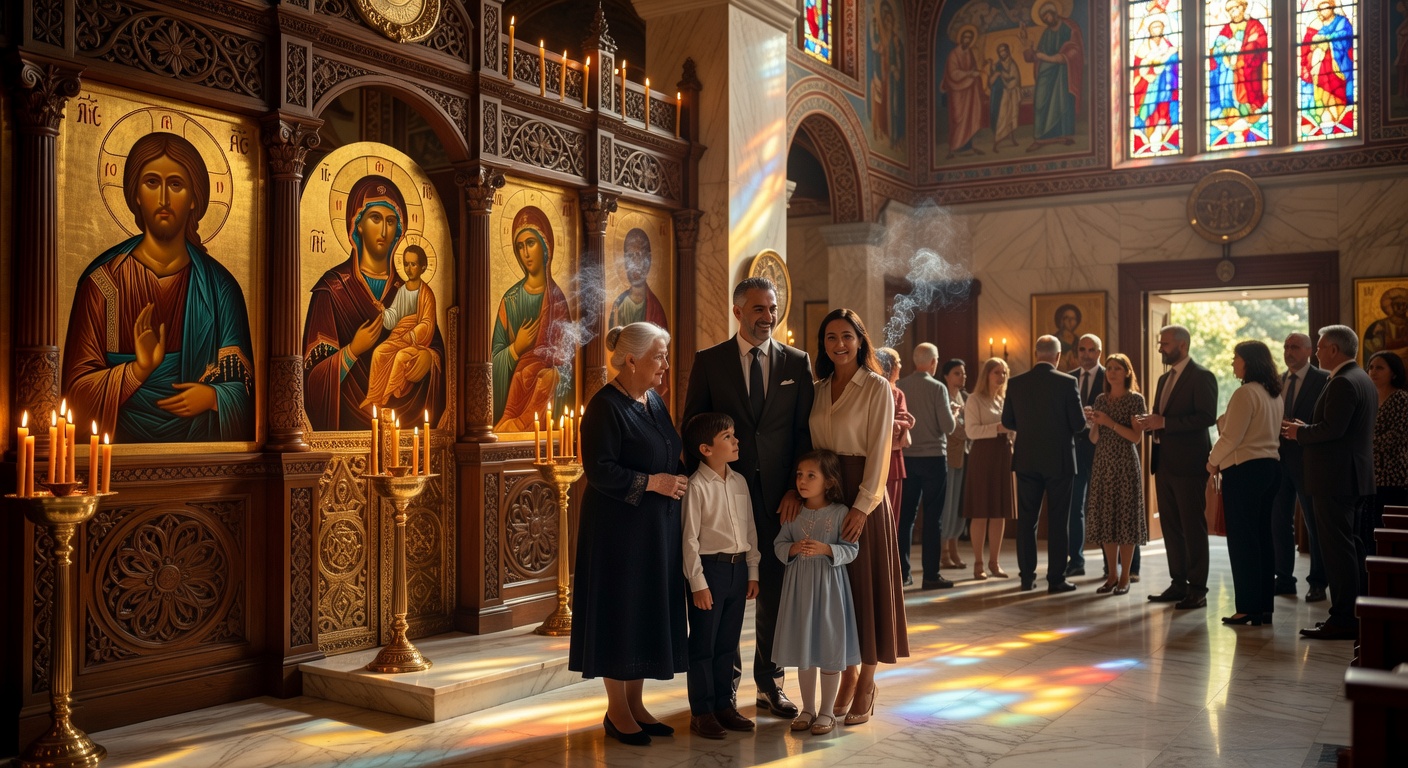
Stand on a Sunday morning in any of the roughly five hundred Greek Orthodox parishes scattered across the United States — from Saint Sophia Cathedral on Garfield Street in Washington, D.C. to the tiny Holy Trinity church in Tarpon Springs, Florida — and you will hear something that has changed very little in seventeen centuries: a deacon in gold-embroidered vestments singing the Trisagion in Byzantine chant, incense rising past icons of the Theotokos and Saint Nicholas, and a congregation of grandmothers, third-generation engineers, and brand-new immigrants from Athens and Thessaloniki crossing themselves three times before they say Christos Anesti. When a Greek family walks into your American church, you are meeting people whose Christianity predates almost every Protestant tradition by more than a thousand years.
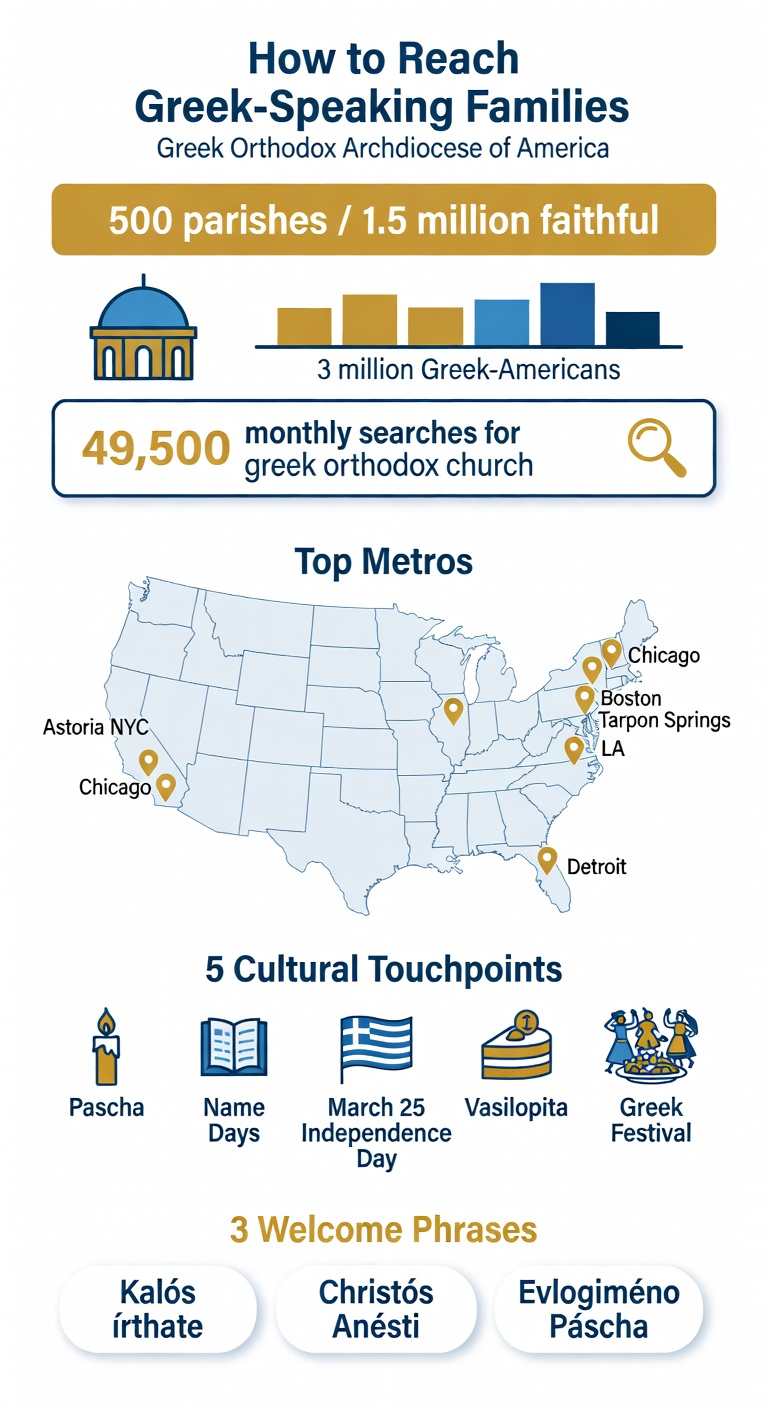
Roughly 3 million Americans claim Greek ancestry — the tenth-largest European-American group in the country — and the search data tells the story of a community that is unusually loyal to its parishes. Each month, roughly 49,500 Americans search for "greek orthodox church," 9,900 search for "greek orthodox church near me," 22,200 look up "holy trinity greek orthodox church," 14,800 search "annunciation greek orthodox church," 12,100 look for "st nicholas greek orthodox church," and another 8,100 search "assumption greek orthodox church." Behind every one of those queries is a real family — a second-generation Greek-American mother in Chicago looking for the parish her grandparents helped build in the 1920s, an H-1B engineer just arrived from Patras who cannot find an English Bible study, a college student in a small town with no Greek parish for three hundred miles wondering if any nearby church will understand.
This guide will help your church — Protestant, Catholic, or non-denominational — understand Greek-speaking families, why Greek Orthodox worship can feel almost otherworldly to Western Christians, and how to welcome Greek-speaking families well, even if you do not have a Greek parish next door and do not plan to start one.
Who Are Greek-Speaking Families in America?
Greece is a country of about 10.4 million people on the southern Balkan peninsula, with another 350,000 ethnic Greeks across the island of Cyprus, sizable historic communities in Albania (the Northern Epirus region), Turkey (the dwindling Constantinople Greek community of about 3,000 souls who once numbered 200,000), the Black Sea coast (Pontic Greeks from former Soviet Georgia, Ukraine, and Russia), and Egypt (the Alexandrian Greek community). When you meet a Greek-American family, ask gently where in the Greek world they come from — Athenians, Cretans, Cypriots, Macedonian Greeks from Thessaloniki, Pontic Greeks from the Black Sea, and Greek-Albanians each carry distinct family histories, dialects, and saints, even though they share one Church and one mother tongue.
Greek (Ελληνικά / Elliniká) is one of the oldest continuously written languages in the world, with a literary tradition reaching back to Homer in the eighth century B.C. The New Testament itself was written in Koine Greek, the everyday Greek of the eastern Mediterranean in the first century, which is why every seminary student of Scripture eventually learns at least a little of the language. Modern Greek (Demotiki) is the language of newspapers, television, and family dinners; Katharevousa is the older formal register; and Ecclesiastical Greek, very close to the Koine of the Gospels, is the language of the Divine Liturgy. A Greek-American grandmother praying Pater imon in your pew is praying the words Saint Matthew and Saint Luke wrote down.
Greek families came to the United States in three major waves. The first wave (1880-1924) brought about 450,000 mostly young men from rural Peloponnese, the Aegean islands, and Asia Minor to the textile mills of Lowell, Massachusetts, the candy and shoe-shine shops of Manhattan and Chicago, the railroad camps of Utah, and the sponge-diving fleets of Tarpon Springs, Florida. The second wave (1945-1980) was driven by the Greek Civil War, the dictatorship of the colonels, and the Turkish invasion of Cyprus in 1974, bringing well-educated professionals to Astoria, Queens; Boston; San Francisco; and Detroit. The third wave, still ongoing, was triggered by the Greek economic crisis after 2010 and the broader brain drain — engineers, doctors, and young families relocating to Houston, Charlotte, Austin, and the Bay Area, often with H-1B visas and a deep Orthodox faith they assumed they would find easily in America.
The Greek Orthodox Church: From Pentecost to Your Neighborhood Parish
It is almost impossible to overstate how central the Greek Orthodox Church is to Greek family identity. The Greek-speaking world produced the New Testament, the Nicene Creed, the seven Ecumenical Councils, and the bulk of early Christian theology. The Ecumenical Patriarchate of Constantinople, founded by tradition in the year 38 by the Apostle Andrew, is still considered the "first among equals" of the world's Orthodox Churches, even as it operates today from a single block in modern Istanbul with only a handful of remaining Greek parishes. For most Greek families, being Greek and being Orthodox are two sides of the same coin.
In America, the Greek Orthodox Archdiocese of America (GOARCH) — under the Ecumenical Patriarchate — oversees roughly 500 parishes, 1.5 million faithful, and the seminary at Holy Cross Greek Orthodox School of Theology in Brookline, Massachusetts. The Archdiocese was formally organized in 1922 and has been led since 2019 by His Eminence Archbishop Elpidophoros. Most American Greek parishes are named after saints (Saint Nicholas, Saint George, Saint Demetrios, Saint Sophia, Saint John the Baptist), great feasts (Holy Trinity, Annunciation, Assumption, Holy Resurrection, Holy Apostles), or major theological doctrines (Holy Cross, Holy Wisdom). When a Greek family searches for "annunciation greek orthodox church" or "saint george greek orthodox church" they are usually trying to find a specific parish their family has belonged to for generations.
Two important nuances. First, a smaller number of Greek Christians are Greek Catholic (in full communion with Rome but worshiping in the Byzantine rite), often Italo-Greek-Albanians from southern Italy and Sicily — this is what the 390-monthly-search query "greek catholic church near me" is asking about. Second, a small but significant minority follow the Old Calendar (Julian) and have separated from the Ecumenical Patriarchate over the 1924 calendar reform; if a Greek family in your area celebrates Christmas on January 7 instead of December 25, they are likely Old Calendar (or Russian/Serbian Orthodox rather than Greek Orthodox).
If your church is Protestant, Catholic, or non-denominational and a Greek family walks in, the kindest thing you can do is not pretend to be a Greek Orthodox parish. Greek families are not generally looking to leave Orthodoxy — they are looking for community, language access, and spiritual nourishment while their nearest parish is fifty miles away, or while their college student is too far from yiayia to drive back for Sunday Liturgy. Welcome them as they are.
Where Greek Families Live in the United States
Greek-Americans are concentrated in a handful of historic metropolitan corridors, but third-wave migration has spread the community far beyond the old hubs. Knowing where Greek families live in your region helps your church plan outreach with realistic expectations.
- New York metro — Astoria (Queens) is the largest Greek neighborhood in the Western Hemisphere, with the Cathedral of Saint Demetrios as its anchor. Long Island, Westchester, and northern New Jersey all host major parishes.
- Chicago and the Midwest — the historic Greektown along Halsted Street, the cathedral of Saints Constantine and Helen in Palos Hills, and dozens of suburban parishes from Naperville to Northbrook serve a community founded by 1900s railroad workers.
- Boston and New England — Lowell (the original mill-town Greek community), Brookline (home of Holy Cross seminary), and the Annunciation Cathedral in Boston anchor one of the densest Greek populations per capita in America.
- Tarpon Springs, Florida — the sponge-diving Greek community since 1905, with Saint Nicholas Cathedral; today the largest concentration of Greek-Americans per capita anywhere in the country.
- Detroit and Cleveland — old Pontic and mainland-Greek industrial communities centered on Saint Constantine and Saint Helen Greek Orthodox Cathedrals.
- California — Saint Sophia Cathedral in Los Angeles (Pico-Union), the Annunciation Cathedral in San Francisco, and growing third-wave communities in Silicon Valley, Sacramento, and San Diego.
- Washington, D.C. metro — Saint Sophia Cathedral and the Northern Virginia / Maryland suburbs are home to a thriving professional and diplomatic Greek community.
- Texas, Charlotte, Atlanta, Phoenix, Houston, Austin, Nashville — the new third-wave destinations, where Greek families arrive without an existing parish nearby and quickly start mission communities or look for English-speaking host churches in the meantime.
If your church is in one of those new third-wave cities, you are in an unusual position: a Greek-speaking family may walk in not because they are leaving Orthodoxy but because the closest Greek parish is two hundred miles away and a Sunday-morning English service feels closer to home than nothing at all. Welcome them generously. They may stay forever, or they may eventually find a permanent Orthodox home — either way, your hospitality matters.
Why a Greek Family Might Visit Your Non-Orthodox Church
Most Greek families are still rooted in their Orthodox tradition, so when they walk into a Protestant or Catholic church on a Sunday morning, there is usually a specific reason. Understanding the reason helps you welcome them appropriately.
- Geographic distance from the nearest Greek parish. A family that just relocated for a tech job to Boise, Knoxville, Tulsa, or Madison may simply not have a Greek Orthodox church within driving distance. They are looking for community while they figure out the rest.
- A mixed marriage. A Greek-American who married a Baptist, Methodist, Presbyterian, or Catholic spouse often alternates Sundays — half the year at the Greek parish, half the year at the spouse's church. Your church may be that other home.
- A college student far from yiayia. International and out-of-state students often struggle to find OCF (Orthodox Christian Fellowship) chapters and end up at the campus InterVarsity, RUF, or Newman Center while still considering themselves Orthodox.
- A funeral, baptism, or wedding invitation that ended up at your church because of a friendship with a member.
- Spiritual hunger during a difficult life season — divorce, loss of a parent, a serious illness — when the formality of the Divine Liturgy feels overwhelming and a quieter, more conversational service is what they need that morning.
- Curiosity from a young, third-generation Greek-American who barely speaks the language, doesn't really understand the Liturgy, and is exploring what Christianity looks like outside the Orthodox tradition.
In every one of those cases, the right response is the same: do not try to convert them, do not pretend you are Orthodox, and do not be defensive about your own tradition. Welcome the family, learn their story, and give them genuine community. If they eventually go back to a Greek parish, you have served them well. If they stay, they will bring eight centuries of Christian faith with them.
Practical Ways to Welcome Greek-Speaking Families
The mechanics of hospitality matter. Below are concrete, low-cost steps any congregation can take this week — even if you have never hosted a Greek family before.
1. Print a welcome card in Greek
A simple bilingual welcome card on the seatback or in the bulletin tells a Greek visitor that you have done your homework. "Καλώς ήρθατε — Welcome to our church. We are glad you are here. _ is our pastor; please ask any question. Here is what to expect today." The Greek word is pronounced Kalós ír̥thate_ — "You are well-arrived."
2. Learn three phrases by heart
- Καλώς ήρθατε — Kalós ír̥thate — "Welcome."
- Χριστός Ανέστη / Αληθώς Ανέστη — Christós Anésti / Aleethós Anésti — "Christ is risen / Truly He is risen." The standard greeting from Pascha (Greek Orthodox Easter) until the Feast of the Ascension forty days later.
- Ευλογημένο Πάσχα — Evlogiméno Páscha — "Blessed Pascha." Use this in cards or bulletins from Pascha through Pentecost.
Even one of these phrases, said imperfectly by your greeter at the door, will change a Greek family's experience. They are not testing you on accent — they are listening for whether anyone in the room recognized that they exist.
3. Respect their fasting and feast calendar
Orthodox Christians follow a very full liturgical calendar with extensive fasts. Great Lent (the seven weeks before Pascha), Holy Week, the Apostles' Fast (after Pentecost), the Dormition Fast (August 1-14), and the Nativity Fast (November 15 - December 24) all involve significant dietary restrictions. If your church serves food at a small group during one of those seasons, having a vegan / olive-oil-free option means a Greek family can actually eat with you. Major feasts to know: Pascha (Orthodox Easter, usually one to five weeks after Western Easter), the Annunciation (March 25, also Greek Independence Day), the Dormition of the Theotokos (August 15), the Nativity of the Theotokos (September 8), Saint Nicholas Day (December 6), and Theophany (January 6, when waters are blessed).
4. Ask about their name day
In Greek culture, the feast day of the saint you are named for is more important than your birthday. A man named Nikolaos celebrates on December 6; a woman named Maria on August 15; a Yiorgos on April 23 (Saint George's day). "Chrónia pollá!" — "Many years!" — is the right greeting on a name day. Ask new Greek members what their name day is and put it on the church calendar. It is a small, powerful sign that your church sees them as Greek and Christian, not as a generic visitor.
Cultural Touchpoints That Matter to Greek Families
Beyond the liturgical calendar, certain cultural moments touch every Greek family — and a church that pays attention to them earns deep credibility.
Greek Independence Day — March 25
March 25 is both the Annunciation (the angel Gabriel's announcement to the Theotokos) and Greek Independence Day, commemorating the 1821 uprising against the Ottoman Empire. In every American Greek community, March 25 is celebrated with parades, school programs, dancing, and patriotic poetry recited by children at Saint Demetrios in Astoria, in Greektown Chicago, on Tarpon Avenue in Florida, and at parishes across the country. A short bulletin note — "Today is Greek Independence Day; we honor our Greek brothers and sisters" — costs nothing and means everything.
Pascha and the Holy Week services
Greek Orthodox Holy Week is one of the most beautiful and demanding liturgical seasons in world Christianity. Holy Wednesday is the Sacrament of Holy Unction; Holy Thursday evening is the reading of the Twelve Gospels and the carrying of the cross; Holy Friday is the Lamentation Service around the Epitafios (the embroidered burial shroud of Christ); Holy Saturday midnight is the Anastasi — the Resurrection service that begins in darkness and erupts into light when the priest emerges with a single candle and the entire congregation lights candles from his and shouts Christós Anésti. The Lambada candle (the white Pascha candle) is brought home and burned. Many Greek families will attend their Greek parish for these services even if they attend your church the rest of the year. Encourage it. Do not schedule a competing event on Holy Friday or Pascha night.
Vasilopita and the New Year
On January 1 (Saint Basil's Day), Greek families cut the Vasilopita, a sweet bread with a coin baked inside. Whoever finds the coin has a blessed year. If a Greek family in your church wants to bring Vasilopita to the New Year's small group, say yes loudly.
Loukoumades, baklava, and the Greek festival
The annual Greek festival at the local parish — loukoumades, baklava, gyros, dancing — is a major summer event in most Greek-American communities. It is also the parish's primary fundraiser. Mention the festival in your bulletin, encourage your congregation to attend (the food is wonderful and the proceeds go to ministry), and you will build genuine inter-church goodwill that endures for years.
Real-Time Greek Translation for Sundays
Even families that speak excellent English often prefer to hear the sermon, the prayers, and the Scripture readings in Greek when grief, joy, or worship runs deep. The yiayia who has been in America for fifty years still prays in Greek. The first-wave grandfather who survived the Smyrna catastrophe of 1922 still hears the Beatitudes best in the language they were written in. Greek is what Greek families use to talk to God.
This is exactly the gap Glossa.live is built to close. Glossa is real-time AI translation designed for churches: your sermon, prayer, and scripture reading streams in English from the pulpit, and every person in the room — or watching online — can listen in Greek (or Russian, or Spanish, or any of 95+ other languages) on their own phone, with their own headphones, without any special equipment in the sanctuary.
Setup is simple. Most churches go live in fifteen minutes by following our short walkthrough on How to Embed Glossa. There is nothing to install on the visitor's side: a Greek grandmother opens the link in any browser, picks Ελληνικά from the dropdown, and the rest of the service comes through her earbuds in her own language. If you would like to learn more about how AI translation actually works for live services, our deep-dive How AI Translation Works for Church Services walks through the details.
For a fuller treatment of building a multilingual Sunday morning, see our pillar guides How to Start Multilingual Church Services, Why Multilingual Worship Grows Your Church, and Overcoming Language Barriers in Church.
For more on welcoming neighboring Orthodox and Eastern Christian communities, see our companion guides: How to Reach Russian-Speaking Families, How to Reach Ukrainian-Speaking Families, How to Reach Romanian-Speaking Families, How to Reach Serbian-Speaking Families, How to Reach Armenian-Speaking Families, and How to Reach Albanian-Speaking Families.
Worship is the language of grief, gratitude, lament, and praise. English is what Greek families use to live in America. Greek is what they use to talk to God.
The Bigger Picture: Why This Matters
Greek Christianity is not merely one tradition among many in your local area. It is, historically speaking, the cradle in which Christianity itself learned to speak. The New Testament was written in Greek. The Nicene Creed was hammered out at Nicaea and Constantinople in Greek. The Cappadocian Fathers — Basil, Gregory of Nazianzus, Gregory of Nyssa — wrote the basic grammar of Trinitarian theology in Greek. Saint John Chrysostom preached the homilies your seminary still studies in Greek. Saint Athanasius defended the deity of Christ in Greek. The hymns sung every Sunday in 500 American parishes are sung in the language Saint Paul wrote his letters in.
Greek-American families have shaped American religious and civic life in ways that often go unnoticed. The Tarpon Springs sponge-divers were among Florida's first successful immigrant entrepreneurs; the GOYA youth movement of the 1950s influenced a generation of Greek-American physicians, lawyers, and engineers; the Greek Orthodox Ladies Philoptochos Society has quietly fundraised millions for hospitals, refugee resettlement, and global missions for nearly a century. When your church welcomes a Greek family, you are receiving a tradition that has carried the gospel through Roman persecution, four centuries of Ottoman occupation, the Asia Minor catastrophe, civil war, and military dictatorship — and never lost its song.
When a Greek family walks into your American sanctuary, they are bringing two thousand years of unbroken Christian worship with them. They are bringing the Lambada candle their grandmother lit in a village in Crete. They are bringing the icon of the Theotokos that hangs in the kitchen corner where their family eats dinner. They are bringing the bravery to start over in a country that does not know how to pronounce their last name. The least your church can do — the best your church can do — is make absolutely sure they can hear, in their own language, that they are welcome here.
Ready to make Greek welcome on your phone screens this Sunday? Try Glossa.live — free to start, no equipment required, set up in fifteen minutes. Every language spoken in your community deserves to hear the Gospel. Greek families are waiting to find out if yours is the church that finally says kalós ír̥thate.