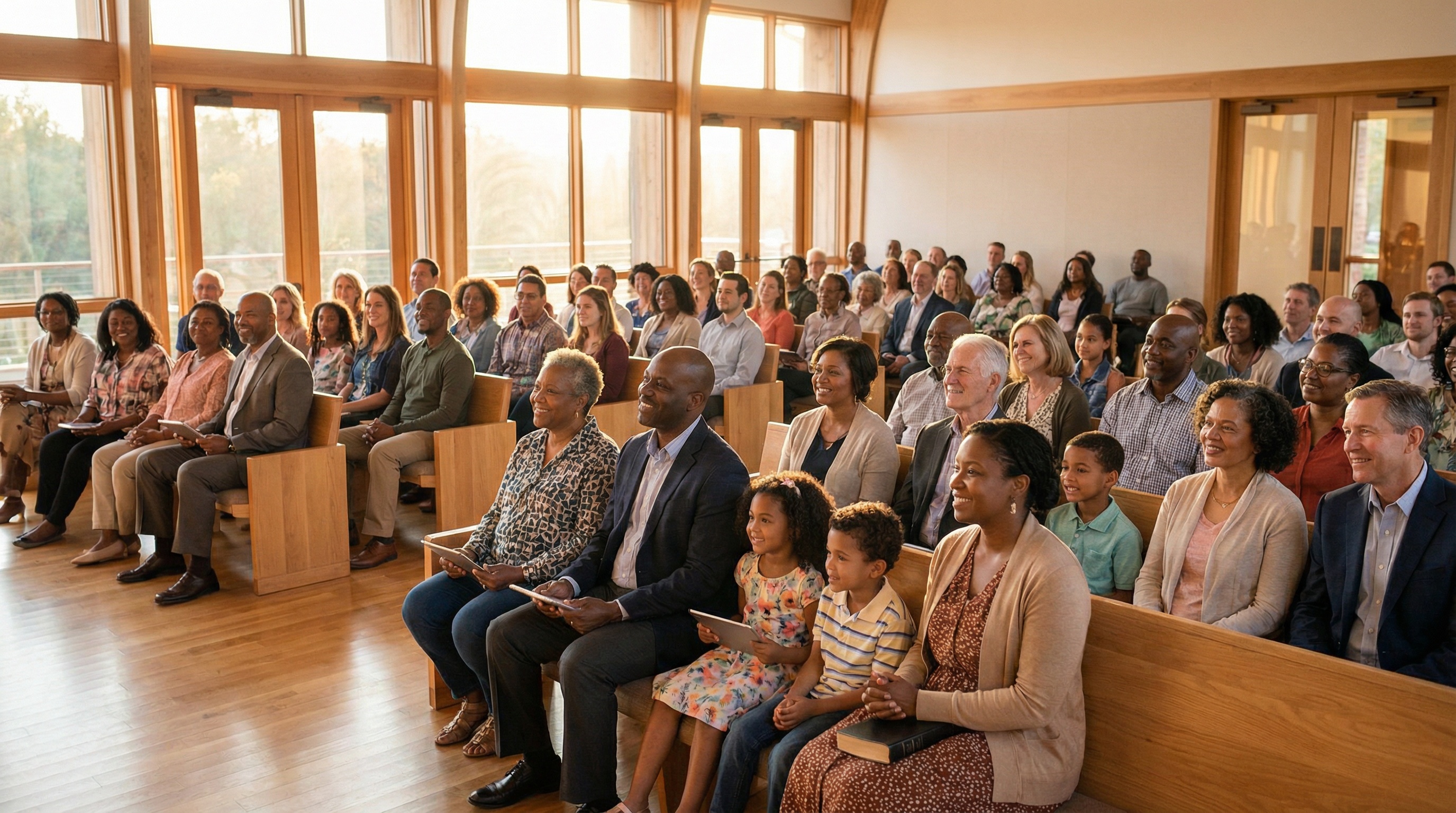
Overcoming Language Barriers in Church: How to Reach Every Family in Your Congregation
Picture this: a family visits your church for the first time. They find the people warm, the worship moving, and the message exactly what they needed. But they don't speak English fluently — or at all. By next Sunday, they're gone.
Language barriers in church are one of the most common — and most heartbreaking — reasons that families who desperately want community never find it. They don't leave because they weren't welcome in spirit. They leave because they couldn't understand what was being said.
The good news? This barrier is removable. Hundreds of churches across the country have already figured out how to create genuinely inclusive, multilingual congregations — and the strategies they use are more practical and affordable than you might think.
In this guide, we're sharing seven actionable church outreach ideas for reaching families who speak different languages, with real examples from churches that are doing it well.
Why Language Barriers in Church Are More Common Than You Think
You might be surprised how many people in your immediate community face a language barrier at church.
According to U.S. Census Bureau data, more than 67 million people in the United States speak a language other than English at home. That's roughly 1 in 5 Americans. In many cities and suburbs, that number is significantly higher — in some zip codes, the majority of residents are Spanish speakers, Vietnamese speakers, Mandarin speakers, or speakers of other languages.
The communities surrounding your church tell a story. If your neighborhood has shifted — as many have — toward greater linguistic diversity, your congregation probably hasn't kept pace. Not because pastors don't care, but because language gaps are genuinely hard to bridge without the right tools.
Here's the challenge: most churches are still running English-only services, not because they're opposed to inclusion, but because they don't know how to start. The idea of "going multilingual" sounds expensive, complicated, or like something only large churches can afford.
Neither of those things is true anymore. Let's break down what actually works.
1. Start with a Listening Exercise: Who Is Already in Your Community?
Before you can remove language barriers, you need to know what they are. That means taking a careful look at who lives within a 2–5 mile radius of your church.
Talk to your local school district. They almost always publish data on which languages are spoken in the homes of their students — and that data is public. If 30% of the students at the elementary school down the road speak Spanish at home, there's a good chance many of those families would love a church where they feel understood.
Talk to your existing congregation, too. You may be surprised to discover that some of your current members are bilingual, have family members who don't speak English, or belong to communities with significant language needs. They are your best source of insight — and eventually, your best bridge to those families.
This isn't just a demographic exercise. It's pastoral listening. When you discover that your community includes 200 Vietnamese families and your church has never once offered anything in Vietnamese, that's a calling, not just a statistic.
2. Add Real-Time Translation to Your Services — Without Extra Equipment
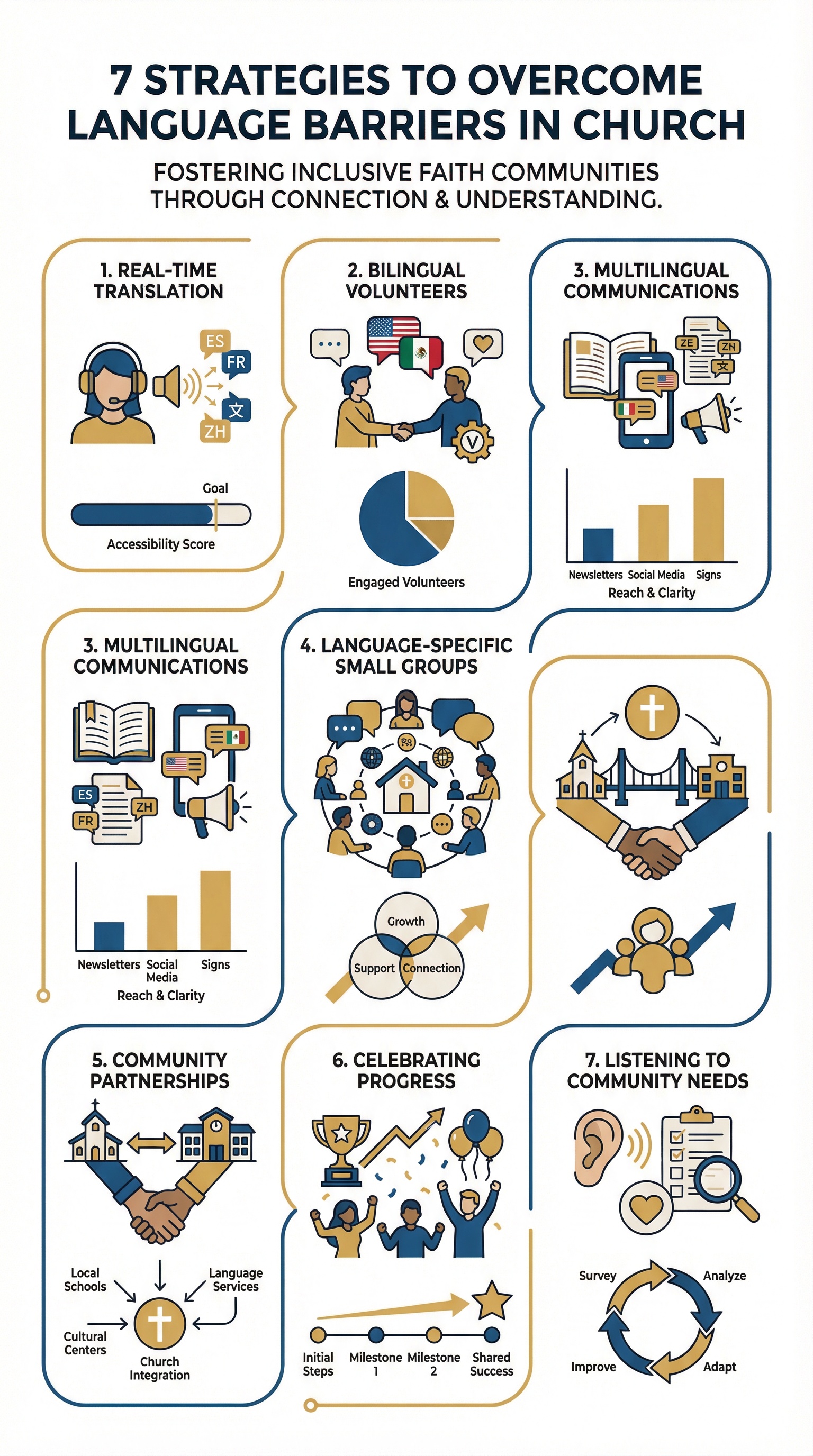
One of the most practical church outreach ideas for multilingual communities is also one of the simplest: offer real-time translation during your regular Sunday service.
This doesn't mean hiring a professional interpreter (though that's an option we'll discuss). It means using technology to provide live, AI-powered translation that congregation members can access directly on their smartphones.
Tools like Glossa.live work by translating your pastor's spoken words in real time, in over 100 languages, and delivering that translation as audio to anyone in the congregation through their phone. No receivers. No headsets. No expensive hardware. A visitor who speaks Spanish, Arabic, or Mandarin can follow the entire sermon in their own language — the same Sunday they walk through the door.
The setup takes minutes. The impact is immediate. And the cost is a fraction of what traditional interpretation systems charge.
If you want to see how this works technically, there's a step-by-step walkthrough on how to embed Glossa on your website that walks you through the process from start to finish.
3. Train Bilingual Volunteers to Serve as Conversation Bridges
Technology handles the sermon. But what about the coffee hour? The announcements? The moment someone walks up to a volunteer and says, in broken English, "I want to learn more" — and that volunteer doesn't know how to respond?
This is where bilingual volunteers become invaluable.
If you have even a handful of bilingual members in your congregation, consider formalizing their role as "language bridges" — people who are specifically available before and after services to welcome non-English-speaking visitors, help them understand what's happening, and connect them with the broader community.
This doesn't require a big program. It can start with one person per language who agrees to be available on Sunday mornings. Over time, as your multilingual community grows, this informal network can become something much more.
Some churches use simple identification — a colored lanyard, a badge, a name tag with a flag — so that non-English-speaking visitors can immediately identify who they can approach. It's a small gesture that makes a massive difference.
4. Make Your Church Communications Multilingual
Language barriers in church don't only exist during the Sunday sermon. They exist in every bulletin, every announcement, every email, and every social media post your church puts out.
If you're trying to reach Spanish-speaking families, publishing your bulletin only in English sends a silent message: "This place isn't quite for you yet."
Here are some simple first steps to make your communications more multilingual:
- Translate your bulletin into the one or two most common languages in your community. Tools like Google Translate can get you 80% there; a bilingual volunteer can refine the rest.
- Post bilingual announcements on social media, especially for events designed for multilingual audiences.
- Create a brief welcome video in multiple languages for your church website — even a 60-second clip in Spanish or Vietnamese saying "We're glad you're here, and we have translation available" goes a long way.
- Display service times and directions in multiple languages in your physical space — on the door, in the lobby, in the restrooms.
These are not high-cost investments. But they signal something important: we thought about you. We planned for you. You're not an afterthought.
5. Host Language-Specific Small Groups or Services
Sunday morning doesn't have to be the only worship opportunity you offer, and it doesn't have to be the only place language inclusion happens.
Many churches have found that launching a Spanish-language Bible study, a Vietnamese-language prayer group, or a Korean-language women's ministry is actually a faster path to building authentic community than trying to make every Sunday service work for everyone simultaneously.
This approach has a few key advantages:
- It builds deep community quickly. When people can worship, discuss, and pray in their native language, the depth of connection is immediate and authentic.
- It's manageable. Starting a Thursday evening Spanish Bible study is far less daunting than rearchitecting your entire Sunday service.
- It creates a natural pathway. Many churches find that families who start in a language-specific small group eventually integrate into the broader English-speaking congregation over time — on their own timeline, not yours.
Check out our guide on how to start multilingual church services for a deeper look at how to structure these offerings, from small groups all the way up to full parallel services.
6. Partner with Immigrant Community Organizations
Some of the most effective church outreach ideas for reaching multilingual families don't start inside the church at all. They start in the community.
Immigrant community organizations — refugee resettlement agencies, ESL programs, cultural associations, immigrant legal aid clinics — serve the very people your church wants to reach. And most of them are actively looking for community partners.
Building a relationship with these organizations can open doors that no amount of advertising ever will. When a resettlement case worker tells a newly arrived refugee family, "There's a church in this neighborhood that has people who speak your language and translation available during the service," that is word-of-mouth evangelism that no marketing budget can buy.
Consider the following partnership opportunities:
- Offering your building for community events hosted by immigrant organizations
- Co-hosting ESL classes, citizenship prep workshops, or job skill training
- Inviting organizational leaders to speak at your church about the needs they're seeing
- Connecting families they serve to your language-bridge volunteers
This kind of relational outreach builds genuine trust over time. And trust is what converts a visitor into a member. To learn more about how churches are successfully reaching immigrant families, read our article on how churches are reaching immigrant communities through real-time translation.
7. Track Your Progress and Celebrate Every Step
One of the most underrated church outreach ideas is also one of the simplest: actually measuring what's happening and celebrating progress publicly.
If you start offering real-time translation and ten non-English-speaking visitors attend in the first month, celebrate that. Share it in your bulletin, from the pulpit, on social media. When people see that their church is becoming more inclusive, they get excited — and they start inviting their friends.
Set simple goals. How many languages are you reaching? How many new multilingual families attended this month? How many bilingual volunteers do you have trained? Track these numbers, even informally, and revisit them quarterly.
Progress motivates more progress. And when your congregation sees — concretely — that their church is removing language barriers and reaching families who would otherwise have nowhere to go, that's a powerful moment of shared mission.
The Practical Path Forward: Start This Week
You don't need a large budget or a full-time multilingual staff member to start removing language barriers from your church.
Here's a realistic first-week action plan:
- Research your community: Find out from your local school district which languages are most common in your zip code.
- Identify your bilingual volunteers: Send an email to your congregation asking who speaks another language and would be willing to help welcome visitors.
- Set up real-time translation: Visit Glossa.live and set up a free trial for your next Sunday service. It takes under 15 minutes.
- Translate one piece of communication: Pick your Sunday bulletin or your church website's welcome page and add Spanish (or whatever language is most prevalent in your community).
- Make one connection: Reach out to one immigrant-serving organization in your area and introduce yourself.
That's five steps. None of them requires a committee meeting or a budget approval. You can start all of them this week.
What Churches Are Already Doing
The churches succeeding at multilingual outreach aren't waiting for perfect conditions. They're doing what they can with what they have — and building from there.
Hillsong churches serve congregations in dozens of countries and have pioneered multilingual worship at scale, offering translation in 15+ languages at many locations. ICF in Cyprus reaches Arabic and Russian speakers who would otherwise have no church home. Vietnamese Baptist churches across the U.S. serve entire communities of immigrants who found faith in a new country.
These churches didn't start with a complete multilingual infrastructure. They started by saying: "There are families in our community who need to hear the Gospel, and language shouldn't stand in the way." Then they took the first step.
Research from Lifeway Research shows that bilingual and multilingual worship is one of the fastest-growing ministry models in North America, with churches that offer multilingual services seeing measurably higher engagement from non-English-speaking communities. And our article on why multilingual worship grows your church digs into that data in detail.
Conclusion: Language Barriers in Church Don't Have to Be Permanent
Language barriers in church are real. They keep families isolated, make visitors feel invisible, and limit the reach of your ministry in ways you may not fully see yet.
But they're not insurmountable. They're not even expensive to address, not anymore.
With the right combination of real-time translation technology, bilingual volunteers, multilingual communications, and genuine community partnerships, your church can become a place where every language spoken in your neighborhood is welcomed on Sunday morning.
The global church was always meant to be multilingual. Acts 2 describes it beautifully: people from every nation hearing the message "in our own native language." That vision doesn't belong only to the early church. It belongs to yours, too.
Start this week. Take one step. Your multilingual congregation is waiting.