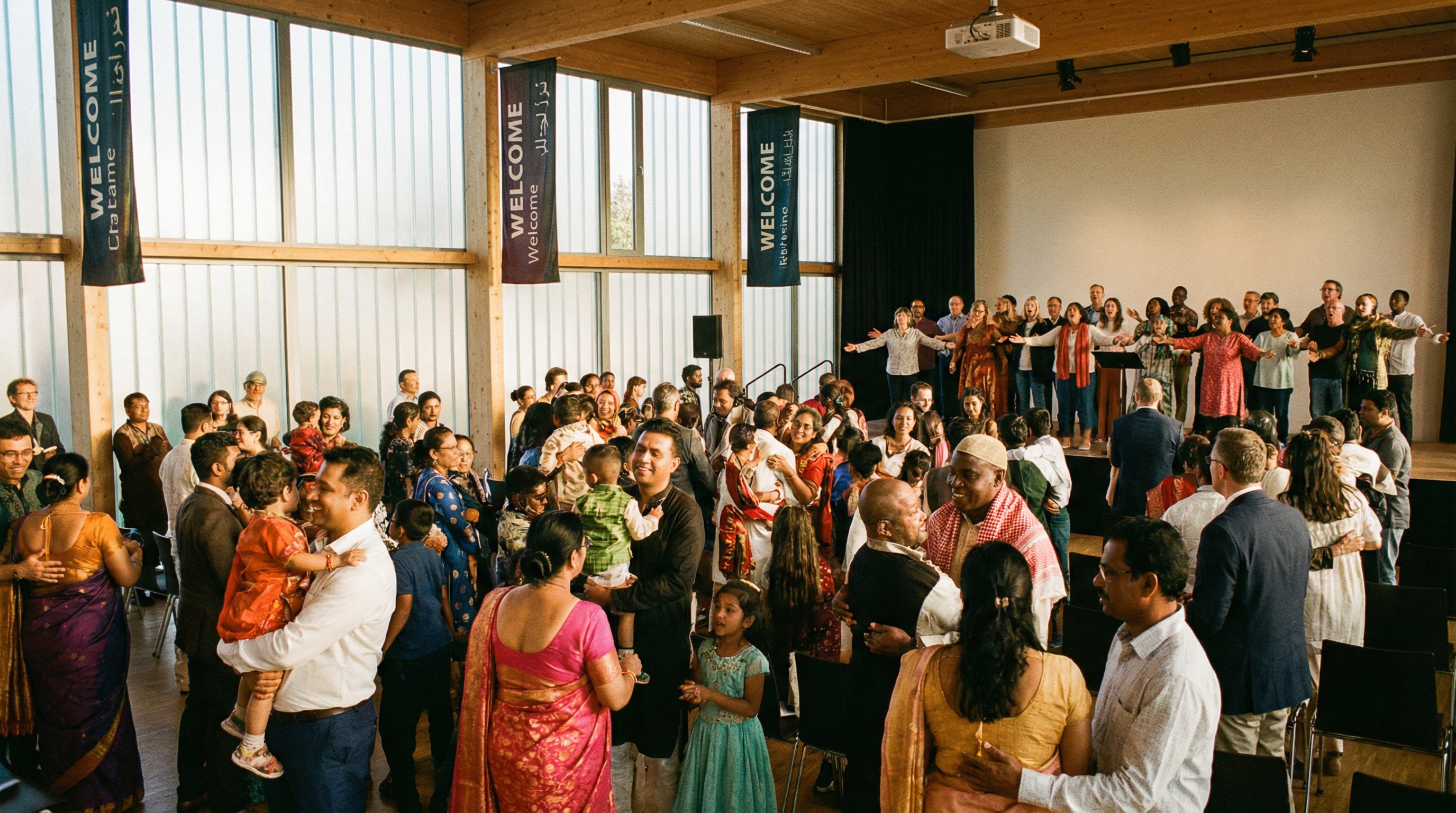
How Churches Are Reaching Immigrant Communities Through Real-Time Translation
Every Sunday, millions of immigrant families sit in church services they can't fully understand. The sermon is in English. The worship songs are in English. The announcements are in English. And for a Vietnamese grandmother, an Arabic-speaking family, or a Spanish-speaking couple, the experience can feel more isolating than welcoming.
Yet these same families are often deeply faithful. Many come from countries where faith is central to daily life. They're searching for community—and language barriers are the one thing standing between them and belonging.
This is where churches across America are discovering a powerful opportunity. By removing language barriers with real-time AI translation, congregations are not only welcoming immigrant communities more effectively—they're also experiencing remarkable church growth in the process.
Why Immigrant Community Outreach Has Become a Church Priority
The numbers tell a compelling story. According to Pew Research Center, immigrants are statistically more religious than native-born Americans. About 59% of immigrants say religion is very important in their lives, compared to 39% of native-born citizens.
At the same time, the foreign-born population in the United States is growing. Over 45 million people living in the U.S. today were born in another country—representing nearly 14% of the total population. In many cities, particularly in Texas, California, Florida, and New York, non-English speakers represent a significant portion of the surrounding community.
For churches serious about community outreach, this is not just a demographic shift to acknowledge—it's a ministry calling to answer. Immigrant families are often looking for community and belonging, and churches that remove language barriers are uniquely positioned to offer both.
Language Is the First Barrier—and the Most Fixable One
There's something important to recognize here: immigrant communities are often deeply motivated to attend church. They're not absent because they're uninterested. They're absent—or attending but not fully engaging—because they can't understand what's being said.
That's actually good news for church leaders. Unlike other barriers to church attendance (distance, scheduling, cultural discomfort), language is fixable. And thanks to AI translation technology, it's now fixable without expensive equipment, professional interpreters, or years of language learning.
The Old Way: Professional Interpreters and Their Limitations
For decades, churches serious about reaching immigrant communities relied on one approach: hiring bilingual interpreters. A Spanish-speaking interpreter would sit in the booth, listen to the pastor, and translate in real time through headsets distributed to Spanish speakers. This approach works—but it comes with real constraints.
Cost: Professional interpreters typically charge $50– style="min-width: 320px;"50 per hour. For a church with two Spanish services and one Korean service per Sunday, that's style="min-width: 320px;"50–$450 every week—or $7,800–$23,400 per year. That's a significant line item for most church budgets.
Scheduling complexity: You need a trained interpreter available every single week. Vacations, illness, and turnover create constant headaches. Finding qualified bilingual interpreters with theological vocabulary is harder than it sounds.
Limited language reach: Even if you hire Spanish and Korean interpreters, what about the Vietnamese family that started attending last month? Or the Arabic-speaking refugees your church is supporting? Each language requires a separate interpreter.
Interpreter fatigue and quality variation: Simultaneous interpretation is one of the most cognitively demanding jobs in the world. Even professional interpreters tire. Quality varies between interpreters. Some handle theological language better than others.
These limitations don't mean interpreters are wrong—they mean churches need a smarter, more scalable approach to language access.
How AI Translation Is Changing Immigrant Church Outreach
Real-time AI translation has reached a point where it genuinely works for worship settings. Tools like Glossa.live were designed specifically for churches, which means the AI is trained on biblical language, theological concepts, and worship contexts—not just generic conversation.
Here's what makes AI translation so powerful for immigrant outreach specifically:
- Multiple languages simultaneously: Instead of serving one language at a time, AI translation can serve Spanish, Vietnamese, Korean, Arabic, Mandarin, and dozens of other languages all at once. One Sunday, your entire multilingual congregation hears the sermon in their own language.
- No physical equipment for attendees: Congregation members use their own smartphones to listen to translated audio. No headsets to distribute, no receiver units to buy, no battery maintenance.
- Consistent quality every week: AI translation doesn't have good days and bad days. It doesn't call in sick. It handles the same theological vocabulary with consistent accuracy week after week.
- Dramatically lower cost: Compare $50– style="min-width: 320px;"50 per interpreter per hour to pay-as-you-go AI translation at $5 per hour per language. For a church serving three languages across two services, that's approximately $30 for the same Sunday that might have cost $300+ with human interpreters.
Real Churches, Real Results: Immigrant Outreach in Practice
The most convincing evidence comes not from statistics but from church stories. Consider what happens when a congregation commits to truly multilingual worship.
A Vietnamese Baptist Church in Texas: When this church added real-time Vietnamese translation through Glossa.live, second-generation members—who had grown up attending English services—suddenly felt they could invite grandparents and older relatives who spoke limited English. Within months, attendance noticeably increased, and the church began hosting a dedicated Vietnamese service for the first time.
ICF Limassol (Cyprus): This international congregation serves a diverse community that includes Arabic, Russian, and other language speakers. By offering real-time translation, ICF made it possible for every attendee—regardless of language background—to fully participate in worship rather than simply sit through a service they couldn't follow.
A Korean Presbyterian Church in suburban Houston: This congregation had a growing number of non-Korean-speaking family members who attended out of family loyalty but struggled to engage. Adding English and Spanish translation channels alongside the Korean service helped bridge the gap between generations and language communities within the same congregation.
These aren't outlier stories. They're the predictable result of removing a barrier that was preventing genuine participation.
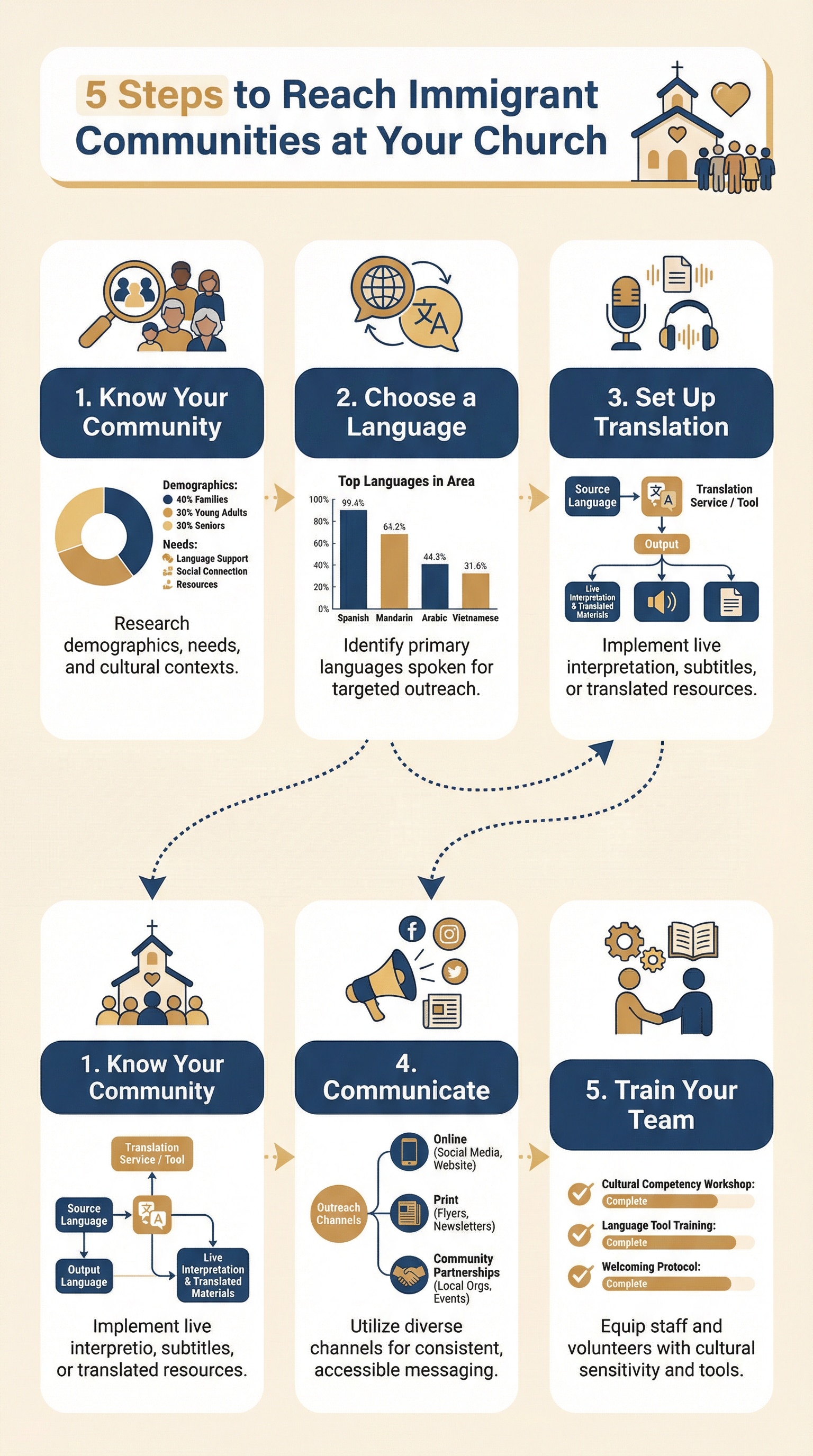
Practical Steps to Start Reaching Immigrant Communities at Your Church
You don't need a style="min-width: 320px;"00,000 budget or a multilingual staff to begin. Here's a straightforward approach that churches of any size can implement.
Step 1: Know Your Community
Before you can reach immigrant communities, you need to understand who lives in your surrounding area. A few practical starting points:
- Check U.S. Census data for your zip code—it breaks down languages spoken at home and country of origin
- Talk to your existing congregation members—many have family or neighbors who are immigrants
- Connect with local immigrant service organizations, ESL programs, and community centers
- Walk the neighborhood around your church; what languages do you see on signage, restaurants, and community boards?
Step 2: Start With One Language
Trying to serve every language at once is overwhelming. Start with the language most represented in your community or congregation. For most churches in the U.S., that means Spanish—about 43 million Americans speak Spanish at home. But for churches in specific cities, it might be Vietnamese, Korean, Amharic, Arabic, or Tagalog. Pick the one language where you have the highest opportunity, launch it well, and build from there.
Step 3: Set Up Real-Time Translation
For most churches, the fastest path to offering multilingual services is through AI translation tools designed for worship. Glossa.live works on any device—there's nothing to install, no equipment to purchase, and no technical background required. Your worship team continues exactly as it always has. Congregation members open Glossa.live on their phones and hear translated audio in real time. You can learn more about how to structure a multilingual service in our step-by-step multilingual services guide.
Step 4: Communicate the Offering to Your Community
Having translation available is only half the work. Immigrant families in your community need to know it exists. Consider:
- Printing service cards in the languages you offer
- Having bilingual congregation members personally invite immigrant neighbors
- Posting in community Facebook groups for specific immigrant communities
- Connecting with local ESL programs, immigrant service organizations, or international student groups
Step 5: Train Your Team on Cultural Welcome
Language access is necessary but not sufficient. Immigrant families will stay if they feel genuinely welcomed—and that requires intentional cultural awareness from your welcome team, greeters, and congregation. Simple practices matter: multilingual signage, greeters who know a few words of the primary immigrant languages in your community, small groups organized around language communities, and pastoral follow-up that doesn't assume English as the default communication channel.
Overcoming Common Concerns About Immigrant Outreach
Won't This Create a Two-Tier Congregation?
This concern is understandable—but it reflects a misunderstanding of how AI translation works in practice. Multilingual services don't separate your congregation into language silos. They allow everyone to worship together, in the same room, hearing the same message. The experience is unified, not divided. Think of it like closed captions in a movie theater: everyone watches the same film. Some people read captions; others don't. The shared experience brings people together rather than dividing them.
Our Church Is Too Small for This
AI translation is scalable in both directions. The same technology that serves a 3,000-seat megachurch works equally well for a 150-person community church. Because there's no equipment to purchase and pricing is pay-as-you-go, small churches aren't penalized for their size. You only pay for the hours you actually use.
Will the Translation Be Accurate Enough for Biblical Content?
This is a legitimate concern that distinguishes tools built for churches from generic translation apps. Glossa.live is specifically trained on biblical language, theological vocabulary, and worship contexts. It handles terms like sanctification, the Holy Spirit, justification, and the Great Commission with accuracy—not the awkward literal translations that general-purpose tools often produce for specialized vocabulary.
Church Growth Through Immigrant Inclusion: What the Data Shows
Churches that have successfully reached immigrant communities report consistent patterns of growth. It's not magic—it's the result of removing a barrier that was preventing people from attending and staying.
According to research from the Barna Group, congregations with intentional multicultural strategies tend to attract younger members, sustain longer-term growth, and develop stronger community ties with their surrounding neighborhoods.
For churches struggling with attendance decline, immigrant community outreach offers a genuine growth pathway—not a marketing strategy, but a ministry response to a genuine need that exists in almost every American community. The question isn't whether there are immigrant families in your area looking for a faith community. The question is whether your church has removed the barriers that would allow them to walk in, understand what's being said, and feel genuinely welcomed.
Language is not just a communication tool—it's the door to belonging. When churches open that door, they don't just grow. They become what they're meant to be: a family of every tongue, tribe, and nation.
Getting Started This Sunday
You don't need a committee meeting to start reaching immigrant communities with real-time translation. Here's what you can do this week:
- Visit Glossa.live and explore how the tool works for churches—free to try, no credit card required
- Identify the one language most spoken in your surrounding community (check census.gov for your zip code)
- Try a free session with your worship team—hear how the translation sounds in real time
- Share the tool with one bilingual congregation member and ask them to invite someone who speaks their language to attend
The technology is ready. The immigrant communities in your area are already there. The only variable left is whether your church takes the step.
Real inclusion means real translation—not good intentions, not bilingual pamphlets, not an eventually-maybe-someday plan. Just opening the door, removing the language barrier, and welcoming every family the way your congregation would want to be welcomed.
For a deeper look at how to structure multilingual services from start to finish—including how to run your first multilingual service, what to expect, and how to communicate the change to your congregation—check out our step-by-step multilingual church services guide.