How to Start Multilingual Church Services (Step-by-Step Guide)
Your community is changing. Walk through any neighborhood in America and you'll hear Spanish at the grocery store, Vietnamese at the nail salon, Mandarin at the restaurant down the street. Yet on Sunday morning, most churches still broadcast their message in one language only.
That disconnect is costing churches more than they realize. Families who don't speak English fluently often feel invisible at church—even when they desperately want to belong. And pastors who see their neighborhoods becoming more diverse often feel stuck, unsure how to bridge the language gap without blowing their budget or hiring a team of interpreters.
Here's the good news: starting multilingual church services is more achievable than ever. Thanks to advances in AI translation technology, churches of any size can now offer real-time translation in dozens of languages—without expensive equipment, without a roster of volunteer interpreters, and without overhauling how you run your services. This guide walks you through exactly how to make it happen.
Why Multilingual Church Services Matter for Growth
If your congregation reflects only one language, you may be reaching just a fraction of your actual community. According to the U.S. Census Bureau, over 67 million people in the United States speak a language other than English at home. In many metro areas, that figure represents 30-40% of the local population.
Churches that offer multilingual church services consistently report significant growth. Hillsong, for example, uses Glossa.live to reach congregants in 15+ languages across their global locations. Korean Presbyterian churches in Texas have seen attendance jump when they added Spanish-language options for their surrounding communities.
The reason is simple: when someone hears the message in their heart language, they feel welcome. They come back. They bring their family. Multilingual services don't just check a box—they fundamentally change who feels invited through your doors.
Assess Your Community's Language Needs
Before you invest in any technology or recruit volunteers, start by understanding who lives around your church. Here's how to figure out which languages your community actually speaks.
Check Local Demographics
The U.S. Census Bureau's American Community Survey lets you look up language data for your zip code. You may discover that 25% of your neighbors speak Spanish, or that there's a growing Vietnamese or Arabic-speaking population nearby. This data gives you a clear picture of which languages to prioritize.
Survey Your Current Congregation
You might be surprised by the language diversity already sitting in your pews. Send out a simple survey asking members what languages they speak at home, whether family members would attend if services were available in their language, and which languages they'd most like to see offered. Many churches discover multilingual potential they never knew existed.
Talk to Community Leaders
Reach out to local immigrant community organizations, ESL programs, and ethnic grocery store owners. They can tell you which populations are growing and what needs are unmet. Often, immigrant families are actively looking for a church that speaks their language—they just haven't found one yet.
Choose Your Multilingual Approach
Once you know which languages to target, it's time to decide how you'll deliver multilingual worship services. There are several options, each with different trade-offs.
Option 1: Separate Language Services
Some churches run entirely separate services in different languages—an English service at 9 AM, a Spanish service at 11 AM, and so on. This approach works well for large churches with enough members to sustain multiple congregations, but it can feel isolating. You're essentially running parallel churches under one roof, which doesn't always build the unified, diverse community most pastors envision.
Option 2: Volunteer Interpreters
Traditional interpretation relies on bilingual volunteers who translate the sermon in real time, usually through a whisper system or separate audio feed. This is personal and can be effective, but it comes with real challenges: finding reliable volunteers every single week, dealing with inconsistent quality, and being limited to the one or two languages your volunteers speak. If your best Spanish interpreter goes on vacation, your Spanish-speaking families get nothing that Sunday.
Option 3: AI-Powered Real-Time Translation
The newest option—and the one that's changing the game for churches of all sizes—is AI-powered translation. Tools like Glossa.live listen to your sermon in real time and translate it into 100+ languages simultaneously. Congregants simply open their phone, tablet, or any device with a browser, select their language, and listen. No special equipment. No downloads. No volunteers to schedule.
This approach lets you maintain one unified service where everyone worships together while hearing the message in their own language. It's affordable (many churches spend less per month than they would on a single interpreter), it's reliable every Sunday, and it scales instantly—whether you need two languages or twenty.
Set Up Your First Multilingual Service
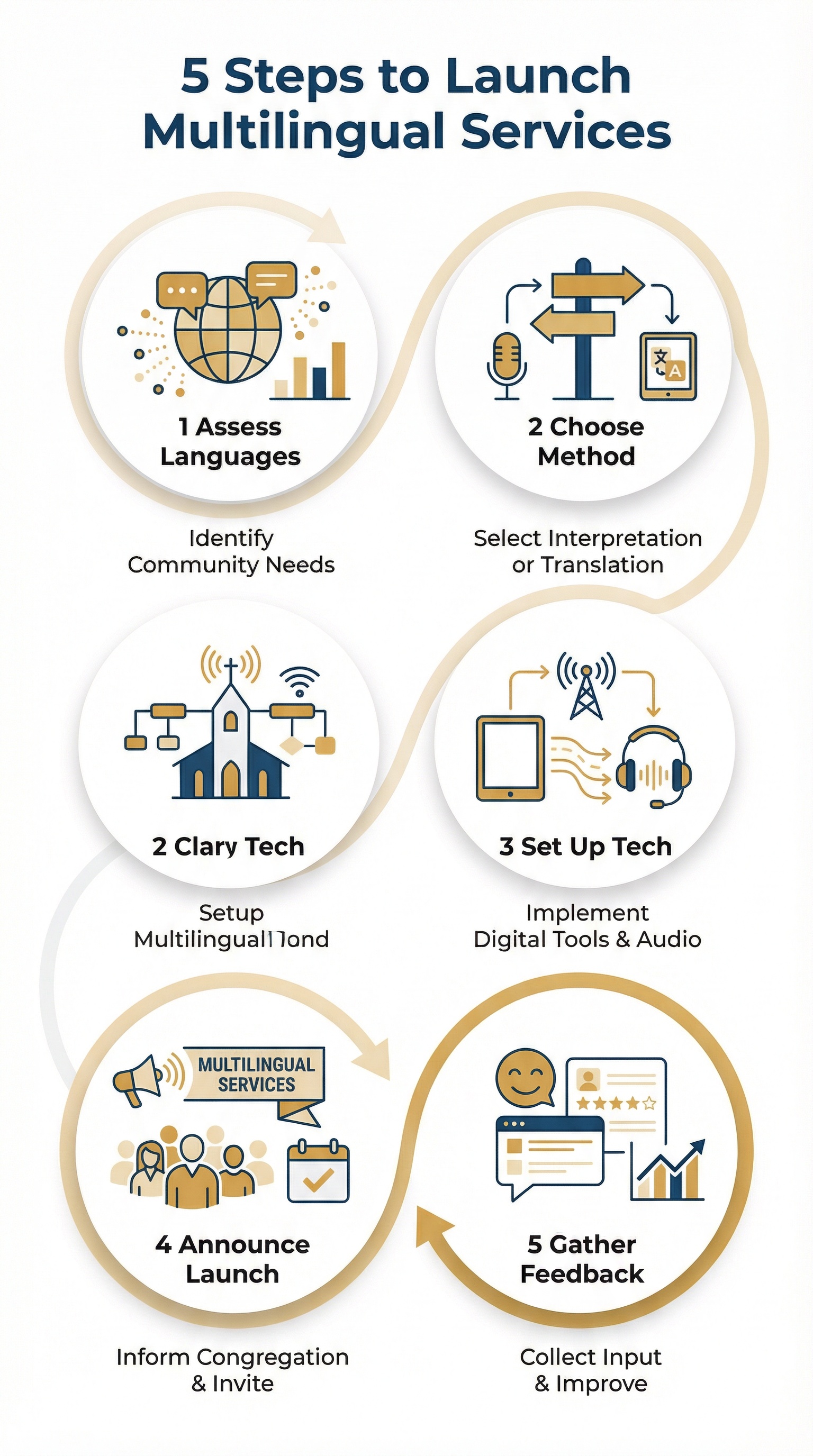
Ready to launch? Here's a practical, step-by-step walkthrough to get multilingual church services running at your church.
Step 1: Pick Your Platform
If you're going with AI translation, sign up for a platform that's built for churches. Generic translation tools like Google Translate aren't designed for sermon-length audio in a worship context. Church-specific platforms understand theological terminology, worship flow, and the practical realities of Sunday morning.
Glossa.live is purpose-built for this. It's been trained on biblical language and church vocabulary, so it handles theological concepts that generic tools often get wrong. Setup takes about 15 minutes, and there's a free trial so you can test it with your congregation before committing.
Step 2: Test Before Sunday
Run a test during a weekday rehearsal or midweek service. Have a few multilingual members listen and give feedback. Check audio quality, connection stability, and whether the translations sound natural. This dry run helps you catch any issues before your big launch.
Step 3: Communicate with Your Congregation
Announce the new multilingual capability from the pulpit, in your bulletin, on social media, and through personal outreach. Specifically reach out to members who you know speak other languages at home. Ask them to spread the word in their communities. You might even create simple flyers in target languages to post at local businesses, community centers, and apartment complexes.
Step 4: Make It Easy on Sunday Morning
On launch day, display clear instructions—ideally on your screens or projection system—showing congregants how to access the translation. A simple QR code works beautifully. People scan with their phone, choose their language, and they're listening within seconds. If you want to learn more about displaying translations on screens, check out how to embed Glossa on your website or display.
Step 5: Gather Feedback and Iterate
After your first multilingual service, ask for feedback from everyone who used the translation. What languages did they select? How was the audio quality? Did they feel included? Use this feedback to improve the experience week over week.
What Multilingual Church Services Actually Cost
Budget is one of the biggest concerns for church leaders considering bilingual church services or broader multilingual offerings. Let's break down the real numbers.
Professional interpreters typically charge style="min-width: 320px;"50-300 per service per language. If you need Spanish and Mandarin interpretation every Sunday, you're looking at style="min-width: 320px;",200-2,400 per month—plus the headache of scheduling, backup interpreters, and quality inconsistency.
Volunteer interpreters are "free" in theory, but they cost you in reliability, quality control, and volunteer burnout. Many churches that rely on volunteers find themselves scrambling when their interpreter is sick, traveling, or simply exhausted.
AI translation platforms like Glossa.live offer flexible pricing that works for churches of any size. Pay-as-you-go options start at just a few dollars per hour per language, and monthly plans make budgeting predictable. A small church using one language once a week might spend $20-50 per month. A larger church with multiple services and languages might spend $200-400—still a fraction of what professional interpreters would cost, and with far more languages available.
The ROI is clear: if adding multilingual services helps you reach even 10-20 new families per year, the investment pays for itself many times over through increased tithes, volunteer engagement, and community impact.
Real Churches Making Multilingual Ministry Work
You don't have to take our word for it. Churches across the country—and around the world—are already running thriving multilingual congregations.
Hillsong uses real-time AI translation to serve their global community in 15+ languages. What started as a solution for their Australian campuses has expanded to locations worldwide, helping them maintain a unified worship experience across language barriers.
Korean Presbyterian churches in Texas discovered that their surrounding communities were increasingly Spanish-speaking. By adding real-time Spanish translation, several congregations saw attendance grow by 30-40% within months. Families who had driven past the church for years suddenly had a reason to walk through the doors.
ICF Limassol in Cyprus serves a congregation that includes Arabic, Russian, and English speakers. Rather than running three separate services, they use AI translation so everyone worships together—building genuine cross-cultural community that separate services could never achieve.
These aren't megachurches with unlimited budgets. Many are mid-size congregations of 200-500 members who simply decided that language barriers shouldn't keep anyone from hearing the Gospel.
Common Concerns About Multilingual Services
Is AI Translation Accurate Enough for Sermons?
Modern AI translation—especially platforms trained on biblical and theological language—delivers remarkably accurate results. Glossa.live's AI understands terms like "sanctification," "atonement," and "grace" in their proper theological context, not just their dictionary definitions. Is it perfect? No translation is, whether human or AI. But it's accurate enough that congregants consistently report feeling included and understood. For a deeper comparison, read our guide on AI translation vs. church interpreters.
Will It Distract from Worship?
Actually, the opposite tends to happen. When someone who's been sitting through English-only services for months suddenly hears the sermon in their own language, the emotional impact is profound. Many churches report tears of joy from congregants experiencing this for the first time. The technology fades into the background—what people notice is the message finally reaching them.
We're a Small Church—Is This Really for Us?
Absolutely. In fact, smaller churches often benefit the most from AI translation because they can't afford professional interpreters. A church of 75 members with even 10-15 non-English speakers can transform their community impact by adding multilingual services. No minimum congregation size required.
Getting Started This Week
Starting multilingual church services doesn't require months of planning or thousands of dollars in new equipment. Here's what you can do right now.
First, look up the language demographics for your zip code. You'll probably discover diversity you didn't know existed. Second, talk to five people in your congregation about what languages their families speak at home. Third, try a free trial of Glossa.live—set it up during a weekday rehearsal and see how it works.
The multilingual congregation you've been praying for might be closer than you think. The families are already in your neighborhood. The technology is already available. The only question is whether you'll open the door.
Every language spoken in your community deserves to hear the Gospel. And with the right tools, your church can be the one that makes it happen.