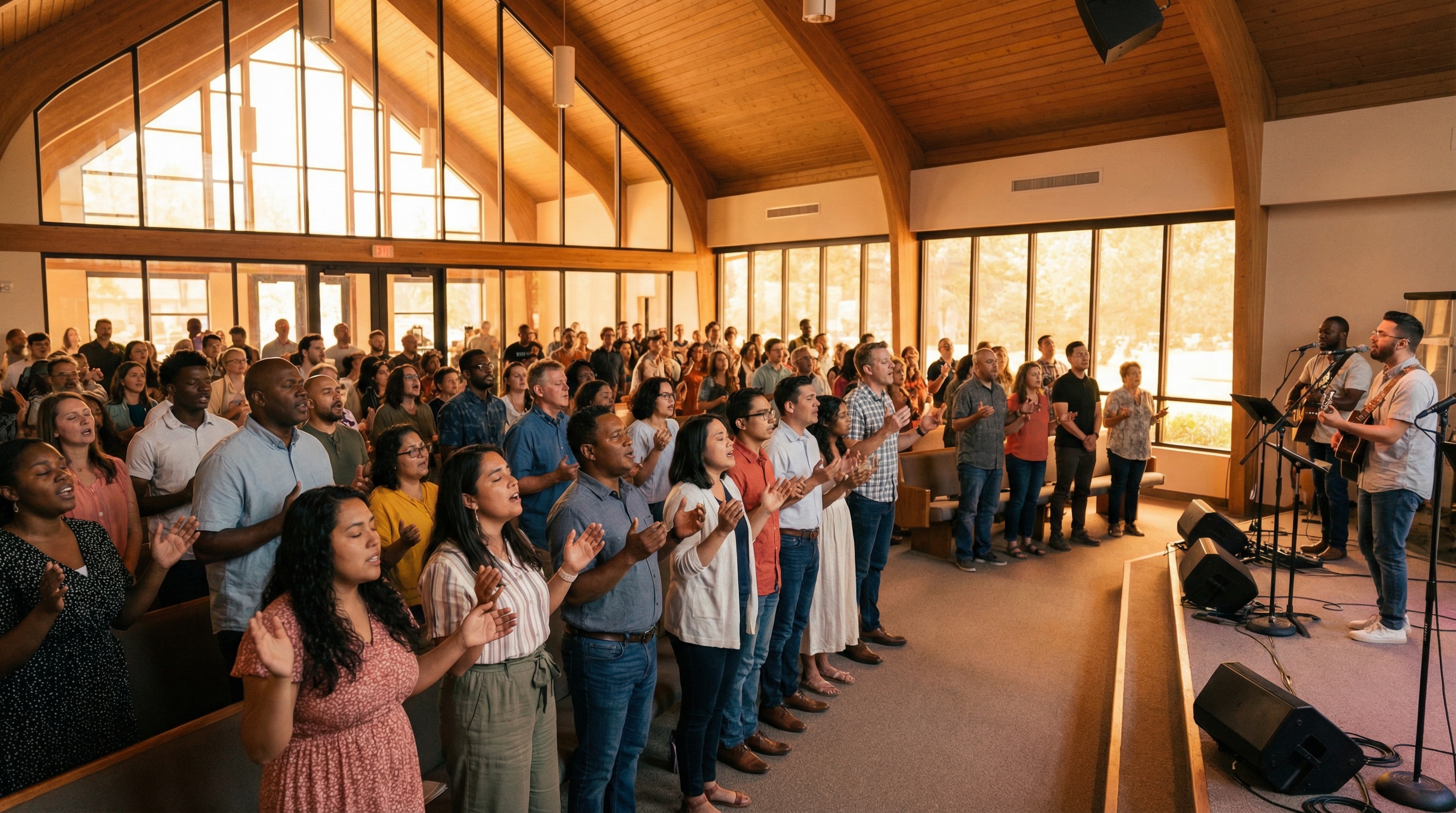
Why Multilingual Worship Grows Your Church (And How to Get Started)
Your community is changing. The neighborhood around your church likely looks very different than it did ten years ago — more languages spoken at the grocery store, more cultures represented at the local school, more families searching for a place to worship in a language that feels like home.
Multilingual worship isn't just a nice idea for churches with big budgets. It's becoming one of the most effective church growth strategies available to congregations of every size. Churches that offer services in multiple languages are seeing 30–50% increases in attendance, stronger community ties, and deeper engagement from members who previously felt like outsiders looking in.
But here's the thing most church leaders don't realize: adding multilingual worship is far simpler and more affordable than it used to be. You don't need a team of professional interpreters. You don't need expensive equipment. And you don't need to be a tech expert. With Glossa.live, real-time AI translation makes it possible for any church to become a multilingual worship community — starting this Sunday.
In this article, we'll look at the data behind why multilingual worship drives church growth, share real examples from churches that have made the shift, and give you a practical roadmap for getting started.
How Multilingual Worship Drives Church Growth
The connection between multilingual worship and church growth is straightforward: when people hear the Gospel in their own language, they come back. And they bring others.
According to the Pew Research Center, roughly 22% of Americans speak a language other than English at home. In many urban and suburban areas, that number climbs above 40%. That means if your church is English-only, you may be unintentionally excluding a significant portion of your own community.
Churches that embrace multilingual worship services tap into this underserved population in powerful ways. First, they remove the single biggest barrier to entry — language. A Vietnamese grandmother, a Haitian-Creole-speaking teenager, or a recently arrived Ukrainian family can walk through your doors and immediately feel included. Second, multilingual worship creates a word-of-mouth engine. When someone experiences worship in their heart language for the first time, they tell their friends, their family, and their community groups. This organic growth is exactly what many churches have been praying for.
Consider Hillsong, which uses real-time translation to reach congregants in 15+ languages across their global locations. Or Korean Presbyterian churches in Texas that added Spanish translation and saw attendance jump from 200 to 800. These aren't outliers — they're the new pattern for growing, healthy churches in diverse communities.
The Data: What Happens When Churches Go Multilingual
Let's look at what the numbers tell us about the impact of multilingual worship services on congregation size, engagement, and community reach.
Churches offering multilingual services report several consistent outcomes:
- Attendance grows by 30–50% within the first year of adding new languages
- Visitor retention rates improve dramatically — first-time guests who hear the service in their language are far more likely to return
- Community engagement deepens as immigrant families begin participating in small groups, volunteering, and tithing
- Online reach multiplies when churches stream their multilingual services to platforms like YouTube and Facebook
Research from the National Association of Evangelicals highlights that multicultural and multilingual congregations are among the fastest-growing church types in America. This aligns with broader demographic shifts. The U.S. Census Bureau projects that by 2045, no single racial or ethnic group will form a majority — a trend that churches ignoring language diversity will struggle to keep pace with.
But perhaps the most compelling data point is this: the cost of not going multilingual. Churches in diverse communities that remain English-only are seeing attendance decline at rates significantly higher than their multilingual counterparts. The community isn't shrinking — it's simply going to churches that speak their language.
Real Church Examples: Multilingual Worship in Action
The best way to understand the impact of multilingual worship is to see it working in real congregations.
Hillsong: Global Worship, Local Languages
Hillsong uses Glossa.live to reach congregants in over 15 languages across their locations worldwide. Their approach is simple: the pastor preaches in English, and AI-powered translation delivers the message in real time to listeners on their own devices. No special headsets. No separate rooms. Everyone worships together in one space, hearing the same message in their own language.
ICF Limassol: Bridging Arabic, Russian, and English
ICF Limassol in Cyprus serves a diverse congregation of Arabic, Russian, and English speakers. By implementing real-time translation, they eliminated the need for sequential interpretation — which used to double the length of every service. Now their services flow naturally, and attendance among non-English speakers has grown significantly.
Community Churches Across the U.S.
Smaller churches are seeing equally powerful results. A community church in Houston added Spanish and Vietnamese translation and saw 60 new families join within three months. A Baptist church in Atlanta implemented Korean translation for their growing Korean-American community and experienced their highest attendance in five years.
The common thread in all these examples? None of them hired additional interpreters. None of them purchased expensive equipment. They all used AI-powered translation technology that works on any device — phones, tablets, or laptops — making multilingual worship accessible and affordable.
For more examples of how churches are welcoming diverse communities, read our guide on how churches are reaching immigrant communities through real-time translation.
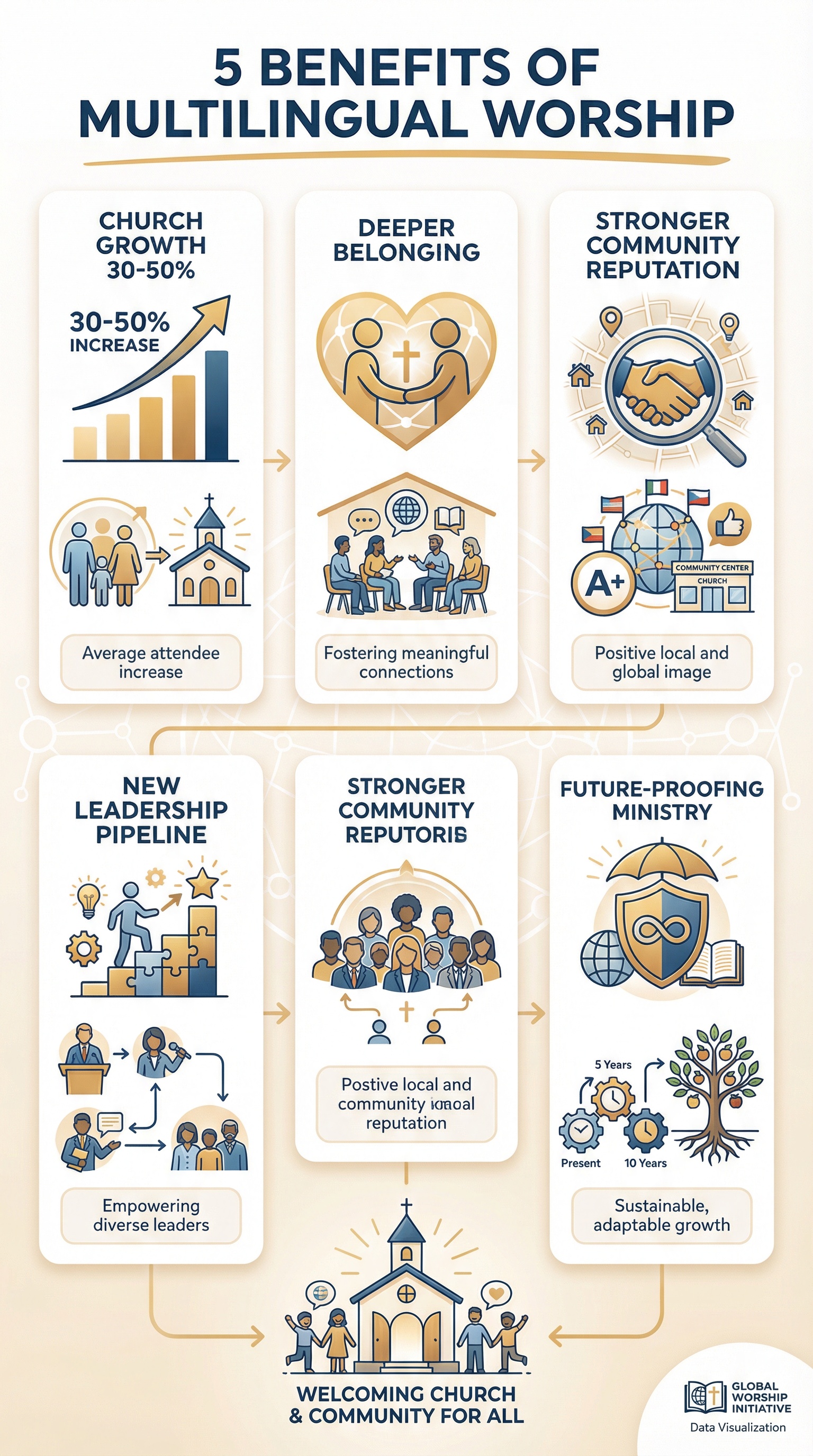
Five Benefits of Multilingual Worship Beyond Attendance
Church growth isn't just about numbers. Multilingual worship transforms your church culture in ways that go far beyond filling seats on Sunday morning.
1. Deeper Belonging and Retention
When someone hears worship and teaching in their heart language, the emotional connection runs deeper. They don't just attend — they belong. This sense of belonging translates directly into higher retention, more consistent giving, and stronger commitment to the church community.
2. Stronger Community Reputation
A church known for welcoming every language becomes a lighthouse in the community. Local organizations, schools, and social service agencies begin referring immigrant families to your church. Your reputation shifts from "a nice church" to "the church that actually understands our community."
3. Richer Worship Experience for Everyone
There's something uniquely powerful about hearing worship in multiple languages. It's a living picture of Revelation 7:9 — people from every nation, tribe, and tongue worshipping together. English-speaking members often report that multilingual worship deepens their own experience and expands their understanding of the global church.
4. Leadership Pipeline from New Communities
As immigrant and multilingual families become integrated into your church, new leaders emerge. These leaders bring unique perspectives, connections, and gifts that strengthen your ministry in ways you can't predict. Many of the fastest-growing churches in America credit their multilingual outreach for developing an entirely new generation of church leaders.
5. Future-Proofing Your Ministry
The demographic reality is clear: America is becoming more linguistically diverse, not less. Churches that invest in multilingual worship now are positioning themselves for long-term relevance and growth. Those that wait will find it increasingly difficult to connect with their changing communities.
Common Concerns About Starting Multilingual Worship
We hear the same questions from church leaders considering multilingual worship. Let's address the most common ones.
Isn't This Too Expensive for Our Budget?
This used to be true. Professional interpreters cost $200–500 per service, per language. Interpretation equipment — headsets, receivers, soundproof booths — could run style="min-width: 320px;"0,000 or more. But AI-powered translation has changed the equation entirely. With Glossa.live, you can add multiple languages to your service at a fraction of that cost, with no translation equipment to purchase. Flexible pricing means you only pay for what you use.
Will AI Translation Sound Natural?
Modern AI translation has come remarkably far. Glossa.live's AI is specifically trained on biblical language, theological terminology, and worship contexts — so it understands the difference between "grace" as a theological concept and "grace" as a name. Voice cloning technology means the translation sounds natural and warm, not robotic. Is it identical to a human interpreter? Not always. But for most church contexts, it's more than good enough — and it's available instantly in 100+ languages.
What About Older Members Who Aren't Tech-Savvy?
The beauty of phone-based translation is its simplicity. If someone can open a web browser and tap a link, they can use Glossa.live. There's no app to download, no account to create. Many churches display a QR code on screen at the start of the service — scan, pick your language, and listen. We've seen 80-year-old grandmothers use it on their first try.
Won't It Disrupt Our Current Service Flow?
Not at all. Because translation happens in real time through personal devices, your service runs exactly as it always has. The pastor preaches normally. Worship flows naturally. The only difference is that members wearing earbuds are hearing everything in their own language. There's no pause for interpretation, no awkward transitions, no divided congregation.
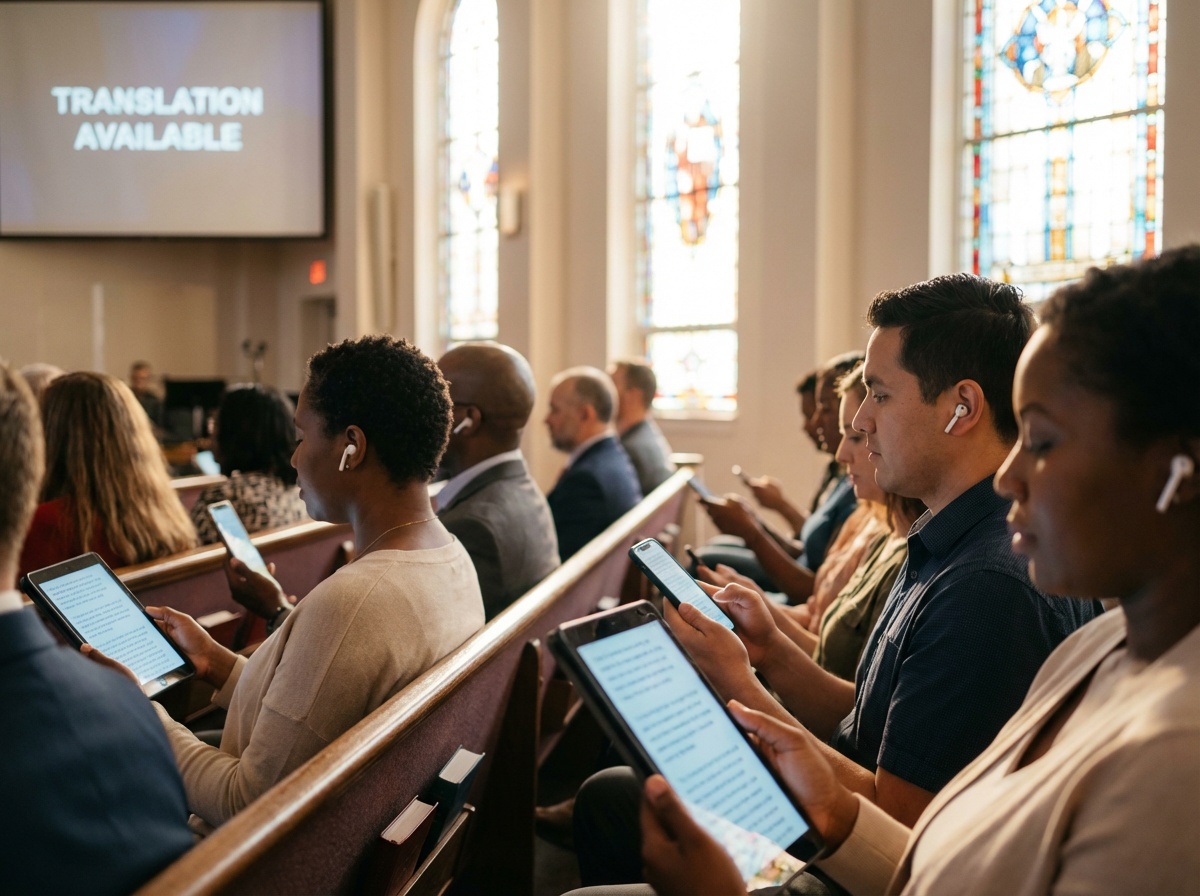
How to Start Multilingual Worship at Your Church
Ready to take the first step? Here's a practical roadmap for launching multilingual worship services.
- Know your community. Check U.S. Census data for your ZIP code, ask current members, and talk to local school districts — they track home languages and can give you surprisingly detailed data.
- Start with one language. Pick the language most represented in your community and start there. Success with one language builds confidence and creates a model you can replicate.
- Choose your technology. AI-powered platforms like Glossa.live work on any device with no special hardware. See our complete guide to multilingual church services for a step-by-step setup walkthrough.
- Communicate the vision. Share the biblical vision of multilingual worship with your congregation. Present the demographic data. Invite members to champion the initiative.
- Launch and learn. Plan a launch Sunday. Promote it through social media, community boards, and local immigrant organizations. Gather feedback and adjust.
- Expand your reach online. Stream your multilingual services to reach audiences beyond your physical location.
The Biblical Vision for Multilingual Worship
At its core, multilingual worship is a deeply biblical practice. The Day of Pentecost described in Acts 2 is essentially the story of God breaking through language barriers so that every person could hear the Good News in their own tongue. Parthians, Medes, Elamites — people from across the known world — each heard the apostles speaking in their own language. It was the birth of a multilingual church.
After this I looked, and there before me was a great multitude that no one could count, from every nation, tribe, people and language, standing before the throne. — Revelation 7:9
When your church offers worship in multiple languages, you're not just being inclusive. You're participating in something profoundly biblical — creating a space where the vision of Acts 2 and Revelation 7 comes alive every Sunday.
Getting Started Is Easier Than You Think
The church that reaches every language in its community is the church that grows. The data confirms it. The examples prove it. And the technology to make it happen is more accessible than ever.
You don't need a massive budget. You don't need a technical team. You don't need to hire interpreters or buy equipment. With Glossa.live, you can add real-time AI translation to your multilingual worship service in minutes — reaching Spanish, Vietnamese, Korean, Arabic, Mandarin, and 95+ other languages on any device.
Hundreds of churches — from small community congregations to major denominations like Hillsong and the SBC — are already experiencing the growth that comes from multilingual worship. The question isn't whether your church should go multilingual. It's how soon you can start.
Try Glossa.live free for 30 days and see how multilingual worship could transform your church's reach, growth, and impact.