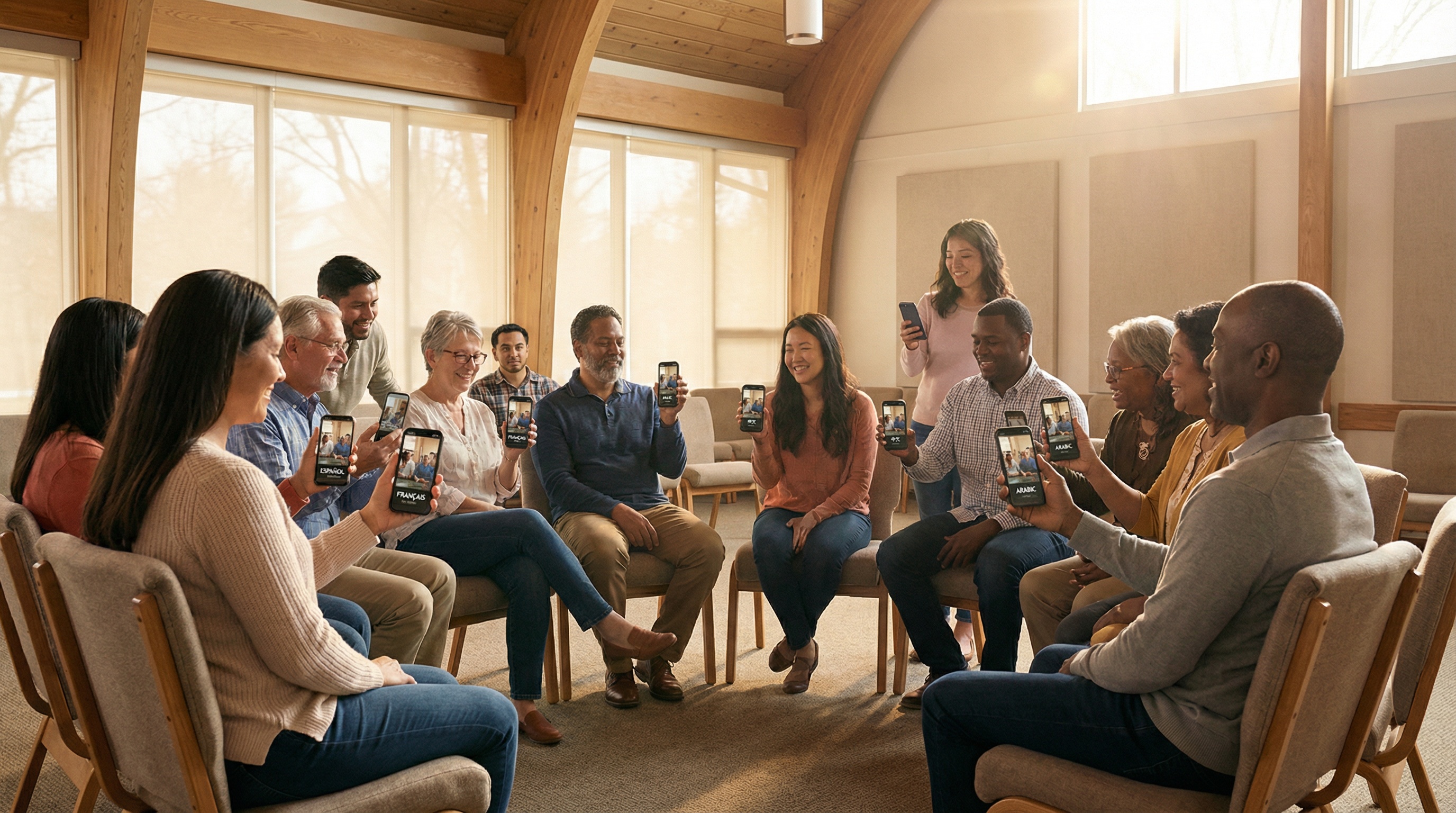
How to Stream Your Church Service in Multiple Languages
Your church livestream reaches people far beyond your building—but if it's only in one language, you're still leaving a significant part of your community behind. With nearly 24 million immigrants in the U.S. alone speaking English less than "very well," the need for multilingual church streaming has never been greater. The good news? Adding real-time translation to your church livestream is simpler and more affordable than you might think.
Whether you're streaming on YouTube, Facebook Live, or your own church website, this guide walks you through everything you need to know about streaming your church service in multiple languages—from choosing the right approach to setting it up this Sunday.
Why Multilingual Church Streaming Matters More Than Ever
The church has always been global, but your local congregation is becoming more global too. Communities across the U.S. are increasingly diverse, with Spanish, Vietnamese, Korean, Mandarin, Arabic, and dozens of other languages spoken at home by families who might be searching for a church that welcomes them.
When your livestream is English-only, you're unintentionally telling non-English speakers that this service isn't for them. That's a barrier no church wants to create—especially when the technology to remove it already exists.
Here's why multilingual streaming matters right now. First, hybrid and online church attendance has become a permanent part of how people engage with worship. A significant portion of congregants now split their time between in-person and online services. Second, immigrant families often discover churches online before they ever walk through the doors. If your livestream offers their language, you've just made a powerful first impression. Third, churches that embrace multilingual services consistently report reaching 30–50% more people in their community.
If your church is already reaching people through multilingual church services, adding translation to your livestream is the natural next step to extending that reach far beyond your walls.
Three Approaches to Streaming in Multiple Languages
Not every church streams the same way, and not every translation solution works for every setup. Here are the three main approaches to multilingual church streaming, along with their pros and cons.
Approach 1: AI-Powered Real-Time Translation
This is the fastest-growing approach and the most accessible for churches of all sizes. AI translation platforms connect to your church's audio feed and translate the sermon in real time into dozens—sometimes over 100—languages simultaneously.
How it works: your audio goes into the platform, and listeners access translated audio or captions on their own devices via a link or QR code. This works for both in-person attendees and livestream viewers at home.
Platforms like Glossa.live are specifically built for churches, with AI trained on biblical language and theological terminology. That means it understands words like "sanctification," "redemption," and "fellowship" in context—not just as generic vocabulary. Setup takes minutes, requires no special equipment, and works on any device.
The advantages of AI translation include support for 100+ languages simultaneously, no need to recruit volunteer interpreters, consistent quality every service, and affordable pricing that fits church budgets. The main consideration is that AI translation continues to improve rapidly, and platforms built for church contexts deliver significantly better accuracy than generic translation tools.
Approach 2: Human Interpreters with Multiple Audio Channels
Some churches use human interpreters who translate the sermon live into one or two languages. The translated audio is then streamed as a separate channel that viewers can select.
This approach works well when you have skilled interpreters on staff and only need one or two additional languages. It's been the traditional method for decades—and it delivers excellent quality for those specific languages.
However, this approach has limitations. Each additional language requires another trained interpreter, which quickly becomes expensive and logistically complex. Scheduling volunteers every week is challenging, and if your interpreter is sick on Sunday morning, that language simply isn't available.
Approach 3: Post-Service Subtitles and Captions
After recording your service, you can add translated subtitles using YouTube's subtitle tools or third-party captioning services. This makes your recorded sermons accessible in multiple languages after the fact.
While this doesn't help with live engagement, it creates a valuable archive of multilingual content that people can access anytime. Many churches combine this with live AI translation for a comprehensive approach—real-time translation during the service and polished subtitles on the recording afterward.
| Approach | Languages | Cost | Best For |
|---|---|---|---|
| AI Real-Time Translation | 100+ simultaneously | $5/hr or ~$99/mo | Any church, any size |
| Human Interpreters | 1–2 languages | $200–500/service/language | Churches with interpreter staff |
| Post-Service Subtitles | Unlimited (delayed) | Free–$50/video | Archived sermon content |
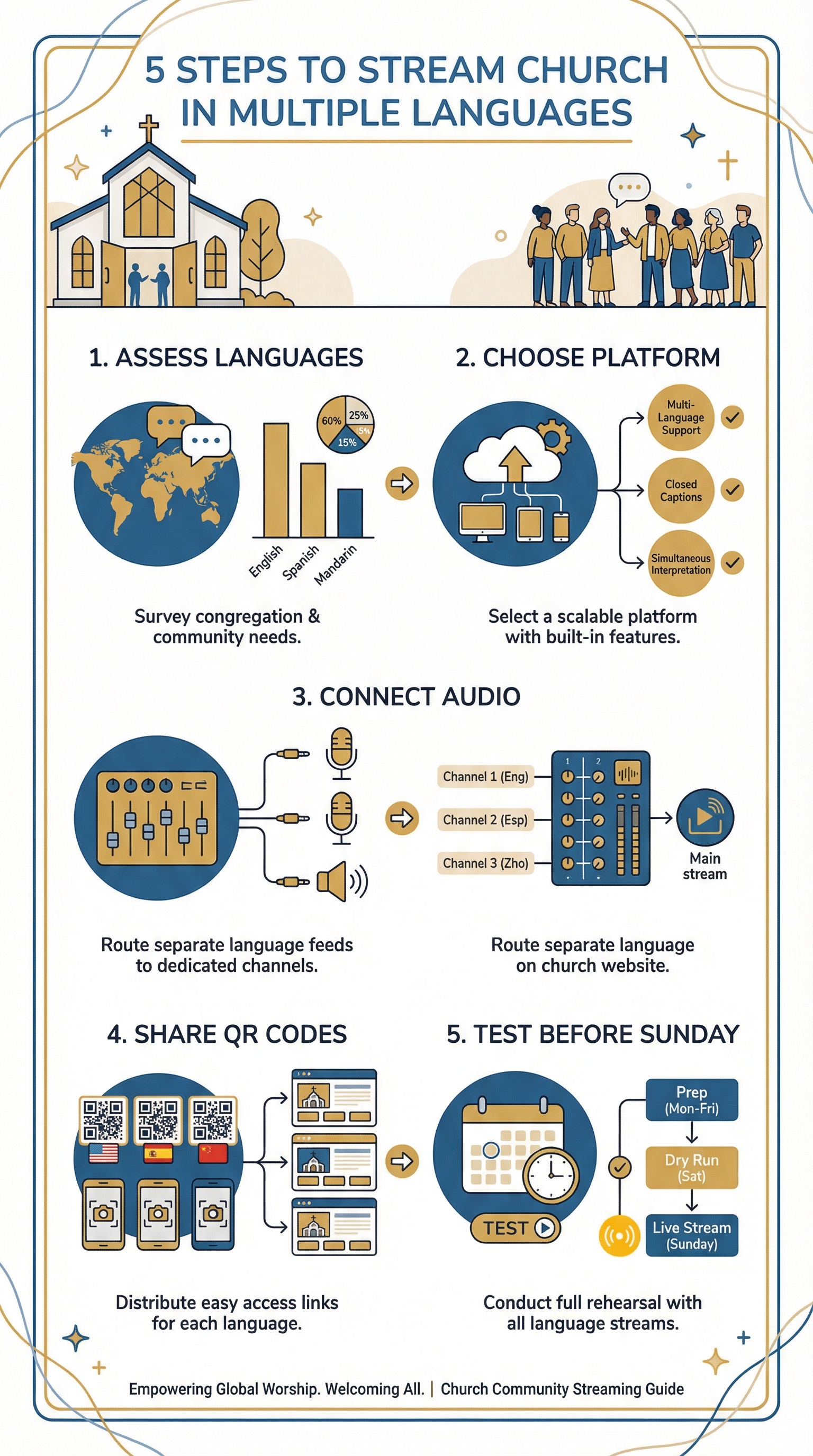
How to Set Up Multilingual Livestream Translation (Step by Step)
Ready to add translation to your church's livestream? Here's a practical, step-by-step guide using AI-powered translation—the approach that works for the widest range of churches.
Step 1: Assess Your Community's Language Needs
Before choosing any tool, find out what languages your community actually speaks. Check your local census data, survey your congregation, or simply ask your greeters and small group leaders what languages they encounter. You might be surprised to learn that 15% of your neighborhood speaks Vietnamese, or that a growing Haitian Creole community has been looking for a welcoming church.
Focus on the top 3–5 languages first. Even though AI platforms can handle 100+ languages, knowing your priorities helps you test and promote effectively.
Step 2: Choose Your Translation Platform
Look for a platform that meets these criteria: it should support the languages your community needs, integrate with your existing streaming setup, require minimal technical expertise to operate, and offer pricing that fits your church's budget.
For most churches, an AI-powered platform designed specifically for church use is the best fit. Glossa.live, for example, works with any audio input—your mixer, a microphone, or even your streaming software—and delivers real-time translation to listeners' phones with no special hardware required.
Step 3: Connect Your Audio Source
The translation platform needs to hear your service clearly. Most platforms offer several connection options: a direct audio feed from your soundboard or mixer (best quality), a microphone placed near speakers (simplest setup), or integration with your streaming software via virtual audio routing.
If your church uses a sound system with an audio mixer, a direct feed is ideal. If your setup is simpler—say, a pastor with a lapel mic and a laptop—that works too. The key is clear, consistent audio input.
Step 4: Create Access Points for Listeners
Your congregation and online viewers need a way to access the translated audio. Most AI translation platforms generate a shareable link or QR code. Here's how to make it easy for everyone.
For in-person attendees, display the QR code on screens before the service starts, print it in your bulletin, or post signs at your entrances. For online viewers, share the translation link in your livestream description, pin it in the chat, or add it to your church website's streaming page.
If you're embedding translations directly on your website, check out the guide on how to embed Glossa on your site for a seamless experience.
Step 5: Test Before Sunday
Run a test during your midweek rehearsal or sound check. Stream a practice sermon and verify that the translation is coming through clearly in your target languages. Check the audio quality, the delay between the original speech and translation, and whether the QR codes and links work on different devices—phones, tablets, laptops.
This is also a great time to brief your tech team. Most AI translation platforms are simple enough that one volunteer can manage the entire setup, but it helps if your whole team knows the basics.
Best Practices for Multilingual Church Streaming
Once you have the technology in place, here are some practical tips to make your multilingual livestream as effective as possible.
- Speak clearly and at a natural pace. AI translation accuracy improves when the speaker maintains a steady pace, pauses between sentences, and avoids talking over background music.
- Announce the translation option every week. Don't assume people know it's available. Show the QR code on screen during announcements and mention the available languages.
- Optimize your stream for mobile viewers. Many translated-stream viewers are on phones. Keep your video layout clean and uncluttered.
- Promote multilingual access on social media. Share posts in the languages you support—a message in Spanish about Spanish translation can reach families who'd never find your English-language posts.
- Track engagement and adjust. Most translation platforms offer analytics. Use the data to understand which languages your community uses most.
What About Translation Equipment and Hardware?
One of the biggest misconceptions about multilingual streaming is that it requires expensive equipment. Traditional interpretation systems with FM transmitters, receiver packs, and headsets can cost thousands of dollars—and they only work for in-person attendees.
Modern AI translation platforms have changed the equation entirely. Because translations are delivered directly to people's smartphones, there's no additional hardware to buy, maintain, or distribute. Your congregation's phones become the "receivers," and the platform handles everything else.
If you're evaluating different approaches, our guide on church translation equipment breaks down exactly what you need (and what you don't) for each type of setup.
For streaming specifically, the only equipment you need is what you already have: a computer for streaming, a microphone or audio mixer, and an internet connection. The translation platform runs in the cloud, so there's nothing to install on your streaming computer either.
Real Churches, Real Results: Multilingual Streaming in Action
Churches around the world are already streaming in multiple languages—and the results speak for themselves.
Hillsong Church uses real-time AI translation to reach congregants in 15+ languages across their global locations. What started as a solution for their diverse in-person audiences became essential for their worldwide livestream audience too.
Smaller churches are seeing similar impact. A Korean Presbyterian church in Texas added Spanish translation to their livestream and saw their online viewership more than double within three months. The Spanish-speaking families who found them online started showing up in person—and many became regular members.
ICF Limassol, a church in Cyprus, serves Arabic, Russian, and English speakers through real-time translation. Their livestream reaches viewers across multiple countries, effectively turning a single Sunday service into a multilingual broadcast that serves diaspora communities worldwide.
These aren't megachurches with massive tech budgets. They're congregations that recognized the opportunity to reach more people and took a simple step to make it happen. As we've explored in our article on how churches are reaching immigrant communities, the technology is now accessible enough for any church to get started.
It's like removing a brick wall that separated us from our community. We went from serving 200 people to reaching over 500—just by making our livestream available in three languages.
Common Questions About Multilingual Church Streaming
How much does it cost to stream in multiple languages?
Costs vary by platform and usage. AI-powered solutions typically range from pay-as-you-go models (around $5/hour per language) to monthly subscriptions starting around $99. Compare this to hiring professional interpreters, which can cost $200–500 per language per service. For most churches, AI translation is significantly more affordable—especially when you're supporting more than one or two languages.
Will the translation quality be good enough for sermons?
AI translation platforms designed for churches are trained on biblical and theological language, which makes a meaningful difference compared to generic tools like Google Translate. While no translation—human or AI—is perfect, church-specific platforms handle terms like "grace," "atonement," and "covenant" with the nuance they deserve. Many churches report that their congregants find AI translation very effective for following along with sermons.
Do my livestream viewers need to download an app?
Most modern platforms are browser-based, so viewers simply click a link or scan a QR code. No app downloads required. This removes a significant barrier—especially for older congregants or visitors who aren't tech-savvy.
Can I add translation to my existing YouTube or Facebook livestream?
Yes. AI translation platforms work alongside your existing stream. Viewers watch your normal livestream for the video and access the translated audio through a separate link or embedded widget. Some platforms also support adding translated captions directly to your stream output.
Start Streaming in Multiple Languages This Week
Adding multilingual translation to your church livestream doesn't require a committee, a capital campaign, or a technology degree. Here's what you can do right now.
- Identify your community's languages. A quick survey, a conversation with your greeters, or a look at local census data will give you a starting point.
- Try a free trial. Most AI translation platforms—including Glossa.live—offer free trials so you can test the experience before committing.
- Announce it to your congregation. Let people know that translation is available. The word spreads quickly—not just within your church, but across the community.
Every language spoken in your congregation deserves to hear the message. With multilingual streaming, your church's reach isn't limited by the walls of your building or the languages your team speaks. It's limited only by how many people know the option exists.
Start streaming in multiple languages this Sunday. Your community is waiting.