Church Translation Equipment: What Your Congregation Actually Needs
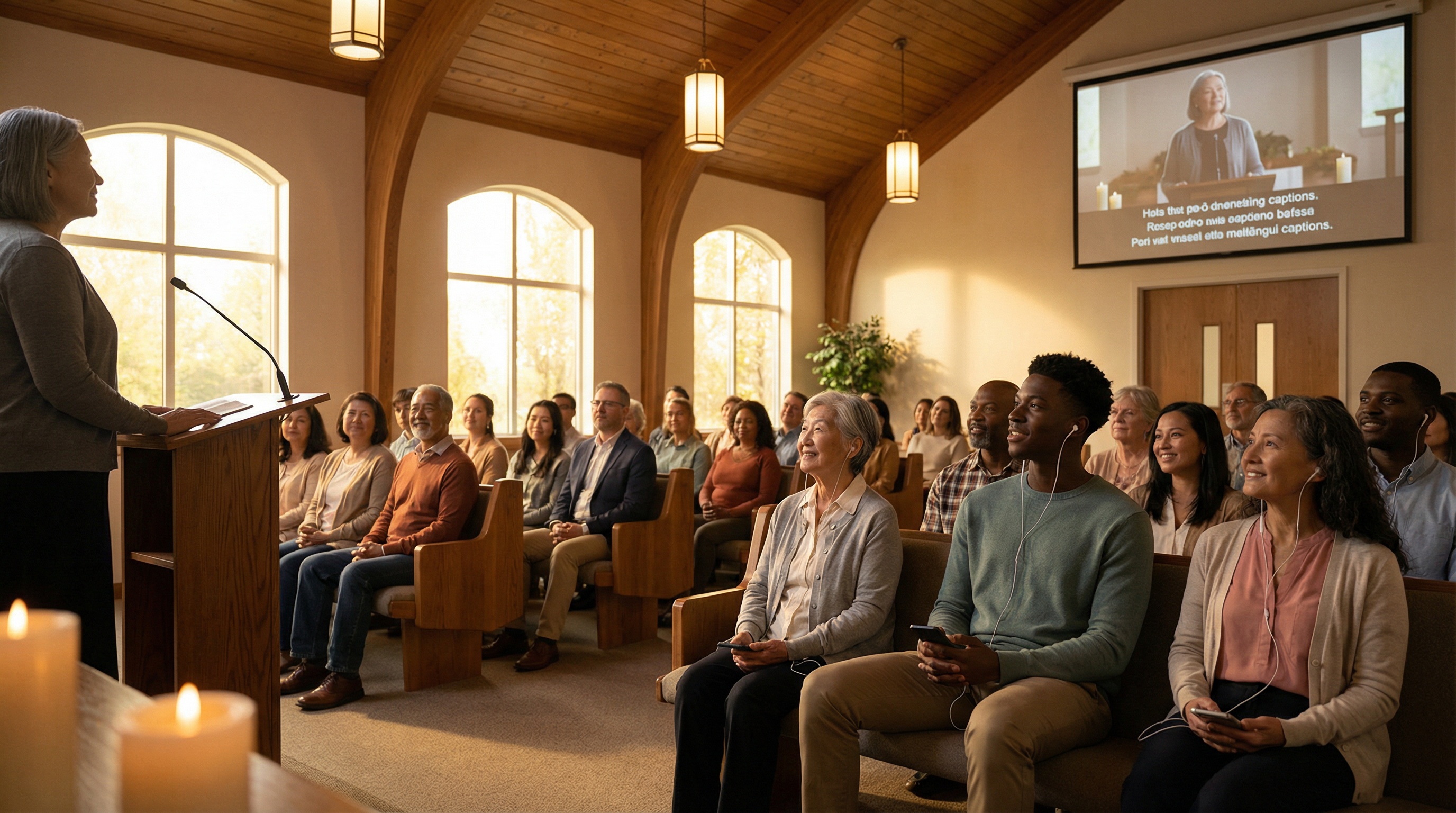
Walk into any large church that serves a multilingual congregation, and you might notice members wearing small receiver devices — listening through earbuds to a translated version of the service. Behind the scenes, a professional interpreter sits in a booth, translating in real time. That setup works. But it also costs thousands of dollars, requires trained volunteers, and takes weeks to set up.
For most churches — especially growing congregations with limited budgets — traditional translation equipment for church simply is not realistic. Yet the need is real: the United States is home to over 350 languages, and millions of churchgoers speak something other than English as their primary language.
The good news? The landscape for church translation has changed dramatically. Understanding what translation equipment for churches actually involves — and what modern alternatives now make possible — can help your leadership team make the right call for your congregation.
What Is Church Translation Equipment?
Church translation equipment refers to the physical hardware and audio systems traditionally used to provide simultaneous interpretation during worship services. The standard setup includes a transmitter unit that broadcasts the interpreter's translated audio, receiver devices worn by congregation members (like a small FM radio tuned to the translation channel), an interpreter booth or station where a trained bilingual volunteer translates live, and headsets and microphones for the interpreter.
This kind of setup is the industry standard for large conferences, international events, and churches with dedicated resources. It's reliable and clear — but it comes with significant trade-offs that most congregations aren't prepared for when they first start researching.
The Real Cost of Traditional Church Translation Devices
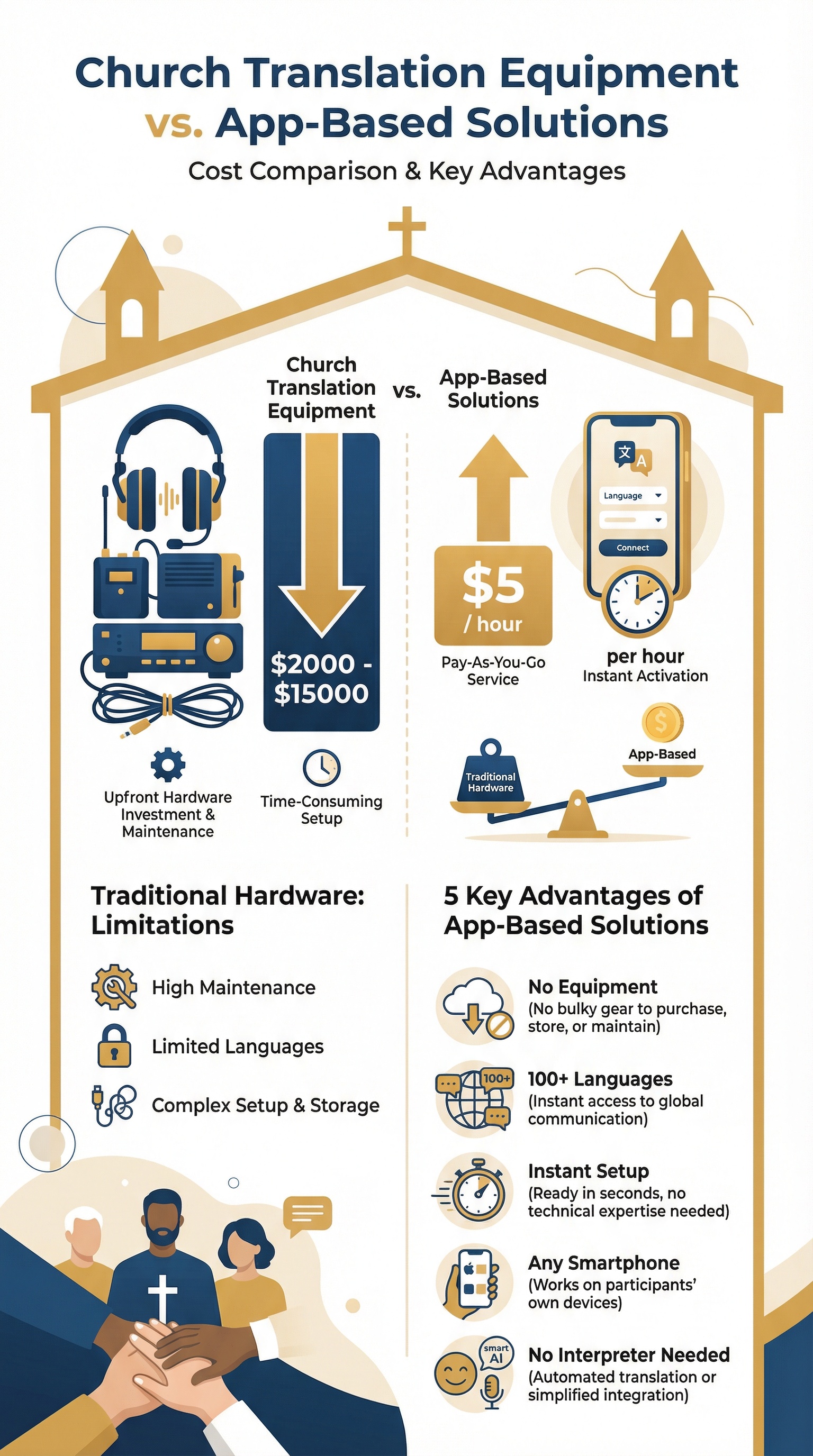
When churches research church translation devices, the initial price often comes as a shock. A basic FM-based system for one language — including transmitter, 30 receiver units, and headsets — typically runs between ,000 and ,300 in hardware alone. A professional infrared system for larger sanctuaries, with emitter panels, 50 receiver units, and installation, can reach ,500 to 5,000 or more.
And that's just the equipment. You still need an interpreter — typically a bilingual volunteer or paid professional — for every language you want to offer. Professional interpreters charge 5–00 per hour. Over a full year of Sunday services and special events, a single-language program easily exceeds 0,000 annually.
For many congregations, this is not just expensive — it is simply not feasible. Church budgets are tight, and committing this level of capital to translation infrastructure often means cutting elsewhere.
Why Most Small and Mid-Size Churches Cannot Sustain This Model
It is not just the cost. Traditional church translation equipment creates operational dependencies that smaller churches struggle to maintain long term.
- Volunteer burnout: Interpretation is cognitively demanding. Requiring the same bilingual volunteer to interpret every Sunday leads to burnout quickly. Most churches find that sustaining a volunteer interpreter program is harder than it sounds.
- Limited language support: Even a well-resourced church might manage one or two languages with traditional equipment. But what about congregations where Spanish, Vietnamese, Korean, and Arabic speakers all attend the same service?
- Technical maintenance: FM and IR systems require regular maintenance, battery replacements, and occasional equipment replacement. A failed transmitter on Sunday morning creates an immediate pastoral challenge.
- Setup complexity: Someone has to distribute receivers before services, collect and sanitize them after, and troubleshoot technical issues — all during the busiest time of the week for church staff and volunteers.
According to Barna Group research, church leaders consistently rank budget constraints and volunteer capacity as their top operational challenges. For most congregations, committing significant budget to translation hardware — with all the ongoing logistics — simply does not make the short list.
The Modern Alternative: App-Based Church Translation
Over the past several years, AI-powered translation has become accurate enough for real ministry use. Instead of broadcasting audio to dedicated receiver devices, app-based systems like Glossa.live deliver translated audio directly to congregants' smartphones via a simple web link — no special equipment required.
Here is how it works: the service audio is captured via a microphone or existing soundboard output, AI translates it in real time (trained specifically on biblical and worship language), and congregants open a link on their phone to hear the translation through their own earbuds in their language. No app download. No devices to distribute. No interpreters to schedule.
The result is remarkably similar to the traditional equipment experience, but the logistics are radically simpler. For churches that want to understand how this technology integrates with their existing setup, how to embed Glossa into your service workflow provides a practical step-by-step starting point.
Comparing Translation Equipment for Churches vs. App-Based Solutions
Here is a side-by-side look at the two approaches across the factors that matter most to church leaders:
| Factor | Traditional Equipment | App-Based Translation |
|---|---|---|
| Upfront cost | ,000–5,000+ | Free to start / low monthly |
| Per-service cost | 5–00 (interpreter) | /hour per language |
| Languages supported | Typically 1–2 | 100+ languages |
| Setup time | Weeks to months | Minutes |
| Devices needed | Dedicated receivers | Congregants' own smartphones |
| Interpreter required | Yes | No — AI handles it |
| Maintenance | Ongoing (batteries, repair) | None |
| Scalability | Expensive to expand | Easy to add languages |
For smaller and mid-size congregations — and even many large churches — the math is straightforward. App-based translation removes the most significant barriers: cost, complexity, and ongoing maintenance. To understand the full picture of how multilingual services work in practice, our guide on how to start multilingual church services walks through each decision point step by step.
When Traditional Translation Equipment Still Makes Sense
App-based translation is the right fit for most churches. But there are specific contexts where investing in traditional church translation devices still makes sense:
- Congregations where members don't have smartphones: Older congregations or certain communities may have members who don't carry personal devices. In those cases, dedicated receivers ensure everyone can participate.
- Very large international conferences: When hosting thousands of attendees from dozens of countries, professional-grade simultaneous interpretation equipment offers robustness and audio quality that major events demand.
- Churches with existing equipment: If your church already has a working FM or IR system and trained volunteers, maintaining it may be more practical than transitioning. Many churches in this situation use app-based translation as a complement — adding languages their equipment does not support.
- Denominations or networks with shared resources: Some larger church networks can spread the cost of equipment across multiple congregations, making the economics work better than they would for a single church.
For most congregations exploring translation for the first time, starting with an app-based solution allows you to test the concept, serve your multilingual members immediately, and avoid a significant capital investment before you know it will work for your community.
How Churches Are Making the Shift Away from Equipment
The churches that have moved to app-based translation share a common story: they wanted to reach the Spanish speakers, Vietnamese families, or Arabic-speaking seniors in their congregation — but traditional church translation equipment was out of reach.
A church in Texas with a growing Latino congregation started using real-time AI translation during their Sunday service. Within a month, several Spanish-speaking families who had been attending inconsistently became regular members — because, for the first time, they could follow the sermon in their own language. The total monthly cost was less than one hour with a professional interpreter.
A Korean Presbyterian church in the Southeast found that their bilingual volunteer had become a single point of failure. Every time he traveled or was unavailable, the Korean-speaking members of their congregation received no translation at all. Switching to an app-based system eliminated that dependency overnight.
These stories reflect a broader trend documented in Pew Research Center studies on religious diversity: churches that invest in language inclusion see measurable increases in attendance and engagement from minority-language communities. To see how churches like yours are approaching immigrant and multilingual outreach, read about how churches are reaching immigrant communities through real-time translation.
The churches reaching the most people are not the ones with the most equipment — they are the ones with the fewest barriers between their congregation and the Gospel.
Getting Started with Translation at Your Church
If your congregation is ready to remove the language barrier — without the cost and complexity of traditional translation equipment for church — here is where to begin:
- Identify which languages your congregation speaks. Talk to your small group leaders, youth workers, and neighborhood outreach team. You may be surprised how many languages are represented.
- Start with one language. Do not try to launch a five-language program in week one. Start with the most-spoken language in your congregation — often Spanish — and build from there.
- Announce it in advance. Let your multilingual members know that translation will be available. Give them time to charge their phones and bring earbuds.
- Run a test service. Use the first service as a learning experience. Check audio quality, connection stability, and whether the translation captures your pastor's specific vocabulary.
- Gather feedback. Ask the members who used translation what worked and what did not. Their input will help you refine the experience for future services.
The Bottom Line on Church Translation Equipment
Traditional church translation devices have served multilingual congregations faithfully for decades. But for most churches — especially those navigating tight budgets, limited volunteers, and multiple languages — the hardware model creates more barriers than it removes.
App-based real-time AI translation changes the equation entirely. With no translation equipment for church to purchase, no interpreters to schedule, and no maintenance to manage, churches can begin reaching their multilingual congregation this Sunday — not after a six-month implementation project.
The question is not whether your congregation needs translation. If you have members who speak a different language at home, you need translation. The question is simply: which path gets you there fastest, with the least friction, and at a price your church can sustain?
For most churches, the answer is not new hardware. It is a smarter approach. See how Glossa.live works for churches like yours →