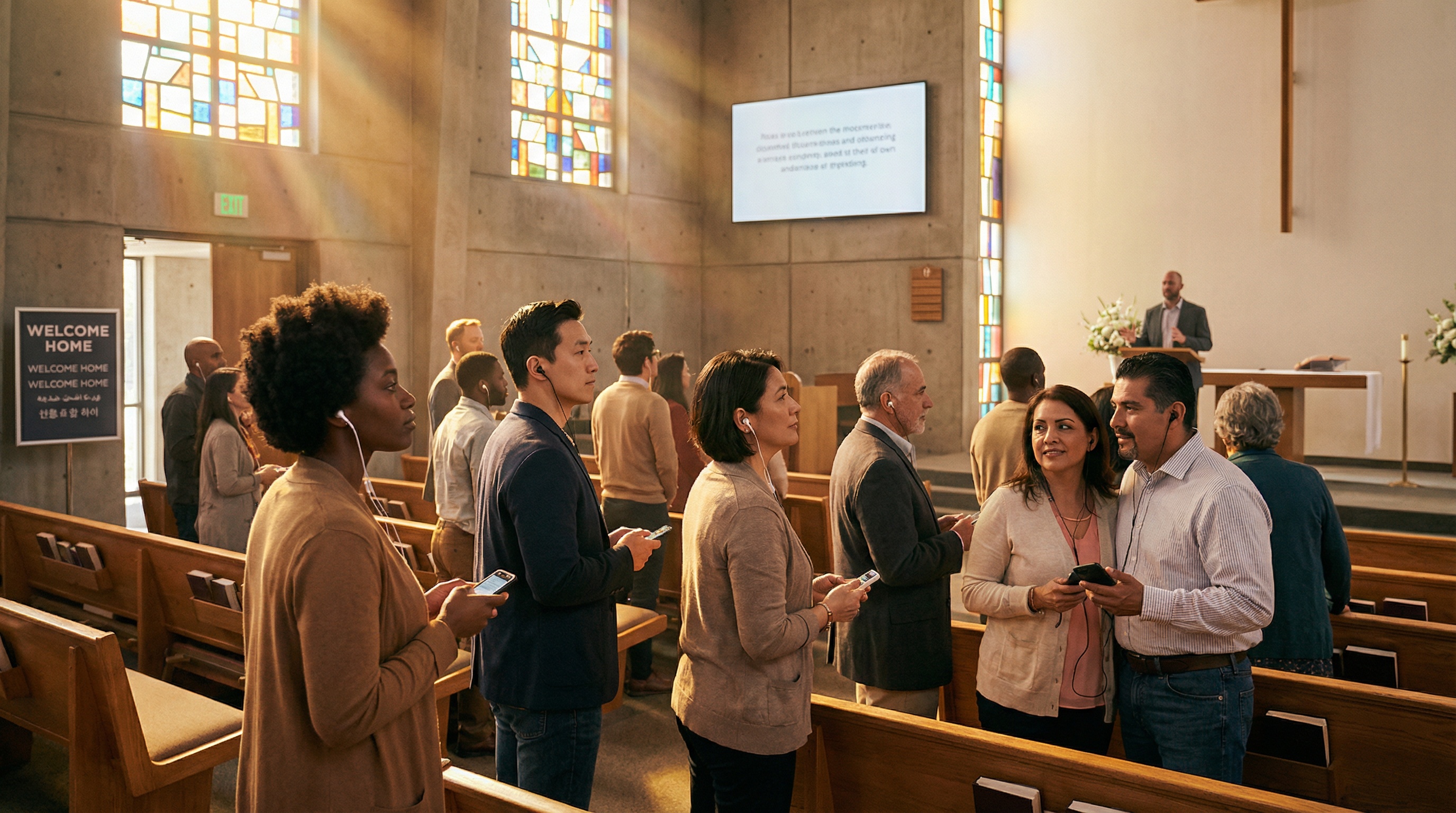
How AI Translation Works for Church Services (And Why It Matters)
If your congregation includes families who speak Spanish at home, grandparents who are most comfortable in Korean, or newcomers who just arrived from Ukraine, you already know the challenge. Language barriers don't just make sermons harder to follow—they make people feel like outsiders in a place that should feel like home.
AI translation for churches is changing that. In February 2026, even the Vatican introduced AI-powered real-time translation at St. Peter's Basilica, making Holy Mass accessible in 60 languages through visitors' smartphones. If the world's largest church can embrace this technology, your congregation can too—and it's simpler than you might think.
Here's how AI translation actually works in a church setting, what makes it different from generic translation tools, and why hundreds of churches are already using it to reach more people every Sunday.
How AI Translation for Churches Actually Works
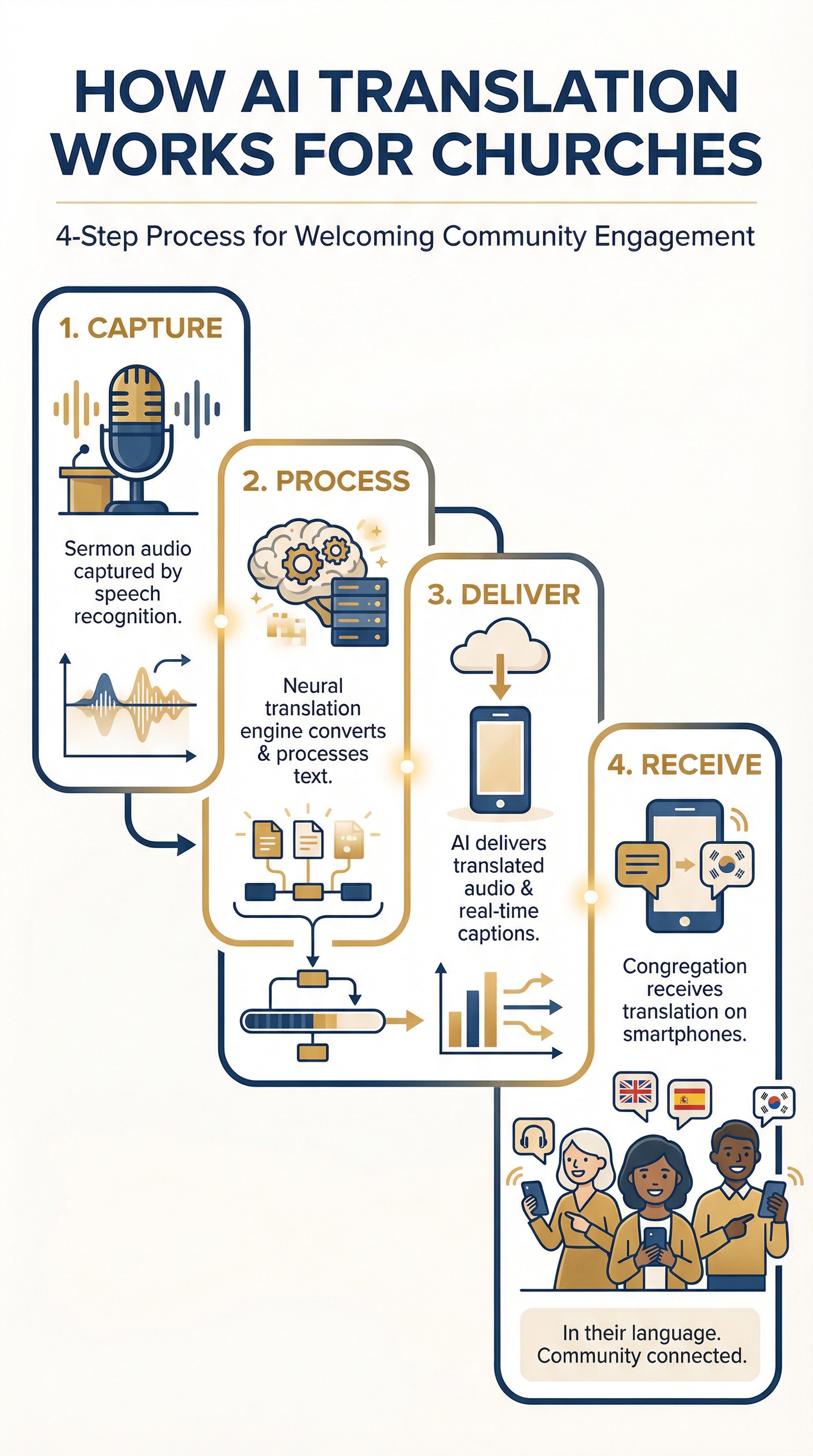
At its core, AI translation for churches takes the spoken word from your pastor or worship leader and converts it into another language—in real time. But the process behind it involves several sophisticated steps working together seamlessly.
First, automatic speech recognition (ASR) listens to the sermon and converts spoken words into text. Think of it as an incredibly fast transcriptionist who never gets tired and never falls behind. This step happens in milliseconds.
Next, a neural machine translation engine takes that text and translates it into the target language. Modern AI models don't translate word by word—they understand context, sentence structure, and meaning. That's why a phrase like "washed in the blood of the Lamb" gets translated as a theological expression, not a literal description.
Finally, text-to-speech technology can convert the translated text into natural-sounding audio in the target language. Some platforms even use voice cloning technology to make the translated audio sound similar to the original speaker's voice, creating a more natural listening experience.
The entire process—from spoken English to translated Spanish, Vietnamese, Arabic, or any of 100+ languages—happens in seconds. Congregation members simply open a link on their phone, select their language, and listen or read along as the service happens.
What Makes Church-Specific AI Translation Different
You might wonder: why not just use Google Translate or a generic translation app? The answer comes down to context and accuracy.
Generic translation tools are trained on everyday language—business emails, news articles, social media posts. They often struggle with the specialized vocabulary that fills every church service. Words like "sanctification," "atonement," "fellowship," and "the body of Christ" carry specific theological meaning that generic AI can miss or mistranslate.
AI translation built for churches is trained on biblical texts, sermon transcripts, worship song lyrics, and theological content. This specialized training means the technology understands that "breaking bread" in a church context isn't about lunch—it's about communion. It knows that "the Word" with a capital W refers to Scripture or Christ, not just any word.
This distinction matters because a mistranslation in a sermon isn't just awkward—it can change the meaning of a spiritual message that someone traveled miles to hear. Churches using real-time AI translation report that members in their target languages follow along just as naturally as English speakers, precisely because the technology was built for this context.
The Technology Behind Real-Time Church Translation
Understanding the technology helps church leaders make informed decisions. Here's what happens under the hood during a typical Sunday service.
Speech Recognition in Noisy Environments
Churches aren't recording studios. There's ambient noise, echo from high ceilings, music playing, and congregations responding. Modern AI speech recognition systems are trained to filter out background noise and focus on the primary speaker's voice. Most platforms work best when connected directly to your sound system's audio feed, which gives the AI a clean signal without room noise.
Handling Multiple Speakers
A typical service might include a senior pastor, a worship leader, someone reading Scripture, and a guest speaker—each with different accents, speaking speeds, and vocal patterns. Advanced AI systems adapt to different speakers in real time, adjusting their recognition models on the fly. Some platforms let you switch between speakers manually, while others detect the change automatically.
Latency and Real-Time Delivery
"Real time" doesn't mean instant—there's always a small delay as the AI processes speech, translates it, and delivers the result. Most modern church translation platforms operate with a 3-to-8-second delay. That's fast enough that congregation members reading or listening in another language stay in sync with the service flow. You won't notice the gap during a 30-minute sermon.
Language Quality and Accuracy
AI translation accuracy has improved dramatically in recent years. For common language pairs like English to Spanish, modern systems achieve accuracy rates above 95%. Less common language pairs may have slightly lower accuracy, but the technology improves continuously as it processes more content.
The Vatican's recent implementation at St. Peter's Basilica—developed in collaboration with the AI company Translated and their Lara interpreter system—demonstrates how far this technology has come. Pilgrims can now follow the liturgy in 60 languages by simply scanning a QR code, with no app download required.
Why Churches Are Choosing AI Over Traditional Interpreters
For decades, churches that wanted multilingual services had two options: hire professional interpreters or rely on bilingual volunteers. Both approaches have significant limitations that AI translation solves.
Professional interpreters are expensive. A single interpreter for one language can cost 50-300 per service. If your congregation speaks three or four languages, that adds up to ,000-5,000 per month—a significant line item for most church budgets. And interpreters need scheduling, backup coverage, and coordination every single week.
Volunteer interpreters are harder to sustain. Finding bilingual church members willing to interpret every Sunday is challenging. Volunteers burn out, move away, or simply aren't available some weeks. And even dedicated volunteers may lack the theological vocabulary or training to accurately convey complex sermon content.
AI translation eliminates these constraints. It's available every service, never calls in sick, handles multiple languages simultaneously, and costs a fraction of professional interpretation. As we explored in our guide on church translation equipment, modern AI solutions require no special hardware—just the sound system you already have and your congregation's smartphones.
Churches that have made the switch report reaching 30-50% more people in their community, as families who previously felt excluded by language barriers finally have a reason to attend and stay. You can learn more about this impact in our article on why multilingual worship grows your church.
| Factor | Professional Interpreter | Volunteer Interpreter | AI Translation |
|---|---|---|---|
| Cost per service | style="min-width: 320px;"50-300 per language | Free (but hidden costs) | $5-25 depending on plan |
| Languages available | 1 per interpreter hired | 1 per volunteer | 100+ simultaneously |
| Reliability | Scheduling dependent | Volunteer availability | Available every service |
| Theological accuracy | High (if trained) | Variable | High (biblically trained AI) |
| Setup required | Sound booth, headsets | Microphone, separate room | Existing sound system + phones |
How to Set Up AI Translation at Your Church
Getting started with AI translation is simpler than most church leaders expect. Here's what the setup typically looks like.
Step 1: Connect Your Audio
The AI needs to hear your pastor clearly. The best approach is connecting your sound board's auxiliary output directly to the translation platform. This gives the AI a clean audio feed without room echo or congregation noise. If your church uses a simple setup with a single microphone, that works too—most platforms can work with standard audio inputs.
Step 2: Choose Your Languages
Which languages does your congregation need? Start by surveying your community. If you're not sure, look at the demographic data for your zip code—the U.S. Census Bureau provides language data by neighborhood. Many churches start with one or two languages and add more as word spreads through the community.
Step 3: Share Access with Your Congregation
Most AI translation platforms deliver translations through a web link or QR code. Display the QR code on your lobby screens, print it in your bulletin, or include it in your weekly email. Congregation members scan the code, pick their language, and start listening—no app download required.
Step 4: Test and Refine
Run a test during a midweek service or rehearsal before going live on Sunday morning. Check audio quality, translation accuracy, and the user experience on different devices. Most churches get everything dialed in within one or two test runs.
For a comprehensive walkthrough, our step-by-step guide to multilingual church services covers everything from initial planning to launch day.
Common Concerns About AI Translation for Churches
Church leaders often have legitimate questions before adopting AI translation. Here are the most common concerns—and honest answers.
"Is AI accurate enough for sermons?"
Modern AI translation is remarkably accurate, especially for the structured, clear speech patterns typical of sermons. When trained on biblical and theological content, these systems handle religious vocabulary with precision. That said, no translation—human or AI—is perfect. The question isn't whether AI is flawless, but whether it's better than the alternative: having non-English speakers sit through a service they can't understand at all.
"Will it feel impersonal?"
Some church leaders worry that technology will create distance. In practice, the opposite happens. When a Korean grandmother can finally understand every word of the sermon through her earbuds, she feels more connected to the community, not less. Technology doesn't replace human connection—it removes the barrier that was preventing it.
"What about our internet connection?"
Most AI translation platforms are cloud-based, so you need a stable internet connection. A standard broadband connection (25 Mbps or higher) is typically sufficient. If your church already livestreams services—as many do since the pandemic—your internet is likely fast enough. Some platforms offer offline or hybrid modes for churches with limited connectivity.
"Can we afford it?"
AI translation is significantly more affordable than human interpretation. Many platforms offer pay-as-you-go pricing or monthly subscriptions designed for church budgets. The cost of reaching families who would otherwise never walk through your doors is often the most compelling argument for church boards and finance committees.
Real Churches Using AI Translation Today
This isn't theoretical. Hundreds of churches worldwide already use AI translation every week.
Hillsong Church uses AI translation to reach congregants in 15+ languages across their global locations. Korean Presbyterian churches in Texas have expanded their reach to Spanish-speaking neighbors using real-time translation. Small community churches with 100 members use the same technology to welcome immigrant families who recently arrived in their neighborhoods.
The movement is growing beyond individual churches. As we covered in our article on how churches are reaching immigrant communities, entire denominational networks—including SBC, UMC, and PCA churches—are adopting AI translation as a standard part of their outreach strategy.
And the Vatican's February 2026 announcement signals something even bigger: AI translation for worship is moving from early adoption to mainstream acceptance. When St. Peter's Basilica embraces the technology, it sends a clear message that AI-powered translation belongs in sacred spaces.
Getting Started with AI Translation for Your Church
The best way to understand how AI translation works for your church is to try it. Glossa.live offers real-time AI translation trained specifically on biblical and theological content, delivered in 100+ languages directly to your congregation's phones—no special equipment, no complicated setup.
Whether your church serves 50 people or 5,000, whether you need Spanish and Vietnamese or Arabic and Mandarin, AI translation makes it possible to reach every language spoken in your community. The technology is ready. The question is simply: when will your church start?
If you're exploring your options, our guide on streaming church services in multiple languages and our how to embed Glossa on your website tutorial can help you plan your next steps.