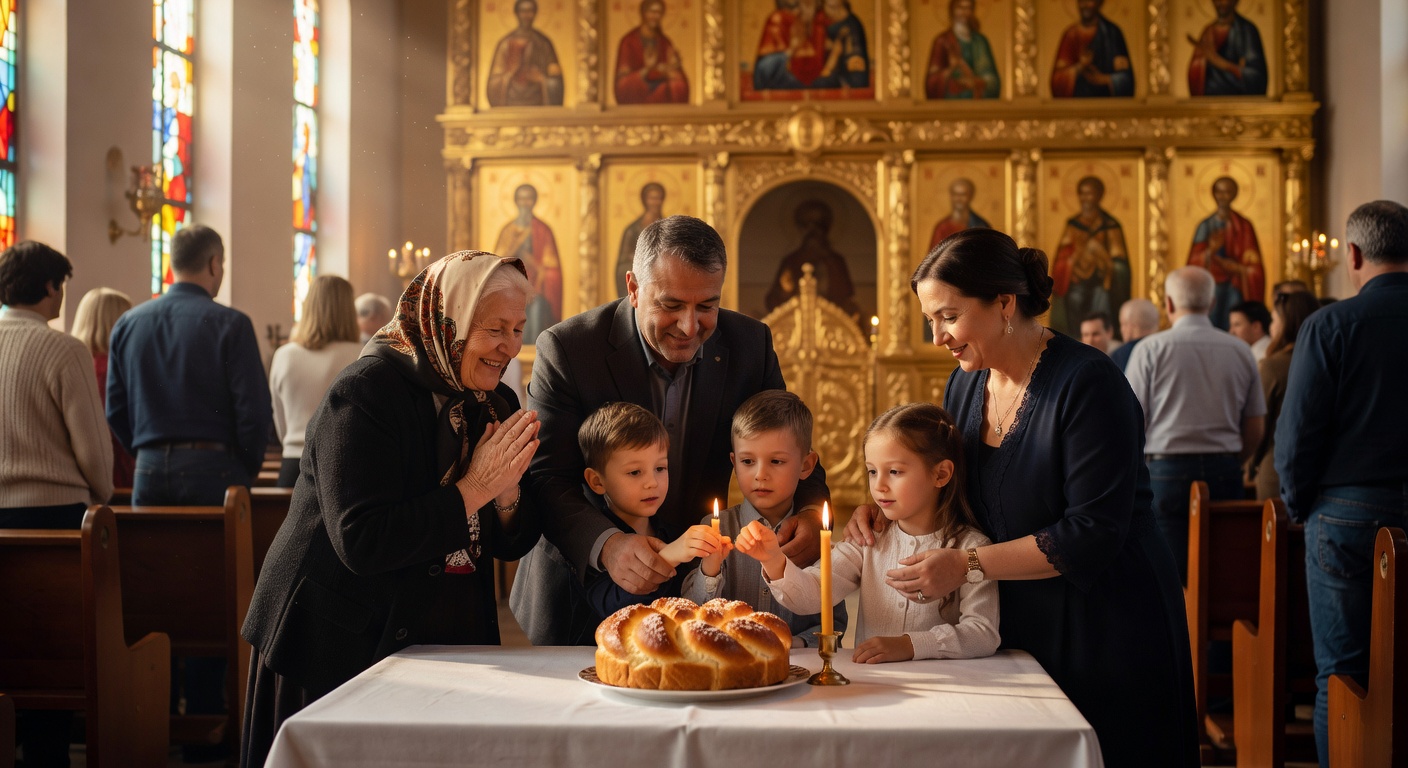
How to Reach Serbian-Speaking Families at Your Church
Stand inside Saint Sava Cathedral in Vračar, Belgrade, on a Sunday morning, and you will hear something most American Christians have never heard: a deep, slow, four-part choir singing the Cherubic Hymn in Old Church Slavonic, voices rising up under the largest Orthodox dome in the Balkans, incense climbing past the icons of Stefan Nemanja and Saint Sava himself. The same chant — note for note — is sung every Sunday in a converted Lutheran sanctuary in suburban Chicago, in a small wooden church on the Iron Range of Minnesota, and in a brand-new parish hall in Phoenix that opened just last year. When a Serbian family walks into your American church, you are meeting people whose worship has held its shape, almost note for note, since the year 1219.
Roughly 200,000 to 350,000 people of Serbian ancestry live in the United States, with the largest communities in Chicago and the surrounding Indiana steel belt, the Pittsburgh and Youngstown corridor, Cleveland, Detroit, New York and northern New Jersey, Los Angeles, Phoenix, Las Vegas, Milwaukee, San Francisco, and the Florida Gulf Coast. Monthly search volume reflects how many Serbian-Americans are looking for a spiritual home: "serbian orthodox church" draws about 5,400 searches a month, "saint sava serbian orthodox church" another 4,400, "st george serbian orthodox church" 3,600, "holy resurrection serbian orthodox church" 2,900, "saint sava church" 1,300, and "serbian church near me" 720. Behind every one of those searches is a real family — a Bosnian-Serb refugee mother who fled Sarajevo in 1992, a second-generation engineer in Pittsburgh who barely speaks Serbian but still drives an hour to slava every November, a recently arrived IT worker from Novi Sad in Phoenix — looking for a congregation that honors their faith, their language, and their story.
This guide will help you understand Serbian families, why Serbian Orthodox worship can feel so different from a typical American service, and how to welcome Serbian-speaking families well — without needing to launch a separate Serbian service from scratch.
Who Are Serbian-Speaking Families in America?
Serbia is a landlocked country of about 6.6 million people in the central Balkans, bordered by Hungary, Romania, Bulgaria, North Macedonia, Kosovo, Montenegro, Bosnia and Herzegovina, and Croatia. But the Serbian-speaking world is much larger than the Republic of Serbia. Serbian is the mother tongue of ethnic Serbs in Bosnia and Herzegovina (especially the Republika Srpska), Montenegro, Croatia (the Krajina region before 1995, the Vojvodina-adjacent Slavonia today), Kosovo and Metohija (especially northern Kosovska Mitrovica and Serbian enclaves like Gračanica), and the Vojvodina region of northern Serbia, which is also home to large Hungarian, Slovak, and Romanian minorities. When you meet a Serbian-American family, ask gently where in the former Yugoslavia they trace their roots — Krajina Serbs, Bosnian Serbs, Montenegrin Serbs, and Vojvodina Serbs each carry distinct family stories, even though they share a language and a Church.
Serbian (српски / srpski) is a South Slavic language closely related to Croatian, Bosnian, and Montenegrin — linguists often call all four together BCMS (Bosnian-Croatian-Montenegrin-Serbian), and they are mutually intelligible. What sets Serbian apart in writing is its use of both the Cyrillic alphabet (the official script) and the Latin alphabet, often interchangeably. Liturgical Serbian uses Cyrillic, and so do most parish bulletins, Bible editions, and the inscriptions inside Serbian Orthodox sanctuaries. If your church prints anything in Serbian — a welcome card, a prayer, even a single word — printing it in Cyrillic alongside Latin tells a Serbian visitor that you have done your homework.
Serbian families came to the United States in four major waves. The first wave (1880-1924) brought economically motivated migrants from Austro-Hungarian-ruled Vojvodina, Lika, and Herzegovina to the steel mills of Pittsburgh, the iron mines of Minnesota's Mesabi Range, the copper smelters of Butte, Montana, and the meatpacking plants of Chicago and Gary, Indiana. The second wave (1948-1965) was Cold-War political — anti-Communist Serbs, Chetniks, royalists, and DP-camp survivors who refused to live under Tito's Yugoslavia. The third wave (1992-1999) was the Yugoslav-wars refugee generation: Serbs displaced from Croatia (Operation Storm, 1995), Bosnia (Sarajevo siege, Srebrenica aftermath), and Kosovo (NATO bombing, 1999 exodus). The fourth wave, ongoing since 2000, is largely an economic-and-professional migration of younger Serbs — engineers, doctors, IT workers, students — drawn to the United States and Canada by opportunity and stability. Each wave brings its own pastoral needs, its own wounds, and its own definition of "home."
Most Serbian-Americans are bilingual or trilingual. Older family members are often most comfortable in Serbian, and many also speak Russian, German, or Italian (depending on which European country they passed through before arriving). Younger generations born or raised in the US are usually fluent in English but still pray, sing, and celebrate slava in Serbian. The single most important thing for pastors to grasp is that for many Serbian Christians, language and Orthodoxy are inseparable from ethnic identity. The Cyrillic prayer their grandmother taught them in Banja Luka is the same prayer they want to whisper at their child's baptism in Cleveland.
Serbian Christianity: Orthodoxy, Slava, and the Eight Centuries of Saint Sava
To understand Serbian Christian families, you have to understand Saint Sava. Born Rastko Nemanjić around 1175, the youngest son of the founder of medieval Serbia, he ran away from his royal upbringing as a teenager to become a monk on Mount Athos. In 1219 he secured autocephaly — self-governance — for the Serbian Church from the Patriarch of Constantinople, becoming its first archbishop. He wrote the first Serbian-language constitution, the first Serbian legal code, and the first Serbian school curriculum. He is, without exaggeration, the founding father of Serbian national, religious, and educational identity. His feast day, January 27, is celebrated as Sveti Sava Day in every Serbian Orthodox parish and Serbian-American school in the world. Knowing his name and his story is the single fastest way to gain trust with a Serbian family.
Today there are several distinct Christian streams in the Serbian community, and a healthy welcoming church should at least be able to recognize them by name:
- Serbian Orthodox Church (Српска православна црква / Srpska pravoslavna crkva) — by far the largest stream, the spiritual home of roughly 85% of all Serbs worldwide. Autocephalous since 1219 (with a few interruptions). Liturgy in Church Slavonic and Serbian. The North American jurisdiction is the Serbian Orthodox Church in North, Central and South America, divided into the Diocese of Eastern America (seated at Saint Sava Cathedral in New York City), the New Gračanica-Midwestern American Diocese (seated at the New Gračanica Monastery near Chicago), the Western American Diocese (seated at Saint Steven's Cathedral in Alhambra, California), and the Diocese of Canada.
- Serbian True Orthodox Church and Old Calendarist groups — small breakaway communities that reject certain post-Vatican II ecumenical dialogues. Mostly relevant in pockets of Cleveland, Chicago, and Toronto.
- Serbian Catholic and Greek Catholic communities — historically tiny but present, especially among Serbs from western Bosnia, Slavonia, and the Bay of Kotor in Montenegro. Some Serbian families are Roman Catholic and identify as Croato-Serbian or Bunjevac.
- Serbian Evangelical and Pentecostal churches — small but growing, especially among second-wave anti-Communist refugees and recent fourth-wave migrants. Notable congregations include Serbian Baptist churches in Chicago and Cleveland, Pentecostal Serbian Romani fellowships, and Adventist and evangelical Serbian missions in Vojvodina that have planted small US daughter congregations.
If your church is welcoming a Serbian family for the first time, gently asking "is your family Orthodox, Catholic, or evangelical background?" is a respectful and useful opening question. The answer will shape what feels like home in your worship — and it will tell the family that you see them as Serbian Christians, not just "another Eastern European family."
Where Serbian-Americans Live (And Why It Matters for Your Church)
Serbian diaspora settlement patterns in the US were shaped by the steel mills, the Cold War, and the Yugoslav wars — in that order. If you serve in any of these metros, there is a real and well-organized Serbian community within driving distance of your sanctuary.
| Metro Area | Serbian Community Profile |
|---|---|
| Chicago, IL / Northwest Indiana | The largest Serbian-American community in the country. Home to New Gračanica Monastery (Third Lake), Holy Resurrection Cathedral, Saint Sava Cathedral in Merrillville, Saint George in Schererville, and dozens of smaller parishes. Strong Lika, Krajina, and Bosnian-Serb roots from steel-era migration. |
| Pittsburgh, PA / Youngstown, OH | Steel-era Serbian community with Saint George Cathedral in Hopewell, Saint Elijah in Aliquippa, and many parishes throughout western Pennsylvania and eastern Ohio. Strong Lika and Herzegovina roots. |
| Cleveland, OH / Akron | One of the oldest and strongest Serbian communities. Saint Sava Cathedral in Parma is a national landmark. The Ohio Serbian community publishes the long-running newspaper Amerikanski Srbobran. |
| Detroit, MI / Windsor, ON | Saint Lazarus Cathedral, Saint George Serbian Orthodox, and a strong Serbian-Canadian community across the river in Windsor. Auto-industry migration roots. |
| New York City / Northern NJ | Saint Sava Cathedral in Manhattan (Diocese of Eastern America seat), Saint Stephen's in Lackawanna, and a growing fourth-wave professional community in Astoria, Bayside, and Bergen County. |
| Phoenix, AZ / Las Vegas, NV | The fastest-growing Serbian communities in the country. Saint George Serbian Orthodox in Phoenix, Saint Simeon Mirotochivi in Las Vegas. Drawn by warm climate, retirement migration, and a thriving professional class. |
| Los Angeles / Alhambra, CA | Saint Steven's Serbian Orthodox Cathedral (Western American Diocese seat), plus parishes in San Diego and the Inland Empire. |
| Milwaukee, WI | Strong Serbian community with Saint Sava Cathedral in West Allis, Holy Resurrection in Milwaukee, and active Serbian heritage organizations. |
| San Francisco Bay Area, CA | Saint Archangel Michael in Saratoga, Holy Trinity in San Francisco, and a growing tech-industry community. |
| Florida (Tampa, Miami, Jacksonville) | Smaller but growing communities, with retirement migration from northern industrial cities and direct fourth-wave arrivals. |
| Minnesota Iron Range / Twin Cities | Historic Serbian settlement in Chisholm, Hibbing, and Eveleth dating to the 1890s mining era. Smaller but deeply rooted. |
If your church is in or near any of these metros, you almost certainly have Serbian families — Orthodox, Catholic, or evangelical — within fifteen minutes of your front door. Most are not actively visiting non-Serbian churches yet. The question is whether your church is ready for them when they do.
Why Serbian Translation Changes Everything
It is tempting to assume that because most Serbian-American families have working English, language is not really a barrier. In daily life — at school, at work, at the grocery store — that is often true. But worship is different. Worship is the language of grief, gratitude, lament, and praise. It is the language a mother prays in when she remembers the cousins she lost in Vukovar. It is the language a grandfather sings in when he remembers his own father chanting Tebe pojem in a stone monastery in Žiča fifty years ago. It is the language a baba whispers over her grandchild at a baptism in Schererville, Indiana, the same way her own baba whispered it in a village outside Banja Luka. English is what Serbians use to live in America. Serbian is what they use to talk to God.
This is where real-time translation transforms welcome from an aspiration into something practical. With Glossa.live, every person in your sanctuary — including the Serbian-speaking grandmother who just arrived from Belgrade two months ago — can hear the sermon, the prayers, the announcements, and the call to respond in their heart language, on their own phone, in real time. No headsets to buy. No interpreter to recruit. No separate service to launch. Just open the app, scan a QR code, and listen.
Glossa supports Serbian, Croatian, Bosnian, Russian, and more than 95 other languages — which means a single Sunday service can include a Serbian-speaking family from Republika Srpska, a Russian-speaking family from Moscow, a Ukrainian family resettled from Kharkiv, a Spanish-speaking family from Mexico, and an English-speaking family from across the street, all hearing the same sermon in the language of their hearts at the same moment. For Serbian families specifically, this means your church can become a place where Serbian matters without your pastor having to learn a new language and without your worship team having to find a Serbian interpreter every week.
If you would like to see how this works in practice, the Glossa embed setup guide walks you through every step — most churches are running in under fifteen minutes.
Cultural Foundations: Eight Things Every Pastor Should Know
Serbian Christian culture is rich, layered, and quite different from typical American evangelical or mainline church culture. These eight points are not the whole story, but they are a meaningful start.
1. Slava Is the Defining Family Tradition
The single most important religious-cultural practice in Serbian Orthodoxy is slava (слава) — the celebration of the family's patron saint, inherited father-to-son for generations. Every Serbian Orthodox family has a patron saint: Saint Nicholas (Nikoljdan, December 19), Saint John the Baptist (Jovanjdan, January 20), Saint George (Đurđevdan, May 6), Saint Demetrius (Mitrovdan, November 8), Saint Michael (Aranđelovdan, November 21), and the Holy Archangel Michael (Mihajlovdan) are among the most common. On the family's slava day, the priest visits the home, blesses the slavski kolač (a beautifully decorated round ritual bread), pours red wine over it in the sign of the cross, and the family hosts an open-house feast with koljivo (boiled wheat with sugar and walnuts) and a candle that burns all day. UNESCO inscribed slava on its Representative List of Intangible Cultural Heritage in 2014. Asking a Serbian family "what is your slava?" is one of the warmest possible greetings.
2. Fasting (Post) Is Central
Serbian Orthodox Christians observe roughly 200 days of fasting per year — far more than most Western Christians realize. Fasting means vegan: no meat, no dairy, no eggs, no fish (with exceptions for fish on certain feast days like Annunciation and Palm Sunday). The major fasts are Časni post (Lent, 48 days), Wednesdays and Fridays year-round, the Apostles' Fast, the Dormition Fast, and the Nativity Fast (Božićni post, 40 days before Christmas). If your church serves food at events, always have a vegan option — and label it clearly. This single act of hospitality tells Serbian families that you have done your homework.
3. The Calendar Is Different
The Serbian Orthodox Church follows the Julian calendar for fixed feasts, which is currently 13 days behind the Gregorian. Christmas (Božić) is celebrated on January 7, with Christmas Eve (Badnji dan / Badnje veče) on January 6 marked by burning the badnjak (oak branch) and the greeting "Hristos se rodi! Vaistinu se rodi!" ("Christ is born! Truly He is born!"). Easter (Vaskrs) follows Eastern Orthodox calculations and is usually a week or so after Western Easter, marked by the greeting "Hristos voskrese! Vaistinu voskrese!" Vidovdan (June 28) is the national-religious memorial of the 1389 Battle of Kosovo and is one of the most emotionally significant days of the year. Knowing these dates and naming them publicly — "happy Božić" or "Christ is risen" in a service announcement — is a small thing that means a great deal.
4. Cyrillic Carries Identity
Serbian is one of the only languages in the world that uses two alphabets concurrently — Cyrillic and Latin. The Serbian Orthodox Church and most cultural institutions consider Cyrillic the proper script of the language, and many Serbian families feel that Cyrillic carries identity in a way Latin does not. If you print even a single welcome word in your bulletin in Serbian, print it in both scripts: "Добродошли / Dobrodošli" (Welcome). This tiny choice tells a Serbian family you understand who they are.
5. Names Carry Stories
Most Serbian surnames end in -ić (pronounced -itch) or -ović / -ević — Petrović, Jovanović, Marković, Nikolić, Stojanović, Đurđević. The ending originally meant "son of" and works like the Scandinavian -son or the Irish O'-. First names often carry deep theological or historical meaning: Marko, Nikola, Stefan, Petar, Jovan (John), Aleksandar, Dušan, Lazar (after Tsar Lazar of Kosovo), Milica, Jelena, Marija, Ana, Sanja, Jovana. A grandfather named Lazar was likely born to parents who wanted to honor the prince-martyr of Kosovo Polje. Treating names carefully — pronouncing them right, asking what they mean, never anglicizing without permission — communicates respect.
6. Sunday and the Saturday Soul Memorial
Serbian Orthodox families often observe zadušnice — memorial Saturdays — several times a year (especially the Saturday before Lent, the Saturdays of Lent, and the Saturday before Pentecost). On these days the family visits the grave of their loved ones, lights candles, and shares koljivo. If a Serbian family at your church seems absent on a particular Saturday morning, they may be at the cemetery. An understanding word the next Sunday — "may their memory be eternal" ("Vječnaja pamjat") — is the right thing to say.
7. Trauma Lives in the Room
Many Serbian-Americans, especially the third-wave refugee generation that arrived between 1992 and 1999, have first-hand experience of the Yugoslav wars: ethnic cleansing, refugee camps, the siege of Sarajevo from the Serbian side, Operation Storm in Croatia (in which 200,000 Krajina Serbs were displaced in 72 hours), the NATO bombing of Belgrade in 1999, and the loss of homes, neighborhoods, and family members on every side of every line. The wars are not history; they are within living memory of every Serbian-American adult over 35. Don't ask probing questions early. Don't bring out a news headline as a conversation opener. Don't ask anyone to explain the Bosnian war or the Kosovo question. Earn the right to hear the story slowly. A trauma-informed pastoral presence is essential.
8. The Kosovo Question Is Sacred Ground
For Serbian Orthodox families, Kosovo and Metohija is not primarily a political question — it is a spiritual and ancestral one. Kosovo is where Saint Sava's Patriarchate of Peć stands, where the medieval monasteries of Visoki Dečani, Gračanica, and the Patriarchate of Peć are UNESCO World Heritage sites, and where the 1389 Battle of Kosovo Polje shaped the Serbian national soul. Every Serbian child grows up reciting the Vidovdan epic poetry. Avoid political opinions on Kosovo independence. Instead, honor the spiritual weight of the place. "Your monasteries are beautiful" is a sentence that lands well. "Why don't you just accept the Kosovo situation" never lands well, no matter how it is meant.
Practical Steps for Welcoming Serbian Families This Sunday
You do not need to be an Orthodox liturgist, a Balkan historian, or a Serbian speaker to welcome a Serbian family. Most of what makes the difference is simple, learnable, and rooted in what your church already does well. Here is a practical starter list.
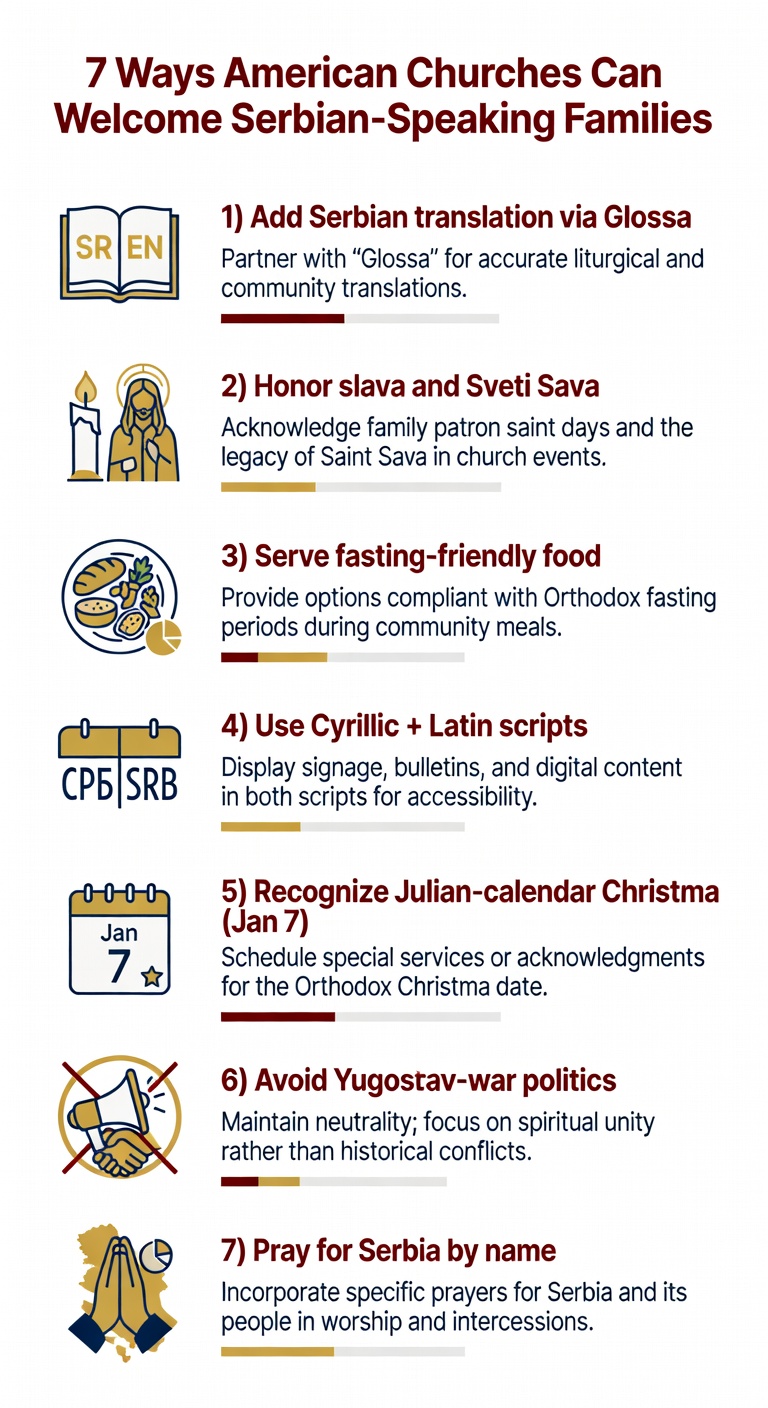
- Add Serbian translation to your service. Use Glossa.live so any Serbian speaker can listen on their phone. Print a small "Translation available — scan here" card in the bulletin and at the welcome table — in both Cyrillic and Latin scripts.
- Learn three Serbian words. Dobrodošli (welcome), Bog vas blagoslovio (God bless you), and Hvala (thank you). Use them with confidence and a smile. You will not pronounce them perfectly. It will not matter.
- Make sure there's vegan food at every fellowship event. Bean stew (pasulj), cabbage rolls without meat (sarma posna), grilled vegetables, bread without butter, fresh fruit. Always have at least one option clearly labeled vegan / fasting-friendly.
- Recognize the Serbian Orthodox calendar. Mention Božić (January 7), Sveti Sava (January 27), Vaskrs (Eastern Easter), Vidovdan (June 28), and the major slava days in your bulletin or service announcements when those dates fall on a Sunday.
- Don't ask about Yugoslav-war politics on the first visit. Bosnia, Croatia, Kosovo, and the 1990s wars are extraordinarily painful and divide families. Stay away from the topic until trust is deep.
- Honor slava when you find out about it. If a Serbian family mentions their slava is coming up, ask which saint, congratulate them with "Srećna slava!" ("Happy slava!"), and ask if you can bring them anything (a fasting-friendly dish is perfect).
- Connect the kids. Many second-generation Serbian-American kids speak only basic Serbian and feel caught between cultures. A youth group that knows their parents' homeland exists — and asks about it — is a gift.
- Pray for Serbia, Republika Srpska, and the Serbian diaspora by name. From the pulpit. Out loud. In English. Let a Serbian family hear their people lifted up in your service. It will mean more than you know.
Building a Serbian-Welcoming Service Without Starting a New Church
One of the biggest myths in immigrant ministry is that welcoming a new language community requires planting a new ethnic congregation. For most Serbian families in most US cities, that is exactly the wrong approach. Most Serbian-American families want both: the dignity and depth of their own Orthodox parish on one hand, and the accessible, English-speaking, multicultural American congregation that meets their kids and their neighbors on the other. Your church doesn't need to replace anything. It needs to make room.
Here is what "making room" looks like in practice for a midsize American church that wants to welcome Serbian families:
- Real-time Serbian audio translation of your sermon and key prayers via Glossa.live, listenable on any phone with no headset purchase.
- Bilingual Scripture reading once a month: a Serbian teen reads the passage in Serbian (Cyrillic script projected on screen), you read in English. Beautiful, simple, costs nothing.
- A Serbian Christmas (Božić) gathering in early January — a small fellowship moment with fasting-friendly food, a reading of the Christmas Eve gospel, and a chance for a Serbian family to share the badnjak tradition.
- A Sveti Sava Day (January 27) educational moment — a brief paragraph in your bulletin about the saint, a prayer for Serbian Orthodox schools and families, and an invitation for Serbian children to share what they learn at their parish school.
- A bulletin column or weekly email feature highlighting a member of your Serbian community — their story, their hopes, their family.
- Quietly building referral relationships with the local Serbian Orthodox parish, Serbian Cultural Center, and any nearby Serbian Sister Days School. You don't need to compete with these spaces; you need to know them.
Common Mistakes to Avoid
- Calling Serbians "Yugoslavian" or "Eastern European generally." Yugoslavia hasn't existed since 1992. Just say "Serbian."
- Assuming all Serbians are Orthodox. A small but real minority are Catholic, evangelical, or atheist. Ask, don't assume.
- Conflating Serbian, Croatian, and Bosnian. They share a language and a region but their religious and historical identities are deeply distinct.
- Bringing up the 1990s wars unprompted. Sarajevo, Vukovar, Srebrenica, Operation Storm, NATO bombing — these are not conversation starters. Ever.
- Treating English fluency as evidence that translation isn't needed. Worship language is heart language, not job language.
- Printing Serbian only in Latin script. Cyrillic is the primary liturgical and identity script. Use both, with Cyrillic first when possible.
- Skipping the slava question. If a Serbian family invites you to their slava, go. Bring a fasting-friendly dish if it falls on a fast day. The invitation is one of the highest honors in Serbian culture.
- Forgetting that the Julian-calendar Christmas is January 7, not December 25. Wishing a Serbian Orthodox family "Merry Christmas" on December 25 is fine and kind, but the real moment is January 7.
Resources for Going Deeper
Three trustworthy starting points for understanding Serbian Christian culture and the post-Yugoslav refugee experience:
- Serbian Orthodox Church in North, Central and South America — the official site of the Serbian Orthodox dioceses in the Americas, with parish locators, calendar of feasts, and pastoral letters.
- UNHCR's regional pages on the Western Balkans offer up-to-date data on Serbian and former-Yugoslav refugee populations and resettlement.
- Lifeway Research provides practical, pastor-friendly studies on welcoming new ethnic groups into existing congregations.
For more on welcoming neighboring Slavic and Eastern European communities, see our companion guides: How to Reach Russian-Speaking Families, How to Reach Ukrainian-Speaking Families, How to Reach Polish-Speaking Families, How to Reach Romanian-Speaking Families, and How to Reach Albanian-Speaking Families.
Worship is the language of grief, gratitude, lament, and praise. English is what Serbians use to live in America. Serbian is what they use to talk to God.
The Bigger Picture: Why This Matters
Serbian Christianity is one of the most resilient unbroken traditions in the church universal. It survived four centuries of Ottoman occupation, during which Serbian monks at Hilandar on Mount Athos and at the Patriarchate of Peć kept the language, the Cyrillic alphabet, and the liturgy alive when Serbian statehood itself ceased to exist. It survived two World Wars, four decades of Communist atheism that closed seminaries and persecuted clergy, and the cataclysm of the 1990s wars in which Serbian families on every side of the new Balkan borders lost homes, churches, and loved ones. It is, by any honest measure, a miracle of perseverance.
When a Serbian family walks into your American sanctuary, they are bringing eight centuries of autocephalous Orthodox faith with them. They are bringing the chant of Saint Sava and the icon-painters of Studenica. They are bringing the slava candles their great-grandparents lit in Lika and Hercegovina. They are bringing the courage to start over in a country that does not know how to pronounce their name. The least your church can do — the best your church can do — is make absolutely sure they can hear, in their own language, that they are welcome here.
Ready to make Serbian welcome on your phone screens this Sunday? Try Glossa.live — free to start, no equipment required, set up in fifteen minutes. Every language spoken in your community deserves to hear the Gospel. Serbian families are waiting to find out if yours is the church that finally says dobrodošli.