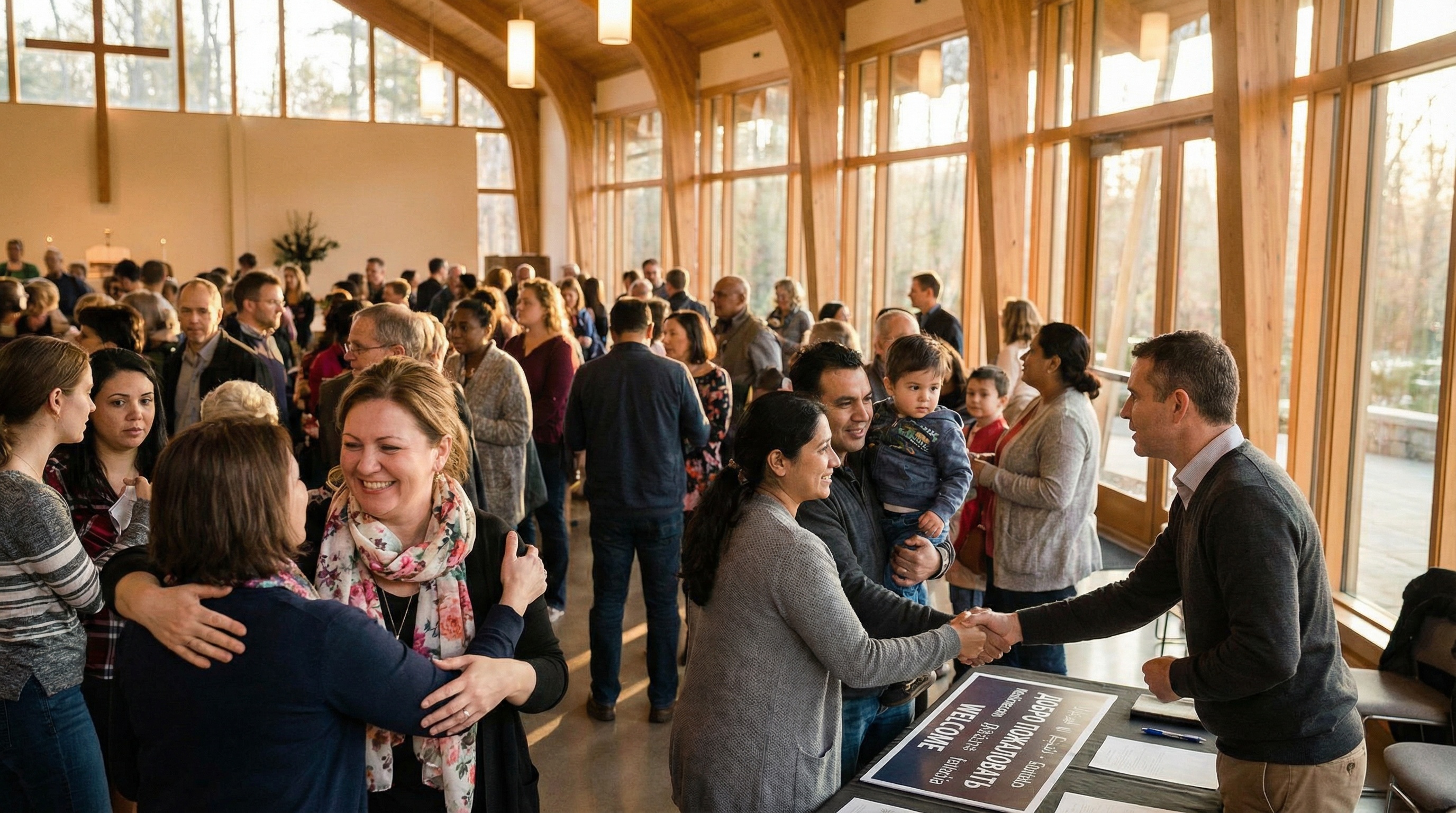
How to Reach Russian-Speaking Families at Your Church
Is your city home to a growing Russian-speaking community? Across the United States, more than three million people speak Russian as their primary language at home—and millions more speak it as a second language, including communities from Ukraine, Belarus, Kazakhstan, Georgia, and other post-Soviet nations. Many of these families are searching for a welcoming church home. But if your congregation only offers services in English, language barriers may be keeping them from walking through your doors.
Russian-speaking families represent one of the most spiritually receptive immigrant communities in America today, yet most churches have no idea how to take the first step. The good news? You don't need a fluent Russian-speaking pastor, expensive interpretation equipment, or years of preparation. With today's real-time translation technology, any church can extend a genuine welcome to Russian-speaking neighbors—starting this Sunday.
In this guide, you'll learn exactly who the Russian-speaking community is, why they're searching for a church home, and the practical steps your congregation can take to reach them in the language that speaks to their heart.
Who Are Russian-Speaking Families in America?
"Russian-speaking" is a broader category than most pastors realize. It includes ethnic Russians arriving through work visas, green cards, or refugee programs; Ukrainian-Americans who grew up speaking Russian alongside Ukrainian; Belarusian and Kazakh immigrants for whom Russian is a native language; and Georgian, Armenian, and Azerbaijani communities that communicate widely in Russian. It also includes Jewish communities from the former Soviet Union, many of whom settled in major US cities in the 1990s.
The Russian-speaking diaspora in America is concentrated in cities like New York, Los Angeles, Miami, Chicago, Seattle, and Sacramento—but communities exist in virtually every major metropolitan area. Many families have lived in the US for 10–20 years and are bilingual, but prefer worship in their heart language. Others are newer arrivals who speak little or no English.
What unites this diverse community is a hunger for authentic spiritual community—and a history of faith that has survived intense pressure. Many Russian-speaking families come from backgrounds where Christianity was practiced quietly under Soviet oppression. For them, worship is deeply meaningful. A church that takes the step of offering services in Russian—or even just Russian translation—signals something important: you are seen, and you are welcome here.
Why Russian-Speaking Families Are Looking for a Church Home
Several factors are driving Russian-speaking families toward evangelical and non-denominational churches in the United States. Faith is central to many immigrant families—for communities that endured religious suppression under Soviet rule, Christianity carries deep meaning. Many arrive in the United States with a sincere desire to practice their faith openly and raise children in a church community.
While the Russian Orthodox Church has a significant presence in the US, many Russian-speaking immigrants—especially younger generations and those from evangelical or Baptist backgrounds—are looking for churches with contemporary worship, community groups, and accessible teaching. Your church may be exactly what they're looking for.
Recent years have also seen significant migration from Ukraine, Russia, and neighboring countries to the United States. Many newly arrived families are navigating significant life transitions and are especially open to community and spiritual support. Without a church that speaks their language, these families often feel isolated from the broader faith community. Offering even basic translation can transform their experience from outsider to belonging.
Understanding this context helps your church extend an invitation that goes beyond words—it shows you've thought about their situation and genuinely care. For a broader view of how churches are making this kind of impact, read about how churches welcome immigrant families.
The #1 Barrier: Language, Not Culture
Ask most pastors why they haven't reached their Russian-speaking neighbors, and the answer is usually the same: "We don't speak Russian." But here's what's worth knowing—you don't have to.
The real barrier isn't culture. Russian-speaking families navigate American life every day. They understand American customs, shop at the same stores, and their kids attend the same schools as your congregation's children. What keeps them from your services isn't cultural unfamiliarity—it's the inability to understand a 45-minute sermon delivered entirely in English.
This is why real-time translation technology is such a game-changer for churches trying to reach immigrant communities. When a Russian-speaking family can open a simple app on their smartphone and hear your pastor's sermon translated live into Russian, the main barrier disappears. They can experience your worship, hear your message, and connect with your community—in the language that moves them most.
According to research from the Barna Group, immigrants who attend churches in their heart language report significantly higher levels of spiritual engagement and sense of belonging. Translation isn't a peripheral accommodation—it's a ministry multiplier.
How Real-Time Church Translation Works for Russian-Speaking Visitors
Many churches assume that offering Russian translation requires expensive hardware, a trained bilingual interpreter on staff every week, or complicated technical setup. In reality, modern AI-powered translation has changed the equation entirely.
Here's how it works in practice: Before the service, your church sets up Glossa.live—a platform that listens to your pastor's microphone feed and translates speech in real time using AI trained specifically on biblical and church-context language. Setup takes minutes and requires no special equipment beyond an internet connection.
During the service, Russian-speaking attendees open Glossa.live on their smartphones and select Russian from a menu of 100+ available languages. They hear the sermon and announcements translated live, through their own earbuds or headphones—without disrupting anyone else in the room.
For churches just getting started, you can learn more about the technical setup by reading how to embed Glossa on your website, which walks through the straightforward process of integrating live translation into your existing worship setup.
Practical First Steps to Welcome Russian-Speaking Families
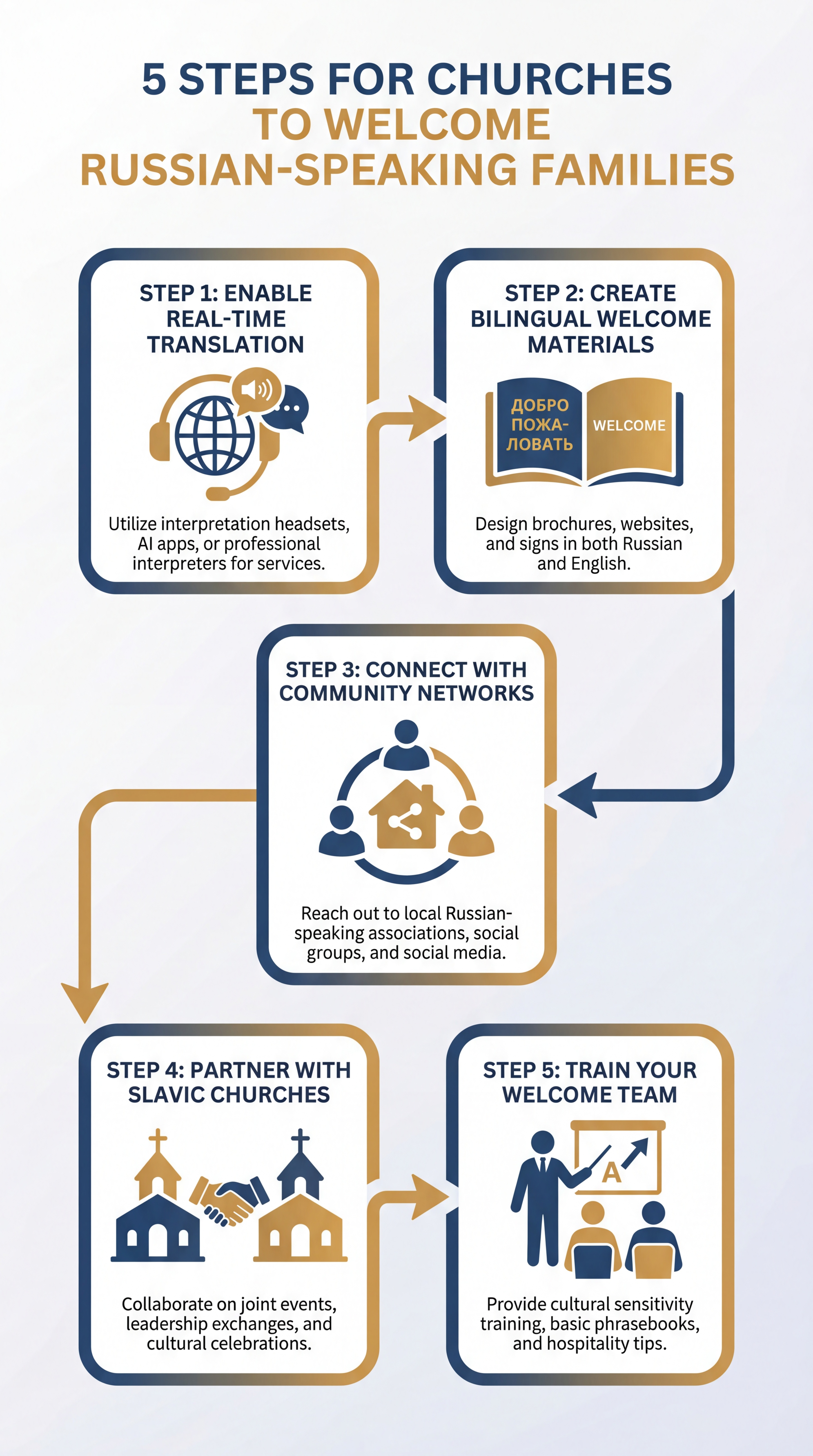
Translation technology is the cornerstone, but reaching Russian-speaking families is also about intentional hospitality. Here are practical steps any church can take:
Step 1: Start with Translation
Enable Russian translation in your services before anything else. When Russian-speaking visitors arrive and discover they can understand the sermon in their own language, it signals that your church is serious about welcoming them. This single step removes the most significant barrier.
Step 2: Create Bilingual Welcome Materials
Print a simple bilingual (English-Russian) welcome card or bulletin insert. You don't need to translate your entire program—just the basics: service times, pastor's name, community group information, and how to access translation on their phone. Google Translate can help you draft a first version, and a Russian-speaking community member can proofread.
Step 3: Reach Out Through Community Networks
Russian-speaking communities often have their own social networks, WhatsApp groups, and community organizations. A simple post in a local Russian-speaking Facebook group or community channel—inviting families to a church that offers Russian translation—can reach people who have been looking for exactly this.
Step 4: Connect with Slavic Church Networks
In many cities, there are established Slavic evangelical churches (Russian Baptist, Ukrainian Pentecostal, etc.) serving these communities. Building relationships with these churches—not as competitors, but as partners in ministry—can open doors for collaboration, referrals, and shared outreach.
Step 5: Train Your Welcome Team
Make sure your greeters, connection volunteers, and children's ministry team know that Russian-speaking visitors may be attending. Brief them on how to guide visitors to the translation app, and encourage them to express a warm welcome even without shared language. A genuine smile and a helpful gesture go a long way across any language barrier.
What to Expect When Russian-Speaking Families Attend
It's worth preparing your congregation for what multicultural worship looks and feels like. When you start reaching Russian-speaking families, a few things may happen. Growth tends to be gradual—the first few families may come because a friend invited them. But as word spreads that your church genuinely welcomes Russian speakers, attendance grows.
Russian-speaking communities are tightly networked. When one family finds a welcoming church, they often bring others. If you serve one Russian-speaking family well, you may find five more arriving in the following weeks. Many second-generation children speak English fluently and will engage naturally with your English children's programming, while their parents may still need Russian translation for adult services.
Many Russian-speaking immigrants have overcome significant hardship. When they experience genuine welcome and meaningful worship, their engagement with the church can be remarkably deep. Don't be surprised if Russian-speaking families become some of your most committed members. Our guide on how to build a multicultural church offers a helpful framework for fostering this kind of deep community.
Common Questions Pastors Ask
Does AI Translation Handle Russian Accurately?
Yes. Modern AI translation—especially platforms like Glossa.live that are trained on biblical and church-context language—handles Russian with high accuracy. Russian is one of the most widely-spoken languages in the world, with robust AI training data. Theological terms like "salvation," "covenant," and common church phrases translate reliably.
What If We Already Have Russian-Speaking Members Who Could Interpret?
Bilingual members are a tremendous asset. However, relying on volunteer interpreters creates challenges: they have to concentrate on interpretation instead of worship, they may not be available every week, and interpretation quality varies. AI translation offers consistent, always-available translation that frees your bilingual members to fully participate in worship themselves.
How Much Does It Cost?
Glossa.live offers flexible, pay-as-you-go pricing—meaning you pay only for what you use. For many smaller churches just beginning to reach Russian-speaking families, the cost is minimal. Our guide on church translation on a budget breaks down the cost comparison clearly.
Should We Offer a Separate Russian-Language Service?
That depends on the size and growth of your Russian-speaking congregation. Many churches start with translation within existing services and organically grow toward a separate or bilingual service as the community grows. Our guide on how to start multilingual church services walks through both approaches in detail.
Getting Started This Week
Reaching Russian-speaking families doesn't require a language degree, a major budget, or a complete overhaul of your worship program. It starts with one simple decision: to remove the language barrier so Russian-speaking families can hear the Gospel in the language that moves them most.
- Enable Russian translation at your next service using Glossa.live—setup takes less than 15 minutes
- Create a bilingual welcome card in English and Russian for first-time visitors
- Identify one Russian-speaking contact in your community who might help spread the word
- Brief your welcome team on how to assist Russian-speaking visitors and point them to the translation app
The Russian-speaking community in your city is searching for exactly what your church offers: genuine community, spiritual meaning, and a place to belong. The only thing standing between them and your congregation is a language barrier—and you now have the tools to remove it.
Start today. Reach more. Welcome everyone.
Try Glossa.live free — real-time translation for Russian, Ukrainian, and 100+ languages. No equipment needed. No technical experience required.