How to Build a Multicultural Church: Practical Steps for Every Pastor
Building a multicultural church isn't just a trend — it's a reflection of what the global church was always meant to be. If your community is becoming more diverse but your Sunday services still feel like they're designed for one culture, you're not alone. Pastors across the United States are asking the same question: how do we build a church that truly welcomes every family, every language, and every background? The good news is that creating a multicultural church doesn't require a massive budget or years of planning. It starts with intentional steps that any congregation can take, beginning this Sunday.
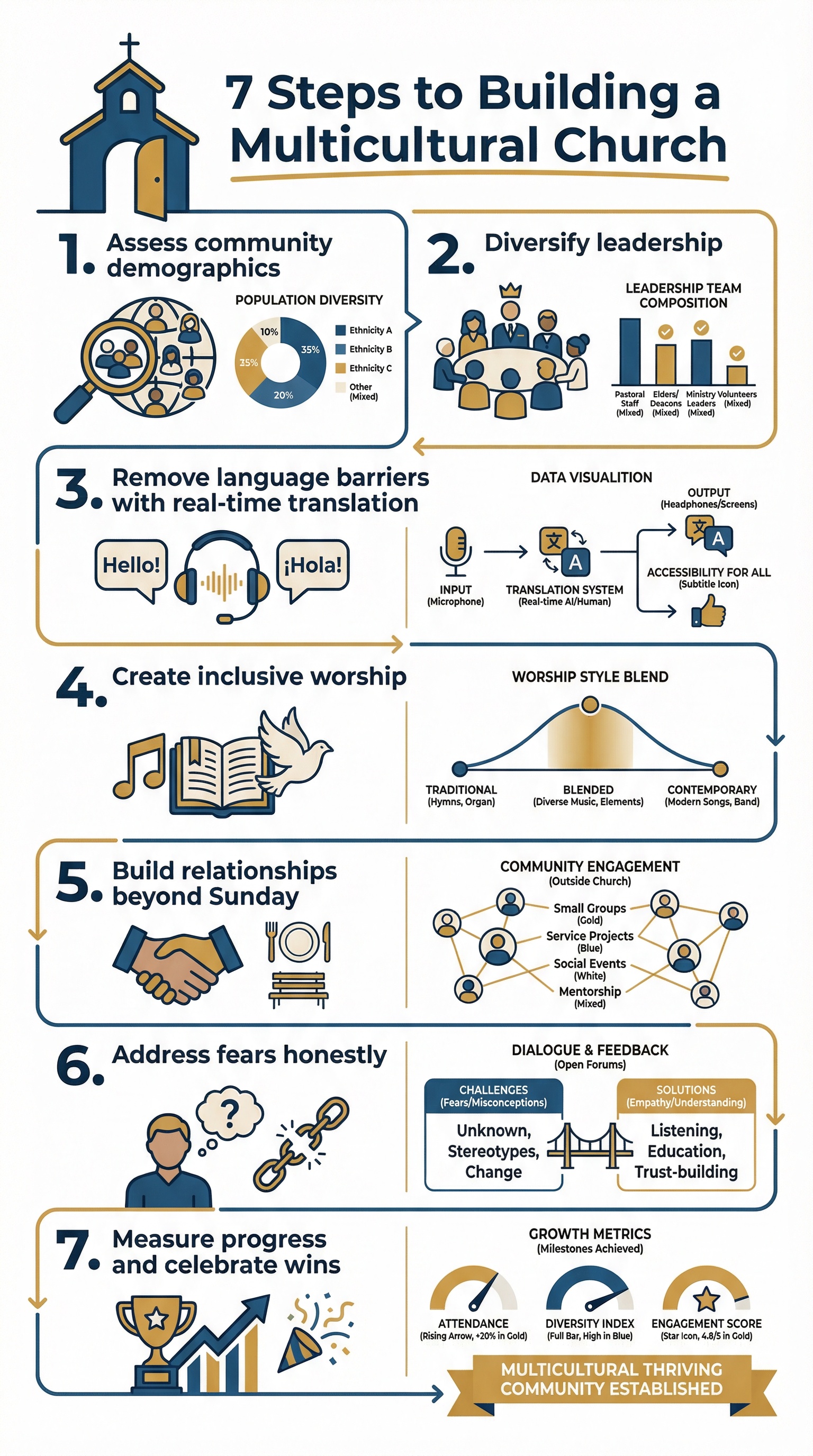
In this guide, we'll walk through practical, proven strategies for building a multicultural church — from diversifying your leadership team to removing language barriers with real-time translation. Whether your community is 20% Spanish-speaking, has a growing Vietnamese population, or serves families from a dozen different countries, these steps will help you create a church where everyone belongs.
Why Building a Multicultural Church Matters Now
The demographics of American communities are shifting faster than many church leaders realize. According to the Pew Research Center, nearly one in four U.S. residents now speaks a language other than English at home. In cities like Houston, Los Angeles, Miami, and Atlanta, multilingual families make up 40-60% of the local population.
Yet many churches still operate as if their community speaks one language and shares one cultural background. The result? Entire neighborhoods go unreached — not because they're uninterested in faith, but because they don't see themselves reflected in the church down the street.
A multicultural church changes that. When families walk in and hear their language, see leaders who look like them, and experience worship that honors their culture, something powerful happens: they feel like they belong. And belonging is the foundation of lasting community.
Churches that have embraced multicultural ministry report remarkable growth. Congregations offering multilingual worship services have seen attendance increase by 30-50%, and retention rates among immigrant families climb even higher. Building a multicultural church isn't just the right thing to do — it's one of the most effective growth strategies available to pastors today.
Assess Your Community's Cultural Landscape
Before you can build a multicultural church, you need to understand who lives in your community. This step is more straightforward than you might think, and it's absolutely essential.
Start with the U.S. Census Bureau's data tools. Search your zip code and you'll find detailed breakdowns of languages spoken, countries of origin, and demographic trends. Many pastors are surprised to discover that their community is far more diverse than their congregation suggests.
Here's a simple framework for your community assessment:
- Languages spoken at home: Which languages beyond English are most common in your area? Spanish, Vietnamese, Mandarin, Korean, Arabic, and Tagalog are among the most widely spoken in U.S. communities.
- Immigrant population growth: Has your community seen significant growth in immigrant families over the past five years? Check census data and local school enrollment records.
- Existing cultural institutions: Are there cultural centers, international grocery stores, or ethnic restaurants nearby? These are indicators of established communities you could reach.
- Other churches serving these communities: Are immigrant families already attending language-specific churches, or are they unchurched entirely?
This assessment gives you a clear picture of who you're trying to reach. And once you see the numbers, the urgency of building a multicultural church becomes undeniable.
Diversify Your Leadership and Worship Team
One of the most common mistakes churches make when pursuing multicultural ministry is treating diversity as a program rather than a priority. Adding a Spanish-language bulletin insert or playing one international worship song per month won't transform your church culture. Real change starts at the top.
Your leadership team should reflect the community you want to serve. That means intentionally recruiting elders, deacons, worship leaders, and volunteers from different cultural backgrounds. When a Korean family visits your church and sees a Korean face on the worship team, or when a Haitian family sees a Creole-speaking greeter, the message is clear: you belong here.
This doesn't happen overnight. Start with these practical steps:
- Identify bilingual members in your existing congregation who could serve in visible roles
- Partner with cultural leaders in your community — invite them to speak, share their story, or lead a prayer in their language
- Create pathways for emerging leaders from diverse backgrounds to grow into formal leadership roles
- Train your existing team on cross-cultural communication and cultural sensitivity
Mark DeYmaz, founding pastor of Mosaic Church in Arkansas and a pioneer in the multiethnic church movement, emphasizes that diverse leadership isn't optional — it's the engine that drives authentic multicultural ministry. Without it, diversity efforts remain surface-level.
Remove Language Barriers with Real-Time Translation
Language is often the single biggest barrier standing between your church and the diverse community around it. A family that speaks primarily Spanish, Vietnamese, or Arabic may feel welcomed by a smile, but they won't stay if they can't understand the sermon.
For decades, the only options were hiring professional interpreters (expensive and logistically complex) or relying on volunteer translators (inconsistent and hard to scale). Today, AI-powered translation technology has changed the game entirely.
Tools like Glossa.live deliver real-time AI translation directly to congregants' phones in 100+ languages — no special equipment, no headsets, and no complicated setup. A Spanish-speaking family simply opens the app on their phone and hears the sermon translated in real time. A Vietnamese grandmother follows along in her language on her tablet. Everyone participates in the same service, together.
This approach solves several problems at once:
- Cost: Real-time AI translation is a fraction of the cost of professional interpreters
- Scale: You can offer dozens of languages simultaneously, not just one or two
- Simplicity: No special equipment means no training, no maintenance, and no technical headaches
- Inclusion: Everyone stays in the same room, experiencing worship together rather than separated into language-specific groups
Churches like Hillsong and hundreds of SBC congregations are already using this approach to reach multilingual communities. If your goal is to build a multicultural church, removing the language barrier is the single most impactful step you can take. Learn more about how to set up multilingual services with our step-by-step guide.
Create Culturally Inclusive Worship Experiences
Multicultural worship goes beyond translation — it's about creating an environment where multiple cultures feel honored and represented. This doesn't mean you need to overhaul your entire worship style. It means making intentional choices that signal welcome.
Here are practical ways to create culturally inclusive worship:
- Incorporate songs from different traditions: Add a Spanish-language worship song, a gospel hymn, or a Korean praise song to your rotation. You don't need to replace your existing style — just expand it.
- Acknowledge cultural celebrations: Mention Lunar New Year, Hispanic Heritage Month, or other cultural observances. Even a brief acknowledgment in a sermon shows cultural awareness.
- Adapt your communication style: Some cultures value direct communication; others prefer storytelling and metaphor. Varying your preaching style makes your message more accessible to diverse listeners.
- Use multilingual elements in the service: A Scripture reading in Spanish, a prayer in Mandarin, or a greeting in several languages creates moments of inclusion that immigrant families remember.
- Display translations on screen: If your church uses projection, adding translated text or captions makes your service instantly more accessible.
The goal isn't to abandon your church's identity. It's to expand it. A multicultural church doesn't lose its character — it enriches it by weaving together the traditions, languages, and worship styles of every family in the community.
Build Relationships Beyond Sunday Morning
The most effective multicultural churches don't just welcome diverse families on Sunday — they build relationships throughout the week. This is where true community forms, and it's often where immigrant families decide whether a church is truly their home.
Consider these relational strategies:
- Host multicultural potlucks and gatherings: Food is a universal language. Monthly potlucks where families share dishes from their culture create natural connection points.
- Offer English language classes: ESL classes are one of the most effective outreach tools for churches serving immigrant communities. They meet a genuine need and create lasting relationships.
- Create affinity groups: Small groups organized by language or cultural background give families a space to connect deeply while remaining part of the larger church family.
- Celebrate cultural events: Host a Día de los Muertos service, a Korean Thanksgiving celebration, or a Vietnamese Tet gathering. These events honor the cultures in your community and draw new families.
- Partner with local organizations: Work with immigrant support organizations, cultural centers, and community groups to serve families holistically — not just spiritually.
Churches that are reaching immigrant communities through real-time translation and intentional outreach consistently report that these relational touchpoints are what turn visitors into members. Technology opens the door; relationships keep families coming back.
Address Common Fears and Challenges
Building a multicultural church isn't without challenges. It's important to acknowledge the concerns that pastors and congregations commonly face — and to address them honestly.
"We'll lose our existing members." Some churches worry that pursuing diversity will alienate their current congregation. Research from Lifeway and other organizations shows the opposite: churches that become more diverse typically retain their existing members while adding new ones. The key is communication and gradual change, not overnight transformation.
"We can't afford it." Multicultural ministry doesn't require a massive budget. Real-time translation technology has made multilingual services affordable for churches of any size. Community events like potlucks and ESL classes cost very little. The biggest investment is time and intentionality, not money.
"We don't know where to start." Start small. Pick one cultural community to focus on first. Invite a bilingual member to help you understand that community's needs. Add one multilingual element to your service this Sunday. Growth happens through consistent small steps, not grand gestures.
"The quality of translation won't be good enough." Modern AI translation, especially tools trained on biblical language and church contexts, delivers remarkably accurate results. Churches using AI-powered tools report that congregants are impressed by the quality — and grateful for the effort.
Becoming a multicultural church means becoming a church of multiple cultures — not just a church where multiple cultures happen to show up. It requires intentionality, humility, and a genuine commitment to honoring every family in your community.
Your First 30 Days: A Practical Action Plan
If you're ready to begin building a multicultural church, here's a practical 30-day plan to get started:
Week 1: Research your community demographics. Use Census data to identify the top 3-5 non-English languages spoken in your area. Talk to local school administrators about the cultural makeup of families they serve.
Week 2: Audit your church. Walk through your building and service with fresh eyes. Would a non-English-speaking family feel welcomed? Are there any multilingual signs, materials, or resources? Identify 3-5 quick wins.
Week 3: Take action on one barrier. Set up real-time translation for your next service using a tool like Glossa.live. Train your greeters to say "welcome" in the top languages of your community. Add a multilingual Scripture reading to your service.
Week 4: Build one new relationship. Visit a cultural center, attend a community event, or invite a leader from an immigrant community for coffee. Listen to their needs and share your vision for a multicultural church.
This isn't about perfection — it's about progress. Every church that's become genuinely multicultural started exactly where you are now: with a first step.
The Vision of a Multicultural Church
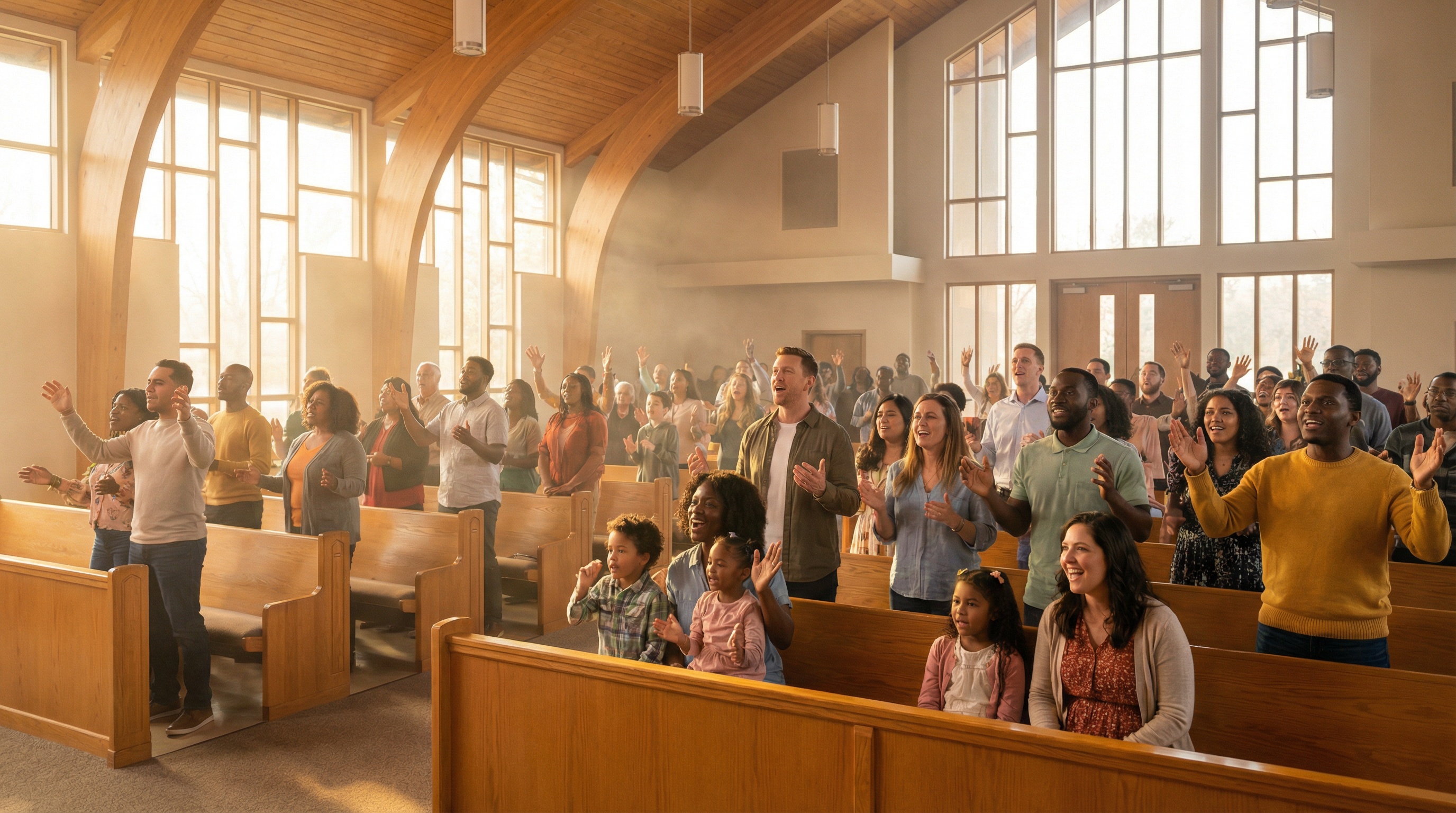
Imagine your sanctuary on a Sunday morning. Families from six different countries sit side by side. A grandmother follows the sermon in Vietnamese on her phone. A young couple reads the lyrics in Spanish as the worship team leads in English. A Haitian family sings along in Creole. After the service, everyone gathers for coffee and conversation — some in English, some in other languages, all in community.
This isn't a dream. Hundreds of churches across the United States are living this reality every week. And with the right tools, the right mindset, and a genuine heart for your community, your church can too.
Building a multicultural church starts with believing that every language spoken in your congregation deserves to hear the Gospel. It continues with practical steps: diversifying leadership, removing language barriers, creating inclusive worship, and building authentic relationships. And it grows — steadily, beautifully — as your church becomes a reflection of the diverse community God has placed around you.
Ready to take the first step? Start by exploring how real-time AI translation can make your next service welcoming for every language in your community. No special equipment needed. No complicated setup. Just a simple, powerful way to say: you belong here.