Church Translation on a Budget: Affordable Solutions for Every Congregation
Your congregation is more diverse than ever. You hear Spanish in the lobby, Vietnamese in the parking lot, Mandarin at the potluck. Yet every Sunday, you deliver your message in one language—and you know families are missing out.
The reason most churches haven't added affordable church translation isn't a lack of desire. It's a fear that translation services are too expensive. And for years, that fear was justified. Professional interpreters can cost $200–$500 per service, and traditional translation equipment runs $5,000– style="min-width: 320px;"5,000 upfront. For a church operating on a tight budget, those numbers feel impossible.
But here's what many pastors don't realize: the landscape has changed dramatically. Today, there are church translation solutions at nearly every price point—including options that cost less than your monthly coffee budget for the welcome team. This guide walks you through every option, from free tools to premium AI-powered platforms, so you can find the right fit for your congregation and your budget.
Why Affordable Church Translation Matters More Than Ever
The need for multilingual ministry isn't a future trend—it's today's reality. According to the U.S. Census Bureau, over 67 million Americans speak a language other than English at home. Many of those families are sitting in your pews, attending your events, and sending their children to your programs. When they can't fully understand the sermon, they may attend—but they never truly belong.
Churches that have added multilingual worship services report significant growth. Congregations offering translation in even one additional language see 30–50% increases in attendance from those language communities. That's not just a number—it's families who finally feel welcomed, understood, and included. Research from Lifeway Research confirms that effective bilingual worship is one of the fastest-growing models in American churches.
The cost of not translating is real, too. Every Sunday that passes without translation is another week where non-English-speaking families silently wonder if this church is really for them. For a ministry built on reaching people, that's a problem worth solving—even on a budget. As we've seen with churches that have embraced multilingual worship and church growth, the return on investment is transformational.
How Much Does Church Translation Actually Cost?
Before exploring solutions, it helps to understand what you're comparing. Church translation costs vary widely depending on the method, and most church leaders overestimate what they'll actually need to spend.
Professional Human Interpreters
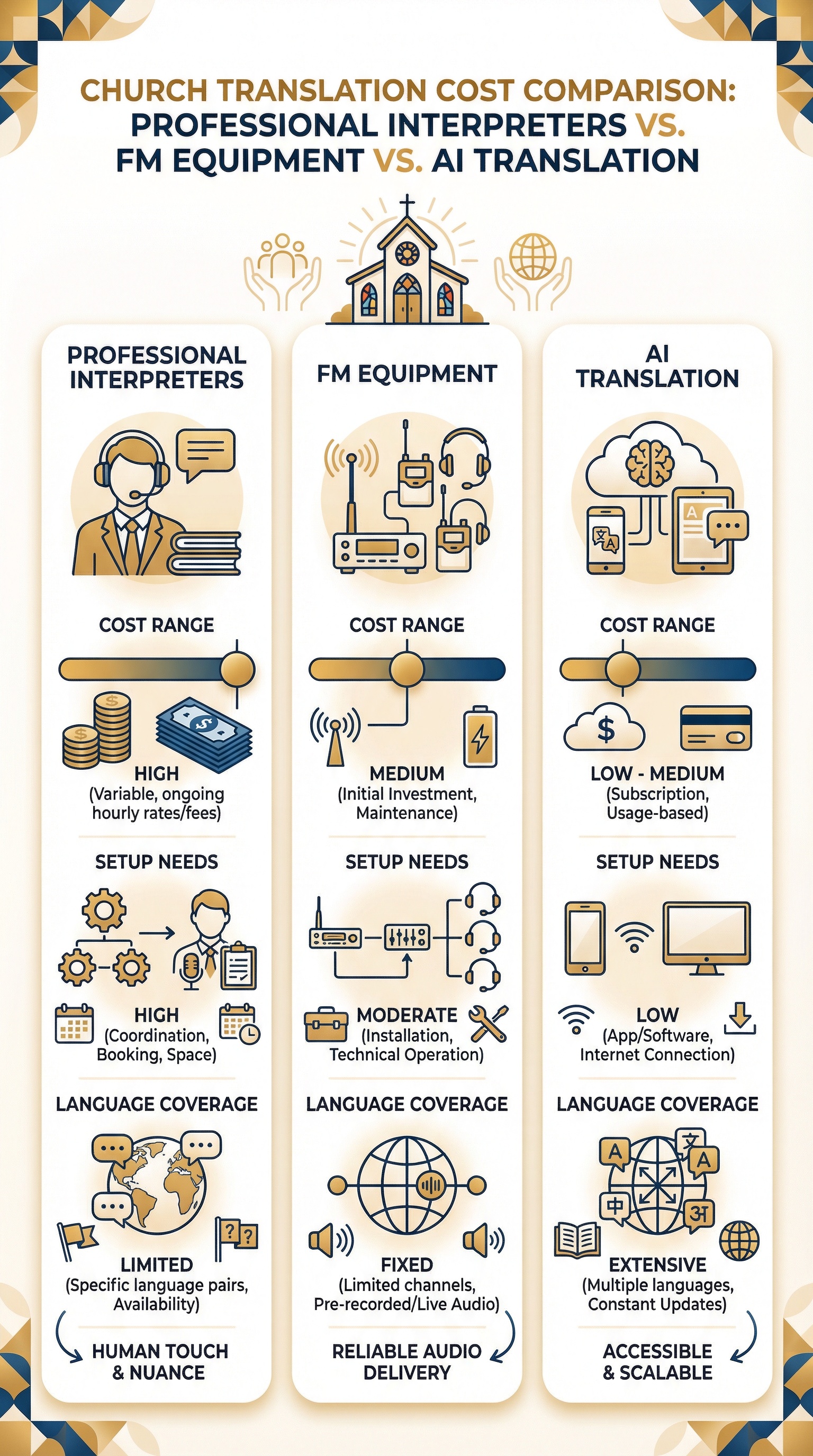
Hiring a live interpreter is the traditional approach. A qualified interpreter typically charges style="min-width: 320px;"50–$500 per service, depending on the language, location, and whether they're providing simultaneous or consecutive interpretation. For a church running two services per week, that's style="min-width: 320px;",200–$4,000 per month—per language.
Add in the logistics of scheduling, backup interpreters for sick days, and the reality that qualified church interpreters are hard to find in many areas, and this option quickly becomes unsustainable for most congregations.
Traditional Translation Equipment
Dedicated translation hardware—FM receivers, transmitter systems, headsets, and interpretation booths—can cost $5,000– style="min-width: 320px;"5,000 for initial setup. Ongoing maintenance, battery replacement, and equipment management add another $500– style="min-width: 320px;",500 per year. If you've looked into what translation equipment your congregation actually needs, you know these systems also require trained volunteers to operate.
AI-Powered Translation Platforms
This is where the budget equation changes dramatically. AI translation platforms like Glossa.live offer real-time translation starting as low as $5 per hour per language, with no equipment to buy and no interpreters to hire. For a church running a single one-hour service in Spanish each week, that's roughly $20 per month.
Monthly subscription plans bring the cost even lower for churches that use translation regularly. Most AI platforms offer plans ranging from $49– style="min-width: 320px;"99 per month, depending on usage and the number of languages.
Cost Comparison at a Glance
| Method | Monthly Cost | Setup Cost | Languages | Effort Required |
|---|---|---|---|---|
| Professional interpreter | $600–$2,000 | None | 1 | High (scheduling) |
| FM equipment system | $40– style="min-width: 320px;"25 (maintenance) | $5,000– style="min-width: 320px;"5,000 | 1–2 | Medium (volunteers) |
| AI translation platform | $20– style="min-width: 320px;"99 | $0 | 100+ | Low (self-service) |
| Free tools (see below) | $0 | $0 | Varies | Medium–High |
Free and Low-Cost Church Translation Options
If your budget is truly zero, you still have options. They come with trade-offs, but they can get you started.
Volunteer Interpreters
Many churches start here—asking bilingual members to volunteer as interpreters. This costs nothing financially, but it has real limitations. Volunteer interpreters tire quickly during long sermons, may not have training in simultaneous interpretation, and can't always commit consistently. It also asks members to serve every single week, which leads to burnout.
That said, volunteer interpreters are a great short-term solution while you build toward something more sustainable. If you're considering this approach, invest in a simple wireless earpiece system ( style="min-width: 320px;"00–$300 on Amazon) so the interpreter can whisper-translate without disrupting the service.
Free Translation Apps
Consumer translation apps like Google Translate offer free real-time translation on any smartphone. A congregation member can hold their phone up during the sermon and read translated captions on their screen. The accuracy is improving but still struggles with theological language, biblical references, and the nuanced vocabulary pastors use.
Free apps work best as a stopgap measure. They're not built for church contexts—they don't understand terms like "sanctification," "fellowship," or "called to ministry" the way a church-specific platform would. But they're free, available today, and better than nothing.
Printed Sermon Summaries
Some churches prepare translated sermon outlines or key point summaries and print them for non-English speakers. This is low-tech and low-cost (just printing costs), but it only captures a fraction of the full sermon experience. Members miss the emotion, the stories, and the real-time connection of hearing the message as it's delivered.
AI-Powered Translation: The Budget-Friendly Breakthrough
The biggest shift in affordable church translation over the past few years has been AI-powered real-time translation. Understanding how AI translation works for church services helps explain why costs have dropped so dramatically.
AI translation platforms use speech recognition to capture the pastor's words, then instantly translate and deliver the message in the listener's chosen language—all through their own smartphone, tablet, or computer. No headsets to distribute. No equipment to maintain. No interpreters to schedule.
Why AI Translation Costs Less
Traditional translation requires paying a skilled human for every hour of every service. AI platforms spread their costs across thousands of churches, making per-church pricing dramatically lower. Once the AI model is trained—including on biblical and theological vocabulary—it can serve unlimited churches simultaneously.
The result is a pricing model that actually makes sense for churches: pay only for the hours you use, or subscribe to a monthly plan that covers all your services. A church that would spend style="min-width: 320px;",500 per month on a human interpreter can get the same language coverage for under style="min-width: 320px;"00 per month with AI.
What to Look For in an AI Translation Platform
Not all AI translation platforms are equal, especially for church use. Here's what matters:
- Biblical vocabulary training. Generic AI translators stumble on theological terms. Look for platforms specifically trained on biblical language and church contexts. When your pastor says "the blood of the Lamb," the translation should be theologically accurate—not a literal reference to animal blood.
- Voice quality. Some platforms deliver translation as text captions, while others offer natural-sounding voice output. Voice translation feels more natural and personal, especially for members who may have limited literacy in their own language.
- Language range. If your congregation speaks Spanish today, it may include Haitian Creole, Arabic, or Burmese tomorrow. Choose a platform that supports 50+ languages so you're ready for whatever your community brings.
- Ease of setup. If it takes an IT team to configure, it's not practical for most churches. The best platforms work on any device with a web browser—no downloads, no apps, no special equipment.
- Integration with streaming. If your church livestreams or records services, look for platforms that integrate with your streaming workflow. For a deeper dive, check out our guide on streaming church services in multiple languages.
How to Choose an Affordable Church Translation Solution
Choosing the right solution depends on your church's size, budget, and the languages your congregation needs. Here's a framework for deciding.
Small Churches (Under 200 Members)
If you have a small congregation with one or two non-English language groups, start simple. A combination of volunteer interpreters for your primary second language and a free or low-cost AI platform for occasional needs keeps costs near zero.
As your multilingual community grows, transition to a pay-as-you-go AI platform. At $5 per hour per language, you can offer Spanish translation every Sunday for about $20 per month—less than most churches spend on bulletin printing.
Medium Churches (200–800 Members)
Medium-sized churches typically have more diverse congregations and more resources. A monthly AI translation subscription ($49– style="min-width: 320px;"49 per month) gives you unlimited or high-volume access to multiple languages. This is where the ROI becomes clear: the cost of translation is a fraction of what you'd spend on any other outreach program that reaches this many new families.
Consider designating a "multilingual ministry coordinator" from your volunteer team—someone who manages the translation platform, promotes it to non-English speakers, and ensures it's set up before each service.
Large Churches (800+ Members)
Large churches often need translation in three or more languages and may run multiple services, campuses, or livestreams. At this scale, a premium AI subscription ( style="min-width: 320px;"50–$300 per month) is still dramatically cheaper than hiring multiple interpreters. Many large churches also benefit from combining AI translation with one or two human interpreters for their largest language groups, creating a hybrid approach that maximizes quality and coverage.
If you're building multilingual services from scratch at a large church, our step-by-step multilingual church services guide covers the full implementation process.
Real Churches Making Translation Work on a Budget
The most convincing evidence that affordable church translation works comes from churches already doing it.
A Small-Town Church Reaches Its Growing Hispanic Community
A 150-member Baptist church in rural Georgia noticed more Spanish-speaking families attending but leaving before the sermon. With no budget for an interpreter, they started with a bilingual volunteer from their congregation who summarized key points in Spanish. Within three months, they transitioned to an AI translation platform at $20 per month. Spanish-speaking attendance grew from 8 families to 27 within six months.
A Suburban Church Adds Three Languages for Under $200/Month
A 500-member nondenominational church in suburban Dallas serves English, Spanish, Korean, and Vietnamese speakers. Rather than hiring three interpreters at $4,500+ per month, they implemented AI translation for all three languages at under $200 per month. Their multilingual worship community has become one of the most vibrant parts of their church.
A Megachurch Saves $40,000 Annually
A 3,000-member church in Houston was spending over $50,000 per year on professional interpretation services for Spanish and Mandarin. By switching to a hybrid model—AI translation for regular services and human interpreters for special events—they reduced costs to under style="min-width: 320px;"0,000 per year while adding Korean, Vietnamese, and Arabic translation. That $40,000 in savings was redirected to community outreach programs.
Every dollar saved on translation costs is a dollar you can invest back into the ministry that translation makes possible—reaching more people in more languages.
Getting Started with Affordable Church Translation
You don't need a big budget, a tech team, or months of planning. Here's how to start reaching your multilingual congregation this week.
- Identify your languages. Walk through your church and listen. Ask your greeters, children's ministry leaders, and small group hosts which languages they hear. You might be surprised by the diversity already present.
- Start with one language. Don't try to launch five languages at once. Pick the language spoken by the largest non-English group in your congregation and start there. Build confidence and momentum before expanding.
- Choose your solution. Based on your budget, pick the approach that fits. Even if that means starting with a bilingual volunteer or a free app, that's progress. You can always upgrade later.
- Promote it. Translation only works if people know about it. Announce it from the stage. Print cards in the target language. Ask bilingual members to spread the word. Put it on your website and social media.
- Evaluate and grow. After a month, check in. How many people are using the translation? What feedback are you hearing? Use what you learn to refine your approach and consider adding more languages.
If you're ready to explore AI-powered translation for your church, Glossa.live offers real-time translation in 100+ languages with no equipment needed—and you can try it free to see how it works for your congregation.
Affordable Church Translation Is Within Reach
Affordable church translation isn't a dream—it's a reality that's available right now. Whether your budget is $0 or $200 per month, there's a solution that can help you reach the multilingual families in your community. The technology exists. The costs have dropped. The only question is whether you'll take the step.
Every language spoken in your congregation deserves to hear the message. And with today's translation options, budget is no longer the barrier—it's just a matter of choosing to start. If you want to learn more about how to build a truly multicultural church, we've got you covered. Your multilingual congregation is waiting.