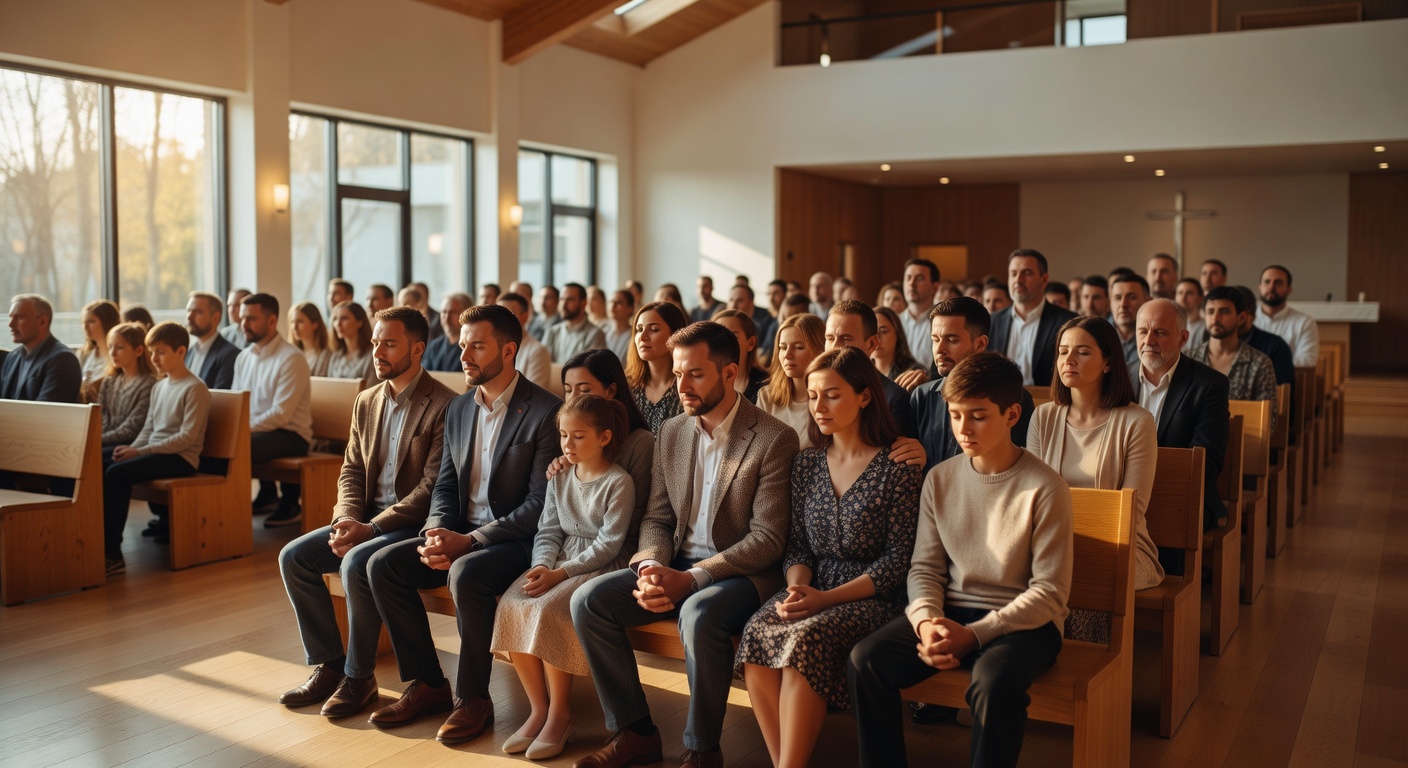
How to Reach Romanian-Speaking Families at Your Church
If you have ever searched for a romanian church near me, you already know how meaningful it is for diaspora communities to worship in their heart language. For the estimated 500,000+ Romanian Americans living in the United States — along with hundreds of thousands more from neighboring Moldova — finding a faith community that truly understands their culture and language is not just a preference. It is a spiritual lifeline.
For American churches that want to grow into genuinely multicultural congregations, Romanian-speaking families represent a remarkable opportunity. They are deeply rooted in faith — Romania is one of the most religiously observant countries in Europe — and they carry a rich tradition of worship, community, and hospitality. The question is: how does your church open the door?
Understanding the Romanian-Speaking Community in America
Romanian immigration to the United States has ebbed and flowed over the past century, with major waves arriving after World War II (political refugees), during the Cold War (defectors and asylum-seekers), and again after the fall of communism in 1989. Today, Romanian Americans are concentrated in cities like Chicago, Detroit, Los Angeles, New York, Cleveland, and Sacramento — but they are present in almost every major metro area.
Romanian is a Romance language closely related to Italian, Spanish, French, and Portuguese — which surprises many Americans who assume it is a Slavic language. In church contexts, this matters: Romanian-speaking families often appreciate when they hear familiar liturgical expressions, but they deeply value services and communications delivered in their own language.
Religiously, Romanian immigrants are predominantly Orthodox Christian (Romanian Orthodox Church), but there are also large and growing communities of Romanian Pentecostals and Romanian Baptists — both of which have thriving church networks in the U.S. Understanding which tradition a family comes from can help your church offer a more tailored welcome.
Why Romanian Families Search for "Romanian Church Near Me"
The number of people searching for a romanian church near me (880 monthly searches) or romanian orthodox church near me (720 monthly searches) tells you something important: Romanian-speaking families are actively looking for communities of faith where they can feel at home. Many are not finding what they need at English-only congregations.
Here are the most common reasons Romanian families search for a church in their language:
- Language barrier in worship — Following a sermon, understanding prayer, and participating in communion all require language comprehension. Worship that stays in the heart language is spiritually deeper for many first-generation immigrants.
- Cultural connection — Romanian worship has distinctive traditions: specific hymns, liturgical rhythms, fasting practices, and community celebrations like Christmas colinde (carols) and Easter midnight services.
- Community and belonging — Church is often the center of Romanian immigrant social life. Families seek a place where they can speak freely, share recipes, celebrate name-days, and support one another through the challenges of building a new life.
- Children and youth ministry — Romanian parents want their children to maintain language and cultural identity. Church is often the primary place where this happens outside the home.
- Trust and safety — In many Romanian communities, especially among refugees or those who experienced the repression of communism, church is associated with trustworthiness, stability, and spiritual safety.
What Romanian-Speaking Families Are Looking for at Your Church
You do not need to be a Romanian church to welcome Romanian families. What matters most is genuine hospitality paired with practical accessibility. Based on what we hear from multicultural ministry leaders across the country, Romanian families tend to look for:
- A warm welcome that does not make them feel like outsiders or token diversity
- The ability to understand worship — sermons, Scripture readings, announcements
- Information available in Romanian (bulletins, newcomer packets, website)
- Leaders who show genuine curiosity about Romanian culture and history
- A pathway to community — not just Sunday services, but fellowship, small groups, and ministry involvement
The single biggest barrier? Language. Many Romanian-speaking families — especially first-generation immigrants or elderly members — do not feel confident enough in English to fully participate in worship. They may understand enough to get by socially, but the depth of a sermon or the intimacy of prayer is lost when it is not in their native tongue.
This is exactly the problem that real-time AI translation for churches was designed to solve.
Using Real-Time Translation to Welcome Romanian Speakers
Glossa.live provides real-time AI translation that streams directly to your congregation members' smartphones. During a service, Romanian-speaking attendees can open Glossa on their phone and read (or listen to) a live translation of the sermon in Romanian — with no extra hardware, no interpreter booth, and no disruption to the flow of worship.
This means that a Romanian grandmother who has been attending your church for years but struggling to follow the message can finally engage fully. A newly arrived couple from Bucharest can walk in on their first Sunday and understand the entire service. A second-generation Romanian-American teenager can bring their grandparents without worrying that the experience will be inaccessible.
Glossa supports Romanian along with 95+ other languages — so the same system that serves your Romanian-speaking members can also reach Spanish, French, Mandarin, Ukrainian, or any other language community in your congregation. You invest in one solution and it serves your entire multilingual church.
For a step-by-step guide on setting up real-time translation at your church, see our article on how to start multilingual church services.
Practical Steps for Romanian Church Outreach
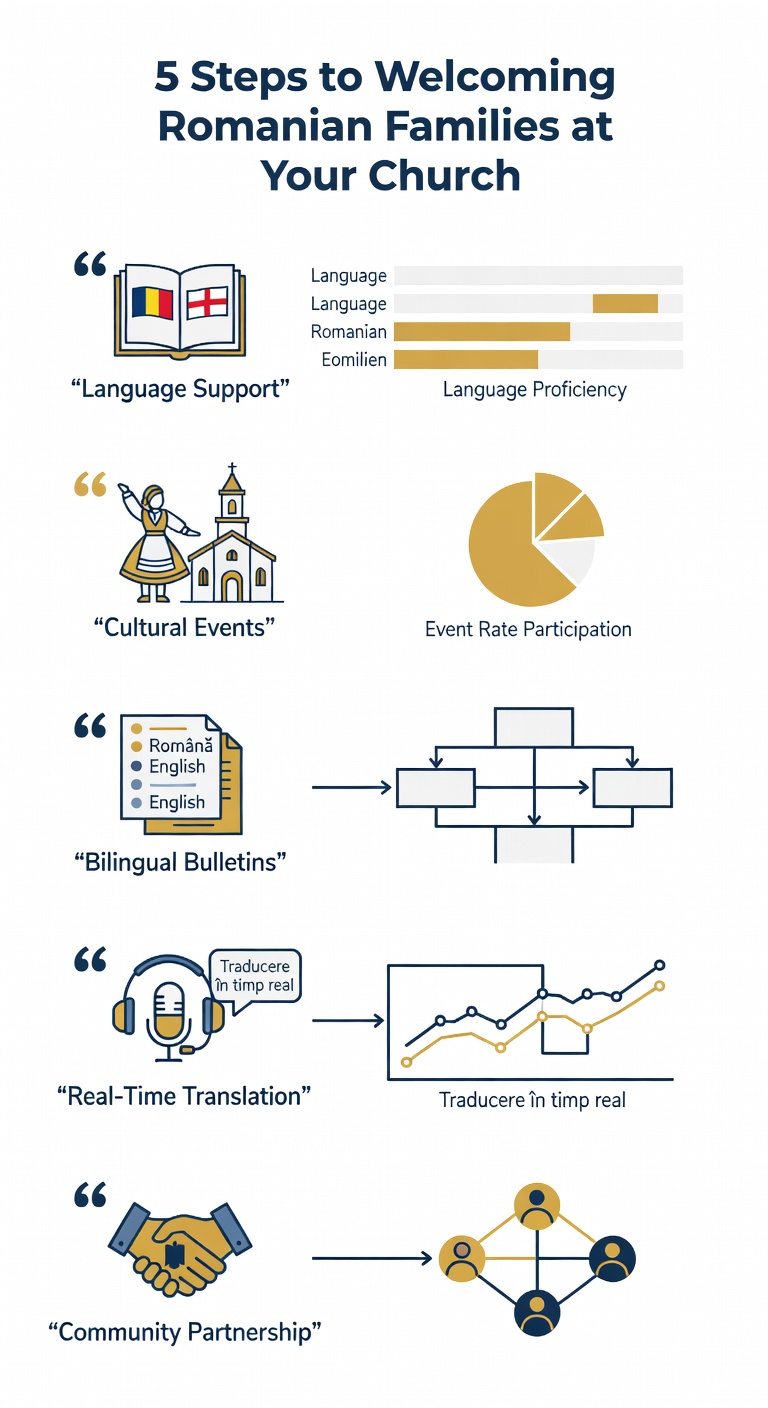
Translation is the foundation, but outreach is a full strategy. Here is a practical framework for welcoming Romanian-speaking families at your church:
1. Research the Romanian Community in Your Area
Before launching any outreach initiative, understand who lives in your community. Use census data, local Romanian Orthodox or Pentecostal church directories, Romanian community associations, and social media groups to get a picture of the Romanian diaspora in your city. This will help you tailor your approach and build genuine relationships rather than generic "outreach campaigns."
2. Build Relationships with Romanian Church Leaders
One of the most effective strategies is to connect with existing Romanian churches — Orthodox, Pentecostal, or Baptist — in your area. Rather than competing for their congregation, look for partnership opportunities: shared community events, joint prayer services, referrals for families who want a more English-oriented environment while still maintaining their Romanian roots.
3. Add Romanian to Your Welcome Materials
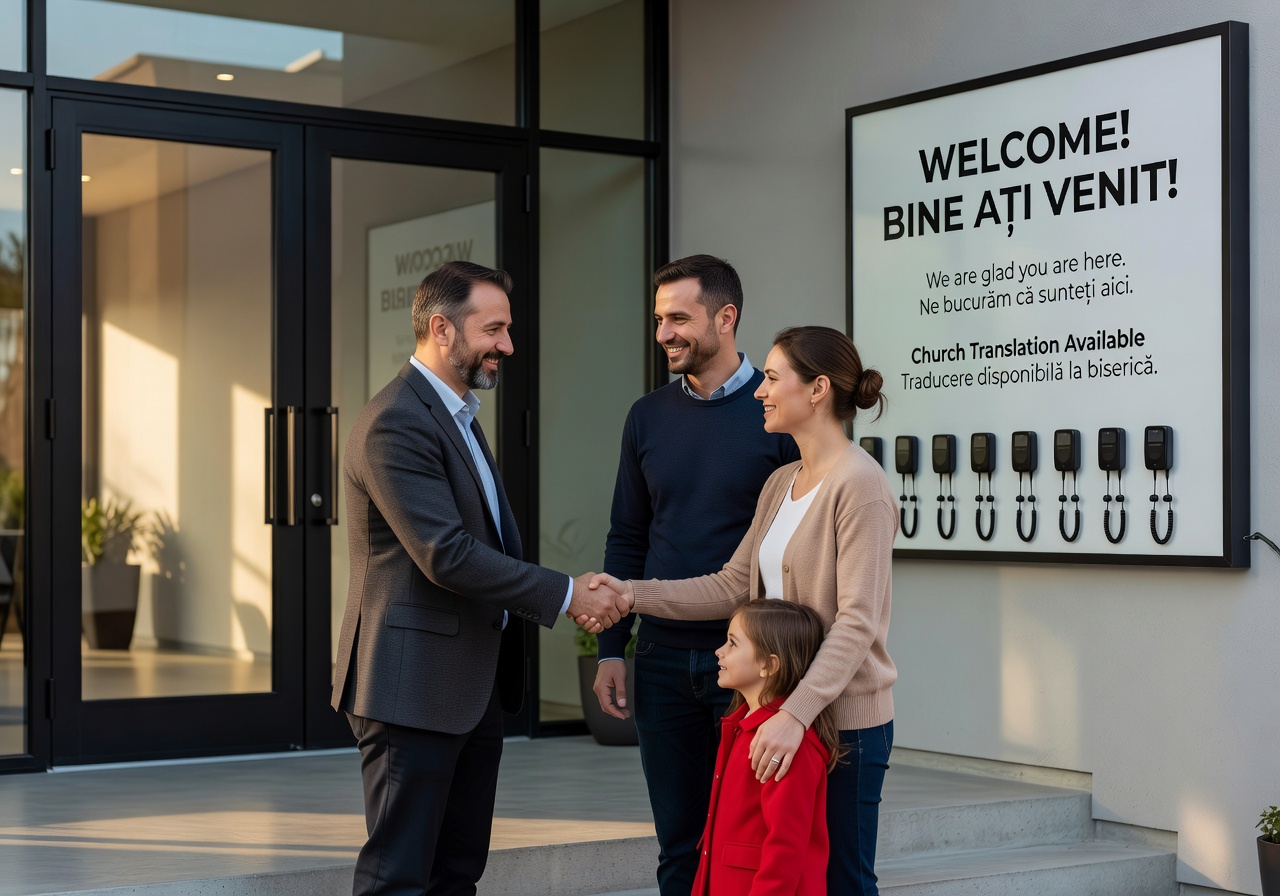
This can be as simple as a bilingual welcome card (English/Romanian) at the entrance, a Romanian-language page on your website, or a short greeting in Romanian at the beginning of your service. These small gestures signal that you see and value Romanian-speaking visitors. Many Romanians are moved when they hear "Bun venit!" (Welcome!) from a pastor or greeter.
4. Deploy Real-Time Translation on Sunday Mornings
Enable Glossa.live so that Romanian speakers can follow along in real time. Announce at the beginning of the service that translation is available — and show a simple QR code slide so visitors can connect instantly. This removes the biggest barrier in one step, and it communicates that your church has invested in making the service accessible to everyone.
5. Host Cultural Events That Celebrate Romanian Heritage
Easter is the holiest celebration in Romanian Orthodox tradition, observed with late-night resurrection services, special foods, and the greeting "Hristos a Înviat!" (Christ is risen!). Christmas brings the tradition of colinde — community caroling that goes door to door. Hosting a multicultural Easter dinner or inviting a Romanian choir to perform during Advent can be a powerful bridge. For ideas on planning inclusive celebrations, see our guide to multilingual worship and church growth.
6. Create a Romanian Language Small Group or Bible Study
For families who are not yet comfortable in all-English settings, a weekly or biweekly Romanian-language small group can be a gentle entry point into your church community. It does not require a full-time Romanian-speaking staff member — a volunteer leader who speaks Romanian, paired with good translated resources, can run an effective group.
Understanding Romanian Denominational Traditions
To build genuine bridges, it helps to understand the main traditions Romanian Christians come from:
| Denomination | Characteristics | Worship Style |
|---|---|---|
| Romanian Orthodox | Largest tradition; liturgical, icon-centered worship; follows Julian calendar for some feasts | Highly liturgical, choral, incense, long services |
| Romanian Pentecostal | Fast-growing globally; emphasis on Holy Spirit, spiritual gifts, evangelism | Contemporary worship, prayer ministry, expressive |
| Romanian Baptist | Strong in Transylvania; emphasis on Scripture, baptism by immersion, congregational governance | Hymn-based, expository preaching, community-focused |
| Romanian Greek Catholic | Byzantine rite in communion with Rome; smaller but present in some U.S. cities | Eastern liturgical with Roman Catholic theology |
Each tradition has distinct worship styles, theological emphases, and cultural expectations. An Orthodox Romanian family may feel initially disoriented in a Pentecostal-style service — and vice versa. Understanding these differences allows your pastoral team to have more informed, respectful conversations with Romanian visitors about their background and what they are looking for.
Success Stories: Churches Bridging the Language Gap
Across the United States, churches of all sizes and denominations are discovering that breaking the language barrier transforms their congregation. When families who were previously sitting through services they could not understand finally hear the Gospel in their language, the response is often deeply emotional.
One pastor serving an urban congregation in Chicago described the moment a Romanian grandmother — who had attended for three years without understanding most of the sermons — first used real-time translation during a Sunday service. "She came up to me afterward with tears in her eyes," he said. "She told me it was the first time she had truly understood a complete sermon in English. She felt like God was speaking directly to her."
This kind of transformation does not require a massive budget or a full-time multilingual staff. It requires the right tools — and a genuine heart to reach every family in your community. To learn more about what breaking language barriers looks like in practice, read our article on overcoming language barriers in church.
Building a Long-Term Romanian Ministry
Welcoming Romanian families is not a one-time campaign — it is a long-term commitment to becoming a church where people of all language backgrounds feel truly at home. As you build relationships with Romanian-speaking members, you will discover natural leaders, gifted worship musicians, passionate evangelists, and faithful intercessors who will enrich your congregation in ways you cannot yet imagine.
Here are a few longer-term investments worth considering:
- Hire or train a Romanian-speaking ministry coordinator — even part-time — to shepherd the growing community
- Partner with Romanian community organizations — cultural associations, Romanian schools, immigrant services — to become a trusted community hub
- Offer English classes or immigrant support services at your church, which creates natural entry points for Romanian families who may not initially come for Sunday worship
- Celebrate Romanian language and culture visibly — include a Romanian flag among your multicultural décor, feature Romanian music during special services, and acknowledge Romanian national holidays in your bulletins
- Equip your whole congregation with cultural competence — a brief teaching series on global Christianity and diaspora communities can build empathy and curiosity across your church
The investment is real, but so is the reward. Romanian families who find a true church home become some of the most committed, generous, and missionally-oriented members of any congregation. Their experience of navigating language and cultural barriers gives them a powerful empathy for others who are new — and that spirit spreads.
Getting Started Today
You do not need to wait until you have a full strategy in place. Here are three things you can do this week to begin reaching Romanian-speaking families at your church:
- Enable real-time translation — Set up Glossa.live so Romanian speakers can follow along in their language starting this Sunday. It takes less than 10 minutes to get started.
- Add a Romanian greeting — Coach your greeters and welcome team to say "Bun venit!" to Romanian-speaking visitors. It costs nothing and communicates everything.
- Research your local community — Spend 30 minutes this week finding out how many Romanian families live within 10 miles of your church. The numbers may surprise you.
Reaching a Romanian church near you — or becoming the church where Romanian families find their home — starts with a simple decision: to value every language, honor every culture, and remove every barrier that keeps people from hearing the Good News.
For more on how technology is making multilingual ministry possible for churches of all sizes, explore our guide on AI translation for church services. And if you are ready to embed real-time translation into your worship experience, see our article on how to embed Glossa.
"Every tribe and language and people and nation" — Revelation 5:9. The Romanian-speaking families in your community are part of that vision. The tools to reach them have never been more accessible.