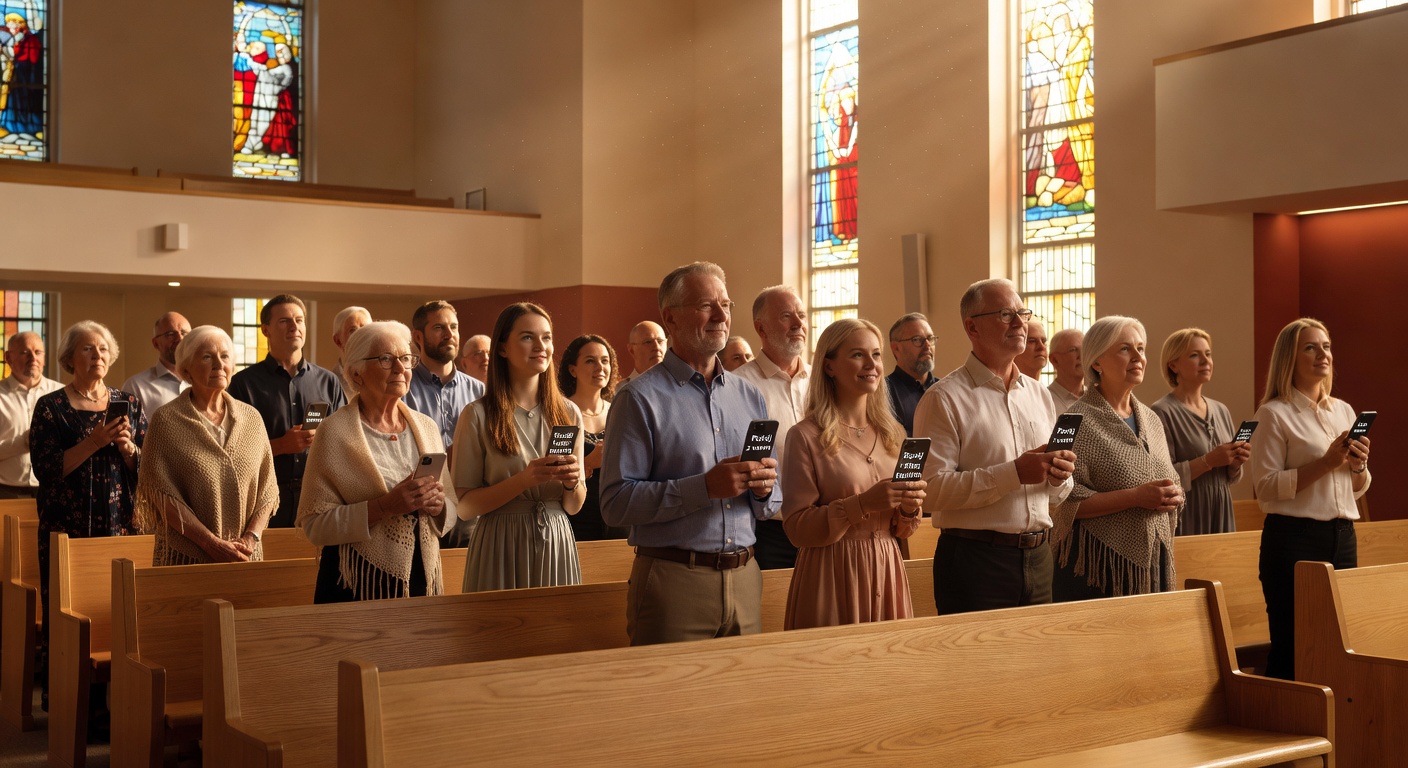
How to Reach Polish-Speaking Families at Your Church
When a Polish family visits your church for the first time, chances are they already believe in the God you worship. Poland is one of the most Catholic nations on earth, and Polish immigrants in the United States carry a profound faith tradition that stretches back more than a thousand years. They may know the liturgy by heart — in Polish. They may have memorized the Our Father before they could read. What they often lack is not faith, but a church home where their language is welcomed alongside their neighbors'. Reaching Polish-speaking families at your church is not about evangelism from scratch. It is about removing the language barrier that keeps deeply faithful people from feeling at home in your congregation.
An estimated 9.15 million Americans claim Polish ancestry, making Polish-Americans one of the largest European heritage groups in the country, according to the U.S. Census Bureau. Cities like Chicago, New York, Detroit, Pittsburgh, Philadelphia, and Milwaukee have vibrant Polish communities — many with their own parishes, cultural centers, and Saturday schools. But as older Polish parishes close and younger generations drift toward English-speaking congregations, a growing number of Polish families find themselves between two worlds: not quite ready to worship entirely in English, yet without a nearby parish that serves them in Polish. Real-time AI translation can bridge that gap, making your church accessible to Polish-speaking families this Sunday.
Why Polish-Speaking Families Are Looking for a Church Home
Poland's Christian heritage runs deep. The nation's baptism in 966 AD under Mieszko I marks one of the founding moments of Polish identity. For over a millennium, Catholicism and Polish culture have been inseparable — through partitions, Nazi occupation, and Communist rule, the Church remained the bedrock of Polish life. When Pope John Paul II became the first Polish pope in 1978, it was not just a religious event; it was a national awakening that helped spark the Solidarity movement.
Polish immigrants carry this heritage with them. For a Polish grandmother, the rosary is as essential as breathing. For a young Polish family recently arrived in the U.S. on a work visa, finding a church that feels like home is one of the first things they do. But the reality of immigrant life means that the closest Polish-language parish may be an hour away, or the local one may have closed due to declining attendance as younger generations moved to the suburbs.
That is the opening for your church. If you can offer a warm welcome and a way to hear the sermon in Polish, you become the answer to a prayer that Polish family has been saying since they arrived.
Who Are the Polish-Speaking Families Near You?
The Polish-American community is layered and diverse. Understanding these layers helps you serve them more effectively.
- Recent immigrants and visa holders: Many Poles arrived in the U.S. on work visas, particularly in trades like construction, trucking, healthcare, and IT. They are often young families with school-age children adjusting to American life while maintaining strong ties to Poland.
- The post-1989 wave: After the fall of Communism, a significant wave of Polish immigrants arrived in the 1990s and 2000s. Many are now middle-aged, well-established, bilingual — but still deeply Polish in their faith and cultural identity.
- Heritage Polish-Americans (third and fourth generation): Concentrated in the Midwest and Northeast, these families may not speak fluent Polish but attend Polish festivals, celebrate Wigilia (Christmas Eve), and feel a strong emotional connection to their roots. Some are rediscovering the language through heritage classes.
- Polish National Catholic Church members: The PNCC, founded in 1897 by Polish immigrants in Scranton, Pennsylvania, is a uniquely American denomination with about 60 parishes across the U.S. Some members move to areas without a PNCC parish and look for alternative worship communities.
- Polish seasonal and temporary workers: Some Polish workers come to the U.S. on seasonal visas and return home after several months. During their time in America, they seek out a place to worship on Sundays.
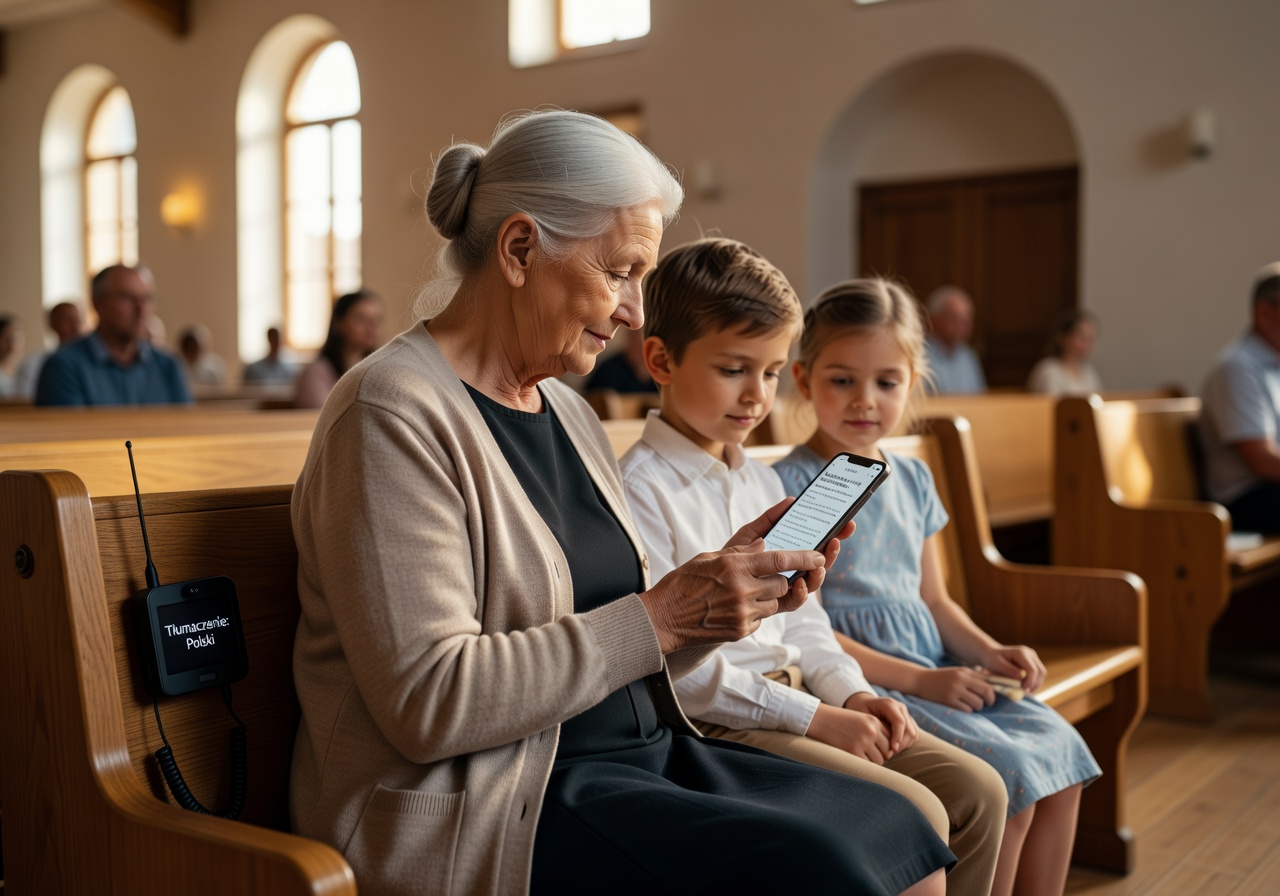
Real-Time Polish Translation: How It Works in Your Church
Traditionally, offering Polish translation at a service meant finding a bilingual volunteer willing to whisper translations to a small group, or hiring a professional interpreter with earpiece equipment. Both approaches are expensive, unreliable, and difficult to scale. Today, AI-powered real-time translation eliminates all of those barriers.
Here is how it works with Glossa, the AI translation platform built specifically for churches. Your pastor preaches in English as usual. As the words are spoken, Glossa transcribes and translates the sermon into Polish — instantly. Any Polish-speaking attendee can open the service link on their phone, choose Polish, and read the translated text in real time or listen to a natural-sounding Polish audio translation. No headsets. No extra volunteers. No equipment at all.
Glossa supports over 100 languages simultaneously, so if your church also has Spanish, Korean, or Vietnamese speakers, everyone can follow the same sermon in their own language at the same time. For the full technical walkthrough, see our guide on how AI translation works for church services.
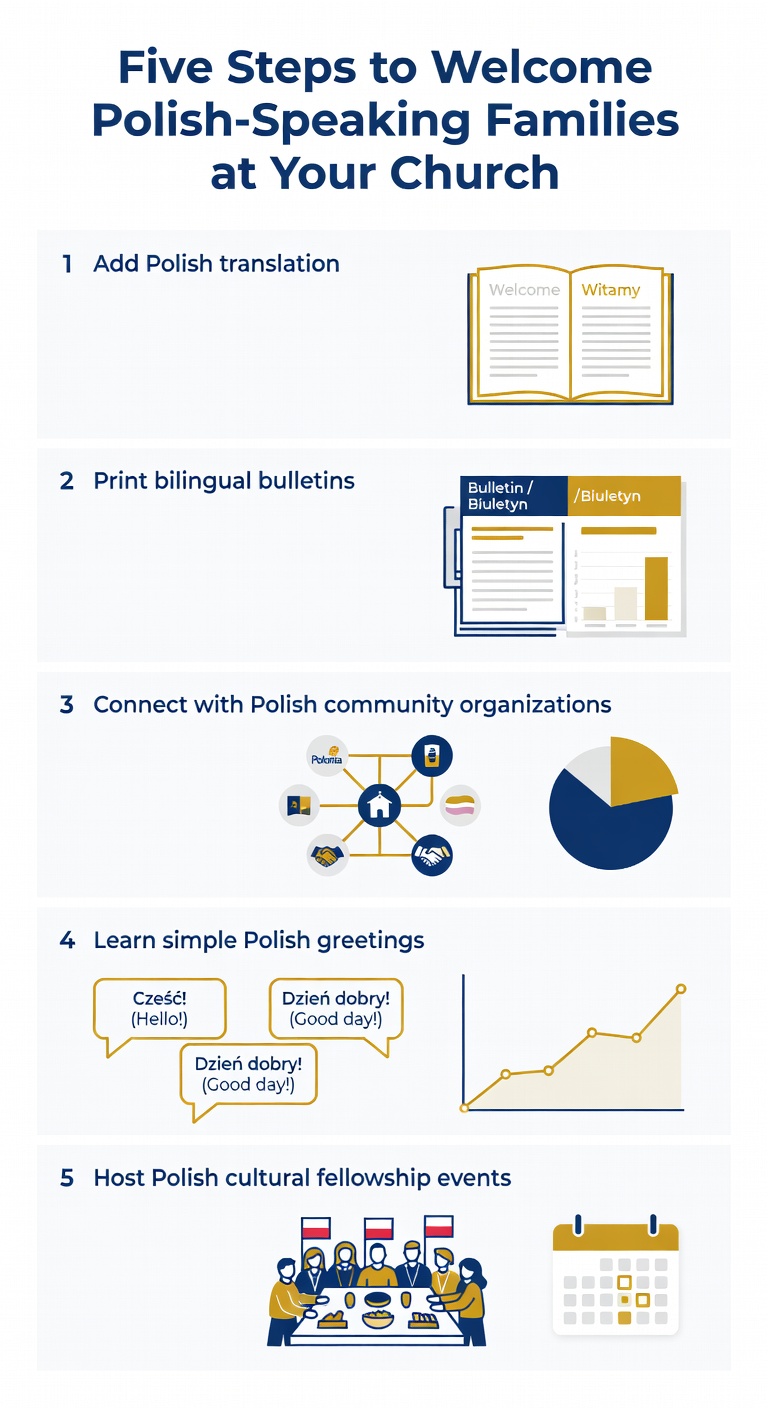
Six Practical Steps for Reaching Polish Families at Your Church
You do not need a six-month plan. These steps can be implemented in weeks, not months.
1. Add Polish Translation to Your Sunday Service
Start with your primary worship gathering. With Glossa, adding Polish translation takes minutes — not weeks. Once activated, any attendee can open the translation link on their personal device and follow along in Polish. Even if only one Polish family attends, this gesture communicates volumes: we prepared for you.
2. Print a Bilingual Welcome Card
Create a simple card in English and Polish with the church name, service times, WiFi password, the Glossa translation link, and a warm welcome message. Something as simple as Witamy w naszym kościele! Jesteś tu mile widziany. (Welcome to our church! You are warmly welcomed here.) can make a powerful first impression. Place the card at the welcome desk and hand it directly to visitors who speak Polish.
3. Connect With Local Polish Organizations
Nearly every major Polish-American community has a Polish-American Congress chapter, a Polish Saturday school (Polska Szkoła Sobotnia), or a Polish cultural center. Reach out and let them know your church offers worship accessible in Polish. Post a flyer at the Polish deli or grocery store. Many Polish communities maintain active Facebook groups — a respectful post about your multilingual worship offering can reach hundreds of families overnight.
4. Learn a Few Polish Greetings
Train your greeters to say three phrases: Dzień dobry (Good day), Witamy (Welcome), and Niech będzie pochwalony Jezus Chrystus (Praised be Jesus Christ — the traditional Polish Catholic greeting, to which the response is Na wieki wieków, Amen). Even imperfect pronunciation will delight a Polish visitor. It shows effort, respect, and genuine warmth.
5. Acknowledge Polish Liturgical Traditions
Polish Christians observe certain traditions with deep devotion. Wigilia (Christmas Eve supper) with the sharing of the opłatek wafer is the most sacred family moment of the year. The blessing of Easter baskets (Święconka) on Holy Saturday is a beloved custom. Gorzkie Żale (Bitter Lamentations) is a uniquely Polish Lenten devotion. You do not need to adopt all of these, but acknowledging them — perhaps by sharing opłatek at a Christmas fellowship or inviting Polish families to bring Easter baskets for a blessing — creates a bridge between your church and their heritage.
6. Host a Polish Heritage Fellowship Event
Once a quarter, host a fellowship event that celebrates Polish culture. Serve pierogi and bigos. Play Polish hymns. Invite a Polish family to share their story. Read a passage of Scripture in both English and Polish. These gatherings do not need to be elaborate — a potluck after service with intentional Polish touches is enough to tell families: your identity is welcome here, not just your attendance.
Understanding Polish Faith Culture: What Makes It Unique
Polish Catholicism is not generic European religion. It is a cultural force that shaped a nation through centuries of foreign occupation. Understanding a few key elements will help your church connect authentically with Polish families.
First, Marian devotion runs extraordinarily deep. The Black Madonna of Częstochowa (Matka Boska Częstochowska) is the spiritual heart of Poland. Many Polish homes have a small image of the Black Madonna. If your church is Protestant, you do not need to adopt Marian devotion, but understanding its importance helps you appreciate where Polish families are coming from spiritually.
Second, community and family are inseparable from faith. In Poland, the parish is the center of social life. Baptisms, First Communions, weddings, funerals — all mark not just spiritual milestones but community celebrations. A Polish family looking for a church is also looking for a community where their children can grow up surrounded by faith.
Third, respect for clergy is deeply embedded. Polish parishioners generally show great deference to their pastor. A personal welcome from your pastor — even a brief handshake and a few words in Polish — carries enormous weight.
Polish vs. Other Slavic Languages: Getting Translation Right
Polish is a distinct West Slavic language, closer to Czech and Slovak than to Russian or Ukrainian. Do not assume a Polish speaker can understand Russian or vice versa — the languages are related but not mutually intelligible in conversation. If your church already offers Russian or Ukrainian translation, adding Polish is not redundant; it is essential for Polish-speaking families.
With Glossa, you can offer Polish, Russian, Ukrainian, Czech, Slovak, and any other Slavic language simultaneously. Each attendee simply selects their language on their own device. This is particularly useful in churches that serve mixed Slavic communities — a common reality in cities like Chicago, where Polish, Ukrainian, and Russian speakers often live in overlapping neighborhoods. For a closer look at serving Russian-speaking neighbors alongside Polish ones, see our guide on reaching Russian-speaking families at your church.
Where Polish-Speaking Families Are Concentrated
While Polish-Americans live across the country, the densest communities are concentrated in specific metro areas. Knowing where they are helps you assess the opportunity near you.
- Chicago, IL: The largest Polish population outside Warsaw. Neighborhoods like Jackowo, Avondale, and Niles have thriving Polish businesses, churches, and schools.
- New York metro area: Greenpoint in Brooklyn was historically the Polish capital of the East Coast. Maspeth, Ridgewood, and parts of New Jersey also have significant Polish communities.
- Detroit, MI: Hamtramck and Dearborn have deep Polish roots. Polish churches like St. Florian and Sweetest Heart of Mary are local landmarks.
- Pittsburgh, PA: The Polish Hill neighborhood and South Side have served Polish immigrants since the 1800s.
- Philadelphia, PA: Port Richmond and Bridesburg remain Polish strongholds with active parishes and cultural societies.
- Milwaukee, WI: The South Side Polish community sustains one of the country's most vibrant Polish Fests.
- Connecticut and Massachusetts: Towns like New Britain, CT and Chicopee, MA have significant Polish populations tied to the manufacturing history of New England.
Even outside these traditional centers, Polish families are everywhere. A church in suburban Dallas, a small town in Georgia, or a fast-growing community in Arizona may discover Polish speakers who have been worshipping in silence because no one thought to offer translation.
Common Concerns When Adding Polish Translation
Will AI translation handle theological language accurately?
Polish is a richly inflected language with complex grammar, and theological terminology adds another layer. Platforms trained on biblical and worship content — like Glossa — handle scripture references, theological terms, and sermon language well. The translation is not perfect (no translation is), but Polish-speaking attendees consistently report that imperfect real-time translation is vastly better than no translation at all.
What if we only have one or two Polish families?
Start anyway. With AI translation, there is no minimum audience size — the cost is the same whether one person or one hundred use the Polish channel. More importantly, once your church appears in searches for terms like Polish church near me, more families will find you. Word of mouth in Polish communities is powerful; one family's positive experience becomes a personal invitation to five more.
Is it worth it if our Polish members speak some English?
Absolutely. Many Polish immigrants speak conversational English but struggle to follow a fast-moving sermon with theological vocabulary and cultural references. Offering Polish translation is not about language proficiency — it is about spiritual accessibility. People absorb, reflect, and pray most deeply in their heart language. If your church offers the option, families will use it. For more context on the cost question, see our honest breakdown of affordable church translation options.
When I heard the pastor's words in Polish on my phone, I felt like God was speaking directly to me — not through a translator, but heart to heart. That Sunday, I knew this was our church.
How to Get Started This Week
You can welcome Polish-speaking families into your congregation starting this Sunday. Here is the simplest path forward:
- Today: Visit Glossa and create a free account. Add Polish as a target language for your next service.
- This week: Print bilingual welcome cards in English and Polish. Share the translation link in your bulletin and weekly email.
- Next Sunday: Announce from the pulpit that Polish translation is now available. Invite attendees to share the link with Polish-speaking friends and family.
- This month: Contact your nearest Polish cultural center, Polish Saturday school, or Polish-American Congress chapter and let them know your church offers worship accessible in Polish.
- This quarter: Plan a Polish heritage fellowship event — a potluck with pierogi, a Scripture reading in Polish, and a moment to honor the traditions Polish families bring to your community.
If you need help setting up the translation link on your website, our step-by-step tutorial on how to embed Glossa walks through the entire process in under ten minutes.
The Bigger Vision: Every Language Welcome
Reaching Polish-speaking families is part of a much larger story. Across America, churches are discovering that multilingual ministry is not a specialty program — it is the natural expression of the Gospel. At Pentecost, visitors from every nation heard the apostles in their own tongues. Today, AI translation lets every church recreate that miracle, every week, in every language their community speaks.
If Polish families inspire you to think about who else in your neighborhood might be worshipping in silence, our complete multilingual church services guide shows how to scale from one language to many. And if your community includes Ukrainian, Russian, Czech, or Slovak neighbors, the same Glossa infrastructure supports them all — simultaneously, on the same service, at no extra complexity.
A Final Word for Pastors
Reaching Polish-speaking families at your church is about a mother who wants her daughter to hear the Gospel in the language she learned to pray in. It is about a grandfather who built churches in Silesia and wants to worship with the same devotion in Ohio. It is about a young professional from Kraków who moved for a tech job and cannot find a parish that feels like home.
You do not need to speak Polish. You do not need to understand the intricacies of Polish Catholicism. You need a willing heart, a working WiFi connection, and the courage to say: Witamy — welcome. The language barrier has always been the hardest wall to break. Today, it is the easiest. Visit Glossa.live and add Polish to your next service. It takes ten minutes. It could transform someone's Sunday — and your church — forever.