How to Reach Ukrainian-Speaking Families at Your Church
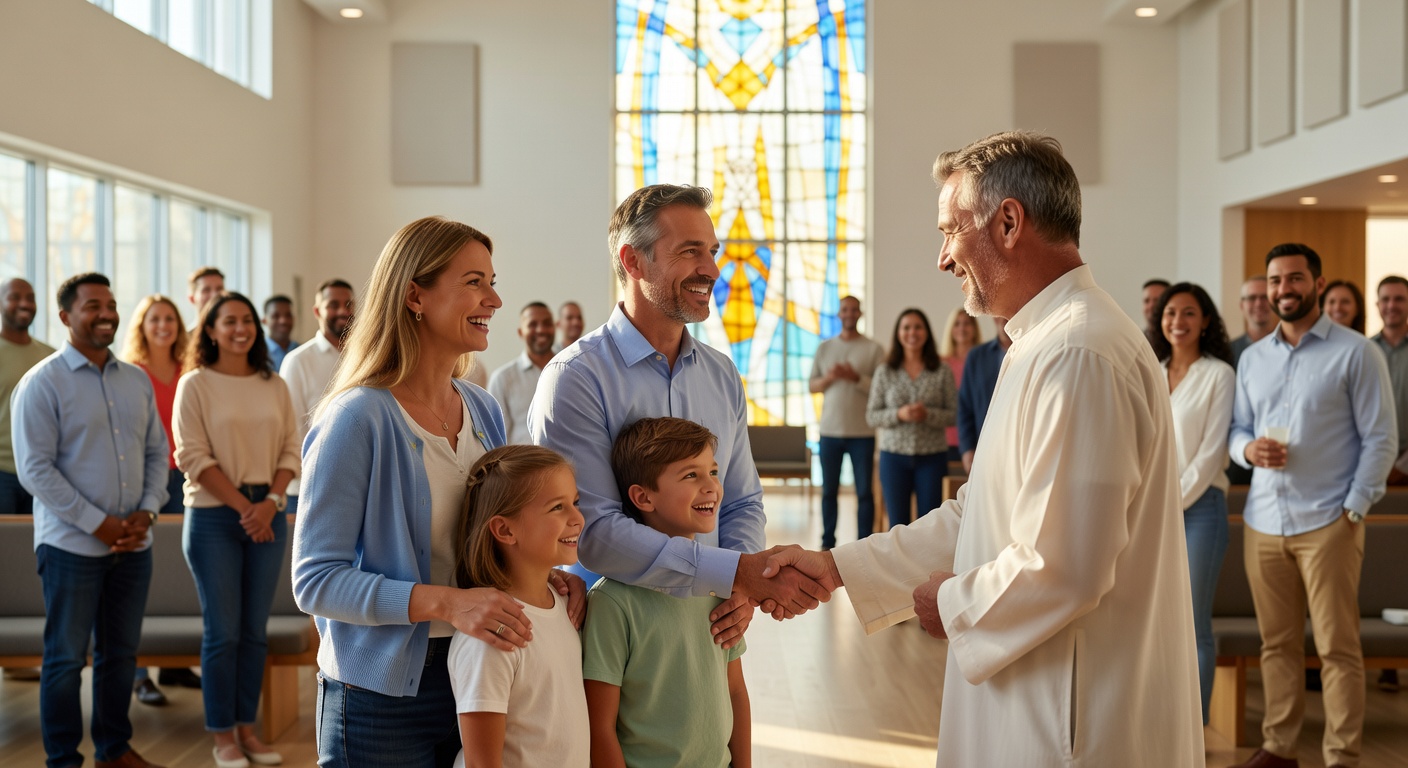
When a Ukrainian family walks through your church doors for the first time, they often carry stories most of us cannot imagine. Many fled war. Many left grandparents behind. Many haven't heard a sermon in their heart language in months — or years. If your community has welcomed Ukrainian refugees, neighbors, or coworkers and you want to truly include them in worship, this guide is for you. Reaching Ukrainian-speaking families at your church is one of the most meaningful forms of multilingual ministry happening in the U.S. and Canada today, and it does not require a Ukrainian-speaking pastor or expensive equipment to start.
More than 350,000 Ukrainians have arrived in the United States since 2022 through the Uniting for Ukraine program and other humanitarian pathways, according to the U.S. Department of Homeland Security. Many of them are devout Orthodox, Catholic, Baptist, or Pentecostal believers looking for a spiritual home. Your church can be that home — and real-time AI translation makes it possible to welcome them this Sunday.
Why Ukrainian-Speaking Families Need a Church Home Now
Faith has always been at the center of Ukrainian life. From the medieval baptism of Kyivan Rus' in 988 to the resilient underground churches of the Soviet era, Ukrainian Christians have a deep, layered religious heritage. When families arrive in a new country — often after weeks of travel, long border waits, and the trauma of leaving home — church is one of the first places they look for stability.
But for many, the local English-speaking church feels closed off. The hymns are unfamiliar. The sermon is hard to follow. Children adjust to English quickly, but parents and grandparents may need months or years to feel confident in conversation. Without translation, they can sit in the pew for an entire service and leave without understanding a single sentence of the Gospel message.
That gap is where your church can step in. By offering Ukrainian translation in worship, even part-time, you tell newly arrived families: You belong here. We see you. Your language matters.
Who Are the Ukrainian-Speaking Families Near You?
The Ukrainian-speaking community in North America is more diverse than most people realize. Understanding who lives near you helps you minister well.
- Recent war refugees (2022–2026): Mostly women, children, and seniors. Many fled Kyiv, Kharkiv, Odesa, and the eastern oblasts. They often live with sponsor families or in transitional housing.
- Established Ukrainian-American communities: Long-standing parishes in cities like New York, Chicago, Cleveland, Philadelphia, Detroit, and Minneapolis. Many trace their roots to the 1890s, the displaced-persons wave of the 1940s, or post-Soviet immigration in the 1990s.
- 1.5- and second-generation Ukrainian-Americans: Often bilingual, comfortable in English, but still emotionally tied to Ukrainian liturgy, hymns, and Easter traditions like paska bread blessing.
- Ukrainian-speaking citizens of other former Soviet states: People from Moldova, Belarus, Kazakhstan, and parts of Russia who grew up speaking Ukrainian at home or in church.
- Western Canadian prairie communities: The descendants of Ukrainian homesteaders in Alberta, Saskatchewan, and Manitoba who still attend Ukrainian Catholic and Orthodox parishes.
Real-Time Ukrainian Translation: How It Works in Worship
A decade ago, offering Ukrainian translation meant hiring a professional interpreter, buying receivers and headsets, and training a volunteer to manage the equipment every Sunday. The cost ran into the thousands. Today, AI-powered real-time translation has changed the equation completely.
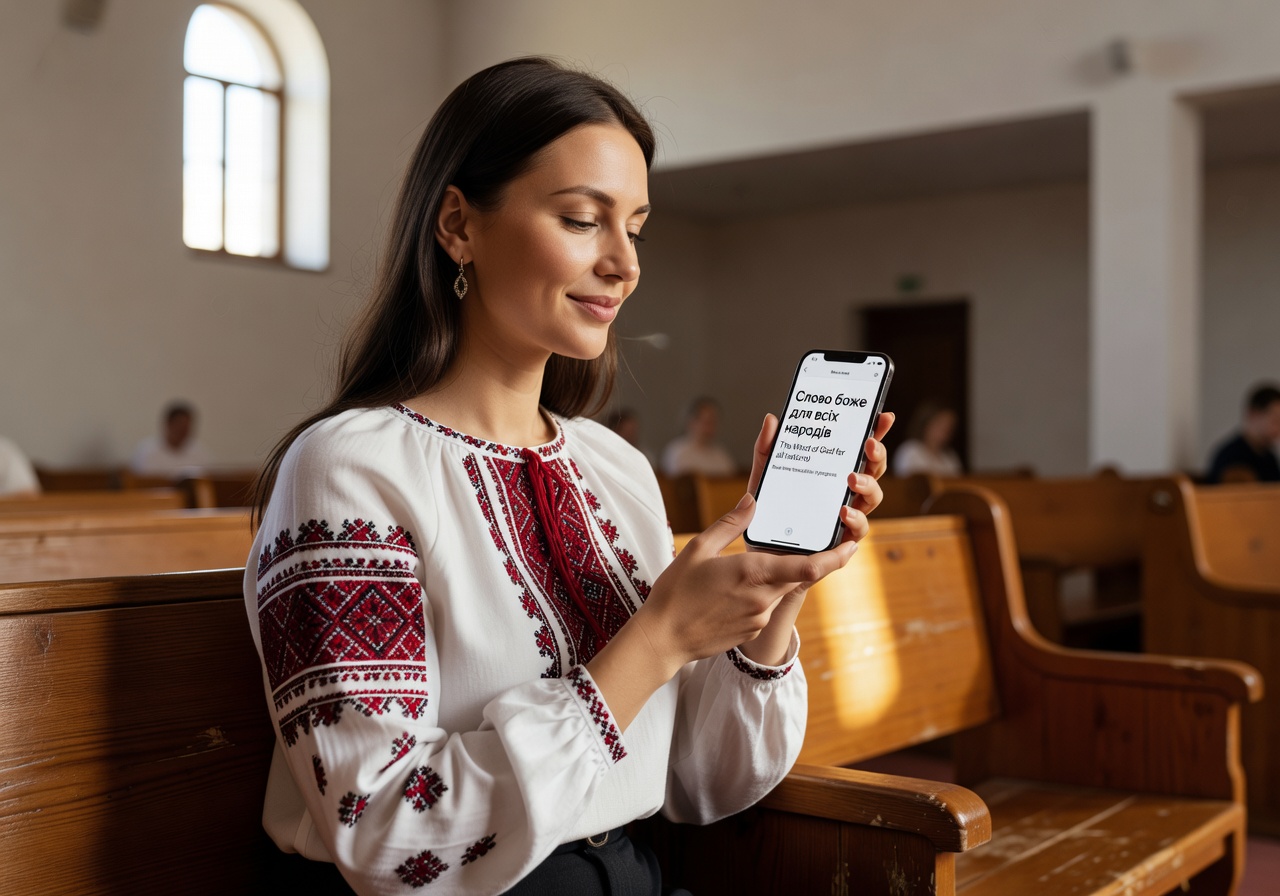
Here's how a typical service works with Glossa, the live AI translation platform built specifically for churches. The pastor preaches in English, just like always. As the sermon unfolds, Glossa listens, transcribes, and translates the audio into Ukrainian in real time. Anyone in the congregation — or anyone joining the livestream from across the country — can open the service link on their phone, tablet, or laptop, choose Ukrainian, and either read the translated transcript or listen with translated audio in a natural-sounding voice.
There are no headsets to hand out. No sound technician needed. No interpreter to schedule. The Ukrainian-speaking grandmother sitting in the third row hears the sermon in her own language at the same moment her English-speaking neighbor does. Want to learn the technical side? We cover the full step-by-step setup in our guide on how AI translation works for churches.
Six Practical Steps for Reaching Ukrainian Families at Your Church
If your congregation is ready to welcome Ukrainian-speaking neighbors, these are the steps that make the biggest difference in the first ninety days.
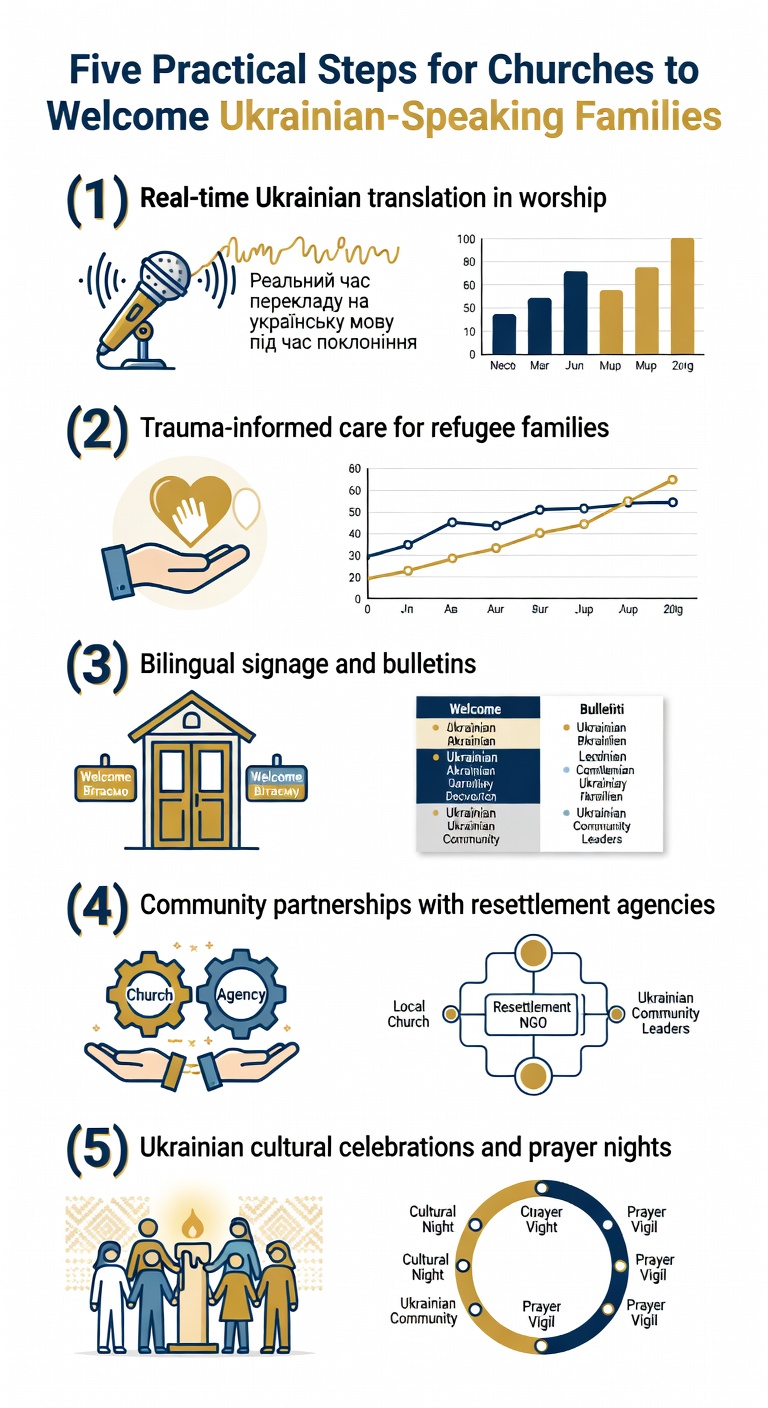
1. Add Ukrainian to Your Sunday Service
Start with your main weekend worship gathering. Even one service per week with Ukrainian translation is enough to invite families to attend regularly. With Glossa, you can switch on Ukrainian translation for a single service and add more languages later. It is the simplest possible commitment, and Ukrainian families will notice immediately.
2. Print a Bilingual Bulletin and Welcome Card
Many Ukrainians are visual learners and will follow along with a bulletin even if they understand the spoken words. Print key elements — the order of service, scripture references, song titles, prayer requests, and a short welcome paragraph — in both English and Ukrainian. A simple welcome card in Ukrainian with the church address, the WiFi password, and a friendly note can become a cherished keepsake for a newly arrived family.
3. Connect With Local Resettlement Partners
You don't have to find Ukrainian families on your own. Most cities have organizations that work directly with newly arrived refugees. Reach out to your local affiliate of Church World Service or World Relief, or partner with a Ukrainian-American cultural society if there's one nearby. Tell them you offer multilingual worship and would love to help host a welcome event. Resettlement agencies are usually thrilled to find a church that can serve their clients in the right language.
4. Train Greeters in a Few Ukrainian Phrases
You don't need to learn Ukrainian to make someone feel seen. Teach your greeters three phrases: Vitayemo (Welcome), Yak vy (How are you), and Slava Isusu Khrystu (Glory to Jesus Christ — a traditional Ukrainian Christian greeting). The look on a Ukrainian grandmother's face the first time she hears Slava Isusu Khrystu from an English-speaking American greeter is something you will not forget.
5. Host a Ukrainian Cultural Sunday or Prayer Night
Once a quarter, dedicate a service or special evening to honoring Ukrainian Christian traditions. Sing one hymn in Ukrainian. Read Psalm 23 in both languages. Serve borscht and varenyky after the service. Light candles for loved ones still in Ukraine. These small acts communicate something words cannot: that Ukrainian identity is welcome inside the walls of your church, not something to be left at the door.
6. Offer Trauma-Informed Pastoral Care
Many Ukrainian refugees have lost homes, jobs, and loved ones. Some have witnessed violence. Even those who arrived years ago carry the weight of watching their homeland under attack on the news every day. Train at least one pastoral care volunteer in basic trauma-informed listening. The Trauma Healing Institute offers free Bible-based training in dozens of languages, including Ukrainian. Equip your team to listen without rushing toward easy answers.
What About Ukrainian vs. Russian? A Sensitive Question
Some churches with existing Slavic congregations serve in Russian or in mixed Russian/Ukrainian. Until 2022, this often felt natural — most Ukrainians of older generations grew up bilingual under Soviet schooling. Today, after years of war, many Ukrainian families specifically do not want to worship in Russian. For them, hearing the sermon in Ukrainian is an affirmation of identity, dignity, and survival.
The most welcoming approach is to offer both languages as separate translation options and let each person choose. Glossa supports more than 100 languages simultaneously, so a single English sermon can be translated into Ukrainian, Russian, Polish, Romanian, Spanish, and any other language your community needs — all at the same time, on the same service. No one is forced to choose between languages, and no one feels excluded. If you'd like to see the full picture of how to serve Russian-speaking families alongside Ukrainian ones, our guide on reaching Russian-speaking families at your church explains the cultural nuances in detail.
Bridging Orthodox, Catholic, and Protestant Backgrounds
Ukraine has the most diverse Christian landscape in Eastern Europe. Most Ukrainians come from one of four traditions: the Ukrainian Orthodox Church, the Ukrainian Greek Catholic Church, evangelical Baptist or Pentecostal congregations, or the smaller Roman Catholic Church. Each tradition has its own liturgical rhythm, calendar, and theology — but all share a deep love for Scripture, family, and prayer.
If you pastor a Protestant church and a Ukrainian Orthodox family visits, do not assume they are looking to switch traditions. Many simply want a worshipping community while they are far from home. Welcome them warmly. Offer translation. Let the Holy Spirit do the work of belonging in His own time. Some families will eventually feel called to join your church. Others will return to a Ukrainian parish when one becomes accessible. Both outcomes are good, and both honor God.
Practical tip: many Ukrainian Christians follow the Julian calendar for Easter and Christmas, which means dates often differ from Western dates by about thirteen days. A small acknowledgment like Khrystos Voskres! (Christ is risen!) on Ukrainian Easter — even if your church already celebrated weeks earlier — goes a long way.
Real Stories From Churches Already Doing This
Across North America, churches of every size and denomination are quietly transforming what hospitality looks like for Ukrainian families. A small Baptist congregation in Sacramento welcomed twelve Ukrainian families through Uniting for Ukraine in 2023; today those families help run the children's ministry. A large nondenominational church in Charlotte added Ukrainian translation to its livestream and discovered viewers tuning in from refugee shelters in Poland and Germany. A Catholic parish in Seattle began offering Ukrainian translation at one Saturday vigil mass and saw attendance triple in six months.
What these churches have in common is not size or budget. It is the willingness to remove the language barrier first and let community grow from there. If you want to see what multilingual hospitality looks like at scale, read our case-driven guide on how churches are reaching immigrant communities through real-time translation.
When I first heard the sermon in Ukrainian, I cried. For nine months I had been a guest in someone else's country. That morning, I was a daughter in my Father's house.
Common Concerns When Adding Ukrainian Translation
Will the AI translation be accurate enough for sermons?
Modern AI translation, especially platforms trained on biblical and theological language like Glossa, handles sermon content remarkably well. It correctly translates scripture references, theological terms, and culturally specific expressions. It is not perfect — no translation is — but it is dramatically better than no translation at all, and Ukrainian-speaking attendees overwhelmingly say they prefer imperfect real-time translation to silence.
What if our church can't afford to add anything new?
AI translation has eliminated the traditional cost barriers. Most churches add Ukrainian translation for less than the price of a single Sunday's coffee budget. There are no devices to buy, no contracts to sign, and no interpreter salaries to fund. If you'd like to see the full cost picture, we break it down honestly in our article on affordable church translation.
We don't have any Ukrainian families yet. Should we still set this up?
Yes — and here's why. Once Ukrainian translation is available on your website and livestream, families will find you. Word travels fast in immigrant communities. Many Ukrainian newcomers search Google for things like Ukrainian church near me or church with Ukrainian translation, and being indexed for those searches can quietly turn your church into a regional hub. Building it before the need arrives is the most generous form of preparation.
How to Get Started This Week
You don't need a six-month rollout plan. Most churches that add Ukrainian translation are up and running in a single afternoon. Here's the simplest possible path:
- Today: Visit Glossa and create a free account. Add Ukrainian as a target language for your next service.
- This week: Print a bilingual welcome card and share the translation link in your bulletin, weekly email, and social media.
- Next Sunday: Mention from the pulpit that translation is available in Ukrainian (and any other languages your community speaks). Invite attendees to share the link with neighbors.
- This month: Reach out to one local resettlement agency or Ukrainian-American organization and let them know your church offers worship in Ukrainian.
- This quarter: Plan one Ukrainian cultural Sunday — a single service that honors Ukrainian hymns, traditions, and stories.
If you're not sure how to set up the translation link itself, our walkthrough on how to embed Glossa on your website shows the entire process in under ten minutes.
The Bigger Picture: Welcoming Every Language in Your Community
Reaching Ukrainian-speaking families is part of a much larger movement. Across the country, churches are discovering that multilingual ministry is not a niche activity — it is the heart of how the Gospel was always meant to spread. Pentecost itself began with people from every nation hearing the apostles speak in their own languages. Today's technology lets every church recreate that moment, every Sunday, in every language.
If welcoming Ukrainian families inspires you to think about other immigrant communities near you, our step-by-step multilingual services guide shows how to scale from one language to many without overwhelming your team. And if your community includes Polish, Romanian, Moldovan, or other Eastern European neighbors, the same translation infrastructure serves them all simultaneously.
A Final Word for Pastors and Lay Leaders
Reaching Ukrainian-speaking families at your church is not about being a sophisticated multicultural ministry. It is about a Ukrainian mother in your zip code who wants her children to grow up knowing Jesus in the language she prays in. It is about a grandfather who survived occupation and wants to thank God in the words his own grandfather taught him. It is about a teenage refugee who feels invisible at school all week and needs one place where her language is treasured.
You don't need to be Ukrainian to do this. You don't need to know the history. You don't need a big budget. You need a willing heart, a working WiFi connection, and the courage to remove the language barrier between your congregation and your neighbors. The technology will do the rest.
Welcome the Ukrainian families in your community this Sunday. Use real-time translation to make your sermon accessible in their heart language. Print a bulletin in Ukrainian. Train a greeter to say Vitayemo. Watch what God does next. To get started today, visit Glossa.live and add Ukrainian translation to your next service — it takes about ten minutes, and it could change everything for someone who walks through your doors this weekend.