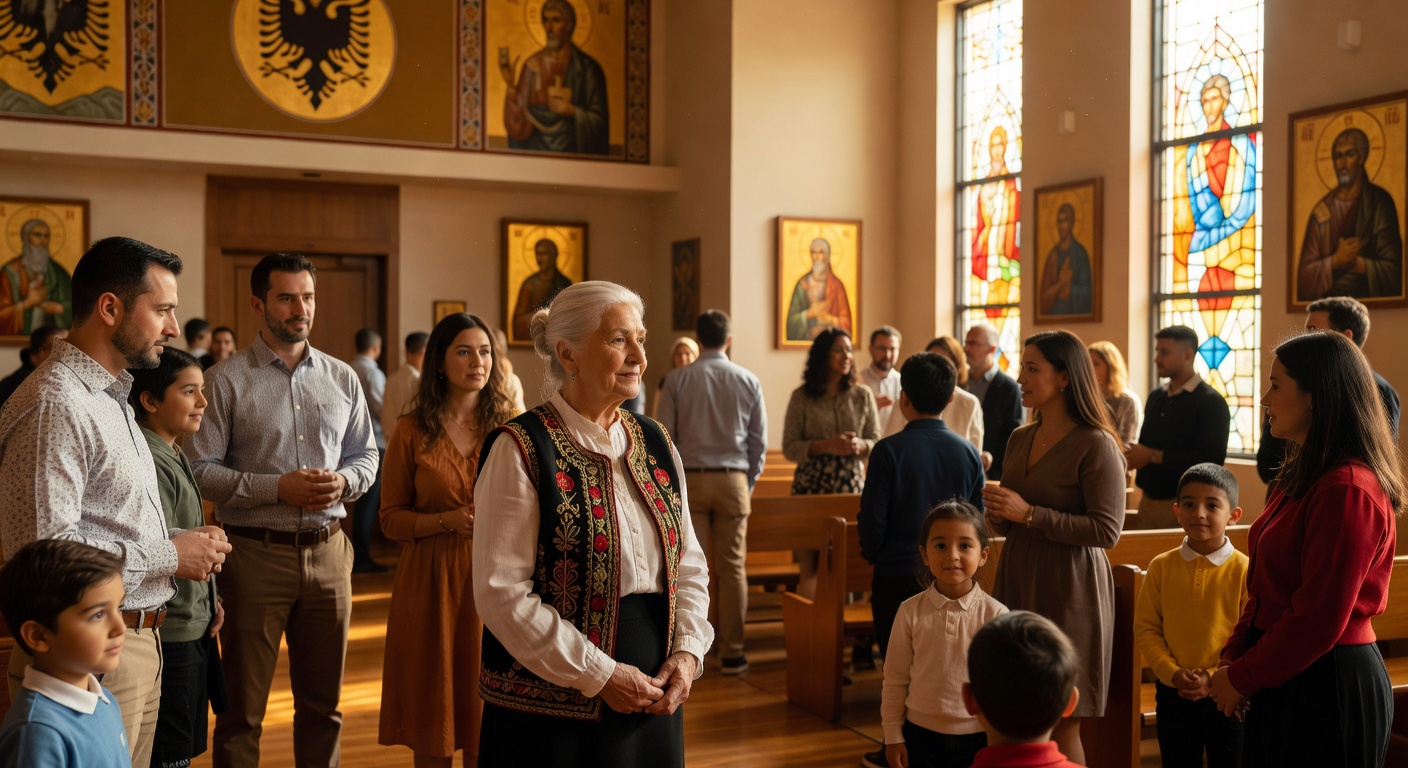
How to Reach Albanian-Speaking Families at Your Church
Why Albanian Ministry Matters Right Now
The Albanian-speaking population in the United States is one of the most underestimated immigrant communities in American religious life. Roughly 200,000 people of Albanian descent live in the U.S., concentrated in Detroit and metro Michigan (the largest single hub), the New York–New Jersey corridor (with Hartsdale, Yonkers, the Bronx, and Staten Island as anchors), Boston and Worcester, Philadelphia, Chicago, and a growing community in Texas and Florida. Add in Kosovar Albanians who arrived after the 1999 war and Albanians from North Macedonia and Montenegro, and you're looking at a Shqiptar diaspora that punches far above its weight in worship participation, family cohesion, and small-business entrepreneurship.
Yet most American pastors don't realize their city has an Albanian community at all—and most Albanian families don't realize there's a local church that would welcome them. That gap is the opportunity. When even a small church learns to say Mirëserdhët ("welcome"), to honor the Saint Paul Albanian Catholic feast, to recognize the difference between an Albanian Orthodox liturgy and an Italo-Albanian Byzantine one, and to broadcast a Sunday sermon in Shqip, doors open that have been closed for a generation.
This guide walks you through the cultural, denominational, and practical steps to reaching Albanian-speaking families at your church—whether you're a Protestant church in suburban Detroit, a Catholic parish in the Bronx, or a small-town congregation in North Carolina that just discovered three Albanian families in the school district.
Understanding the Albanian Christian Story
Albania is unique among European nations: it's the only country with a Muslim plurality (about 50–60%), but it also holds three deeply rooted Christian traditions—Orthodox, Catholic, and Protestant Evangelical—plus the Bektashi Sufi order that occupies its own spiritual category. Religious identity in Albania is layered, often regional, and deeply tied to family lineage rather than personal conversion.
A few markers every pastor should know:
- Albanian Orthodox Church: Autocephalous since 1937. In the diaspora, the Albanian Orthodox Archdiocese in America was organized by Bishop Fan Noli in 1908 (Boston), and the Albanian Orthodox Diocese of America operates under the OCA. Concentrated in Massachusetts, Connecticut, Pennsylvania, Illinois, and South Florida.
- Italo-Albanian Catholic Church (Arbëreshë): An Eastern Catholic Church in full communion with Rome, using the Byzantine rite in Albanian. Communities trace back to 15th-century refugees from Ottoman expansion who settled in Calabria and Sicily. In the U.S., parishes appear in New York, New Jersey, and Louisiana.
- Roman-Rite Albanian Catholics: Mostly from northern Albania and Kosovo. St. Paul Albanian Catholic Church in Rochester Hills, Michigan, is one of the largest and most visible Albanian parishes in North America, serving over 2,000 families.
- Albanian Evangelicals: The fastest-growing segment. The Brotherhood of Albanian Evangelicals (Vëllazëria Ungjillore e Shqipërisë, VUSh) was officially recognized in Albania in 2011. In the U.S., Albanian-language evangelical fellowships meet in Detroit, the Bronx, Worcester, and Houston.
- Bektashi: The Bektashi Sufi order has its world headquarters in Tirana, with a Bektashi community in Detroit. While not Christian, the order's emphasis on tolerance, poetry, and shared meals has shaped Albanian religious sensibility broadly. Many Albanians from Bektashi family backgrounds are open to Christian friendship and conversation.
Understanding these layers prevents the most common pastoral mistake: treating "Albanian" as if it were a single religious bloc. A family from Shkodër in northern Albania is likely Catholic and devout. A family from Korçë is likely Orthodox. A family from Tirana might be Bektashi, secular, evangelical, or all three across three generations.
Where Albanian Families Live (And Where Your Church Probably Has Some)
If you're trying to figure out whether your community has Albanian families, here's a quick map of the largest U.S. Albanian-American populations:
- Metro Detroit, Michigan: 70,000+ Albanians. Rochester Hills, Sterling Heights, Troy, Warren, and the suburbs north of 12 Mile Road. Anchored by St. Paul Albanian Catholic Church and the Albanian Islamic Center.
- New York–New Jersey: 50,000+. Hartsdale (Our Lady of Shkodra Albanian Catholic Church), the Bronx (Albanian Orthodox parish, Albanian Mosque of Bronx), Yonkers, Staten Island, Garfield NJ, Belleville NJ.
- Boston and Worcester, Massachusetts: 15,000+. St. George Albanian Orthodox Cathedral in Boston (Fan Noli's home parish), Worcester's Albanian community clustered around Lincoln Street.
- Philadelphia metro: 10,000+. Holy Trinity Albanian Orthodox Church, Albanian Catholic communities in northeast Philly.
- Chicago metro: 8,000+. Albanian Orthodox Church of Chicago, growing evangelical fellowships.
- Houston, Dallas, Florida: Smaller but rapidly growing Kosovar and Albanian communities. Houston in particular has seen post-2010 immigration tied to oil-and-gas employment.
If your church is anywhere within 30 miles of these clusters, you almost certainly have Albanian families in your school district, your Costco, or your kids' soccer league. Start there.
Common Pastoral Pitfalls (Avoid These)
Before we get to what works, here's what often doesn't:
- Calling them "Eastern European" generically. Albanians are not Slavs. The Albanian language is its own Indo-European branch—closer to Greek than to Russian. Lumping Albanians with Russians, Ukrainians, or Serbians offends quietly. A Kosovar Albanian who survived the 1999 war does not want to be greeted as if they were a Serbian Orthodox visitor.
- Assuming Muslim background equals closed door. Albania's Muslim majority is famously secular and tolerant. The country sheltered Jews during the Holocaust under the *Besa* honor code. Many Bektashi and Sunni-background Albanians attend Christmas and Easter at Catholic or Orthodox churches as a cultural matter. Friendship across faith lines is normal.
- Confusing Albanian with Greek. The Albanian Orthodox Church is autocephalous and distinct from the Greek Orthodox Archdiocese, even though they share Byzantine liturgical roots. Greeting an Albanian Orthodox visitor with *Christos Anesti* in Greek instead of *Krishti u Ngjall* in Albanian is a small thing that lands as a big thing.
- Ignoring Kosovo. Kosovar Albanians (about 40% of U.S. Albanians) carry distinct memories—the 1998–99 war, NATO intervention, refugee camps in Macedonia, family loss. Many arrived through humanitarian parole or asylum. Asking a Kosovar family "where in Albania are you from?" can be jarring if they've never been to Albania.
- Missing November 28. Albanian Independence Day (Dita e Pavarësisë) is a sacred civic moment, on par with the Fourth of July. A church that hosts a community dinner that weekend earns lifelong friendship.
Practical Steps to Welcome Albanian Families
Here's the playbook—starting with the smallest, lowest-cost actions and scaling up.
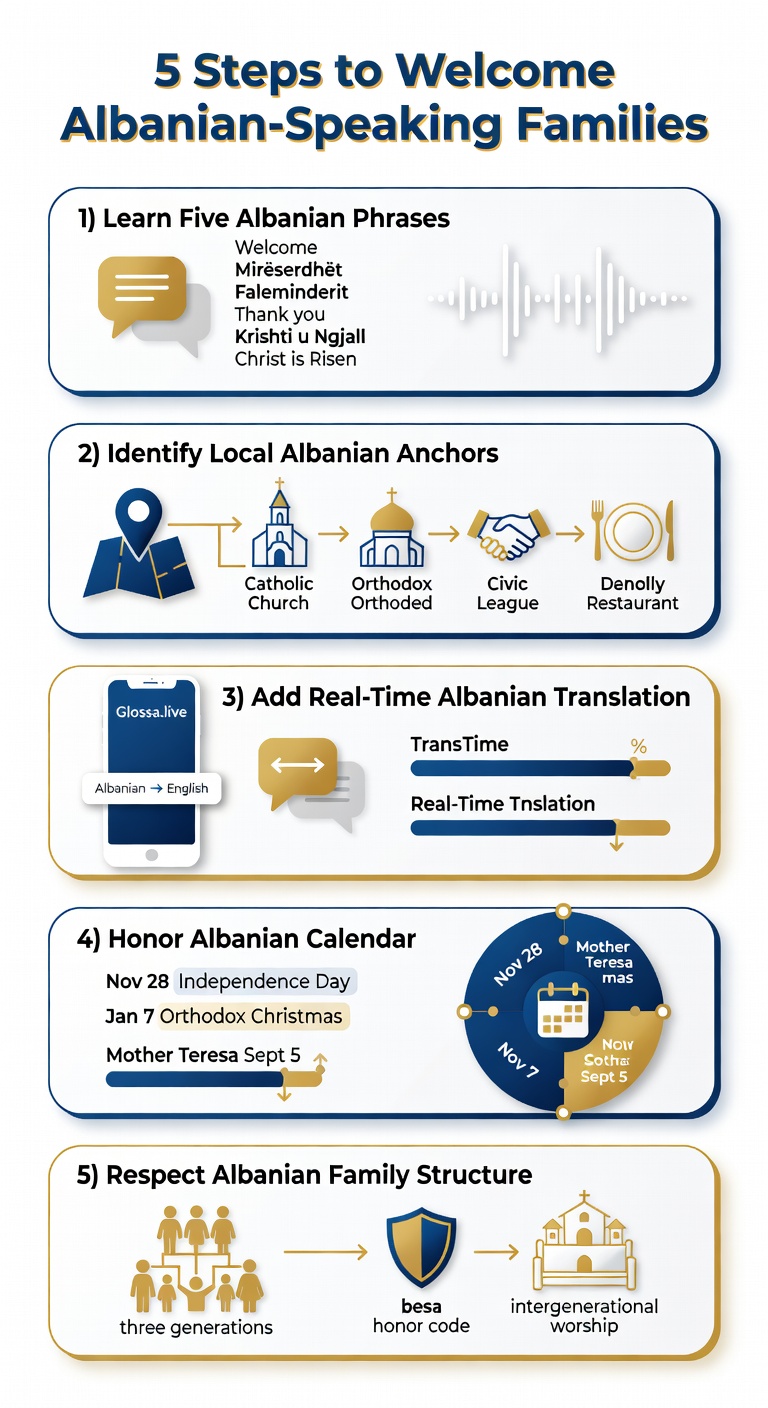
1. Learn Five Albanian Phrases This Sunday
You don't need to speak Shqip to make an Albanian family feel seen. You need five phrases said warmly:
- Mirëserdhët (meer-ser-DHET) — Welcome (formal/plural)
- Faleminderit (fa-le-min-DAY-rit) — Thank you
- Krishti u Ngjall! Vërtet u Ngjall! (KREESH-tee oo n-GYALL / vur-TET oo n-GYALL) — Christ is risen! Truly he is risen! (Easter greeting)
- Gëzuar (guh-ZOO-ar) — Cheers / blessings
- Si je? (see-YEH) — How are you?
Have your greeters learn these. Print them on a small card by the front door. The first time an Albanian visitor hears *Mirëserdhët* from a non-Albanian American, something tightens in their chest in a good way.
2. Identify Your Local Albanian Anchor Institutions
Every Albanian community has a hub. Find yours:
- A Catholic or Orthodox parish that already serves Albanians, and visit. Don't poach—partner. Learn from their priest about who needs friendship outside their existing fold.
- An Albanian-American Civic League chapter (most major cities have one).
- An Albanian restaurant or coffee shop (especially anywhere with *byrek*, *qebapa*, or Turkish coffee on the menu).
- A soccer league or futsal court—Albanians are passionate about football.
- A funeral home that handles the Albanian community (these are often the most accurate census of who lives where).
Walk in, introduce yourself, ask questions, listen. Don't pitch your church on the first visit.
3. Offer Albanian Translation in Worship
This is where most churches stop, and it's where the biggest barrier sits. A pastor preaching for forty minutes in English to a family whose grandmother only speaks Shqip is broadcasting "you don't really belong here," no matter how warm the welcome at the door. Real-time translation flips that script entirely.
Glossa.live runs on any phone, tablet, or laptop in the pew. The grandmother opens it, picks Albanian, and hears the sermon in her heart language while the rest of the service unfolds in English. No headsets to distribute, no interpreter booth, no second service to plan. For a deeper walkthrough of how to add real-time translation to a Sunday morning, see our step-by-step multilingual services guide and our explainer on how AI translation works for church services.
A few practical notes for Albanian specifically:
- The standard literary Albanian is Tosk-based (southern), but many Kosovar and northern Albanian speakers grew up with Gheg dialect at home. Modern AI translation handles standard Albanian well; Gheg-only speakers may need slightly more context.
- Older Albanians sometimes prefer subtitles to audio because they were educated bilingually under the communist period. Offering both modes matters.
- For Italo-Albanian Catholic communities, the liturgical language is Albanian-Byzantine—a sacred register distinct from spoken Albanian. Use translation for the homily and announcements, not the liturgy itself.
4. Honor the Albanian Calendar
Bake these dates into your church calendar:
- January 7 (Christmas, Orthodox): Albanian Orthodox families celebrate Christmas on January 7 (Julian calendar). A simple "Gëzuar Krishtlindjet" text or small gift on January 6 evening means a lot.
- March 14 (Summer Day / Dita e Verës): An ancient Albanian spring festival, especially big in Elbasan. Mostly secular but widely celebrated by all backgrounds. A children's ministry tie-in (planting day, walking-in-spring event) lands beautifully.
- Holy Week / Pashka: Catholic and Orthodox Pashkë. Red eggs, *kulaç* bread, the *Krishti u Ngjall* greeting. Many Albanian Orthodox parishes hold midnight Resurrection liturgy with a procession around the church. Even non-Orthodox churches can echo this with a 5 a.m. Sunrise service that culturally feels right.
- November 28 (Independence Day / Dita e Flamurit): The double-headed eagle goes up. Host an open-house dinner Saturday or Sunday after. Serve byrek and *flija* if you can find someone to teach you.
- November 29 (Liberation Day): For older Albanians who lived under Hoxha, this date carries weight.
- St. Paul's Feast (June 29): Patronal feast of St. Paul Albanian Catholic Church and many Albanian Catholic families—name day for anyone called Pal/Pali.
- Mother Teresa Feast (September 5): Mother Teresa was Albanian, born in Skopje, and Albania declared her the Mother of the Nation. Her feast is observed widely across all Albanian Christian backgrounds.
5. Create Space for the Albanian Family Structure
Albanian family culture is intensely intergenerational. *Familja* (family) is not the nuclear unit—it's three to four generations, often under one roof or one block. A few implications for ministry:
- Don't separate elders from teens too aggressively. The Albanian grandmother (*gjyshja*) and grandfather (*gjyshi*) are not in a separate-but-equal ministry. They're the spiritual authority. If your seniors group meets at the same time as youth group across the building, you've split a family.
- Honor *besa*. Besa is the Albanian honor code—a promise that cannot be broken. When you tell an Albanian family "we'll come visit Tuesday at 6," you'd better come Tuesday at 6. Half-kept promises wreck trust faster here than in most cultures.
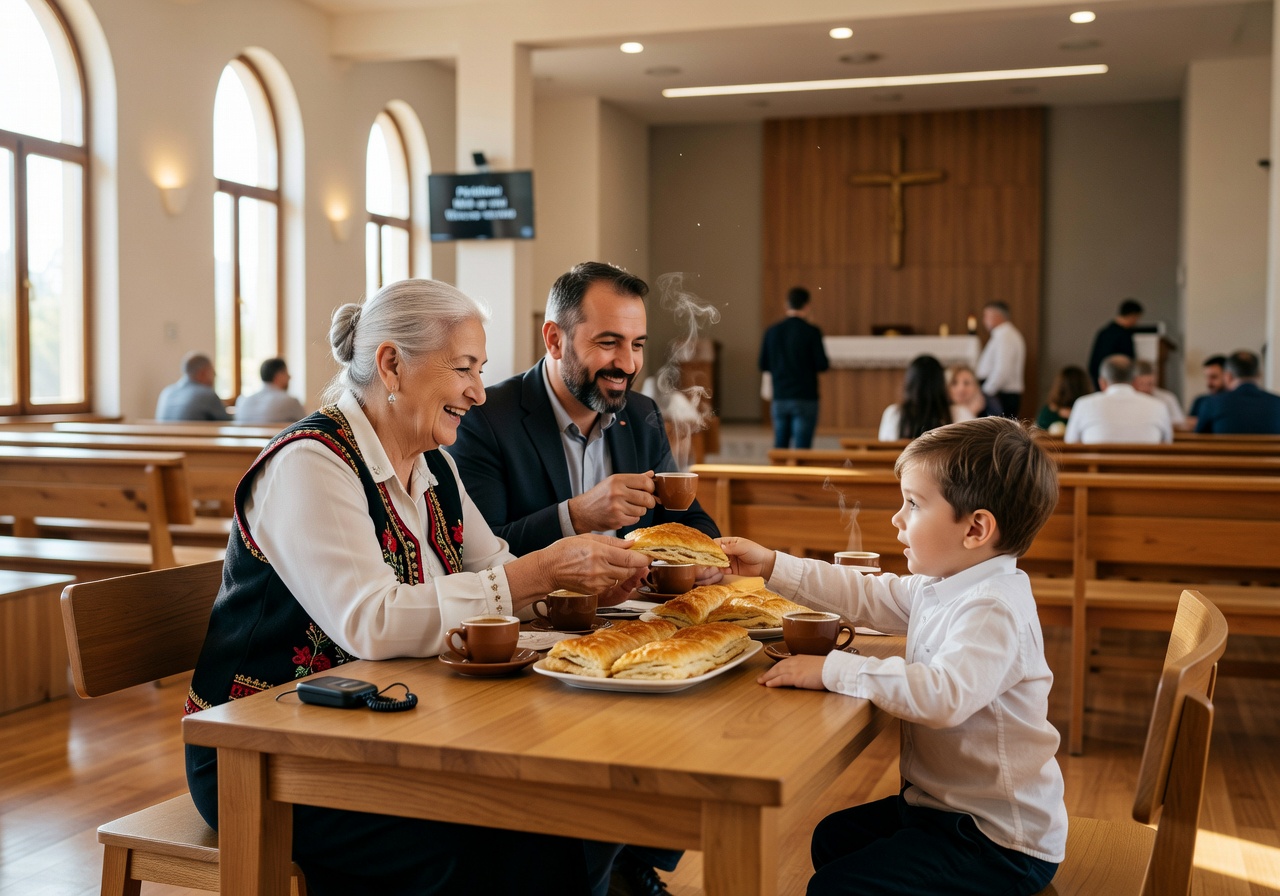
- Expect food. Hospitality is non-negotiable. If you visit an Albanian home, you will be fed. Returning the favor with a pastor's-home dinner or a small-group potluck builds reciprocity.
- Recognize the *xhamadan* and *plis* on holidays. Traditional dress shows up at weddings, baptisms, Independence Day. A pastor who knows the white felt cap is called a *plis* and not "that little hat" earns respect instantly.
6. Build Bridges, Not Walls, with Muslim-Background Friends
Albania's religious harmony is real. Albanian families often include Catholic siblings, Orthodox cousins, Muslim aunts, and Bektashi grandparents at the same Sunday lunch. As a pastor, this means:
- Be relaxed. Don't perform aggressive evangelism. Albanians smell fake from across the room.
- Invite the whole family to non-worship events—Christmas concerts, community dinners, soccer nights, English conversation classes. Shared life builds shared faith over years.
- For families curious about Christianity, point to Albanian-language resources: the Albanian Bible (Diodati i Ri), the Brotherhood of Albanian Evangelicals' radio ministry (Radio 7 in Tirana), and the JESUS film in Albanian.
- For Kosovar refugees who carry trauma, lean toward presence and prayer rather than program. Many Kosovar families found Christ through small house churches in Pristina and Mitrovica during the 1990s—they know what genuine community feels like.
For a broader framework on welcoming families across multiple language backgrounds, see overcoming language barriers in church and our guide to building a multicultural church.
Mother Teresa: The Albanian Saint Every Pastor Should Know
No conversation about Albanian Christianity is complete without Mother Teresa. Born Anjezë Gonxhe Bojaxhiu in 1910 in Skopje to a Kosovar Albanian Catholic family, she became a Missionary of Charity in India and is now venerated as a Catholic saint and a unifying figure across Albanian religious lines—Orthodox, Catholic, Evangelical, and even Muslim and Bektashi families display her image. Her famous statement, "By blood, I am Albanian. By citizenship, an Indian. By faith, I am a Catholic nun," is taught to Albanian children worldwide. For pastors building bridges into Albanian families, Mother Teresa is a shared starting point.
A Sunday Morning Walkthrough
Imagine a typical Sunday at your church after these changes:
A Kosovar Albanian family pulls into the parking lot for the first time—mom, dad, three kids, the *gjyshja* who lives with them. The greeter smiles and says *Mirëserdhët* with a slight nod. The kids' ministry hostess shows them where to drop off the youngest two and offers an Albanian-printed welcome card with the kids' names spelled correctly (Albanian uses ë and ç—worth double-checking).
Inside the sanctuary, an usher hands the gjyshja a printed card: *Skanoni QR-në për përkthim shqip* ("Scan the QR code for Albanian translation"). She holds her phone up, taps Albanian, and a moment later her earbud delivers the worship leader's welcome in clear Shqip. During the sermon, she follows the pastor's words on the meaning of forgiveness—a topic that, after the war, lands with weight. Her grandchildren see her nodding. They see her praying.
After the service, the pastor introduces himself, asks where in Albania (or Kosovo) the family is from, and listens. He doesn't pitch membership. He asks whether the family knows about the Independence Day open house in November. He hands the dad a flyer—half English, half Albanian, with the church address, the pastor's cell number, and a single line: *Familja jonë është familja juaj.* ("Our family is your family.")
Familja jonë është familja juaj. — Our family is your family. The simplest sentence to write on the bottom of an Albanian-language welcome flyer, and the truest one.
That's how you reach Albanian-speaking families. Not with a campaign. With one Sunday at a time, told well.
Frequently Asked Questions
What's the difference between Albanian Orthodox and Greek Orthodox?
The Albanian Orthodox Church is autocephalous (self-headed), meaning it elects its own primate. Liturgy is in Albanian (and English in the diaspora). Greek Orthodox liturgy is in Greek and English, under the Ecumenical Patriarchate. The two are in full communion with each other but are distinct national churches. Albanian Orthodox parishes follow the New Calendar.
Are Italo-Albanian Catholics Roman Catholic?
Yes—they're in full communion with Rome, but they use the Byzantine rite in Albanian (and historically Greek and Latin). Their bishops sit on Italo-Albanian eparchies in southern Italy. In the U.S., Italo-Albanian parishes are rare but present in New York, New Jersey, and Louisiana.
How do I find Albanian Bibles for our church library?
The Diodati i Ri (New Testament + full Bible) is the most widely used Albanian Protestant translation. The Bible Society in Albania (Shoqëria Biblike Ndërkonfesionale) also publishes Catholic editions. American Bible Society can ship Albanian Bibles directly. For audio Bibles, the YouVersion app has Albanian readings.
Can Glossa.live really translate Albanian on the fly?
Yes. Glossa.live supports 100+ languages including Albanian, with biblically-trained AI that handles theological vocabulary better than generic translation tools. There's no setup beyond pointing the congregation to the link or QR code. For a comparison of translation methods, see our explainer on how AI translation works for church services.
What if our Albanian family is from Kosovo, not Albania?
Most Kosovar Albanians speak the same standard Albanian (Shqip) used in Albania, though their home dialect is usually Gheg. The translation works the same way. Be sensitive to the war—Kosovar parents often shield kids from the worst of it. Ask, listen, don't assume.
What about Macedonia and Montenegro Albanians?
Albanians from North Macedonia (especially around Tetovo and Skopje) and Montenegro are part of the same diaspora. Most speak standard Albanian or Gheg. Religious affiliation varies—many North Macedonian Albanians are Sunni Muslim or Bektashi; Montenegrin Albanians are mostly Catholic.
How big is the Albanian Evangelical community?
The Brotherhood of Albanian Evangelicals (VUSh) reports about 12,000 evangelical Christians in Albania (less than 1% of the population), with 200+ congregations. The diaspora evangelical community in the U.S. is smaller—perhaps 2,000–3,000 active—but growing through Albanian-language fellowships in Michigan, New York, and Texas.
Resources Worth Bookmarking
- Brotherhood of Albanian Evangelicals (VUSh) — Official body of evangelical churches in Albania, with ministry resources and Albanian-language materials.
- Albanian Orthodox Archdiocese (OCA) — Bishop Fan Noli's diocese, with parish locator and liturgical resources.
- Send International — Albanian Ministries — Long-running Balkan church-planting and discipleship ministry with Albanian-language resources.
Start Small, Stay Faithful
You don't need to become an expert in Albanian history to welcome an Albanian family well. You need to learn five phrases, know one Independence Day, find one local restaurant, and turn on real-time translation. The rest is what every good pastor already does—show up, pay attention, keep promises, share food, preach the Gospel.
The Albanian community in your city is closer than you think. Many of them have not been inside a church in years, not because they rejected faith, but because no one ever invited them in their language. *Mirëserdhët* is a doorway. Walk through it.
Ready to add Albanian translation to your services? Start with Glossa.live — no credit card, no equipment, just real-time translation in 100+ languages on any device your congregation already owns. For a starter walkthrough on multilingual ministry beyond Albanian, see why multilingual worship grows your church.