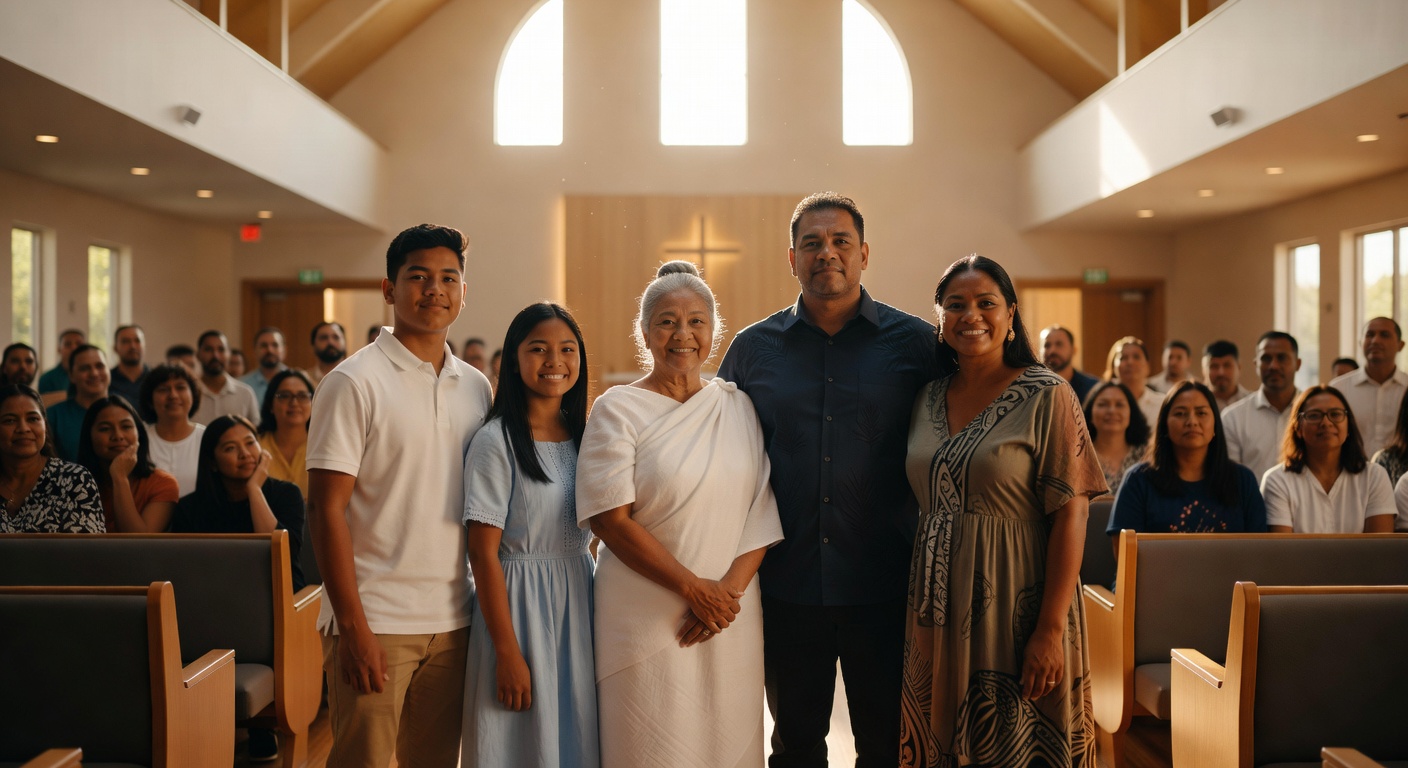
How to Reach Samoan-Speaking Families at Your Church
Samoan Christianity is louder, older, and more musical than most American pastors realize. When a Samoan family walks into your sanctuary on Sunday, you are meeting people from one of the most Christian nations on earth — where the motto Fa'avae i le Atua Samoa ("Samoa is founded on God") is written into the constitution, and where Sunday is still so sacred that stores close and roads quiet. This is the Samoan church tradition, and it is already in your neighborhood.
In the United States, Samoan and Samoan-American families are among the largest Pacific Islander communities. About 200,000 people of Samoan ancestry live across California (Long Beach, San Francisco, San Diego), Hawaii, Utah (Salt Lake City is a major hub), Washington state, Alaska, and the greater Los Angeles region. DataForSEO shows strong monthly search volume for "samoan church" (320), "samoan church near me" (260), and "samoan congregational christian church" (110). Every one of those searches is a real person — a nurse from Apia, a football coach from Pago Pago, a grandmother raised in the EFKS tradition — looking for a congregation that honors their faith, their language, and their story.
This guide will help you understand Samoan families, why Samoan worship feels so different from a typical American service, and how to welcome Samoan-speaking families well — without launching a separate Samoan service from scratch.
Who Are Samoan-Speaking Families in America?
Samoan families in the U.S. come from two closely related places. Understanding the difference matters, because it shapes identity, immigration status, and even which churches families attend.
Independent Samoa (the independent nation, capital Apia) is home to about 200,000 people. Most Samoan-Americans trace family back to villages on the islands of Upolu and Savai'i. Independent Samoa became the first Pacific nation to gain independence in 1962 after a century of German and New Zealand administration. Families here generally arrive in the U.S. through migration, work visas, marriage, or the New Zealand–U.S. pipeline (many Samoan families live in New Zealand before moving on to California or Utah).
American Samoa (the U.S. territory, capital Pago Pago) is home to about 45,000 people and has been a U.S. territory since 1900. American Samoans are U.S. nationals by birth and can move freely to Hawaii and the U.S. mainland without visas. This is why Samoan-American communities in California, Utah, and Alaska are so large — the migration pipeline from Pago Pago to Los Angeles, Honolulu, Anchorage, and Salt Lake City has been steady for generations.
The largest Samoan-American communities are in Honolulu and Hawaii island, Los Angeles County (especially Long Beach, Carson, and Compton), the San Francisco Bay Area (Daly City, Oakland, East Palo Alto), San Diego, Salt Lake City and West Valley City, the Seattle–Tacoma corridor, Anchorage, and growing communities in Dallas-Fort Worth and Las Vegas. In each of these places, Samoan families are planting churches, joining existing congregations, and quietly looking for pastors who will welcome them by name.
Samoan Christianity: Older Than the United States
One of the things every pastor should know is that Samoan Christianity did not begin in America. It began in August 1830, when the London Missionary Society pioneer John Williams landed his ship Messenger of Peace at Sapapali'i on the island of Savai'i. Within a generation, nearly the entire Samoan archipelago had embraced Christianity. The Samoan people did not receive the Gospel as a colonial imposition — they received it and made it their own. Samoan missionaries then carried the Gospel across the Pacific to Papua New Guinea, Vanuatu, Tuvalu, Kiribati, and beyond.
Today, Samoa is one of the most Christian nations on earth. More than 98% of Samoans identify as Christian. The major streams are:
- The Congregational Christian Church of Samoa (CCCS / EFKS) — Ekalesia Fa'apotopotoga Kerisiano Samoa. The direct descendant of the LMS mission and the largest single denomination — about 30–35% of Samoans worldwide. In the U.S., EFKS congregations anchor communities in Carson, San Francisco, Honolulu, Salt Lake City, and Anchorage.
- The Methodist Church in Samoa (Metotisi) — roughly 12–15% of Samoans. Strong presence in Tongan-Samoan Pacific Islander networks across Los Angeles and Utah.
- The Roman Catholic Church — about 20% of Samoans. The Samoan Catholic tradition is deeply musical, with full Samoan-language Mass.
- The Church of Jesus Christ of Latter-day Saints (LDS) — about 25% of Samoans. The reason Salt Lake City, West Valley City, and suburban Utah have the largest mainland Samoan population.
- The Seventh-day Adventist Church (SDA) — about 5%. Strong in Hawaii, Long Beach, and in Utah's Samoan SDA network.
- The Assemblies of God (AOG) and Pentecostal churches — growing quickly, especially among younger Samoans. The First Samoan Assembly of God network has churches across California.
When you meet a Samoan family, the question is rarely are they Christian? It is which tradition did they come from, and what do they miss from home?
Samoan and English: How Language Actually Works in Samoan Families
Samoan (Gagana Sāmoa) is a Polynesian language closely related to Māori, Tongan, Hawaiian, and Tahitian. It is one of two official languages of Samoa (alongside English) and is widely spoken in American Samoa. For Samoan-American families, language use typically looks like this:
- The grandparents (matua tuā) often prefer Samoan for worship, prayer, and pastoral conversation. English may be their second or third language, and they often feel they cannot fully pray in English.
- The parents (40s–60s) are usually bilingual but lean Samoan for church, especially for hymns (pese), prayer, and when giving testimony.
- The teenagers and young adults (the 1.5 and second generations) usually lean English but still want the cultural anchor of Samoan worship — faigalotu faa-Samoa — for weddings, funerals, White Sunday (Lotu a Tamaiti), and major feasts.
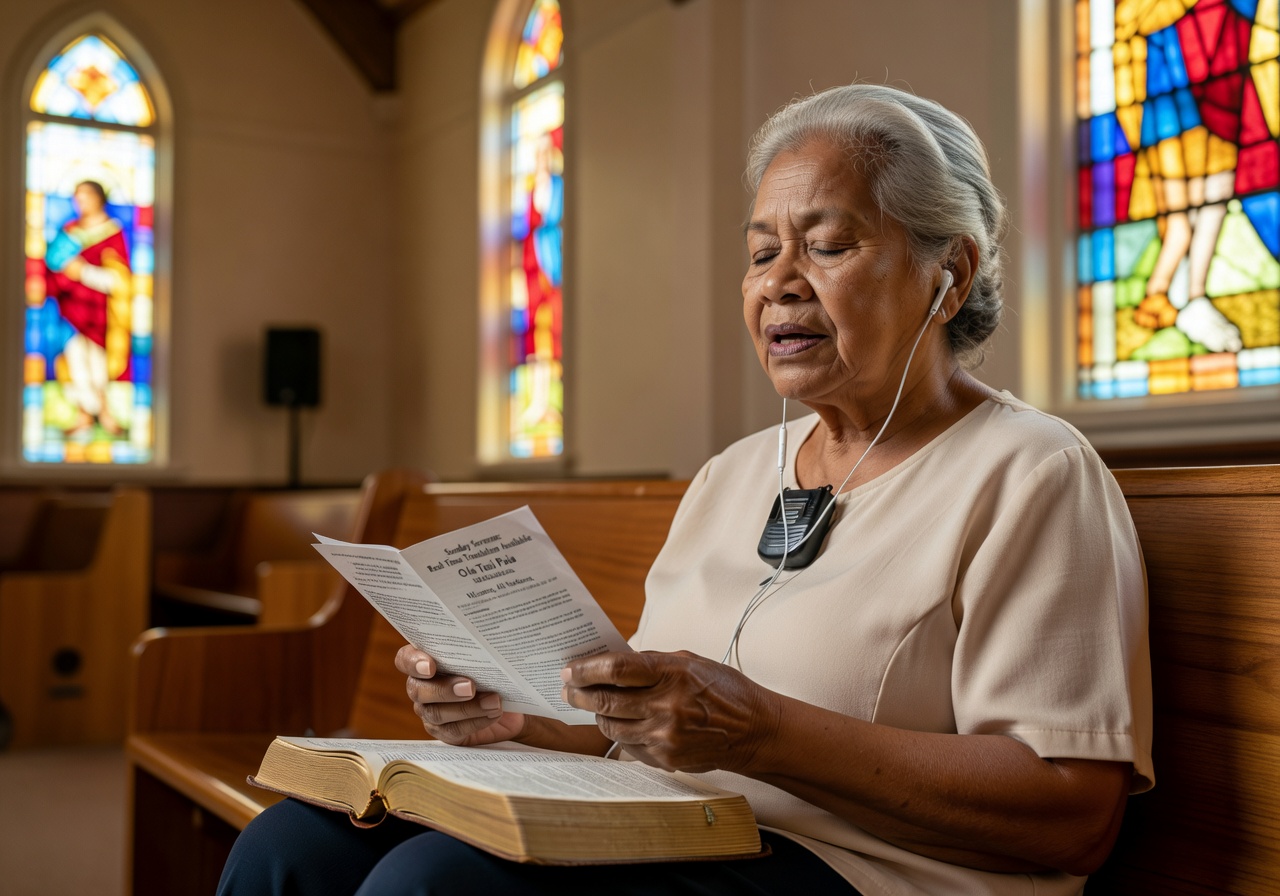
This is the heart of multigenerational Samoan ministry. A Samoan grandmother in Long Beach and her Samoan-American grandson need different things from the same service. She needs the prayer, the scripture reading, and the sermon in Samoan. He needs the vibe of an English-speaking youth group with the cultural recognition that his heritage matters. Real-time AI translation is one of the few tools that can actually serve both generations in a single service, because every person listens to the language they need through their own phone.
Why Samoan Worship Feels Different (And Why That Matters)
If you have never attended a Samoan worship service, expect to be moved — and to stay longer than you planned. Samoan Sunday worship is long, communal, and musically extraordinary. A traditional EFKS service can run two to three hours. The aufaipese (choir) wears matching puletasi or pulenu'u and sings in stunning a cappella four-part harmony. The Samoan Bible is read aloud with ceremony. The pastor's wife (faletua) sits near the front, honored. Offering is collected in a formal, musical procession. After service, nearly every family shares a meal — the to'ona'i — that the church has prepared together through fa'alavelave, the Samoan tradition of shared obligation.
This is not entertainment. It is theology made physical. In Samoan Christianity, the church is the village, and the village is the church. Worship is not something you attend; it is something you belong to. Offering money is not just transactional — it is alofa, love in tangible form. Hymn singing is not a performance — it is how the whole community prays together, in the same breath.
When a Samoan family attends a typical American service — 25 minutes of worship, a stationary pastor, a brief fellowship hour, then everyone leaves — they will love you anyway. They will sing along. They will stay polite. But something is missing for them. The work of multilingual ministry is not to replace your style. It is to open a door so a Samoan grandmother can hear the sermon in her own language, feel genuinely seen, and stay long enough to bring her worship with her.
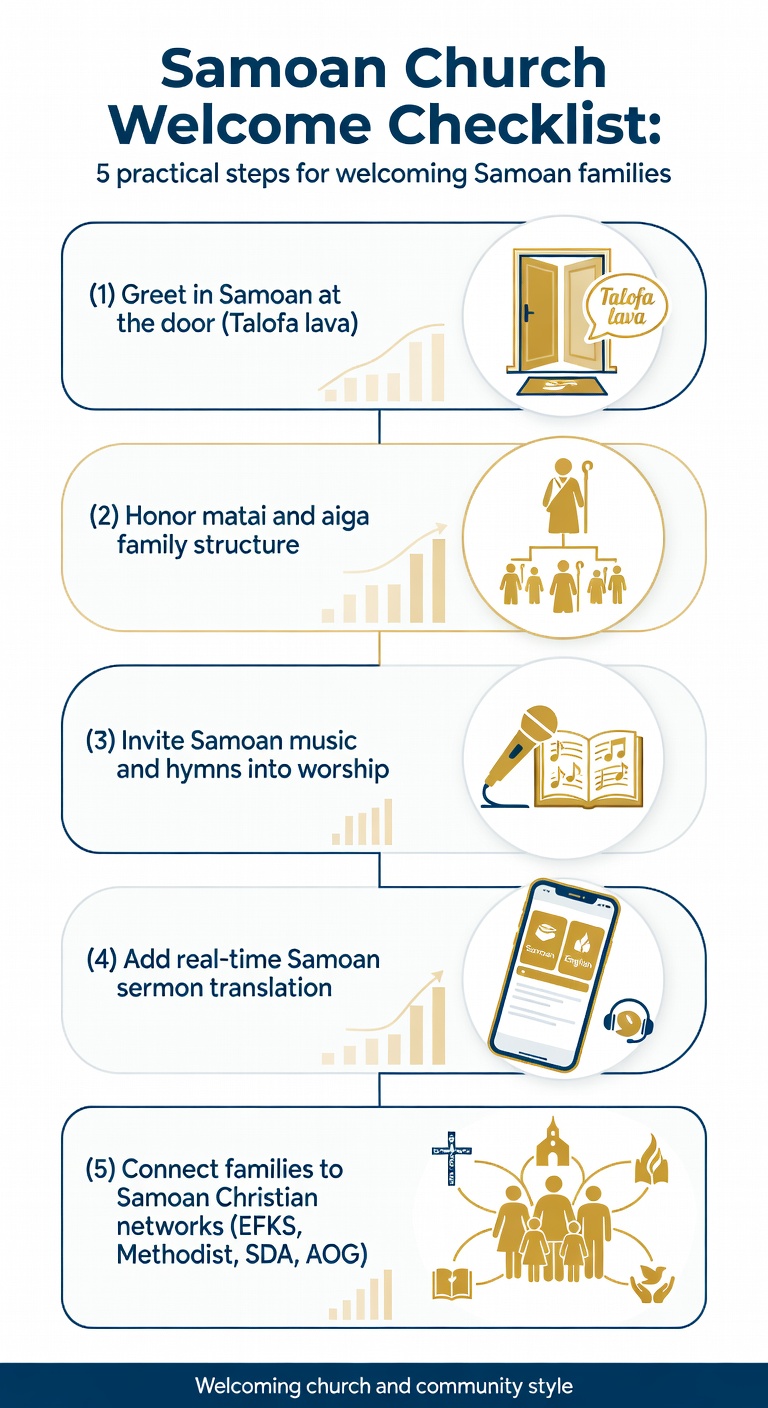
Five Ways to Welcome Samoan Families This Month
You do not need a separate Samoan service, a Samoan choir, or a Samoan associate pastor to welcome Samoan families well. You need to show that you see them. Here are five concrete steps any congregation can take in the next thirty days.
1. Greet in Samoan at the Door
A simple Talofa lava — afio mai i lenei aso pa'ia (roughly, Greetings — welcome on this holy day) at the welcome desk costs nothing and signals everything. Training three greeters to say Talofa (hello), Tofa soifua (goodbye, with blessing), Fa'afetai tele lava (thank you very much), and O ai lou suafa? (what is your name?) is a one-hour investment that will change a first Sunday for an entire Samoan family. If your church livestreams, a few Samoan words in the welcome video will show up in Samoan church searches for years.
2. Honor the Samoan Matai and Aiga Structure
Samoan culture is built around matai (titled chiefs) and aiga (extended family). When you meet the head of a Samoan family, you are meeting the representative of dozens of people, often back to a specific village on Upolu, Savai'i, Manu'a, or Tutuila. A little humility goes a long way. Ask, gently, "What village is your family from in Samoa?" It will open more doors than any program you can design. Also: never seat a younger person above a matai, never serve food before the matai has been served, and always offer the first sermon greeting to visiting matai if they are present.
3. Invite Samoan Music Into Worship
Samoan sacred music is one of the great treasures of global Christianity. Even one Samoan song per month — "Fa'afetai i le Atua" (Thanks be to God), "Silasila Mai" (Look Upon Us), or a Samoan arrangement of "How Great Thou Art" — communicates welcome in a way no English announcement can. If your worship leader is nervous about a Polynesian language, invite a Samoan family to sing one verse. Many Samoan families have been singing these hymns since childhood and will gladly lead. It will transform your sanctuary.
4. Translate the Sermon in Real Time
Nothing says "you belong" like hearing the sermon in your own language without having to ask, without special equipment, and without being separated from the rest of the congregation. Real-time translation through Glossa lets Samoan visitors listen to your pastor in Samoan on their own phones, while the rest of your congregation experiences the same service, unchanged. For a step-by-step walkthrough, see our guide on how to start multilingual church services. For families who also speak Tongan, Māori, or Hawaiian — common in Pacific Islander neighborhoods — the same setup serves all of those languages at once.
5. Point Them Toward Samoan Christian Networks
Even if your church is not primarily Samoan, you can bless Samoan families by knowing who is. Samoan denominational networks — EFKS (Congregational Christian Church of Samoa), the Samoan Methodist Church, the First Samoan Congregational Christian Church in San Diego and Carson, the First Samoan Assembly of God network, Samoan SDA churches, and Samoan Catholic parishes — operate in most major U.S. Pacific Islander metros. A pastor who can say, "We'd love to keep worshipping with you — and there are three Samoan families in town you should also meet, and an EFKS pastor friend of mine in Carson" is a pastor Samoan families trust.
How Samoan Families Actually Find a Church
Samoan families search online in a mix of English and Samoan. The dominant search, by far, is simply "samoan church" (320 monthly U.S. searches per DataForSEO) and "samoan church near me" (260). Long-tail searches include "samoan congregational christian church," "first samoan congregational christian church [city]," "samoan methodist church," "samoan seventh day adventist church," and "church in samoan." Many families also search for specific networks: "EFKS [city]," "samoan assembly of god church," or "samoan catholic church near me."
Four website updates will help your church show up in those searches:
- Add one line to your homepage: "We welcome Samoan-speaking families. Real-time Samoan translation is available during every service."
- Create one short blog post titled "A Warm Welcome to Samoan Families in [Your City]" — 800 words with a few Samoan greetings, a line about White Sunday, and an invitation to bring an aiga will start ranking within weeks.
- Add a Samoan paragraph to your "What to Expect" page: "Talofa lava. O loo maua le fa'aliliuga o le lauga i le gagana Samoa i Aso Sa uma. Afio mai." (Greetings. Samoan sermon translation is available every Sunday. Welcome.)
- Tag your livestream with "Samoan translation available." Most Samoan diaspora families — especially elderly relatives still in Apia or Pago Pago — watch online first.
For a deeper look at how churches are serving immigrant and Pacific Islander communities online, see our guide on how churches are reaching immigrant communities and our piece on streaming church services in multiple languages.
Real-Time Samoan Translation: What Actually Changes on a Sunday
The shift is not technological — it is pastoral. When a Samoan grandmother hears her grandson's American pastor preach in Samoan, through her own phone, she stops being a guest. She becomes a member. When a young Samoan father on a work visa finally understands why the congregation is praying for healing this week, he realizes his own grief is seen.
A multilingual service using Glossa looks like this in practice:
- Your pastor preaches in English, exactly as before.
- Samoan visitors scan a QR code on the bulletin (or open a short link like glossa.live/yourchurch).
- The sermon is translated in real time into Samoan — and 95+ other languages — all at the same time.
- Each person listens through phone earbuds, reads captions on screen, and follows the full service in their heart language.
No headsets to distribute. No separate Samoan service to staff. No interpreter to recruit and pay. Your English-speaking congregation experiences the service unchanged. But a Samoan family — along with Tongan, Filipino, Spanish-speaking, and Korean families — can now participate fully, together.
If you want to compare this with traditional approaches, our guide on church translation equipment breaks down hardware receiver systems versus app-based translation, and our deep dive on AI translation for church services explains how the underlying technology works for liturgical and sermon content.
Samoan Cultural Moments Every Pastor Should Know
A few Samoan cultural and Christian calendar dates that will strengthen your connection:
| Date / Season | What It Means | How a Pastor Can Honor It |
|---|---|---|
| Second Sunday of October — White Sunday (Lotu a Tamaiti) | The most beloved day in the Samoan Christian year; children lead the entire service, dressed in white, reciting scripture. | Invite Samoan children to lead a reading. Mention White Sunday in your October announcements. |
| June 1 — Samoa Independence Day | Samoa's 1962 independence from New Zealand; a day of national pride for Samoan families. | A Samoan greeting, a hymn, or a prayer for Samoa. |
| April 17 — American Samoa Flag Day | Commemorates American Samoa becoming a U.S. territory in 1900. | A pulpit acknowledgment for American Samoan families. |
| Samoan Language Week (late May) | Celebrated globally; a week to honor Gagana Sāmoa. | A Samoan hymn, a Samoan call to worship, a bulletin greeting. |
| Christmas (Kerisimasi) — December 25 | Celebrated with all-night services, new clothes, and the to'ona'i feast. | Invite a Samoan family to share a Samoan carol during Christmas Eve. |
Marking even one of these publicly signals to every Samoan family within driving distance: this church sees us.
Common Concerns (And Honest Answers)
"Our church is small. Is this really worth it?"
Yes. Samoan families move in aiga, not individuals. One family who feels truly welcomed will bring cousins, aunts, neighbors, and half the village back home. And because Glossa serves 100+ languages at once for the same setup, the same investment also welcomes Tongan, Filipino, Haitian, and Spanish-speaking families. The per-language cost approaches zero as more communities participate. For a cost breakdown, see our article on church translation on a budget.
"Will AI really translate Samoan well? It's a smaller language."
Modern AI translation has made huge progress on Polynesian languages. Samoan is supported in Glossa with quality that is strong for sermons, scripture, and announcements — especially given how many Samoan speakers are bilingual with English. For Samoan Bible passages, most churches use the O le Tusi Paia (Samoan Bible) displayed on screen as a complement. For details, see our guide on how AI translation works for church services.
"Should we just plant a Samoan church instead?"
If God is calling a Samoan pastor in your region to plant, bless them, partner with them, and share resources. But church planting is a five-to-ten-year process. Samoan families in your neighborhood today need a place to worship this Sunday. Real-time translation is not a replacement for a Samoan congregation — it is a bridge that lets you welcome Samoan families right now, while longer-term work continues. For the bigger picture, see our guide on how to build a multicultural church.
"What about the music gap? Our service is so short and quiet."
Honest answer: yes, your worship may feel short to Samoan ears. They will still come if you welcome them well. Many Samoan families attend an English-speaking service for the sermon and community, then attend an EFKS, Methodist, or AOG Samoan service on the same Sunday evening for the full-length worship experience. Offering sermon translation in Samoan means you can be their pastor, not their only church. That is a gift.
"What if only one or two Samoan families ever come?"
Those two families matter. They represent a community. They represent a grandmother in Apia who prays every night that her granddaughter in California found a good church. Making space for two families makes space for twenty.
The first Sunday we played Glossa in Samoan, a tina (mother) stayed after service and held the pastor's hand. She said, 'For six years I have come with my daughter and heard nothing but my own heart. Today is the first day I heard the sermon.' That is what translation gives back. Not just words. Understanding.
One Small Step This Sunday
If this article has you thinking about a Samoan family in your neighborhood — the nursing assistant at the rehab center, the football coach, the family with five kids who moved in last fall — start small. This Sunday:
- Put one line on the welcome screen: Talofa lava. Mālō. Aloha. Welcome. (That's Samoan, Tongan, Hawaiian, English.)
- Add one sentence to the bulletin: Real-time Samoan translation is available on any phone — ask an usher for the link.
- Mention from the pulpit: "If Samoan, Tongan, Hawaiian, or another language is your heart language, you can follow every word of this service in your own language today."
One Sunday will not fill your sanctuary with Samoan families. But one Samoan mother, noticing that line in the bulletin, will take a photo, send it to her family WhatsApp group, and three Sundays from now a second family will walk in. That is how multicultural congregations grow — not through a program launch, but through the slow, faithful accumulation of small welcomes. For a fuller playbook, see our guide on overcoming language barriers in church and our post on how to make your church bilingual.
A Final Word
The Samoan Christian story is not new. It is nearly 200 years old — nearly as old as the independent United States. Samoan believers have carried the Gospel through the decades of German and New Zealand administration, through the devastating 1918 influenza epidemic, through the Mau independence movement, through 20th-century migration, and through the 2009 tsunami that reshaped Upolu's coastline. They are now, in 2026, weaving their faith into American congregations from Honolulu to Anchorage, from Long Beach to Salt Lake City. Your church does not have to invent anything to welcome them. You just have to open the door in the language they already speak.
Real-time Samoan translation is one of the simplest and most practical doors you can open this year. One setup. One Sunday. One Samoan grandmother hearing her English-speaking grandson's pastor preach in her heart language — for the first time in your building.
Ready to try it? Start at Glossa, read our walkthrough on how to embed Glossa on your website, and reach out if you'd like help setting up Samoan translation for your next Sunday service.
Talofa lava. Afio mai. Welcome. We are glad you are here.