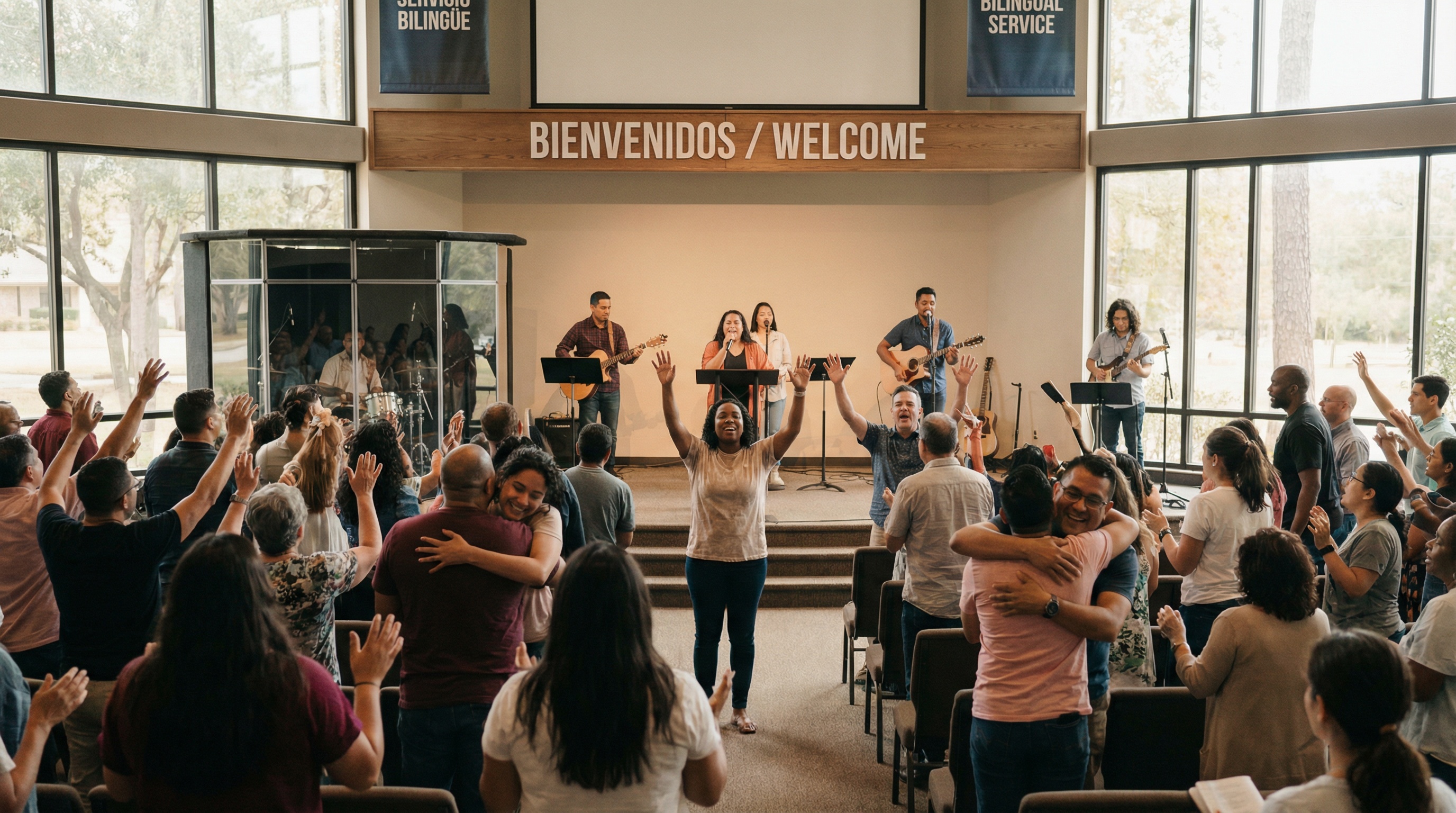
How to Make Your Church Bilingual: A Practical Guide for Pastors
Your neighborhood is changing. More families at your local school speak Spanish at home than they did five years ago. Your city's Vietnamese community has more than doubled. A Korean family visited your church three Sundays ago—and never came back. Not because they didn't feel welcomed. Because they couldn't fully understand what was being said.
This is the reality facing thousands of pastors across North America right now. The question is: what do you do about it?
One of the most powerful answers is becoming a bilingual church—a congregation that offers services in two languages so that every family in your community can worship, hear the Gospel, and belong. This guide will walk you through what bilingual church services actually look like, how to get started, and the tools that make it more affordable and practical than ever before.
What Does a Bilingual Church Service Actually Look Like?
The term 'bilingual church services' covers a wide spectrum—from fully separate services in two languages to a single service where everything flows simultaneously in both. Here are the three most common models:
Model 1: Simultaneous Translation
The most seamless option. Your service runs normally in your primary language, while a translator (human or AI) delivers a real-time translation in the second language. Congregation members who prefer the second language listen via smartphones, wireless earpieces, or a dedicated audio feed. No one's experience is interrupted. The English-speaking family in row four and the Spanish-speaking family in row ten both hear the same message in the language they understand best.
Model 2: Alternating-Language Service
Songs, scripture readings, and announcements alternate between two languages throughout the service. The pastor may preach in English while key passages are repeated in Spanish. Worship leaders take turns leading in each language. This approach builds visible unity—but requires intentional planning and a bilingual worship team.
Model 3: Parallel Services
One service is held in English and a separate service in a second language—often on the same day, staggered by an hour. This model gives each language community a fully immersive experience but requires double the staff, volunteers, and resources. Many churches begin with simultaneous translation and grow into parallel services over time.
According to Lifeway Research, effective bilingual worship involves more than translation—it requires intentional cultural integration, bilingual worship materials, and leadership that reflects both communities. Getting the model right for your church is the first step.
Choosing Which Language to Add to Your Bilingual Services
Before you can launch bilingual church services, you need to choose which second language to add. The answer is usually right in front of you—it's the language spoken most in your surrounding community.
Here's how to identify it:
- Walk your zip code: Visit the elementary schools, grocery stores, and community centers near your church. Which languages do you hear most?
- Check census data: The U.S. Census Bureau's American Community Survey provides language-at-home data by zip code. It's free and surprisingly detailed.
- Ask your congregation: Who are your members' neighbors, coworkers, and family members who don't attend church? What languages do they speak?
- Review visitor data: Have non-English-speaking families visited your church before? If so, which languages were represented?
For most North American churches, Spanish is the natural starting point. With over 40 million native Spanish speakers in the United States—and Hispanic communities growing in every region—Spanish bilingual church services represent the single largest untapped opportunity for most congregations. But the same principles apply whether you're adding Chinese, Arabic, Haitian Creole, Vietnamese, or any other language your community speaks.
The Two Approaches to Bilingual Services: Human Interpreters vs. AI Translation
Once you've chosen your second language, you face a critical decision: how will translation actually happen? There are two primary options, and each has real tradeoffs.
Human Church Interpreters
A bilingual volunteer or paid interpreter sits in a soundproof booth (or off to the side) and translates the sermon and announcements in real time. Congregation members tune in via wireless receivers or their smartphones. This approach has been the standard in large churches for decades.
The advantages: high accuracy, ability to handle theological nuance, and a personal touch. The challenges: cost (professional interpreters can cost $200-500 per service), availability (finding a qualified bilingual interpreter for every service is harder than it sounds), and logistics (equipment rental, booth setup, scheduling).
For a detailed breakdown of equipment options, see our guide to church translation equipment.
AI-Powered Real-Time Translation
AI translation has changed the game for bilingual church services. Platforms like Glossa.live listen to your sermon in real time and deliver natural-sounding translation in 100+ languages—directly to congregation members' smartphones. No interpreter needed. No special equipment. Just a phone in the listener's hand and a QR code they scan when they sit down.
Glossa's AI is specifically trained on biblical language and church contexts—so it understands terms like 'sanctification,' 'the blood of the Lamb,' and 'justification by faith' the way a theologian would, not the way a generic translation app might. The result is translation that feels natural in a worship context.
Compare the two approaches head-to-head:
| Factor | Human Interpreter | AI Translation (Glossa.live) |
|---|---|---|
| Cost | $200–$500/service | From $5/hour per language |
| Setup time | 1–2 hours | Under 5 minutes |
| Languages supported | 1 (per interpreter) | 100+ |
| Equipment needed | Booth, receivers, mixers | Any smartphone |
| Availability | Dependent on scheduling | Always available |
| Theological accuracy | Excellent | Very good (biblically trained) |
For many churches—especially smaller congregations without large budgets—AI translation represents the most practical path to genuine bilingual church services. You can learn more about the cost comparison in our article on affordable church translation options.
Step-by-Step: How to Launch Bilingual Church Services
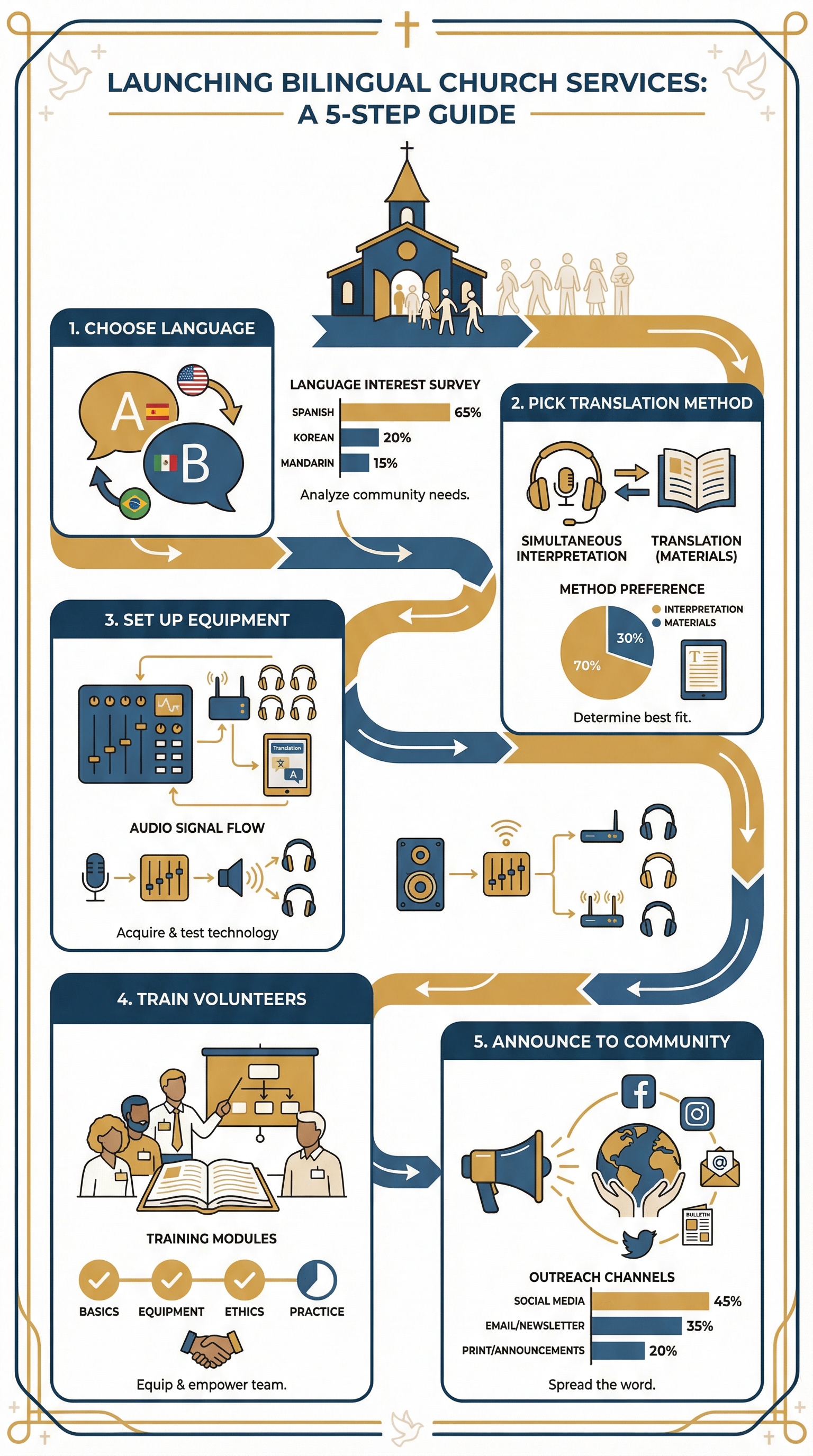
Ready to move from idea to reality? Here's a practical roadmap for launching bilingual church services at your church:
Step 1: Get Leadership Buy-In
Before anything else, your elders, deacons, and key leaders need to be aligned on the vision. Present the demographic reality of your community. Share the biblical mandate for multilingual worship (Revelation 7:9 describes every nation, tribe, people, and language worshipping together). Discuss what it would mean for your church's mission to remove the language barrier between your current congregation and the families just outside your doors.
Step 2: Choose Your Translation Approach
Based on your budget, volunteer resources, and church size, decide between simultaneous AI translation, human interpreter, or alternating-language worship. For most churches launching bilingual services for the first time, we recommend starting with AI translation—it's the most affordable, scalable, and easiest to set up. You can always layer in additional approaches as your bilingual ministry grows.
Step 3: Set Up Your System
If you're using Glossa.live, setup takes minutes, not days. You can embed Glossa on your church website so members can access it before they even arrive, or simply display a QR code in the bulletin and on the welcome screen. Congregation members scan the code, select their language, and they're connected to your service in real time. No apps to download, no hardware to install.
Step 4: Prepare Bilingual Materials
Translation is just the audio—but bilingual church services work best when the whole worship experience is multilingual. Create bulletins in both languages. Display song lyrics in both languages on the worship screens (or on alternate slides). Consider having a bilingual greeter at the door. Small touches communicate that every language is truly welcome here.
Step 5: Announce and Invite
Once your system is ready, spread the word—especially in the communities you're trying to reach. Work with local Spanish-speaking (or Vietnamese, Mandarin, etc.) community organizations, schools, and businesses. Post on social media in both languages. Consider hosting a community meal or event in the weeks before your launch. The announcement of bilingual church services is itself an act of welcome.
Common Challenges When Starting Bilingual Church Services
Starting any new ministry initiative involves growing pains. Here are the most common challenges churches face when launching bilingual services—and how to handle them:
Challenge: Translation Feels Disjointed
"Our Spanish-speaking members say the translation doesn't always match the pastor's energy." This is more common with older hardware-based translation systems. AI-powered solutions like Glossa are specifically designed to match the rhythm and tone of spoken sermons—not just translate the words, but convey the emotion behind them.
Challenge: Low Initial Adoption
You launch bilingual services and only two people use the translation. This is normal at first. Non-English speakers are often cautious about whether a church truly welcomes them before they try. Consistent promotion, bilingual signage, and personal invitations from bilingual members will build trust over time. Give it three to six months before evaluating reach.
Challenge: The Congregation Feels Split
Some bilingual churches report that simultaneous translation makes services feel like two separate groups occupying the same room. The antidote is intentional community: shared meals, bilingual small groups, joint service projects, and moments in the service where both language communities come together visibly. As research from Calvin Institute of Christian Worship shows, multilingual worship at its best creates unity across difference—not just coexistence.
Challenge: Volunteer Burnout
If you're relying on bilingual volunteers for interpretation, the schedule can become exhausting. One of the key advantages of AI translation is that it reduces dependence on individual volunteers—your Spanish ministry doesn't collapse when your bilingual volunteer takes a vacation.
Real Churches Building Bilingual Ministries
Bilingual church services aren't a theoretical possibility—they're a growing reality at churches of every size and denomination.
Hillsong Church runs multilingual services at locations worldwide, reaching Korean, Mandarin, and Spanish speakers alongside their English-speaking congregation. ICF Limassol serves Arabic and Russian speakers through real-time translation. Korean Presbyterian churches across Texas have used simultaneous translation for decades to serve both Korean-speaking elders and English-speaking second-generation members in the same service.
These churches share a common conviction: every person in the room deserves to fully understand what's being said. Not a partial experience. Not just worship songs. The whole message, in the language they speak at home.
For more stories of how churches are making this work, read our article on how churches are reaching immigrant communities through real-time translation.
Is Your Church Ready to Become Bilingual?
You don't need to be Hillsong. You don't need a $50,000 AV budget or a team of professional interpreters. Today, a church of 80 people can offer high-quality bilingual church services for the cost of one monthly cell phone bill.
What you do need is a clear vision of who you're trying to reach, a willingness to invest in welcome, and a tool that makes it practical. That's exactly what Glossa.live is built for—affordable, reliable, real-time translation that works on any device, in 100+ languages, with no special equipment required.
If your community includes families who speak Spanish, Vietnamese, Mandarin, Arabic, Haitian Creole, or any of the 100+ languages Glossa supports, you have everything you need to start this Sunday.
Take the First Step Toward Bilingual Church Services
The families in your community aren't waiting for a perfect multilingual program. They're waiting for a church that genuinely tries—a place where they hear the Gospel in their own language and know they truly belong.
Becoming a bilingual church is one of the most powerful things you can do for your mission right now. And it's more achievable than you think.
Start with one language. Start this week. Start free.
Visit glossa.live to try real-time AI translation for your church service. You'll be surprised how quickly your bilingual church services can become a reality.