How to Reach Congolese-Speaking Families at Your Church
When a Congolese family walks into your sanctuary for the first time, you are meeting people from one of the most Christian countries on earth. More than 95% of Congolese people — roughly 100 million across the Democratic Republic of the Congo and the Republic of Congo — identify as Christian. Sunday worship in Kinshasa, Lubumbashi, and Brazzaville starts early and runs long. Choirs arrive hours before service. Drums, guitars, dance, and four-part Lingala harmonies fill rooms from dawn. This is a Congolese church culture unlike any other — one your English-speaking congregation can welcome, learn from, and grow alongside.
In the United States, Congolese families are one of the fastest-growing African immigrant communities. The U.S. Refugee Admissions Program has resettled tens of thousands of Congolese refugees since 2014, and the Diversity Visa program has added thousands more. DataForSEO places monthly U.S. search volume for "congolese church" at 14,800 — one of the highest volumes for any African-diaspora church search term. Every one of those searches is a real person — a mother who fled eastern Congo with her children, a father on a work visa from Brazzaville, a Kinshasa-born pastor planting a small house church in Dallas — looking for a congregation that honors their faith, their languages, and their story.
If your church is in Dallas, Portland (Maine), Minneapolis, Boston, Phoenix, Atlanta, Kansas City, Grand Rapids, or Houston, Congolese families almost certainly live within a few miles of your building. This guide will help you understand who they are, why Congolese worship feels different, and how to welcome them well — without launching a separate French or Lingala service from scratch.
Who Are Congolese-Speaking Families in America?
Congolese families in the U.S. come from two neighboring but distinct countries. Understanding the difference matters — confusing them is a bit like lumping together someone from Ireland and someone from Scotland.
The Democratic Republic of the Congo (DRC), the larger of the two, has a population of about 100 million and is the second-largest country in Africa. Its capital is Kinshasa — a megacity of more than 17 million people. Most Congolese-American families come from the DRC. The DRC has endured decades of war, particularly in the eastern provinces of North and South Kivu, Ituri, and Tanganyika. The Second Congo War (1998–2003) displaced more than five million people, and conflict in the east continues. Many Congolese refugees in the U.S. are survivors of that violence — from cities like Goma, Bukavu, Uvira, and Beni.
The Republic of Congo (Congo-Brazzaville), across the river from Kinshasa, is a smaller, French-speaking country of about 6 million. Its capital, Brazzaville, sits directly opposite Kinshasa across the Congo River. Brazzaville Congolese often reach the U.S. through professional visas, student exchanges, or diversity visas more than through refugee resettlement. They share many cultural patterns with their DRC neighbors but have their own distinct history.
The largest Congolese-American communities are in Dallas-Fort Worth (estimated 30,000+ — the largest Congolese diaspora city in the country), Portland, Maine (a major refugee resettlement hub), Phoenix, Minneapolis-St. Paul, Boston and Worcester, Grand Rapids, Kansas City, Columbus, and Atlanta. In each of these cities, Congolese families are planting churches, joining existing congregations, and looking for pastors who will welcome them by name.
Four Languages, One People: Lingala, French, Swahili, Kikongo
One of the first things a pastor learns about Congolese families is that "Congolese" is not a single language. The DRC alone has more than 200 languages. Four matter most for church ministry:
French is the official language of both Congos. Every Congolese adult who completed school can read and speak French. Government forms, legal documents, and formal education happen in French. For older Congolese, French still carries the weight of formality and official business — including, for many Catholics, the Mass.
Lingala is the lingua franca of western DRC and the Republic of Congo. It's the language of Kinshasa, of the famous Congolese rumba and soukous music, and of most Pentecostal and evangelical worship. When a Congolese family wants to sing, praise, pray aloud, or tell a story from the heart, they reach for Lingala. The vast Congolese praise and worship music tradition — from Alain Moloto to Dena Mwana to Mike Kalambay — is sung almost entirely in Lingala.
Swahili is the language of eastern DRC — Goma, Bukavu, Lubumbashi, and the Katanga region. Swahili-speaking Congolese often come from the eastern war zones and resettle as refugees. Many also speak Lingala and French, but Swahili is their heart language. This is the same Swahili spoken across Tanzania, Kenya, Uganda, Rwanda, and Burundi — so Swahili-speaking Congolese often worship comfortably alongside other East African families.
Kikongo (sometimes called Kituba, a simplified creole form) is spoken in the Bas-Congo region and in much of Congo-Brazzaville. It's the heart language of many older Kimbanguist and Catholic families.
A practical reality: most Congolese adults in the U.S. can worship in French. But their heart language — the language of grief, joy, lullabies, and grandmothers — is Lingala, Swahili, or Kikongo. When your church can offer worship, prayer, or a sermon in even one of those heart languages, something shifts. Real-time AI translation makes this possible for small churches that couldn't otherwise staff a French service, let alone a Lingala or Swahili one.
Why Congolese Worship Feels Different (And Why That Matters)
If you have never attended a Congolese worship service, expect a shock — in the best sense. Services commonly last three to five hours. The worship set alone can run 90 minutes. The choir wears matching uniforms, rehearses four to six hours a week, and sings in four- or five-part harmony with synchronized dance steps. Offering time is joyful, loud, and often involves the entire congregation dancing toward the front with their gifts. Intercessory prayer is spoken out loud by everyone at once, in a powerful wave of Lingala and French.
This is not performance. This is culture. In Congolese Christianity, bringing your whole body to worship is a theology — a lived response to suffering that says, "We are still standing, and God is still God." For Congolese families who have survived war, displacement, and refugee camps, this is not optional. It is how faith survives.
When a Congolese family attends an English-speaking American service — 35 minutes of quiet songs, a stationary pastor, an orderly offering — they may feel that they've entered a library, not a church. They love you anyway. They sing along anyway. But their spirit is hungry. The work of multilingual ministry is not to replace your style — it is to open a door so a Congolese mother can hear the sermon in French or Lingala, feel understood, and over time, bring her worship with her.
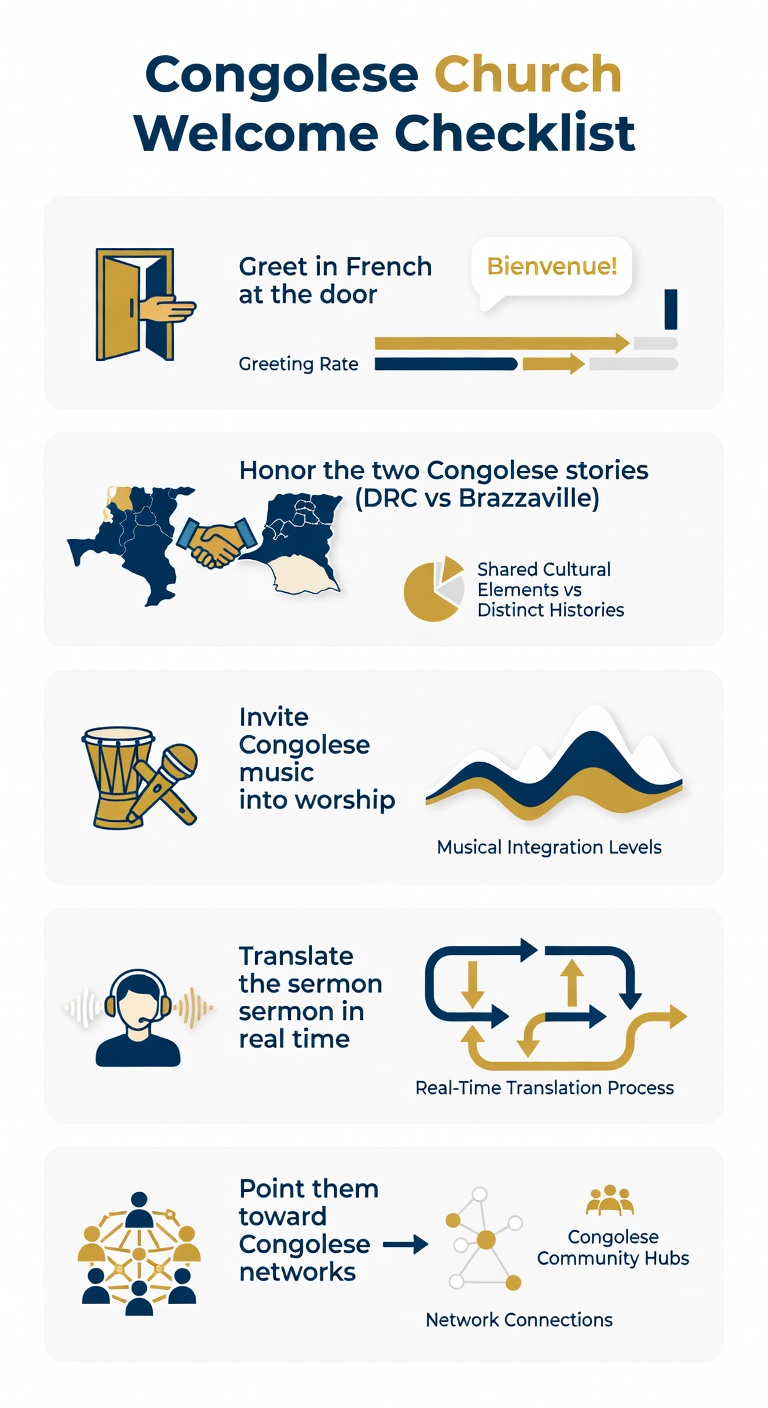
Five Ways to Welcome Congolese Families This Month
You do not need a separate French service, a Lingala choir, or a Congolese associate pastor to welcome Congolese families well. You need to show that you see them. Here are five concrete steps any congregation can take in the next 30 days.
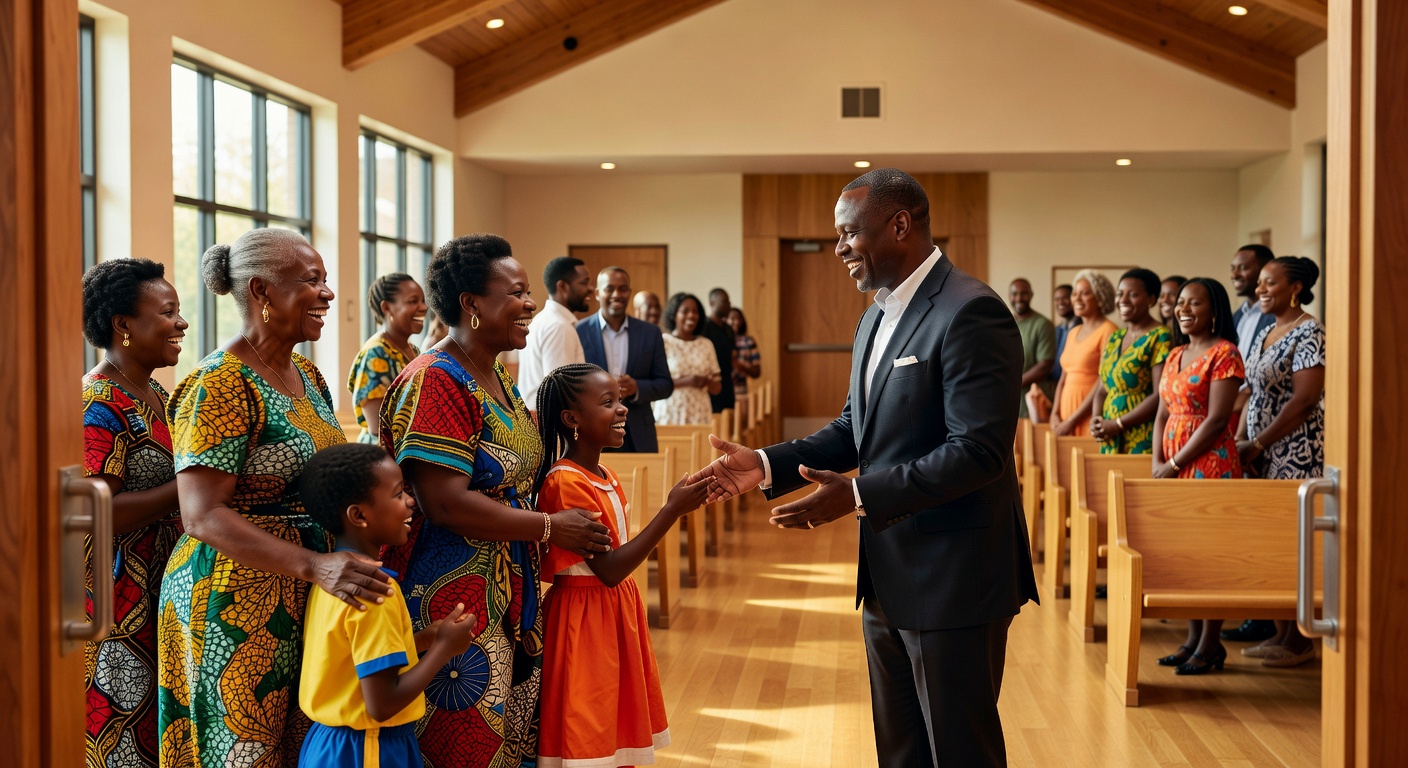
1. Greet in French at the Door
A simple "Bonjour — bienvenue chez nous" at the welcome desk costs nothing and signals everything. French is the official language of 29 countries and about 320 million speakers, including most Congolese, Haitians, Ivorians, Senegalese, Cameroonians, Burundians, and Rwandans. Training three greeters to say "Bonjour," "Bienvenue," "Comment vous appelez-vous?" and "Nous sommes heureux de vous accueillir" is a one-hour investment that changes the feel of a Sunday for an entire French-speaking African network.
2. Honor the Two Different Congolese Stories
Ask gently: "Are you from Kinshasa side, or Brazzaville side?" A family from Goma has a completely different history from a family from the Republic of Congo. Many Congolese from eastern DRC are refugee survivors of horrific violence — and they may not want to talk about it on the first Sunday, or ever. Respect that. Don't ask about the war. Do ask about their family, their cooking, their church back home, and their favorite hymn. Let the harder stories come in their own time.
3. Invite Congolese Music Into Worship
Congolese praise and worship is one of the richest musical traditions in global Christianity. Even one Lingala song per quarter — "Monene Ozali" (How Great Thou Art), "Yesu Azali Awa" (Jesus Is Here), or any Dena Mwana worship track — communicates welcome in a way that no English announcement can. If your worship leader is intimidated by a foreign language, invite a Congolese family to lead one verse of a familiar hymn in Lingala or French. It will transform the room.
4. Translate the Sermon in Real Time
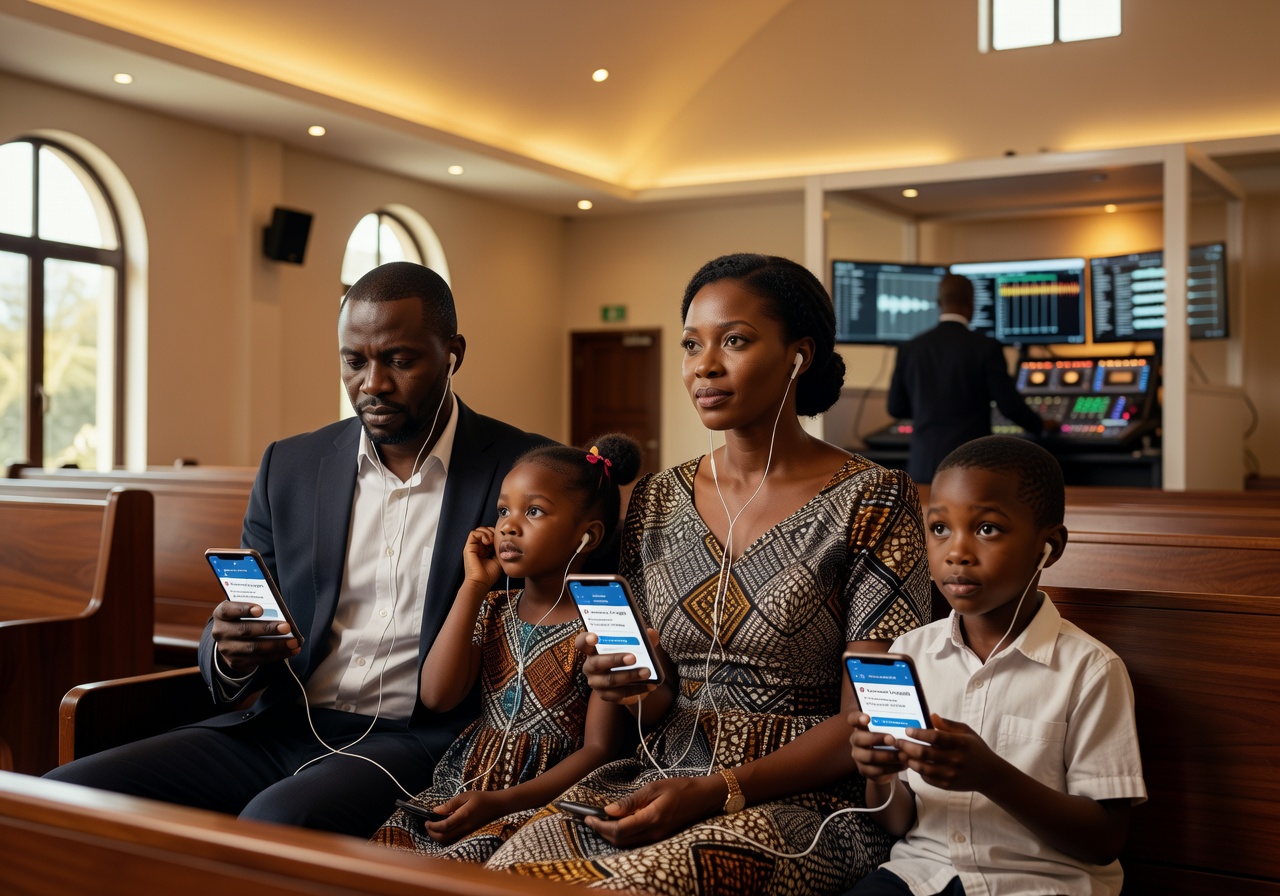
Nothing says "you belong" like hearing the sermon in your own language without having to ask, without special equipment, without being separated from the rest of the congregation. Real-time translation through Glossa lets Congolese visitors listen to your pastor's sermon in French, Lingala, or Swahili on their own phones, while the rest of your congregation experiences the same service, unchanged. For a step-by-step walkthrough, see our guide on how to start multilingual church services.
5. Point Them Toward Congolese Christian Networks
Even if your church isn't primarily Congolese, you can bless Congolese families by knowing who is. Congolese Pentecostal networks — Armée de l'Éternel, Église du Christ au Congo (ECC), Communauté des Églises Évangéliques au Congo, Kimbanguist parishes, and many independent Pentecostal churches — operate in most major U.S. metros. A pastor who can say, "We'd love to keep worshipping with you — and there are three Congolese families in town you should also meet, and a Congolese pastor friend of mine in Dallas" is a pastor Congolese families trust.
How Congolese Families Actually Find a Church
Congolese families search online in a mix of English and French. The dominant search, by far, is simply "congolese church" — 14,800 monthly U.S. searches per DataForSEO. Long-tail searches include "congolese church near me," "congolese church in [city]," "église congolaise près de moi," and "lingala church service." Many families also search for specific networks: "Armée de l'Éternel [city]," "Kimbanguist church [city]," or "communauté francophone église."
Four website updates will help your church show up in those searches:
- Add one line to your homepage: "We welcome French, Lingala, and Swahili-speaking families. Real-time translation is available during every service."
- Create one blog post titled "A Warm Welcome to Congolese Families in [Your City]" — 800 words with a few Lingala and French greetings will start ranking within weeks.
- Add a French paragraph to your "What to Expect" page: "Bienvenue. Nous offrons la traduction en temps réel en français et lingala chaque dimanche."
- Tag your livestream with "French translation available," "Lingala translation available," and "Swahili translation available." Most Congolese diaspora families watch online first.
For a deeper look at how churches are serving immigrant communities online, see our guide on how churches are reaching immigrant communities and our piece on streaming church services in multiple languages.
Real-Time Congolese Translation: What Actually Changes on a Sunday
The shift isn't technological — it's pastoral. When a Congolese grandmother hears her American grandson's pastor preach in French or Lingala, through her own phone, she stops being a guest. She becomes a member. When a Swahili-speaking refugee father from Goma finally understands why the congregation is praying for peace in the Middle East this week, he realizes his war, too, is remembered.
A multilingual service using Glossa looks like this in practice:
- Your pastor preaches in English, exactly as before.
- Congolese visitors scan a QR code on the bulletin (or open a short link like *glossa.live/yourchurch*).
- The sermon is translated in real time into French, Lingala, Swahili — and 95+ other languages — all at the same time.
- Each person listens through phone earbuds, reads captions on screen, and follows the full service in their heart language.
No headsets to distribute. No separate French service to staff. No interpreter to recruit and pay. Your English-speaking congregation experiences the service unchanged. But a Congolese family — along with Haitian, Korean, Ethiopian, Ukrainian, and Spanish-speaking families — can now participate fully, together.
If you want to compare this with traditional approaches, our guide on church translation equipment breaks down hardware systems versus app-based translation, and our deep dive on AI translation for church services explains how the underlying technology actually works for liturgical and sermon content.
Congolese Cultural Moments Worth Knowing
A few Congolese cultural and Christian calendar dates that will strengthen your connection:
| Date / Season | What It Means | How a Pastor Can Honor It |
|---|---|---|
| June 30 — DRC Independence Day | Congo's independence from Belgium in 1960; a day of national pride. | A brief pulpit acknowledgment, a Lingala hymn, or a prayer for peace in the DRC. |
| August 15 — Republic of Congo Independence Day | Independence from France in 1960; celebrated by Brazzaville families. | A French greeting and prayer for the Republic of Congo. |
| April 6 — Kimbanguist founding (Simon Kimbangu) | The founding prophet of Kimbanguism, a major Congolese indigenous Christian movement. | For Kimbanguist families, a pastoral acknowledgment is deeply meaningful. |
| Christmas (Noël) — December 25 | Celebrated with all-night services, new clothes, dancing, and feasting. | Invite a Congolese family to share a Lingala or French carol during Christmas Eve. |
| Palm Sunday and Good Friday | Processions, Passion plays, and all-night vigils are common. | Consider a bilingual French/Lingala reading during Holy Week. |
Marking even one of these publicly signals to every Congolese family in driving distance: *this church sees us.*
Common Concerns (And Honest Answers)
"Our church is small. Is this really worth it?"
Yes. Congolese families move in networks, not individuals. One family who feels truly welcomed will bring their cousin, their aunt, their neighbor, their Facebook group. And because Glossa serves 100+ languages at once for the same setup, the same investment also welcomes Haitian, Ethiopian, Spanish-speaking, and Ukrainian families. Your per-language cost approaches zero as more communities participate.
"Will AI really translate Lingala well? It's a minority language."
Modern AI translation has made enormous progress on African languages. Lingala, Swahili, and French are all supported in Glossa with quality that is good enough for sermons, scripture, and announcements — especially for Lingala speakers who are bilingual with French. Swahili translation quality is strong thanks to the huge East African training corpus. Kikongo and Tshiluba are smaller languages and work best when paired with a French fallback, which Glossa does automatically. For details, see our guide on how AI translation works for church services.
"Should we just plant a Congolese church instead?"
If God is calling a Congolese pastor in your region to plant, bless them, partner with them, and share resources. But church planting is a 5–10 year process. Congolese families in your neighborhood today need a place to worship this Sunday. Real-time translation is not a replacement for a Congolese congregation — it is a bridge that lets you welcome Congolese families right now, while longer-term work continues.
"What about the music gap? Our style is so different."
Honest answer: yes, your music will feel short and quiet to Congolese ears. They will still come if you welcome them well. Many Congolese families attend an English-speaking service for the sermon and community, then attend a Congolese house church on Friday or Saturday night for the full-length worship experience. Offering sermon translation in French or Lingala means you can be their *pastor*, not their only church. That's a gift.
"What if only one or two Congolese families ever come?"
Those two families matter. They represent a community. They represent a grandmother in Kinshasa who prays every night that her daughter and grandchildren in America found a good church. Making space for two families makes space for twenty.
The first Sunday we played Glossa in French, a Congolese mother stayed after service and cried. She said, 'For five years I have been going to American church. Today is the first time I heard the sermon.' That's what translation gives back. Not just words. Understanding.
One Small Step This Sunday
If this article has you thinking about a Congolese family in your neighborhood — the nursing assistant at the retirement home, the rideshare driver who greets you in French, the family with five kids who moved in last fall — start small. This Sunday:
- Put one line on the welcome screen: "Bienvenue — Boyei Malamu — Karibu — Welcome." (That's French, Lingala, Swahili, English.)
- Add one sentence to the bulletin: *Real-time French, Lingala, and Swahili translation available on any phone — ask an usher for the link.*
- Mention from the pulpit: "If French, Lingala, Swahili, or another language is your heart language, you can follow every word of this service in your language today."
One Sunday will not fill your sanctuary with Congolese families. But one Congolese mother, noticing that line in the bulletin, will take a photo, send it to her WhatsApp group, and three Sundays from now a second family will walk in. That's how multicultural congregations grow — not through a program launch, but through the slow, faithful accumulation of small welcomes. For a fuller playbook, see our guide on how to build a multicultural church and our post on overcoming language barriers in church.
A Final Word
The Congolese Christian story is not new. It is nearly 150 years old in its Protestant form, more than 500 in its Catholic form, and ancient in its indigenous prophetic tradition. Congolese believers have carried the Gospel through colonization, two civil wars, HIV/AIDS devastation, Ebola outbreaks, and the ongoing violence of the eastern provinces — and they are now, in 2026, weaving their faith into American congregations from Portland, Maine to Phoenix. Your church does not have to invent anything to welcome them. You just have to open the door in the languages they already speak.
Real-time French, Lingala, and Swahili translation is one of the simplest, most practical doors you can open this year. One setup. One Sunday. One Congolese family hearing the Gospel in their heart language — for the first time in your building.
Ready to try it? Start at Glossa, read our walkthrough on how to embed Glossa on your website, and reach out if you'd like help setting up Congolese translation for your next Sunday service.
Boyei malamu. Bienvenue. Karibu. Welcome. We're glad you're here.