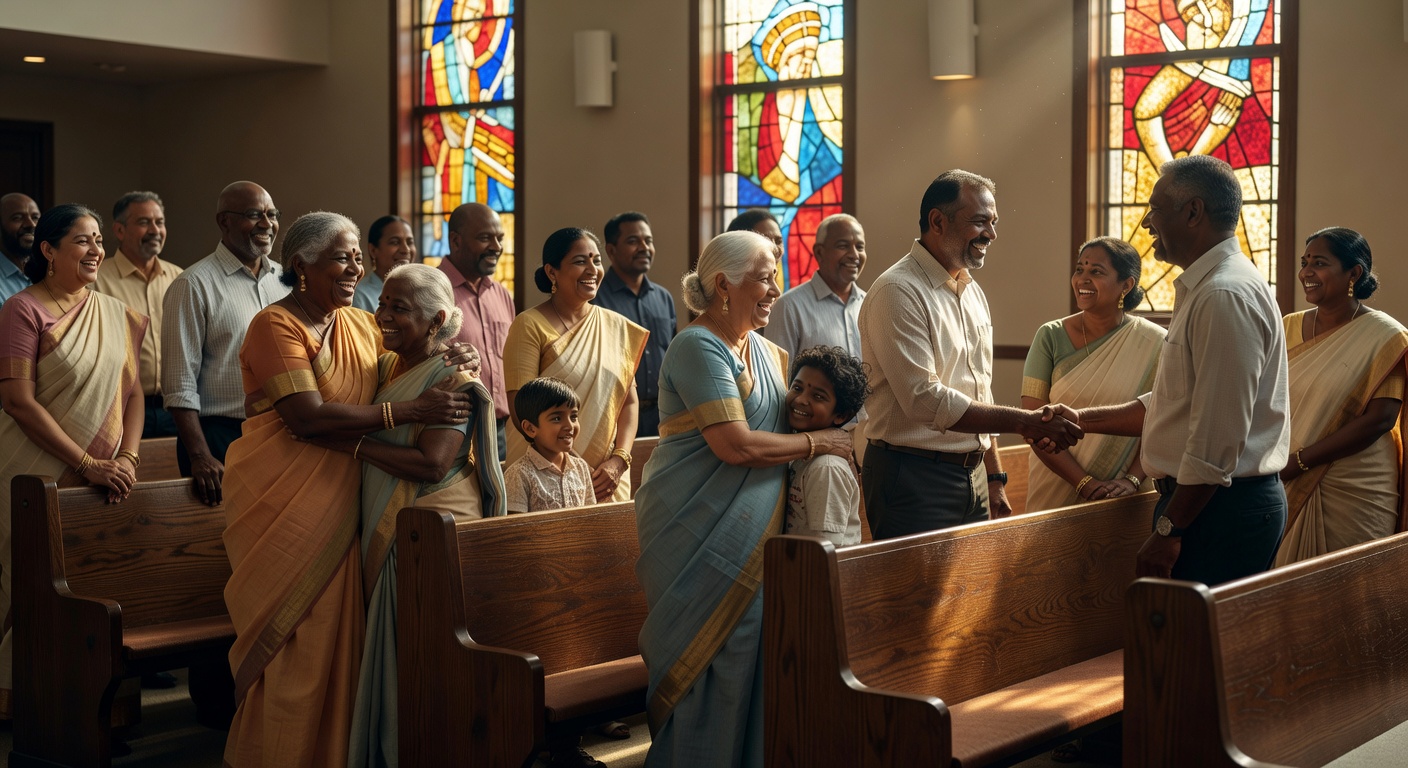
How to Reach Tamil-Speaking Families at Your Church
When a Tamil-speaking family walks through your church doors for the first time, you are meeting people whose Christian faith may be older than yours by a thousand years. The Tamil church traces its roots to the Apostle Thomas — who, according to centuries of Tamil and Malayalam tradition, landed on the Malabar coast of India in AD 52 and is buried in what is now Chennai. That story shapes the way many Tamil Christians approach worship: with quiet confidence, deep reverence, and a love for language that has carried their faith through twenty centuries.
In the United States today, Tamil Christians are one of the fastest-growing and most underserved immigrant church populations. Houston, Atlanta, Dallas, Chicago, Edison, Fremont, Troy, Seattle, and the Washington, D.C. metro area all have active Tamil congregations. According to search data, "tamil church" is searched about 1,600 times a month in the U.S. alone, with hundreds more monthly searches for "houston tamil church," "atlanta tamil church," "dallas tamil church," and "tamil church near me." Those searches are real people — engineers on H-1B visas, Sri Lankan Tamil refugee families, nurses, students, and second-generation kids — looking for a congregation that speaks their heart language.
If your church is in a city with even a modest South Asian population, chances are Tamil-speaking families already live within a few miles of your building. This guide will help you understand who they are, what they care about, and how to welcome them well — without starting a whole new ministry from scratch.
Who Are Tamil-Speaking Families in America?
Tamil is one of the world's oldest living classical languages, spoken today by roughly 79 million people worldwide. In the United States, Tamil-speaking families come from two main streams, and understanding both is the first step to serving them.
Indian Tamils come primarily from Tamil Nadu (Chennai, Coimbatore, Madurai) and the neighboring states of Kerala and Karnataka. Many are Christians from long-established traditions: the Church of South India (CSI), Roman Catholic parishes tied to the Archdiocese of Madras-Mylapore, Syro-Malabar Catholic families, Tamil Evangelical Lutheran congregations, and rapidly growing Pentecostal and charismatic groups such as the Apostolic Christian Assembly and the Assemblies of God. Many Indian Tamils in the U.S. are highly skilled professionals — software engineers, physicians, researchers — often clustered around tech hubs like Fremont, Plano, Edison, and the North Carolina Research Triangle.
Sri Lankan Tamils tell a different story. Many arrived as refugees during and after the Sri Lankan civil war (1983–2009) — a brutal conflict that displaced hundreds of thousands of Tamils from the Jaffna peninsula and eastern Sri Lanka. Sri Lankan Tamil Christians, often from CSI, Methodist, Anglican, Catholic, or AG backgrounds, carry the weight of that history with them. Welcoming them well means acknowledging that many are survivors — of war, displacement, and refugee camps in Tamil Nadu or resettlement in Canada before coming south.
Both groups share the Tamil language, Tamil literature, Tamil music, and an intense cultural pride in Pongal (the January harvest festival), Tamil Puthandu (Tamil New Year, April 14), and the beauty of Tamil Christian hymns — many written by Vedanayagam Sastriar in the 1800s and still sung today.
Why "Just Come to English Service" Doesn't Work
Tamil is one of the most fiercely preserved languages in the world. Tamil families — whether Hindu, Christian, or Muslim — raise their children to read, write, and speak Tamil long after immigration. Tamil Sunday Schools, Tamil cultural associations (Tamil Sangams), and Tamil-language newspapers exist in almost every major U.S. metro. When a grandmother visits from Chennai for six months to help with a new baby, she will not understand your English sermon. When a refugee parent from Jaffna sings "Iyesu Nesar" (Jesus the Friend), they are hearing the faith of their childhood in a way no English translation can capture.
The result: Tamil-speaking families often attend English services reluctantly, travel long distances to reach a Tamil-speaking congregation once a month, or simply stop coming. Language is not a preference — it is the doorway through which grandparents, new arrivals, and the heart's first prayers actually enter.
A real-time AI translation solution for your worship service changes that equation. It lets your pastor preach in English while Tamil-speaking visitors listen in Tamil on their own phones — no special receivers, no separate service, no expensive interpreter. The sermon that feels distant in English suddenly becomes personal again in Tamil.
Five Things That Help Tamil Families Feel at Home
You don't need to redesign your whole church to welcome Tamil-speaking families well. You need to show that you see them. Here are five practical steps any congregation can take in the next 90 days.
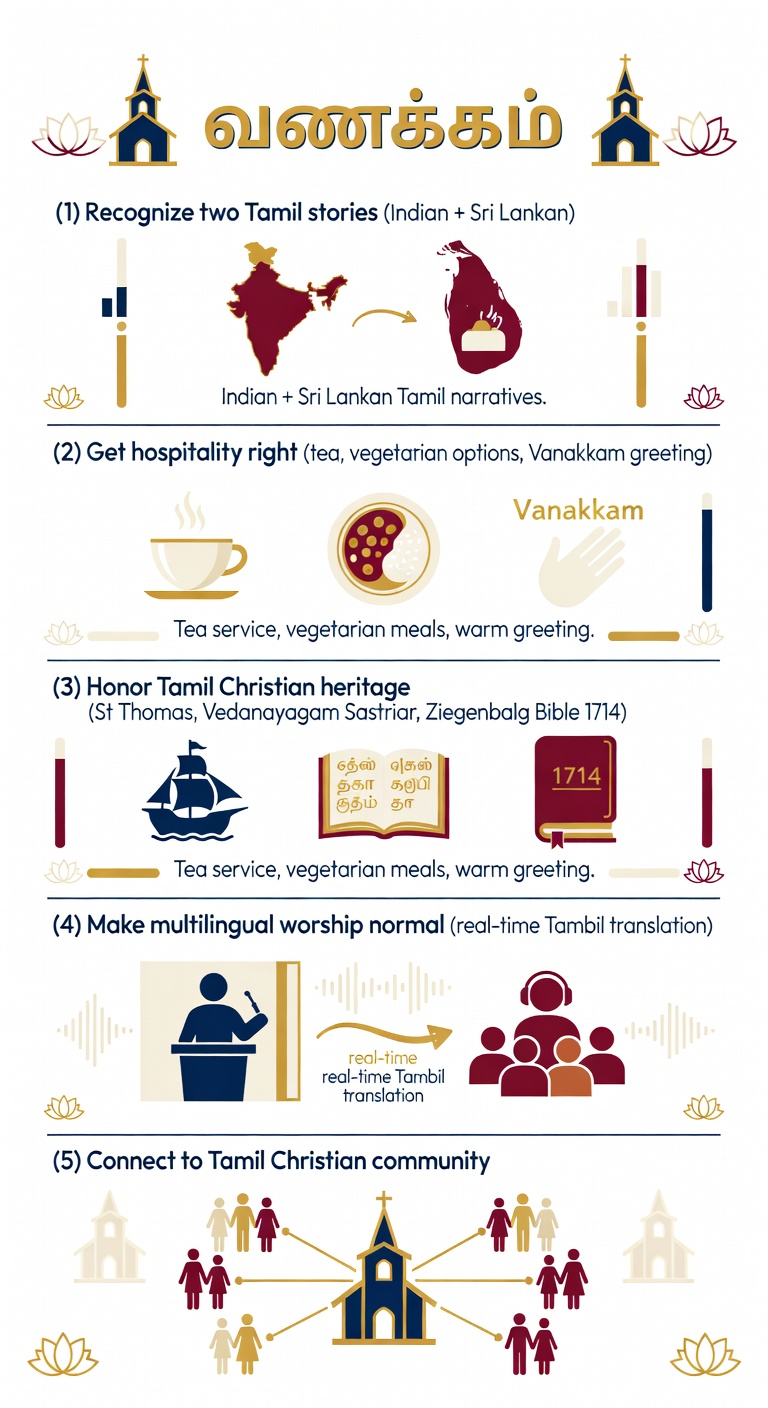
1. Recognize the Two Different Tamil Stories
Ask. Gently. "Are you from Tamil Nadu, or from Sri Lanka?" A Tamil family from Chennai and a Tamil family from Jaffna have shared language but very different histories. Sri Lankan Tamil families may carry grief that is decades old — war, missing relatives, the loss of a homeland. Indian Tamil families may be adjusting to professional pressure, H-1B visa stress, or elderly parents living with them on dependent visas. Don't lump them together, and don't ask intrusive questions. Just make space for the real story to surface when trust has been built.
2. Get the Hospitality Right
Tamil Christian hospitality is rich and generous. If you visit a Tamil home, expect filter coffee, maybe a plate of idlis or a biryani prepared hours in advance. When Tamil families visit your church, match that spirit: offer tea (not just coffee), keep vegetarian options at every potluck (many Tamil Christians were raised vegetarian and some still are), and never assume everyone eats beef. Small things — a warm "Vanakkam" greeting, a handwritten card in Tamil script — matter more than you'd expect.
3. Honor Tamil Christian Heritage
Tamil Christianity is ancient. St. Thomas Christians have been worshipping on the subcontinent since the first century. Vedanayagam Sastriar, the "Christian poet of Tanjore," wrote more than 120 Tamil Christian hymns in the 1700s and 1800s that are still in use. Tamil Bible translation began in 1714 with Bartholomäus Ziegenbalg, the first Protestant missionary to India, who translated the New Testament into Tamil — one of the earliest non-European Bible translations in the world. Acknowledge this heritage publicly. On a Sunday near Tamil Puthandu (April 14), consider singing a Tamil hymn, reading John 3:16 in Tamil script on the screen, or inviting a Tamil family to share a favorite verse.
4. Make Multilingual Worship Normal, Not Special
Nothing says "you belong here" like hearing your language in the room without having to request it. Project scripture in English and Tamil side-by-side for one reading. Sing one verse of a familiar hymn — "Amazing Grace" or "Great Is Thy Faithfulness" — in Tamil. Invite a Tamil teenager to read the call to worship. These are 90-second changes that communicate belonging in a way that no welcome brochure can. For families who want more, offer real-time Tamil translation of the full sermon through Glossa so they can follow every word on their phone, in their own language, without headphones or hardware.
5. Connect Them to a Tamil Christian Community
Even if your church isn't primarily Tamil, you can bless Tamil families by pointing them toward existing Tamil Christian networks. Tamil Christian Fellowships operate in many U.S. cities, CSI congregations serve the U.S. and Canada, Apostolic Christian Assembly Tamil services meet in major metros, and Tamil-language YouTube ministries offer daily teaching in Tamil. A pastor who says, "We'd love to keep worshipping with you — and here are three other Tamil families in town you should meet" is a pastor people trust.
How Tamil Families Actually Find a Church
Pay attention to how Tamil-speaking families search online. Most searches start with a city name: "tamil church houston," "tamil church near me," "tamil christian church dallas," "tamil worship service chicago." Search volume data from DataForSEO shows "houston tamil church" getting about 480 monthly searches, "atlanta tamil church" around 390, and "dallas tamil church" around 320. That means a family is actively looking — right now — and your church may be the answer if they can find you.
Three simple website changes will help:
- Add one line to your homepage: "We welcome Tamil-speaking families. Real-time Tamil translation is available during our Sunday service."
- Create one blog post titled "A Warm Welcome to Tamil-Speaking Families in [Your City]" — it takes 30 minutes and will start appearing in Google searches within weeks.
- Add a "Tamil translation available" badge to your livestream page. Most Tamil diaspora families watch online before visiting in person.
If you want help writing the content, our guide on how to start multilingual church services walks through the step-by-step process, and our piece on how churches are reaching immigrant communities shows what's already working in dozens of congregations.
Real-Time Tamil Translation: What Actually Changes on a Sunday
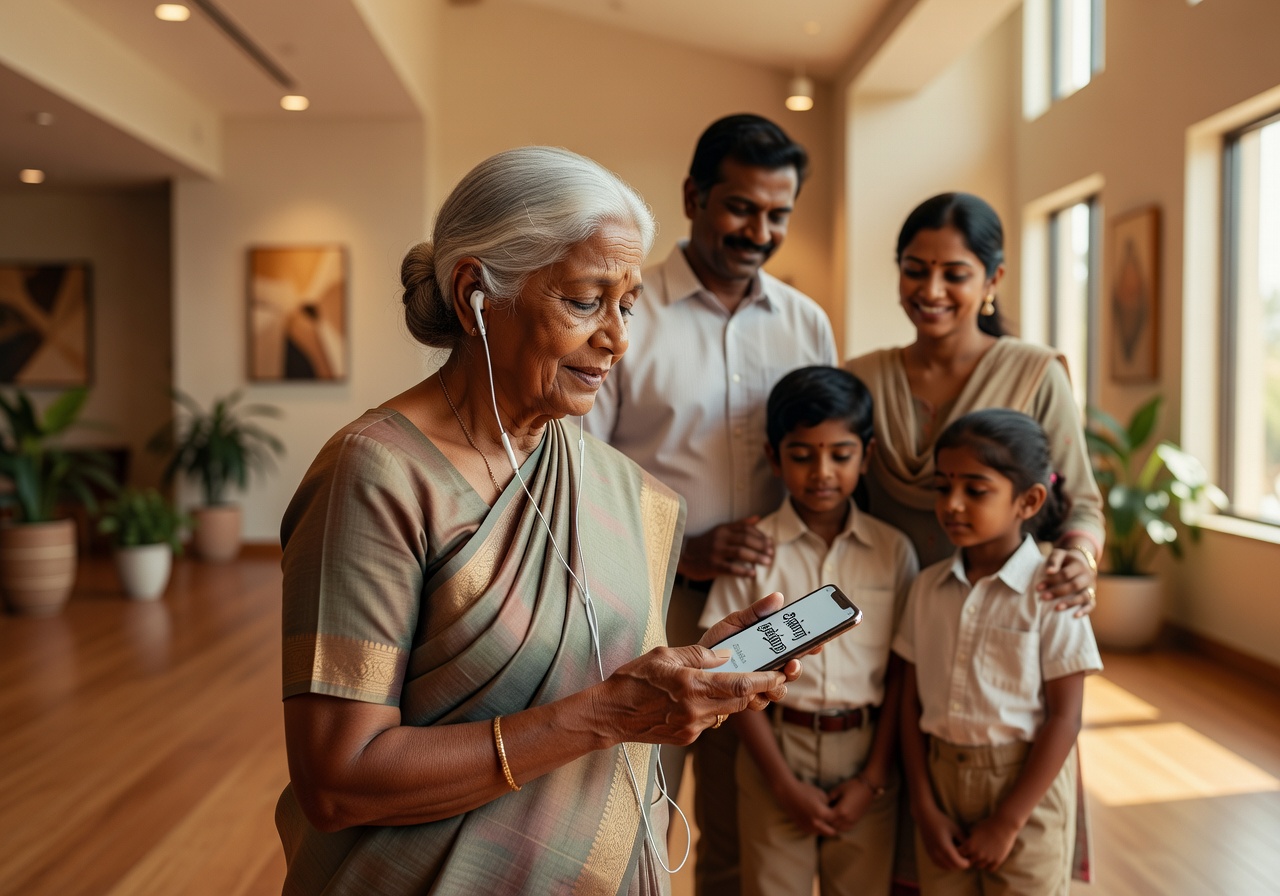
The biggest shift isn't technological — it's emotional. When a Tamil-speaking grandmother hears her grandson's pastor preach, in Tamil, through her own phone, something changes in the room. She stops feeling like a visitor. She starts feeling like a member.
Here's what a multilingual service using Glossa actually looks like in practice:
- Your pastor preaches in English, exactly as they always have.
- Tamil-speaking visitors scan a QR code on the bulletin or on the screen, or open a short link like *glossa.live/yourchurch*.
- The sermon is translated in real time into Tamil — and 99 other languages at the same time.
- Each person listens through their own phone earbuds, hears Tamil in a natural voice, and can follow the captions on screen as well.
No receivers to distribute. No separate Tamil service to staff. No interpreter to recruit. Your English-speaking congregation sees no change in how their service flows. But a Tamil family — or a Korean family, or a Spanish family, or an Arabic family — can now fully participate.
If you're curious about the nuts and bolts, our guide on how to embed Glossa on your website explains the technical setup, and our deep dive on church translation equipment compares Glossa to older hardware-based systems.
Tamil Cultural Moments Worth Knowing
A few Tamil cultural and Christian calendar dates that will strengthen your connection:
| Date / Season | What It Means | How a Pastor Can Honor It |
|---|---|---|
| Tamil Puthandu — April 14 | The Tamil solar new year, celebrated by Hindus, Christians, and Muslims alike. | A warm pulpit greeting: "Iniya Tamil Puthandu Vazhthukkal!" ("Happy Tamil New Year!") |
| Pongal — Jan 14–17 | A four-day Tamil harvest thanksgiving festival. | Mention harvest and gratitude in that week's sermon; invite a Tamil family to share a Pongal testimony. |
| St. Thomas Day — July 3 | Feast day of the apostle who brought Christianity to India in AD 52. | A gift for Tamil Catholic and Syro-Malabar families — mention the Tamil church's ancient roots. |
| Kiristhu Jayanthi (Christmas) | Tamil Christmas, celebrated with carols and family feasts. | Invite a Tamil family to share a Tamil carol during Christmas Eve. |
Marking even one of these publicly — especially Tamil Puthandu or Christmas — signals to every Tamil family in driving distance: *this church sees us.*
Common Concerns (And Honest Answers)
"Our church is small. Is this really worth it?"
Yes. Real-time translation costs a fraction of hiring an interpreter and reaches 100+ languages, not just Tamil. Even if only three Tamil families ever attend, those three families can bring cousins, aunties, and friends — Tamil communities move as networks, not individuals.
"Will the translation really be good enough?"
Modern AI translation models, including the ones built for Glossa, are specifically trained on biblical and liturgical language. They handle Tamil sermons, scripture readings, and worship in a way that would have been impossible even three years ago. Not perfect — but good enough that Tamil-speaking grandparents repeatedly report understanding the whole sermon for the first time. (For a deeper dive, see our guide on how AI translation works for church services.)
"Should we just hire a Tamil pastor?"
If God brings you a qualified Tamil pastor, wonderful. But most churches don't have that option, and waiting for it can mean leaving Tamil families on the outside for another decade. Real-time translation is not a replacement for a Tamil pastor — it's a bridge that lets you welcome Tamil families today, in English, while the longer vision grows.
"What if we're bilingual already — English and Spanish?"
Even better. Many multilingual churches start by adding Spanish and then discover that families from Tamil, Vietnamese, Korean, and Arabic backgrounds are already attending. The same Glossa setup serves all of them simultaneously — you don't have to choose.
When my grandmother heard the sermon in Tamil through her phone, she cried. For twenty years in America she has sat through English services quietly. That Sunday, for the first time, she felt like she belonged.
One Small Step This Sunday
If this article has you thinking about a Tamil family in your neighborhood — the engineer at the school pickup, the nurse on your block, the new student from Chennai your kid sits next to in math class — start small. This Sunday:
- Put a one-line greeting in Tamil on the screen: "Vanakkam — Welcome." (Tamil script: வணக்கம்.)
- Add one line to your bulletin: *Real-time Tamil translation available on any phone — ask an usher.*
- Mention from the pulpit that anyone who speaks Tamil, Spanish, Korean, Vietnamese, or another language at home can follow the whole service in their heart language.
That single Sunday will not fill your sanctuary with Tamil families. But one Tamil family, noticing that line in the bulletin, will take a photo, send it to their cousin in Edison, and two Sundays from now a second family will walk in. That's how multilingual churches grow — not through a program launch, but through the slow, faithful accumulation of small welcomes. For a fuller playbook, see our guide on how to build a multicultural church and our post on overcoming language barriers in church.
A Final Word
The Tamil Christian story is not new. It is two thousand years old. Tamil believers have carried the Gospel through famine, colonization, civil war, and migration — and they are now, in 2026, weaving it into the fabric of American congregations from Atlanta to San Jose. Your church does not have to invent anything to welcome them. You just have to open the door in the language they already speak.
Real-time Tamil translation is one of the simplest, most practical doors you can open this year. One setup. One Sunday. One Tamil family hearing the Gospel in Tamil — for the first time in your building.
Ready to try it? Start with the homepage at Glossa, read our walkthrough on how to start multilingual church services, and reach out if you'd like help setting up Tamil translation for your next Sunday service.
Vanakkam. Welcome. We're glad you're here.