How to Reach Persian-Speaking Families at Your Church
When an Iranian family walks through your church doors for the first time, they often carry a story more remarkable than you realize. Many Persian-speaking believers in the United States came to faith in a country where conversion from Islam can cost them their freedom, their family, or their life. That a Persian Christian family has found your church at all is, in many cases, the end of a years-long journey through house churches, refugee camps, and resettlement agencies.
And yet, when they sit down in your service, the biggest barrier they face may be something simple: the sermon is in English, and their hearts still pray in Farsi. If you're a pastor, worship leader, or ministry director wondering how to reach Persian-speaking families at your church, this guide will walk you through what you need to know — culturally, practically, and technologically. Persian Christian church growth is one of the most remarkable stories in global missions today, and American churches have an open door to be part of it.
Who Are Persian-Americans, and Where Do They Live?
There are approximately 500,000 to 1 million Americans of Iranian descent living in the United States today, with significant Afghan and Tajik Persian-speaking populations as well. Farsi (also called Persian) is the shared heritage language across these groups, with regional variants: Iranian Farsi, Afghan Dari, and Tajik Tajik. For church outreach purposes, Iranian Farsi is the most widely spoken variant in the US Persian Christian community.
The largest Persian-American populations are concentrated in:
- Los Angeles and Orange County, California — often called "Tehrangeles," this is the largest Iranian community outside Iran, centered in Westwood, Beverly Hills, Glendale, and Irvine.
- Washington, D.C. metropolitan area — a growing community including many post-1979 professionals and recent arrivals.
- Dallas and Houston, Texas — significant and growing Persian populations.
- San Francisco Bay Area — particularly in Silicon Valley and the East Bay.
- New York and New Jersey — established Persian-Jewish and Persian-Christian communities.
- Atlanta, Georgia — a rapidly growing Iranian community, many connected to the refugee resettlement pipeline.
This matters for pastors. If your church is near any of these areas, you almost certainly have Persian-speaking neighbors. Many of them are spiritually open in a way that would surprise you.
Understanding the Persian Christian Church Before You Reach Out
To welcome Persian families well, it helps to understand the remarkable story of what God has been doing among Iranians over the past 40 years. Before the 1979 Iranian Revolution, the Christian church in Iran was small — mostly made up of Armenian and Assyrian ethnic minorities, with a handful of Western missionary-planted Protestant churches. Today, multiple ministry organizations estimate that more than one million Iranians inside Iran have come to faith in Jesus Christ, the vast majority through underground house churches.
Iran is often cited as one of the fastest-growing Christian populations in the world, according to groups like Open Doors and Elam Ministries. This growth has shaped the Persian Christian church in the diaspora. Most Persian believers in America come from a Muslim background (often called MBBs — Muslim-background believers), though some are from Persian-Jewish, Zoroastrian, or historic Christian families.
Here's what to understand:
- Most first-generation Persian believers left Islam at great personal cost. Conversion in Iran can mean rejection from family, loss of inheritance, job loss, or imprisonment. Some have been tortured or exiled for their faith.
- Persian Christians are often deeply Bible-literate. Many came to Christ through reading Scripture in Farsi for the first time, sometimes a single Gospel passed hand-to-hand.
- Worship in Farsi is a form of freedom. For someone who could not openly worship in their home country, singing hymns in their own language at your church can be a moving, emotional, and sacred experience.
- Persian church planting is a global movement. Networks like Iran Alive Ministries, Elam Ministries, and Pars Theological Centre have trained thousands of Farsi-speaking pastors and leaders worldwide.
This matters for outreach strategy. An Iranian family visiting your English-language church may have a profound testimony and a deep commitment to Christ. They may also be carrying trauma, family separation, or asylum-related anxiety. They'll notice whether your church honors their story — or treats them as a curiosity.
Why Language Still Matters for Farsi-Speaking Members
You might wonder: aren't most educated Iranians fluent in English? Many younger Persian-Americans are. But fluency doesn't mean comfort, especially in worship. There's a well-documented phenomenon researchers call "the heart language" — the language in which people first learned to pray, cry out to God, or hear Scripture. For many first-generation Iranian believers, that language is Farsi, even if they came to faith as adults. When they sit in an English-only service, they can follow the words, but the spiritual resonance is diminished. They're translating in their heads rather than simply receiving.
For others — especially elderly parents who joined adult children in the US later in life, or recent asylees still processing what they've survived — English is simply too big a barrier to cross each Sunday. Without translation, they stop coming. Or they come, but they don't really belong. This is also true for Afghan Dari-speaking families who arrived through the 2021 Operation Allies Welcome resettlement, many of whom share mutual intelligibility with Iranian Farsi. The same translation capability can serve both communities.
Removing the Farsi language barrier doesn't just help Persian members understand the sermon. It signals something deeper: your church sees them, values their language, and wants them to belong fully. For a broader look at how churches across the country are building translation ministry, our guide on overcoming language barriers in church walks through the strategy step by step.
When I heard the sermon in Farsi for the first time in an American church, I cried. For thirty years I had been sitting in services where I understood maybe half the words. That day, God spoke to me in the language I learned to pray in as a child. That was the Sunday I knew I belonged.
Practical Steps to Welcome Persian Families at Your Church
Here's a practical roadmap. You don't need to do all of this at once. Start with one or two steps and build from there.
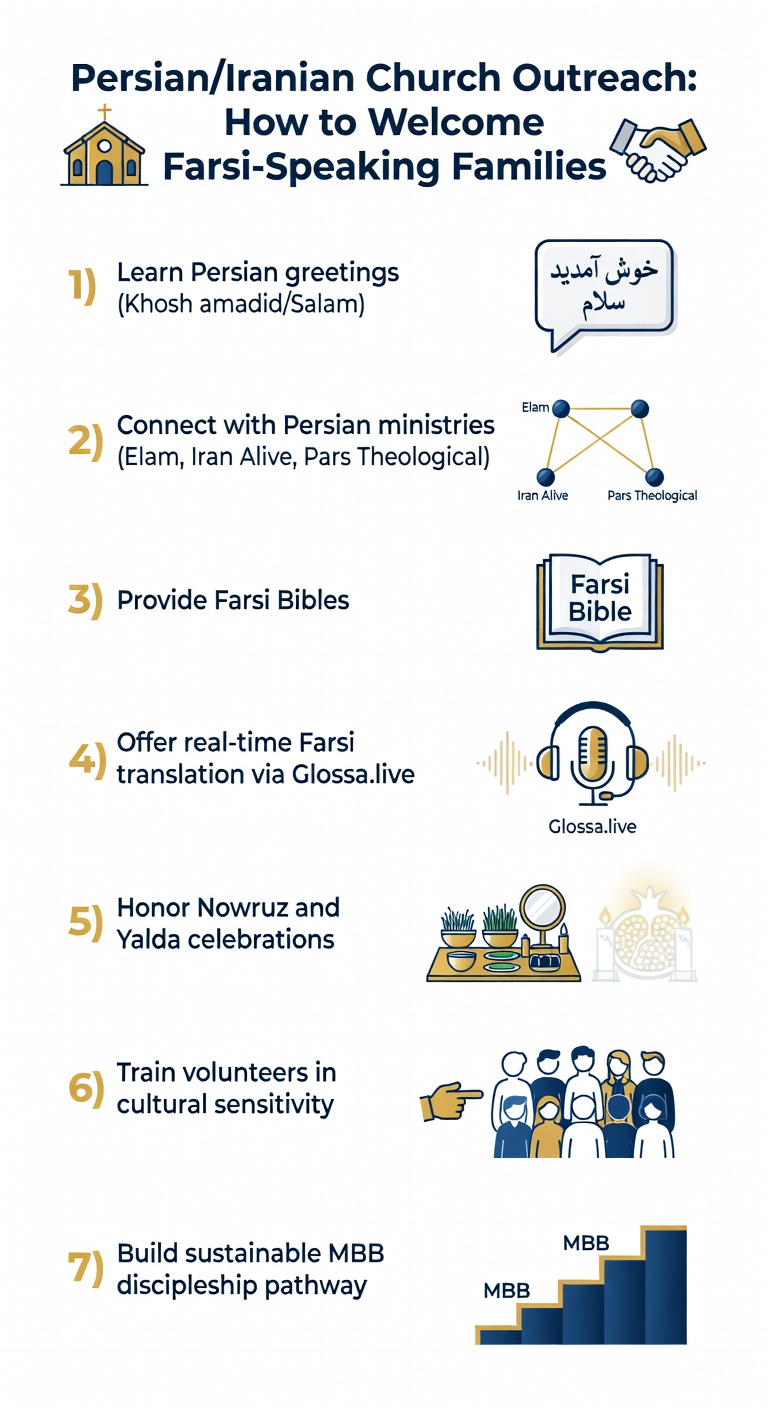
1. Learn a Few Farsi Welcomes and Names
Persian culture places enormous value on hospitality — it's called tarof, an elaborate system of polite gestures and warm welcome. A simple Khosh amadid (welcome) or Salam (hello, peace) at the door goes a long way. Learn to pronounce common Persian names correctly: Amir, Maryam, Reza, Shirin, Arash, Sara, Hossein, Parisa. Getting a name right is a powerful form of honor in Persian culture.
2. Connect With Existing Persian Ministries
You don't have to start from scratch. Established Farsi-speaking ministries can partner with your church, provide resources, or recommend pastoral contacts. Some of the most active include:
- Iran Alive Ministries — Farsi broadcasting and discipleship.
- Elam Ministries — Persian Christian training and leadership.
- Pars Theological Centre — Farsi theological education.
- Persian Christian Church Network (PCCN) — US-based fellowship of Persian churches.
- Voice of Christ Media Ministries — Farsi evangelism and radio.
- 222 Ministries — second-generation Iranian-American discipleship.
Reaching out to any of these as a "friend church" makes it clear to Persian visitors that you're plugged into their wider community.
3. Provide Farsi Bibles and Discipleship Materials
Make sure you have physical Farsi Bibles available for Persian visitors — and not just tucked in a back office. The Farsi Standard Translation, published by Elam, is widely used. Pars-Bible and NMV (New Millennium Version) are other respected Farsi translations. Having a handful of Farsi Bibles visible at the welcome desk or in the back of the sanctuary communicates: we expected you; you belong here.
4. Offer Real-Time Farsi Translation During Services
This is the step that moves Persian-speaking members from "welcomed visitor" to "full participant." Traditionally, churches had three options for translation: (1) hire a professional interpreter, which can cost $300-$800 per service, (2) ask a bilingual volunteer to interpret in real time, which is exhausting and hard to sustain, or (3) offer no translation and hope people stay. Today there's a fourth option: real-time AI translation for churches.
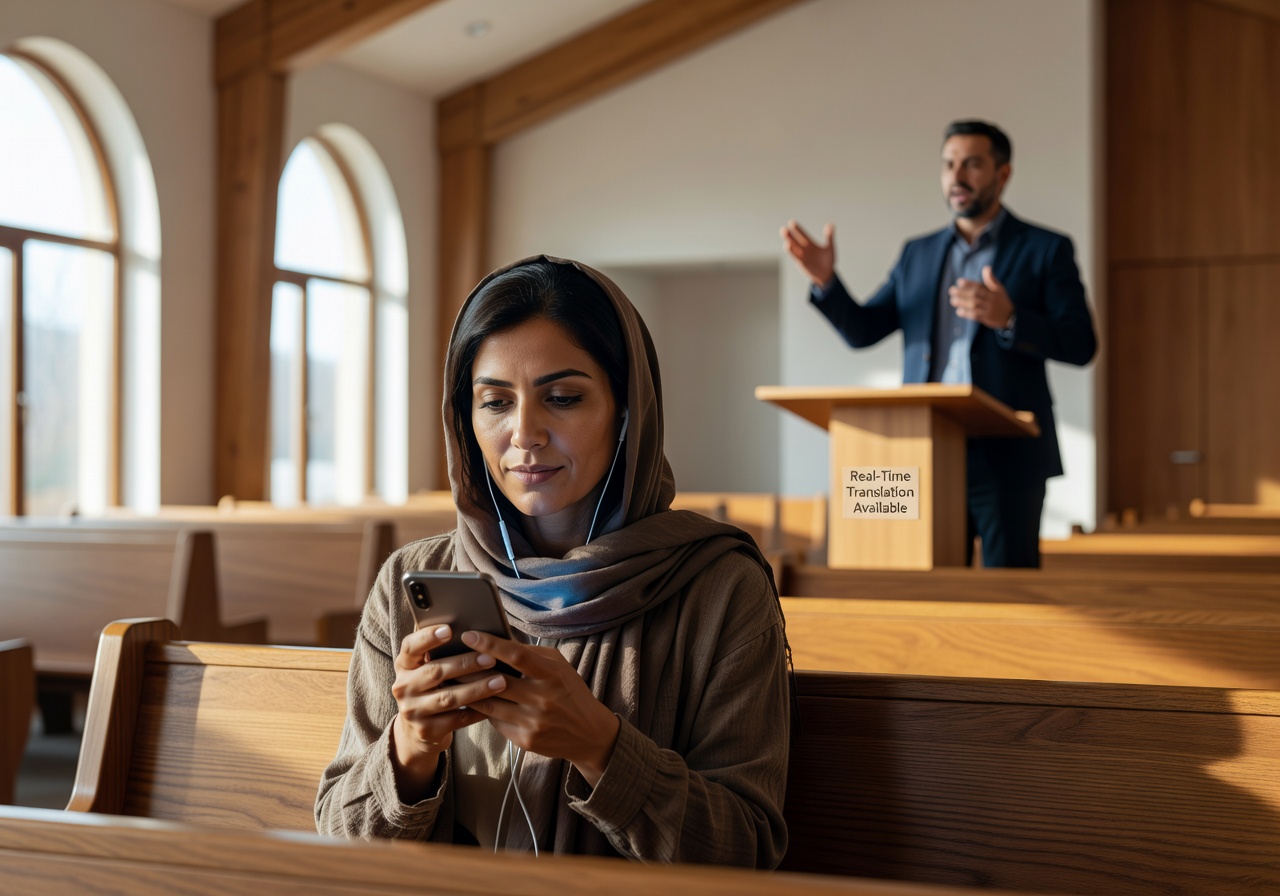
With Glossa.live, the pastor preaches normally in English, and Persian members listen to Farsi translation on their phones through earbuds — no special equipment, no hired interpreter, no awkward pause after every sentence. It works at any size service, from a house church to a 2,000-seat sanctuary.
5. Honor Persian Cultural Moments
There are key moments in the Persian calendar where thoughtful acknowledgment speaks volumes:
- Nowruz (Persian New Year, around March 20-21) — the most important Persian holiday, celebrating the spring equinox. Many Persian churches host a Nowruz gathering with traditional haft-sin table, poetry, and food. Even a simple "Nowruz Mubarak" greeting from the pulpit on the nearest Sunday is deeply appreciated.
- Yalda Night (December 21) — the winter solstice, celebrated with poetry, pomegranates, and family gatherings. A great opportunity for a church-hosted cultural evening.
- Mehregan (October 2) — autumn festival of friendship and love, less widely observed but meaningful for some families.
- Persian weddings, funerals, and birthdays — these are large extended-family events. If you're invited, go. Your presence will be remembered for years.
6. Train Volunteers in Cultural Sensitivity
Brief your greeters and small-group leaders on a few key points: don't ask Persian visitors whether they are "Muslim or Christian" — many are Christians who still carry Muslim-background family relationships, and the question can feel reductive. Don't assume all Iranians are the same — Kurds, Azeris, Baluch, and Armenians may identify as Iranian but carry distinct heritages. Don't discuss politics at the door — US-Iran relations are sensitive and divisive within the diaspora. Do ask about their family, their journey, their favorite Persian foods. Relationships come before religious conversations.
7. Build a Pathway, Not Just an Event
A single "Persian Night" or an Easter Farsi service can be meaningful, but what Persian-speaking families really need is a sustained relationship with your church. Build that pathway: a Farsi-translated small group, a monthly Persian fellowship meal, a discipleship track for new MBB believers, a pastoral counselor who can speak to asylum and trauma. For more on building this kind of sustained multilingual ministry, see our guide on how to start multilingual church services.
Real Glossa.live Translation: How It Works in Your Service
Here's the practical reality of adding Farsi translation to your church service using Glossa.live.
For your worship leader or sound team: Connect a microphone to Glossa.live. Select Persian/Farsi as a target language (alongside Spanish, Armenian, Dari, or any other languages your congregation needs). That's it — the system is ready before the service starts.
For your Persian-speaking members: They open Glossa.live on their phone, join your church's session with a simple QR code or link, put in their earbuds, and listen to the sermon in Farsi, translated in real time. The audio has a warm, natural voice — not a robotic drone.
For your pastor: You preach exactly the way you always have. No pause-and-wait. No dumbing down. No handing off to an interpreter.
The AI is trained on biblical and theological vocabulary, which matters. Generic translation tools often mistranslate words like grace, redemption, covenant, or Spirit. Glossa.live is built specifically for church use.
Cost: Pay-as-you-go at roughly $5 per hour per language, or a monthly plan if you run multiple services. No contracts, no hardware purchase, no interpreter fees. A small church adding Farsi translation to a single Sunday service might spend $20-$30 per month. A larger church running multilingual livestreams might spend more, but still a fraction of what hiring a professional Farsi interpreter would cost. For more on the cost question, see our honest breakdown of affordable church translation options.
Other languages you can add at the same time: Once Farsi is set up, adding Armenian, Dari (Afghan Persian), Russian, Arabic, Spanish, or any of the 100+ languages Glossa supports is a two-click operation. Many churches reaching Persian families also reach Arabic-speaking, Russian-speaking, and Armenian-speaking families — communities that often attend the same churches in diaspora cities like Los Angeles and Glendale. If your congregation overlaps with Armenian neighbors, our guide on reaching Armenian-speaking families at your church covers that community in depth. For a walkthrough of how to integrate translation into your livestream, our guide on streaming your church service in multiple languages covers the technical side.
Building a Sustainable Persian Ministry Over Time
Starting Farsi translation is a beautiful first step. Keeping it alive and growing is the longer work. Here are what successful Persian ministry efforts tend to have in common:
- A Persian point-person on staff or in leadership. This doesn't have to be a paid pastor — it can be a respected Iranian member of your congregation who helps coordinate outreach, translates announcements, and represents the community to church leadership.
- Regular Persian fellowship gatherings. Monthly kebab nights, Farsi Bible studies, or coffee-and-tea fellowship times. Persians love gathering around food and conversation — build that rhythm.
- Intentional discipleship for MBBs. Muslim-background believers often need support around family dynamics, baptism decisions, marriage, and identity. Equip someone to walk with them.
- A pipeline to Persian ministry resources. Know the Farsi Bible apps, podcasts, Christian YouTube channels, and online churches your members can engage between Sundays.
- Trauma-informed pastoral care. Many Persian asylees have experienced imprisonment, torture, family separation, or the death of loved ones. A pastor or counselor trained in trauma-informed care is worth their weight in gold.
- Celebration of bicultural identity. Second-generation Iranian-Americans often feel caught between cultures. A church that tells them "You are fully American and fully Iranian and fully beloved by God" is a church they'll bring their friends to.
Common Concerns Pastors Ask About Persian Ministry
Is AI translation accurate enough for theological content in Farsi?
Modern AI translation, especially tools trained on biblical language, has improved dramatically. Glossa.live is trained specifically on church contexts and theological vocabulary. That said, always invite a Farsi-speaking member to review recordings for nuance — it's a great way to give Persian members ownership of the ministry.
Will this offend Farsi-speaking members who already speak English?
Not if you frame it well. Explain that the translation is there so everyone — including their visiting parents, newer immigrants, and future Persian visitors — can participate fully. Bilingual members often become the biggest champions of Farsi translation, because they know firsthand how exhausting it is to translate for family members.
We've only had one Iranian family visit — is this worth the investment?
Persian communities operate on word-of-mouth trust networks. One family who feels genuinely welcomed will bring five more. The Persian diaspora is tight-knit and spiritually hungry. If you invest, the community will respond. Once your church appears in searches for terms like persian church near me, more families will find you.
Will Iranian families be safe if we post sermon content online?
This is a real and important question. Some Persian believers have family inside Iran who could be harmed if their face appears in a public church video or stream. Offer audio-only options, masked video, or name privacy. Ask each family about their comfort level. This is standard practice in Persian ministry.
Do we need to learn Farsi?
No. But learning a few key phrases and always pronouncing names correctly shows respect. A pastor who says Salam, welcome to every Iranian visitor has already crossed a huge relational threshold.
How to Get Started This Week
You can welcome Persian-speaking families into your congregation starting this Sunday. Here is the simplest path forward:
- Today: Visit Glossa.live and create an account. Add Persian/Farsi as a target language for your next service.
- This week: Print bilingual welcome cards in English and Farsi. Share the translation link in your bulletin and weekly email.
- Next Sunday: Announce from the pulpit that Farsi translation is now available. Invite attendees to share the link with Persian-speaking friends and family.
- This month: Contact your nearest Persian cultural center, an Iranian-American community group, or a local Persian church network, and let them know your church offers worship accessible in Farsi.
- This quarter: Plan a Persian fellowship event — a Nowruz celebration, a kebab potluck with Farsi worship songs, or a Yalda Night gathering — to signal that Persian identity is welcome, not just translated.
If you need help setting up the translation link on your website, our step-by-step tutorial on how to embed Glossa walks through the entire process in under ten minutes.
A Church That Speaks Your Language Is a Church You Can Call Home
Persian-speaking families are arriving in American cities with a story few congregations fully grasp. They've crossed borders. They've left families. Many have walked away from centuries of Islamic tradition to follow Jesus, and they've done so at personal cost. When they find a church that welcomes them in their language — Farsi, the language of their prayers, their grief, their praise — something shifts. They stop being visitors. They start being home.
Reaching Persian-speaking families at your church doesn't require you to become Iranian. It requires you to make room: room for their language, room for their story, room for their families, room for their leaders. Real-time translation is one part of that room. So is hospitality. So is cultural sensitivity. So is the long, patient work of friendship.
Glossa.live exists to remove one barrier from that equation — the language barrier — so pastors like you can focus on the relational and spiritual work only the local church can do. If you're ready to make your services accessible to Farsi-speaking members, you can try Glossa.live for your church today. No special equipment. No contracts. Just open Glossa on any device and begin translating — today.
Khosh amadid. Welcome home.