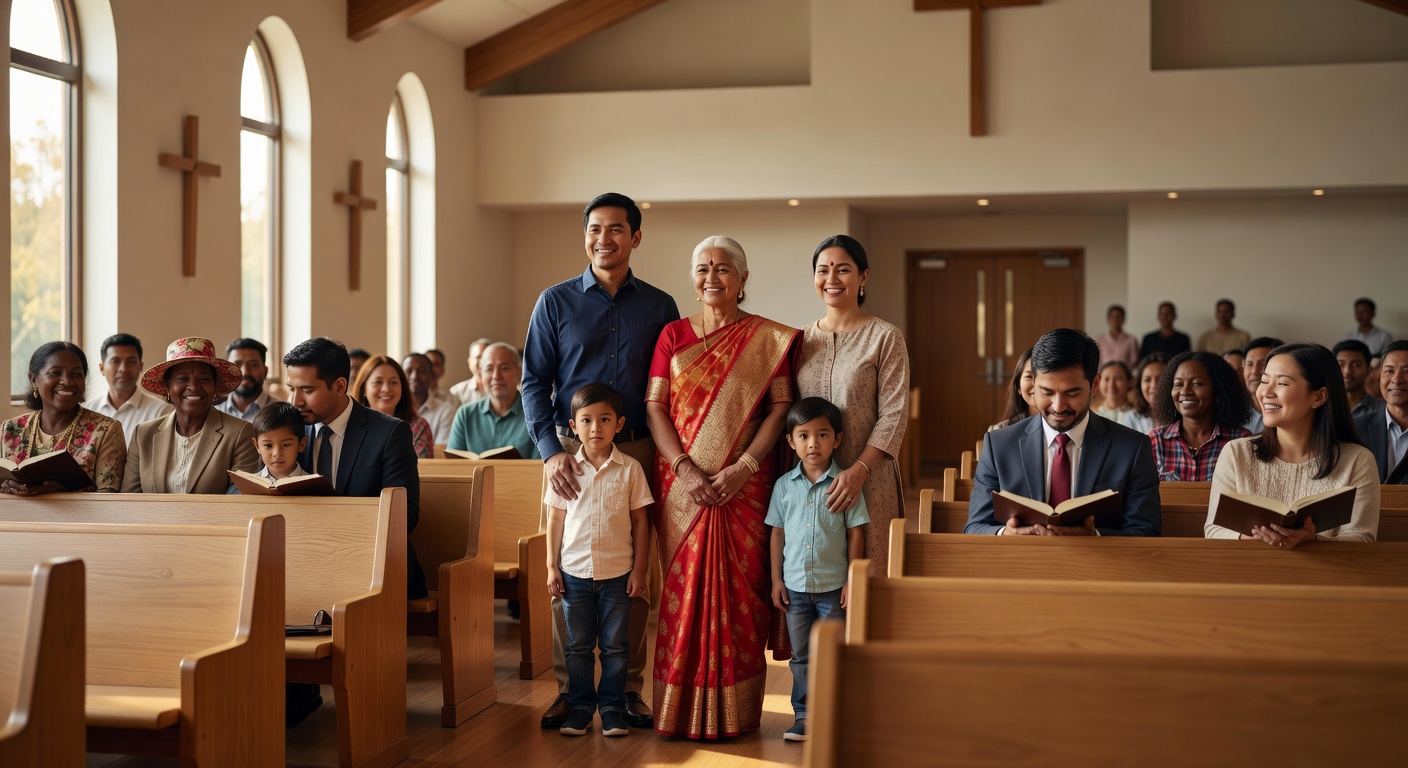
How to Reach Nepali-Speaking Families at Your Church
When a Nepali family walks into your American church for the first time, you are often welcoming someone whose journey has already crossed continents and decades. Many are Bhutanese-Nepali refugees who spent years—sometimes more than a generation—in UN camps in eastern Nepal before being resettled in Columbus, Harrisburg, Pittsburgh, Syracuse, or Akron. Others are Nepali students studying engineering, nursing, or IT in places you'd never expect. Still others are first-generation immigrants who came through family reunification or work visas, adjusting to snowy Ohio winters after a life lived in the foothills of the Himalayas.
They bring with them the Nepali language—melodic, warm, and still deeply tied to how they pray, grieve, and worship.
If you're a pastor, worship leader, or ministry director asking how to reach Nepali-speaking families at your church, this guide walks you through who they are, where they live, what they've been through, and how real-time translation can make the difference between a "visiting" Nepali family and a Nepali family that has truly found a church home. The Nepali Christian community is one of the fastest-growing, most mission-minded groups arriving at American churches today—and many of them are closer to your sanctuary than you realize.
Who Are Nepali-Americans, and Where Do They Live?
The Nepali-American community in the United States is a mosaic of three overlapping groups: Bhutanese refugees of Nepali ethnic origin, Nepali immigrants from Nepal itself, and a growing population of Nepali international students. Together they number roughly 300,000 to 500,000 people, and their presence is growing fast—Nepali is now one of the fastest-growing South Asian languages in America.
Bhutanese-Nepali Refugees (the Lhotshampa): In the early 1990s, the Kingdom of Bhutan expelled about 100,000 ethnic Nepali residents (called Lhotshampa, or "southerners") who had lived in southern Bhutan for generations. They spent nearly two decades in seven UN-administered refugee camps in eastern Nepal. Starting in 2008, a third-country resettlement program led primarily by the United States resettled more than 96,000 of them to American cities. This is one of the largest and most successful refugee resettlement operations in modern US history.
Nepali Immigrants from Nepal: A separate and growing community of Nepali citizens have come to the United States as students, workers, DV lottery recipients, and family-sponsored immigrants. Kathmandu and Pokhara families now have extended networks across American cities.
Nepali International Students: Nepal is consistently among the top 10–12 sending countries for international students to the United States, with more than 15,000 Nepali students studying here each year, clustered near universities and community colleges.
The largest Nepali-speaking communities in America are concentrated in:
- Columbus, Ohio — the largest Bhutanese-Nepali community in the US, with over 30,000 residents and multiple Nepali churches
- Pittsburgh and Harrisburg, Pennsylvania — large Bhutanese-Nepali populations with established churches
- Akron, Dayton, and Cleveland, Ohio — sizable refugee resettlement corridors
- Atlanta (Clarkston) and Jacksonville, Georgia — growing Nepali communities
- Baltimore, Maryland — home to the well-known Nepali Speaking Church of Baltimore
- Syracuse and Rochester, New York — traditional resettlement hubs
- St. Louis, Missouri — a long-established Bhutanese community
- Dallas, Houston, and Fort Worth, Texas — growing Nepali and Bhutanese-Nepali populations
- Boston, Seattle, and the San Francisco Bay Area — student- and tech-driven Nepali communities
If your church is anywhere near one of these cities, you likely have Nepali-speaking neighbors within a five-mile radius. Many of them are spiritually curious or already Christian—and many of them would respond to a church that speaks to them in their heart language.
Understanding the Nepali Christian Story Before You Reach Out
To welcome Nepali families well, it helps to know the remarkable story of Christianity in Nepal and in the Bhutanese-Nepali diaspora.
Until 1990, Nepal was the world's only Hindu monarchy, and conversion was outlawed. Missionaries were not allowed to evangelize openly. In 1960 there were perhaps fewer than 500 Nepali Christians in the entire country. By the 1990s democratic reforms had opened the door, and by today, conservative estimates place the number of believers in Nepal at 1.3 to 2 million—making it one of the fastest-growing Christian populations per capita in Asia, according to Joshua Project and Operation World.
The story inside the Bhutanese refugee camps is just as striking. Although the Lhotshampa came from Hindu, Buddhist, and Kirat backgrounds, something remarkable happened during the long camp years: thousands came to faith in Jesus Christ. By the time resettlement began in 2008, a significant percentage of the refugee population was Christian—particularly through the ministry of Nepali Baptist, Assemblies of God, and local evangelical churches that operated in and around the camps. Those new believers carried their faith with them when they boarded the resettlement flights. Christianity Today documented the remarkable evangelistic zeal of these refugee communities in cities across the US.
This is why so many American resettlement cities now have thriving Nepali churches: Columbus alone has multiple Bhutanese-Nepali congregations, and the Christian and Missionary Alliance, Southern Baptist Convention, Assemblies of God, and Presbyterian denominations have all planted Nepali-language ministries across the US.
Here's what this means for your outreach:
- Nepali Christians are often deeply evangelistic. They've seen the gospel transform their community within one generation. They're not shy about sharing their faith.
- Many Nepali believers are bivocational leaders. A man working night shifts at a warehouse may also be pastoring a Nepali home church of 40 people.
- Hindu and Buddhist family ties are common and important. A Nepali Christian may still be part of a larger extended family that celebrates Dashain and Tihar. Respect for both heritage and faith is essential.
- Worship in Nepali is a sacred gift. For believers who came to faith in a Himalayan village or a camp in Jhapa, hearing a sermon in Nepali in your American sanctuary is profoundly moving.
Why Language Still Matters for Nepali-Speaking Members
You might assume that because most second-generation Nepali-Americans speak English fluently, translation isn't urgent. But fluency isn't the same as heart-level understanding.
There's a well-documented idea in cross-cultural ministry called "the heart language"—the first language in which a person learned to pray, cry out, and hear Scripture. For many first-generation Nepali believers, and for almost all Bhutanese-Nepali grandparents and parents, Nepali is that language. When they sit through a sermon in English, they can usually follow it, but the spiritual resonance is muted. They're translating in their minds rather than simply receiving.
For elderly Bhutanese grandparents who arrived in their sixties or seventies after decades in a refugee camp, English is often an impossible barrier. They stop coming. Or they come, but they sit in the back, nod politely, and never fully belong.
Bhutanese-Nepali families also face unique cultural layers English doesn't always reach. Words like *bhajan* (worship song), *Prabhu* (Lord), *aashirbaad* (blessing), *paap* (sin), *chhama* (forgiveness)—these land differently in Nepali than in English translation. A Nepali believer praying in Nepali is drawing on the deepest, oldest well of their spiritual vocabulary.
Removing the Nepali language barrier signals something powerful to the family in your pew: *this church sees us. This church values our language. This church wants us to belong fully, not just attend politely.*
For a broader strategic view of how American churches are doing this across languages, our guide on overcoming language barriers in church walks through the full playbook.
Practical Steps to Welcome Nepali Families at Your Church
Here's a practical roadmap for making your church a place where Nepali families feel welcomed, valued, and fully at home. You don't need to tackle all of this at once—start with one or two and build.
1. Learn a Few Nepali Greetings and Names
*Namaste* (spoken with hands together) is the universal Nepali greeting—polite, warm, and appropriate across generations. *Namaskar* is a slightly more formal version. *Dhanyabaad* means "thank you." *Swagatam* or *Swagat cha* means "welcome." For a Christian greeting, many Nepali believers use *Jai Masih* ("victory to the Messiah") or *Prabhu lai mahima* ("glory to the Lord").
Learn to pronounce common Nepali and Bhutanese-Nepali names correctly: Prakash, Dilip, Tek Nath, Bhim, Kamal, Sabina, Sushma, Anjali, Sita, Menuka, Nirmala, Puran, Rajesh. Getting a name right on the first try is a profound gesture of dignity in Nepali culture—especially for elders who may have been misnamed at every American institution they've visited.
2. Connect With Existing Nepali Christian Ministries
You don't have to reinvent the wheel. A number of established Nepali ministries can partner with your church, provide resources, or recommend pastoral contacts:
- Nepali Christian Fellowship of America (NCFA) — the largest US network of Nepali-speaking churches
- Bhutanese Nepali Christian Fellowship of America (BNCFA) — a Bhutanese-Nepali-specific fellowship of pastors and churches
- Nepal Christian Society — resources and networks connecting US Nepali ministry to Nepal
- Ekal Nepal and Reach Nepal — discipleship and education partnerships
- South Asian Friendship Center (SAFC) — training resources for South Asian outreach
- Asbury Theological Seminary's South Asian Initiative and Western Seminary's Nepali cohort — theological training for Nepali-speaking pastors
Reaching out to one of these networks as a "friend church" signals to Nepali visitors that you're genuinely connected to their wider community—not just curious about them.
3. Provide Nepali Bibles and Discipleship Materials
Keep physical Nepali Bibles visible at your welcome desk or at the back of the sanctuary. The Nepali Revised Version (NRV) published by the Nepal Bible Society is the most widely used translation. The Nepali Contemporary Version (NCV) is another popular option, especially among younger Nepali believers. The YouVersion Bible app offers the Nepali Bible free, along with audio narration—great to share with visitors.
Having a few Nepali Bibles physically present communicates without a single word: *we expected you to come. You belong here.* That's a language no American church can speak by accident—it has to be prepared.
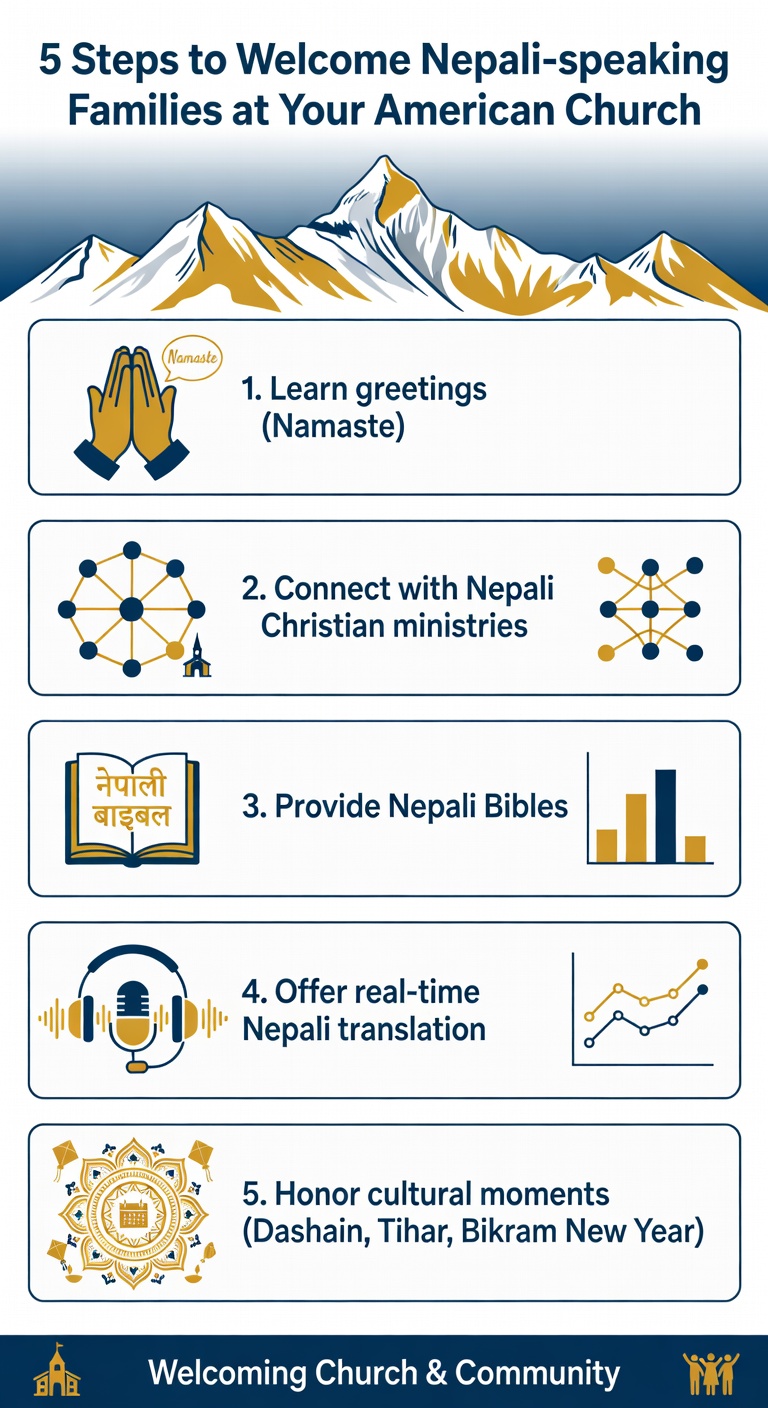
4. Offer Real-Time Nepali Translation During Services
This is the step that turns Nepali-speaking members from "welcomed visitors" into full participants. Traditionally, churches had three options: hire a professional Nepali interpreter (expensive and hard to find outside major cities), ask a bilingual volunteer to whisper-interpret (exhausting and rarely sustainable), or offer no translation at all and quietly lose the family after a few Sundays.
Today there's a fourth option: real-time AI translation for church services. With Glossa.live, your pastor preaches normally in English, and Nepali-speaking members listen to a clear Nepali translation on their phones through earbuds. No special equipment. No hired interpreter. No awkward pause-and-repeat. It works whether you're a 40-person house church or a 2,500-seat multisite.
5. Honor Nepali Cultural Moments
There are several key moments in the Nepali calendar where a thoughtful acknowledgment goes a long way:
- Dashain (September/October) — the largest and most important Nepali Hindu festival, spanning 15 days. Many Nepali Christian families still gather with extended relatives during Dashain. A pastoral note, a meal, or a "praying for your family" text during Dashain is meaningful.
- Tihar / Deepawali (October/November) — the festival of lights, with special days honoring dogs, cows, brothers, and sisters. Many Nepali Christians celebrate a Christianized version around themes of light and family.
- Nepali New Year / Bikram Sambat New Year (mid-April) — based on the Nepali calendar, typically falling April 13–14. A "Happy New Year" greeting at this time is a cultural home-run.
- Bhutanese Resettlement Day (March 25) — many Bhutanese-Nepali churches commemorate the anniversary of the first resettlement flights in 2008. It's a profound opportunity for corporate thanksgiving.
- Maghi (mid-January) — a winter harvest festival particularly important to the Tharu community within the Bhutanese-Nepali diaspora.
6. Train Volunteers in Cultural Sensitivity
Brief your greeters, ushers, and small-group leaders on a few key points:
- Don't conflate "Indian" and "Nepali." Nepal is its own country, with its own language, culture, and history. Nepalis can find it frustrating when Americans assume they're Indian because they "look South Asian." (The same is true for Bhutanese-Nepali, who are from Bhutan.)
- Respect the elderly. In Nepali culture, elders are greeted first, served first, and listened to first. A simple gesture of deference to a grandmother walking in will earn the entire family's trust.
- Remove your shoes when invited into a home. Nepali homes are shoe-free spaces. Always.
- Eat with your right hand at Nepali meals. The left hand is traditionally considered unclean for eating, though this is less rigidly held among younger generations.
- Don't assume anti-Hindu or anti-Buddhist rhetoric will land well. Most Nepali Christians have deeply loved family members who are still Hindu or Buddhist. Speak with respect.
7. Build a Pathway, Not Just an Event
A one-off "Nepali Sunday" or a momo-and-chai fellowship is a great start, but what Nepali-speaking families really need is a sustained pathway into your church community. Build that pathway: a Nepali-language small group, a monthly Nepali dinner, a discipleship track for new believers, a pastoral counselor who understands refugee trauma, and a clear on-ramp for Nepali leaders to serve visibly. For more on sustaining this kind of ministry, see our guide on how to start multilingual church services.
Real Glossa.live Translation: How It Works in Your Service
Here's how adding Nepali real-time translation to your church service with Glossa.live actually looks:
For your worship leader or sound team: Connect any microphone to Glossa.live. Select "Nepali" as a target language (alongside Spanish, Hindi, Burmese, Bhutanese, or any other languages your congregation needs). Setup is done before your service starts.
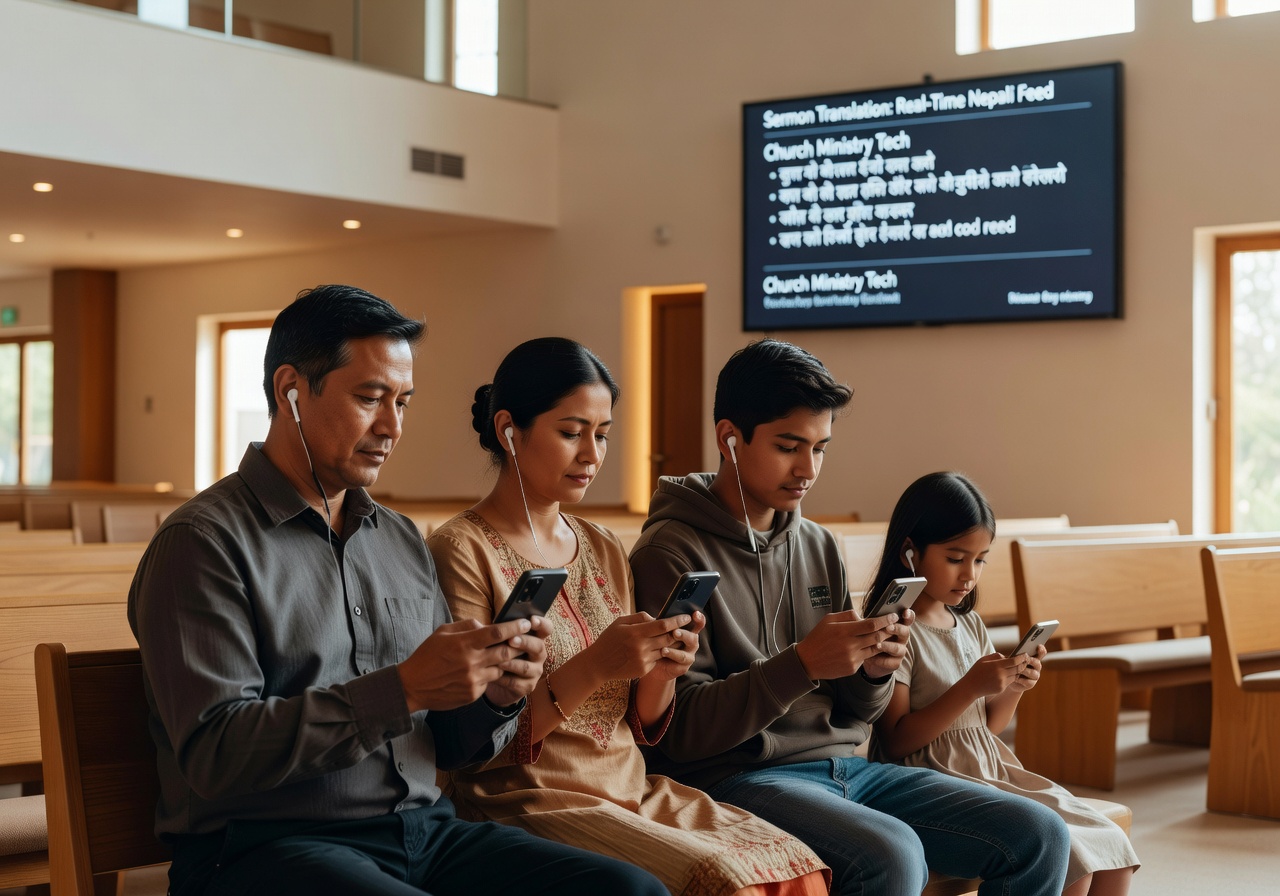
For your Nepali-speaking members: They open Glossa.live on their phone, join your church's session with a simple QR code or link, put in their earbuds, and listen to the sermon in Nepali, translated in real time. The voice is warm and natural—not robotic.
For your pastor: You preach exactly as you always have. No pausing after each sentence. No simplifying your message. No handing the mic to an interpreter mid-sermon.
The AI is trained on biblical and theological vocabulary, which matters enormously for Nepali. Generic translation tools frequently mistranslate words like "grace," "covenant," "righteousness," or "Holy Spirit"—precisely the vocabulary that matters most in a sermon. Glossa.live is built specifically for church use.
Cost: Pay-as-you-go at roughly $5 per hour per language, or a monthly plan if you run multiple services. No contracts, no hardware purchase, no interpreter fees. A smaller church adding Nepali translation to a single Sunday service might spend $20–$30 per month. A multisite church running multilingual livestreams will spend more, but it's still a fraction of what a professional interpreter costs—and no in-house interpreter is available in most cities for Nepali anyway.
Other languages you can add at the same time: Once Nepali is set up, adding Hindi, Burmese, Karen, Tibetan, Spanish, or any of the 100+ languages Glossa supports is a two-click operation. Many churches reaching Bhutanese-Nepali families also reach Burmese refugee families, Karen families, or other South Asian neighbors—communities that often resettle in the same American cities.
For a walkthrough of how to integrate translation into your church livestream, our guide on streaming your church service in multiple languages covers the technical side step by step.
Building a Sustainable Nepali Ministry Over Time
Launching Nepali translation is a beautiful first step. Keeping it alive over years—so that your Nepali ministry is still thriving five years from now—is the longer work. Here's what sustainable Nepali ministries have in common:
- A Nepali point-person in leadership. This doesn't have to be a paid staff pastor. It can be a respected Nepali member of your congregation who helps coordinate outreach, translates announcements, and represents the community to church leadership.
- Regular Nepali fellowship rhythms. Monthly chai-and-momo nights, Nepali Bible studies, family dinners, Nepali worship nights. Nepali culture is built around hospitality and shared meals. Build that rhythm into your calendar.
- A trauma-informed pastoral posture. Many Bhutanese-Nepali families carry decades of refugee trauma—statelessness, camp hardship, family loss. A pastor or counselor trained in trauma-informed care, especially for refugee communities, is a gift to this ministry.
- Intentional youth and second-generation engagement. Second-generation Bhutanese-Nepali teens often feel caught between their grandparents' village Nepal and their American high school. A church that honors both identities will keep them through college and into adulthood.
- A clear path for Nepali leaders to serve visibly. If Nepali members only ever serve as "translators for the real leaders," you've missed something. Nepali believers bring evangelistic fire, cross-cultural wisdom, and gifted leadership. Let them lead.
- A pipeline to Nepali discipleship resources. Know the Nepali Bible apps, Christian YouTube channels, worship artists (Ebenezer Band, Sheshraj Sharma, Shrawan Magar Rai), and podcasts your members can engage between Sundays.
For a model of how this kind of diaspora ministry scales across multiple language groups, see our guide on how churches are reaching immigrant communities through real-time translation.
The most powerful moment in our ministry came when a Bhutanese grandmother who had sat quietly in our services for two years finally heard the sermon in Nepali. She wept through the whole service, then hugged my wife and said, 'Today I understood. Today I belong.'
Common Concerns Pastors Ask About Nepali Ministry
"Is AI translation accurate enough for Nepali theological content?" Nepali AI translation has advanced dramatically in the last five years. Glossa.live is trained specifically on church contexts and biblical vocabulary, not generic conversational Nepali. That said, it's always wise to invite a Nepali-speaking member to review sample recordings for nuance. It's an excellent way to give your Nepali members real ownership of the ministry.
"Will this offend Nepali members who already speak English well?" Not if you frame it well. Most bilingual Nepali members become the biggest champions of Nepali translation—because they know firsthand how exhausting it is to translate for their parents, in-laws, and elderly relatives every Sunday. Explain that translation is there so *everyone* can participate fully: visiting grandparents, newer immigrants, and future Nepali visitors.
"We only have one or two Nepali families—is this worth the investment?" Nepali communities are tightly networked through family, clan, and shared refugee history. One family who feels genuinely welcomed and whose grandmother finally understands the sermon will bring five more families within a year. Bhutanese-Nepali word-of-mouth is among the strongest diaspora networks in America.
"Should we plant a separate Nepali congregation instead?" Both models work. Some cities have thriving standalone Nepali churches; other Nepali families prefer staying connected to a multicultural mother church. The best approach depends on the size of your Nepali community and the preferences of its leaders. Ask them. Many Bhutanese-Nepali pastors we know say their ideal is *bilingual services at a multiethnic church*, not complete segregation—because their kids will be in English, and they don't want to lose them.
"What about Hindi? Can the same service reach Nepali and Hindi speakers?" Nepali and Hindi share Devanagari script and significant vocabulary overlap, but they are different languages, and Nepali speakers don't feel "reached" by a Hindi-only service. Fortunately, Glossa.live supports Nepali and Hindi simultaneously—you can add both at no additional cost per language beyond the per-hour rate. Many South Asian ministries run both.
"Do we need to learn Nepali?" No. But learning three or four phrases—*Namaste, Dhanyabaad, Jai Masih, Swagat cha*—and always pronouncing Nepali names correctly signals deep respect. A pastor who greets every Nepali family with *Namaste, swagatam* at the door has already built more trust than a perfect English sermon ever could.
Conclusion: A Church That Speaks Your Language Is a Church You Can Call Home
Nepali-speaking families are arriving in American cities carrying stories most congregations will never fully grasp. Many have crossed oceans of geography and time—from the Himalayan foothills, from a refugee camp in Jhapa, from a stateless decade that stripped them of citizenship before American resettlement restored it. Many have come to Christ in the shadow of those hardships, and they've brought their faith with them in a language that shapes how they pray, how they grieve, how they sing.
When they find a church that welcomes them in *their* language—Nepali, the language of their *bhajans*, their childhood prayers, their mother's lullabies—something shifts. They stop being visitors. They start being home.
Reaching Nepali-speaking families at your church doesn't require you to become Nepali. It requires you to make room: room for their language, room for their story, room for their families, room for their leaders. Real-time translation is one piece of that room. So is hospitality. So is cultural sensitivity. So is the patient, long work of friendship—the same kind of friendship God extends to every one of us, across every cultural and linguistic distance.
Glossa.live exists to remove one specific barrier—the language barrier—so that pastors like you can focus on the pastoral, relational, and spiritual work only the local church can do. If you're ready to make your services accessible to Nepali-speaking members, you can try Glossa.live for your church today. No special equipment. No contracts. Just open Glossa on any device and start translating this Sunday.
*Namaste. Swagatam. Welcome home.*