How to Reach Cambodian-Speaking Families at Your Church
If your church is near a Cambodian community, you already know something beautiful and heartbreaking at the same time. Beautiful because Cambodian families often carry deep faith—many survived the Khmer Rouge genocide and found hope through Christian ministry in refugee camps. Heartbreaking because language barriers still keep many of these families from fully participating in your worship services, small groups, and community life.
Cambodian Americans represent one of the most resilient refugee communities in the United States. With over 330,000 Cambodian Americans concentrated in cities like Long Beach, Lowell, Philadelphia, and Seattle, there is a real and growing opportunity for churches to welcome Khmer-speaking families into their congregations. And the good news is that you do not need a Khmer-speaking pastor or expensive interpretation equipment to make it happen.
This guide walks you through practical steps to reach Cambodian-speaking families at your church—from understanding the community's unique cultural and spiritual background to offering real-time Khmer translation during your services.
Why Cambodian Families Are Looking for a Church Home
The Cambodian American community has a unique relationship with Christianity. Unlike many other Southeast Asian immigrant groups, a significant portion of Cambodian refugees first encountered the Gospel in Thai refugee camps during the 1980s. Organizations like World Vision, World Relief, and the Christian and Missionary Alliance provided both physical aid and spiritual support during one of the darkest chapters in Cambodian history.
Today, an estimated 20-30% of Cambodian Americans identify as Christian—a much higher percentage than in Cambodia itself, where Buddhism is the dominant religion. This means that when Cambodian families arrive in your community, many are already believers looking for a church that feels like home.
The challenge is that many Cambodian elders and recent immigrants speak limited English. Even second-generation Cambodian Americans often prefer hearing Scripture and worship in Khmer—the language of their heart. When your church offers services that include Khmer translation, you are telling these families that they belong.
If your church is already working to overcome language barriers, adding Khmer is a natural next step for communities with Cambodian populations.
Understanding Cambodian Culture and Faith Traditions
Before launching a Khmer-language ministry, take time to understand the cultural values that shape how Cambodian families experience church. This cultural awareness will help you build genuine relationships rather than simply offering a service.
Respect for Elders and Authority
Cambodian culture places tremendous emphasis on respect for elders. In church settings, this means that older Cambodian members may not speak up even if they do not understand the sermon. They will sit quietly and respectfully rather than ask for help. Offering Khmer translation proactively—rather than waiting for someone to request it—shows sensitivity to this cultural value.
Community Over Individualism
Cambodian culture is deeply communal. Decisions about church attendance often involve the entire family, including grandparents and extended relatives. When you welcome one Cambodian family, you are potentially welcoming an entire network. Food fellowship is central to Cambodian community life—hosting shared meals with Cambodian dishes like samlor korko (a traditional mixed vegetable soup) or num banh chok (Khmer noodles) after services creates a powerful sense of belonging.
The Weight of Trauma
Many older Cambodian Americans survived the Khmer Rouge genocide (1975-1979), which killed an estimated 1.5 to 2 million people—roughly a quarter of the population. This trauma shapes how families approach community, trust, and faith. Churches that acknowledge this history with sensitivity and create safe, welcoming spaces will build deeper connections than those that ignore it.
Buddhist Background Considerations
Even Cambodian Christians often come from families with strong Buddhist traditions. Pchum Ben (Ancestors' Day), Khmer New Year (Chaul Chnam Thmey), and other cultural celebrations remain important to families even after conversion. Understanding that cultural identity and faith can coexist will help you welcome families without asking them to abandon their heritage.
How to Offer Khmer Translation at Your Church
You do not need a fluent Khmer-speaking interpreter on staff to offer translation. Modern AI translation tools make it possible to provide real-time Khmer translation during your worship services, and the technology has improved dramatically in recent years.
Option 1: AI-Powered Real-Time Translation
Tools like Glossa.live provide real-time AI translation in over 100 languages, including Khmer. Here is how it works: your pastor speaks in English, and Cambodian families listen to the translation on their smartphones, tablets, or through a shared speaker. No special equipment is needed—just a device and an internet connection.
This approach is especially valuable for churches that cannot afford a dedicated Khmer interpreter or that only have a handful of Cambodian families. As our guide on how AI translation works for church services explains, AI translation trained on biblical language can handle theological terminology that generic translation tools miss.
Option 2: Volunteer Interpreters
If your church has bilingual Cambodian members, they can serve as volunteer interpreters. However, this approach has limitations: volunteers may not always be available, they may lack theological vocabulary in Khmer, and asking the same person to interpret every week leads to burnout. Many churches find that combining volunteer interpreters with AI translation backup provides the best of both worlds.
Option 3: Bilingual Service Elements
Even without full translation, you can incorporate Khmer elements into your worship. Consider including Khmer worship songs, Scripture readings in Khmer, or bilingual announcements. The guide on how to make your church bilingual provides practical steps that apply to any language, including Khmer.
Building Relationships with Cambodian Communities
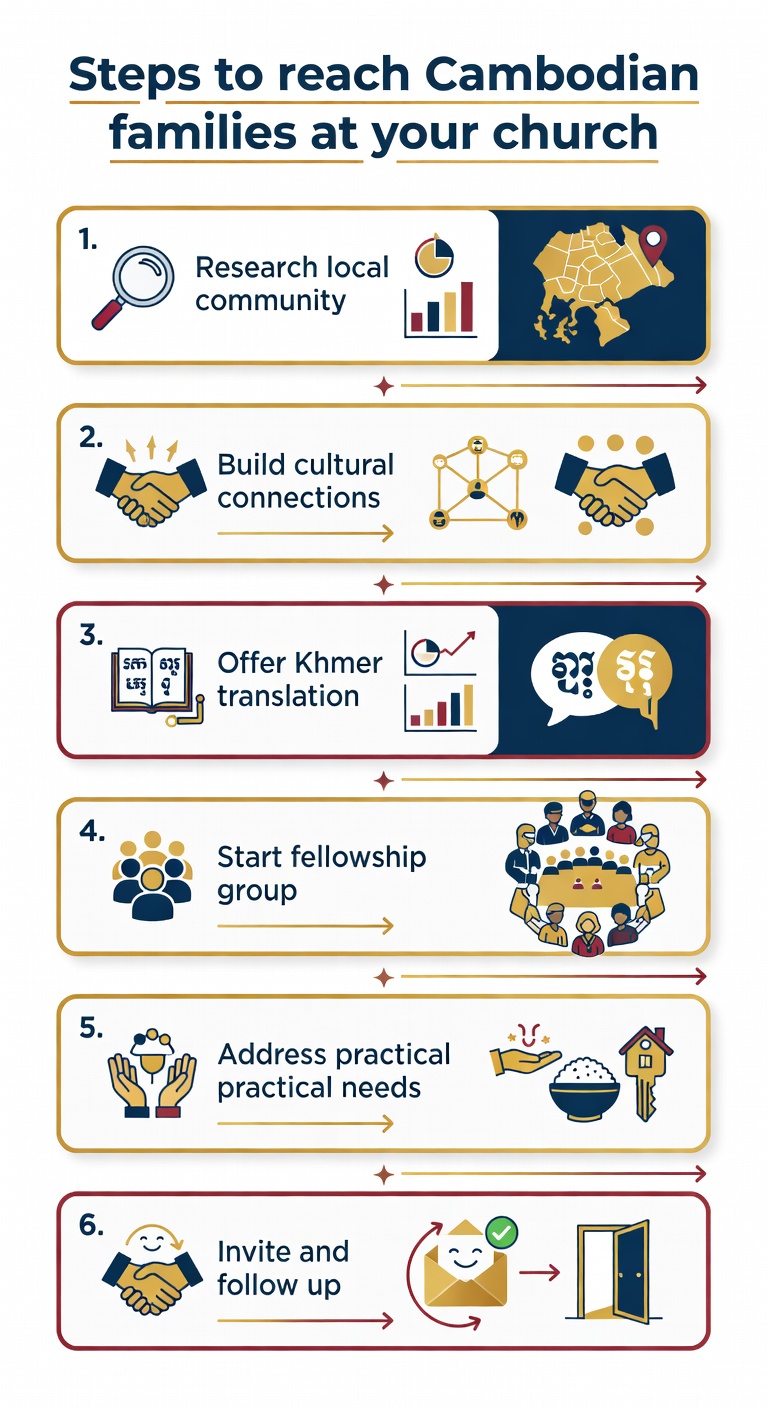
Translation is the bridge, but relationships are the foundation. Here are concrete steps to connect with Cambodian families in your area.
Partner with Cambodian Community Organizations
Every major Cambodian community has mutual assistance associations (MAAs) and cultural organizations. In Long Beach, the Cambodian Association of America serves as a community hub. In Lowell, the Cambodian Mutual Assistance Association plays a similar role. These organizations can help you understand community needs and connect you with families who are looking for a church home.
Attend Cambodian Cultural Events
Khmer New Year (mid-April), Pchum Ben (September-October), and Water Festival (November) are major cultural celebrations. Attending these events as a church—not to evangelize, but to participate and show genuine interest—builds trust and visibility in the community. Bring food to share, learn a few Khmer greetings (ជម្រាបសួរ—chom reap sour means hello), and simply be present.
Start a Khmer Fellowship Group
Before launching a full Khmer-language service, consider starting with a weekly fellowship group. This smaller setting allows Cambodian families to build relationships with each other and with your church leadership in a more intimate, less intimidating environment. Many churches that later grow into multicultural congregations started with exactly this approach.
Address Practical Needs
Many Cambodian families, especially recent arrivals and refugees, face practical challenges: navigating government systems, finding employment, learning English, and accessing healthcare. Churches that offer ESL classes, job skills training, immigration assistance, and after-school programs for children build credibility and trust that naturally opens doors for spiritual connection.
Where Cambodian Communities Are Growing in the U.S.
Knowing where Cambodian Americans are concentrated helps you assess whether this outreach strategy applies to your church. According to the U.S. Census Bureau, the largest Cambodian populations are in these metropolitan areas:
- Long Beach, California — the largest Cambodian community outside Cambodia
- Lowell, Massachusetts — a major Cambodian cultural center in the Northeast
- Philadelphia, Pennsylvania — growing Cambodian community in South Philadelphia
- Houston and Dallas, Texas — expanding Southeast Asian populations
- Seattle and Tacoma, Washington — significant Cambodian refugee settlement
- Stockton, California — historic Cambodian community in the Central Valley
- Providence, Rhode Island — concentrated Cambodian neighborhoods
- Minneapolis-St. Paul, Minnesota — diverse refugee community
If your church is in or near any of these areas, there are almost certainly Cambodian families within reach of your ministry. Even smaller communities may have Cambodian students at local universities or Cambodian families who moved for employment.
Real Churches Reaching Cambodian Families
Several church models demonstrate what effective Cambodian outreach looks like. The Cambodian Christian Ministry model, common in Long Beach and Lowell, typically starts as a small group within a larger English-speaking church. A bilingual leader facilitates Bible study and prayer in Khmer, while families participate in the main church's worship services with translation support.
Cambodian Evangelical Church networks across the country have grown by combining strong Khmer-language worship with community service programs. These churches show that when families hear the Gospel in their heart language, they respond and invite others.
Churches using real-time translation technology have found that Cambodian families appreciate the ability to follow along in Khmer without needing a separate service or dedicated interpreter. One pastor in Stockton described the impact: Cambodian grandparents who had sat silently for years suddenly began engaging with the sermon and participating in discussions.
Common Challenges and How to Overcome Them
"We only have a few Cambodian families."
Even two or three families represent an opportunity. With AI translation like Glossa.live, you do not need a critical mass to offer Khmer translation. Start small, serve the families you have, and word of mouth within the Cambodian community will do the rest.
"Khmer is a difficult language for translation."
Khmer is a complex language with its own script and tonal nuances. However, AI translation technology has made significant advances in handling Southeast Asian languages, including Khmer. While no translation is perfect, providing a solid Khmer translation is far better than offering nothing at all. Cambodian families understand that translation is a bridge—they appreciate the effort even when it is imperfect.
"We are worried about cultural sensitivity."
The fact that you are reading this guide means you already care about doing this well. Start by building relationships with Cambodian community leaders, learning basic cultural norms, and asking Cambodian families directly what would make them feel welcome. Humility and genuine interest go much further than having all the answers.
"Our budget is tight."
Many Cambodian outreach strategies cost little or nothing. Cultural partnership events, fellowship groups, and community service programs are primarily time investments. AI translation tools like Glossa.live offer affordable pricing that works for churches of any size—you can start with pay-as-you-go at $5 per hour per language and scale as your Cambodian ministry grows.
Getting Started This Month
Here is a simple action plan to begin reaching Cambodian families at your church within the next 30 days:
Week 1: Research your local Cambodian community. Check Census data, search for Cambodian associations or cultural organizations, and identify where Cambodian families gather. Drive through the neighborhood and look for Cambodian businesses, temples, and community centers.
Week 2: Make a personal connection. Visit a Cambodian restaurant or market, attend a community event, or simply introduce yourself to a Cambodian family in your congregation or neighborhood. Listen to their story and ask what they need.
Week 3: Set up Khmer translation for your Sunday service. Try Glossa.live for free and test Khmer translation during your next service. Have a Cambodian family member test the quality and provide feedback.
Week 4: Invite and follow up. Personally invite Cambodian families to a service where Khmer translation is available. After they attend, follow up with a meal together—food is the universal language, and Cambodian families deeply value shared meals as an expression of community.
A Vision for Your Church
Imagine your sanctuary on a Sunday morning where Cambodian grandmothers hear the sermon in Khmer for the first time, tears streaming down their faces because they finally understand every word. Imagine second-generation Cambodian teens leading worship alongside their American peers, singing in both English and Khmer. Imagine your church becoming the place where a community that survived genocide finds healing, hope, and home.
That vision is not a fantasy. Churches across the country are already making it happen—and with the right approach and the right tools, your church can too. Glossa.live makes it possible to offer real-time Khmer translation without expensive equipment or dedicated interpreters, so you can focus on what matters most: welcoming every family into the body of Christ.
The Cambodian families in your community are waiting. Will your church be the one that opens the door?