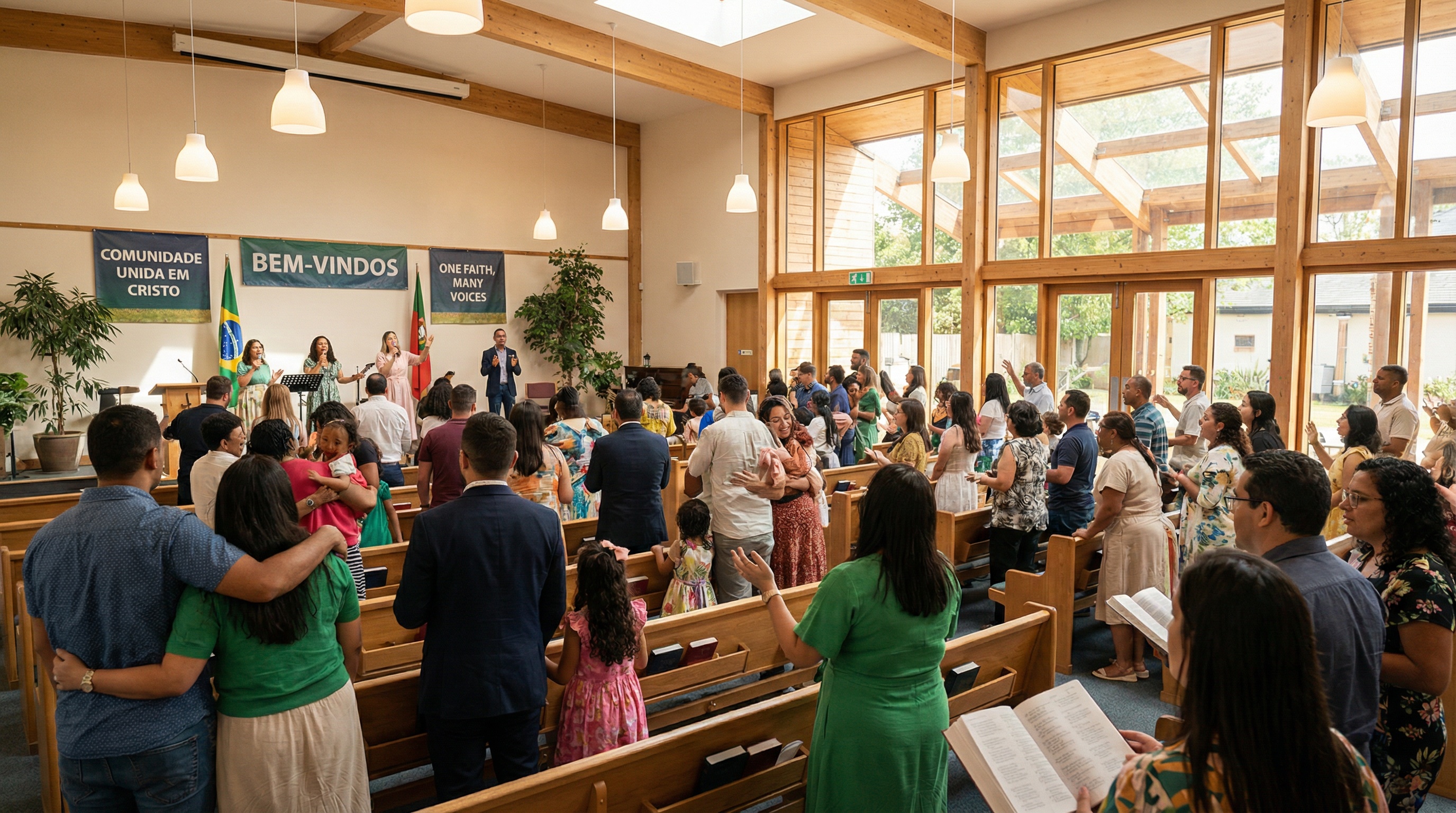
How to Reach Portuguese-Speaking Families at Your Church
Walk through almost any major American city—Boston, Miami, Newark, Houston, Orlando—and you will encounter a significant Brazilian and Portuguese-speaking community. In the United States alone, over 1.8 million people speak Portuguese at home, and that number has been growing steadily for decades. Yet for many of these families, finding a Portuguese-speaking church that truly welcomes them remains a challenge.
The good news? You do not need a dedicated Portuguese congregation or a full-time bilingual pastor to welcome Portuguese-speaking families into your church. With today's technology—specifically real-time AI translation—any church can begin reaching Portuguese speakers this Sunday.
This guide will show you exactly how churches across the U.S. are doing it, what you need to get started, and how to build a genuine, lasting connection with Brazilian and Portuguese-speaking families in your community.
Understanding the Portuguese-Speaking Community in Your Neighborhood
Before you can reach any community, you need to understand who they are and what they care about. The Portuguese-speaking community in America is rich and diverse. The largest group is Brazilians, who have established major communities in cities like Boston (especially the Framingham area), Miami, New York, and Orlando. Beyond Brazilians, you will also find significant populations of Portuguese-Americans concentrated in Massachusetts, Rhode Island, New Jersey, and California—communities with deep roots going back generations.
There are also growing numbers of Angolan, Mozambican, and Cape Verdean immigrants whose primary language is Portuguese. Each group brings distinct cultural traditions, worship styles, and community needs. What they share is a heart for community, a strong faith tradition, and a deep longing to feel genuinely welcomed.
The Faith Dimension
Brazil is one of the most religiously active nations on earth. According to Pew Research Center, nearly 90% of Brazilians identify as Christian—with a roughly even split between Catholic and Protestant (especially Pentecostal and evangelical) traditions. Brazil has the world's largest Catholic population and one of the fastest-growing evangelical movements.
For Brazilian immigrants especially, church is not just a weekly event—it is often the center of social life, family identity, and community belonging. This means that when a Brazilian family moves to your town and searches for a church, they are looking for more than a service. They are looking for a spiritual home. If your church can welcome them in Portuguese—even partially—you signal something powerful: we see you, we value you, and you belong here.
The Challenge: Why Language Remains a Barrier
Even in cities with large Brazilian populations, many Portuguese-speaking families quietly attend English-only churches and feel like outsiders. They follow along as best they can, but the sermon's nuances escape them. The announcements are confusing. The worship songs are unfamiliar. And they never quite feel like full members of the congregation.
Traditional solutions are expensive and logistically difficult. Hiring a professional Portuguese interpreter costs 0–50 per hour. Recruiting a bilingual volunteer is possible, but reliability is a challenge, and volunteer interpreters often feel immense pressure to perform perfectly in a sacred setting. Running a fully separate Portuguese-language service requires another pastor, another set of volunteers, and essentially another church inside your church.
What if there were a simpler path?
Real-Time Translation: The Modern Solution for Reaching Portuguese Speakers at Church
This is where technology has genuinely changed what is possible for churches. Real-time AI translation—powered by platforms like Glossa.live—lets you provide live translation of your sermon, worship, and announcements directly to Portuguese speakers' phones, with no special equipment required.
Here is how it works in practice: Your pastor preaches in English. The AI listens and translates in real time. Portuguese speakers open Glossa on their phones and listen to the audio in Portuguese—simultaneously, as the sermon is happening. The translation is trained on biblical language, so theological terms, Scripture references, and worship vocabulary come through naturally and accurately.
The result? A Portuguese-speaking family in the third row hears the full message in their language. They understand the announcements. They can follow along with the prayer. For the first time in years, they leave a church service feeling like they actually heard something.
It was like someone finally turned on the lights. I had been sitting in darkness not understanding, and suddenly everything was clear. — Brazilian church member after their congregation adopted real-time translation
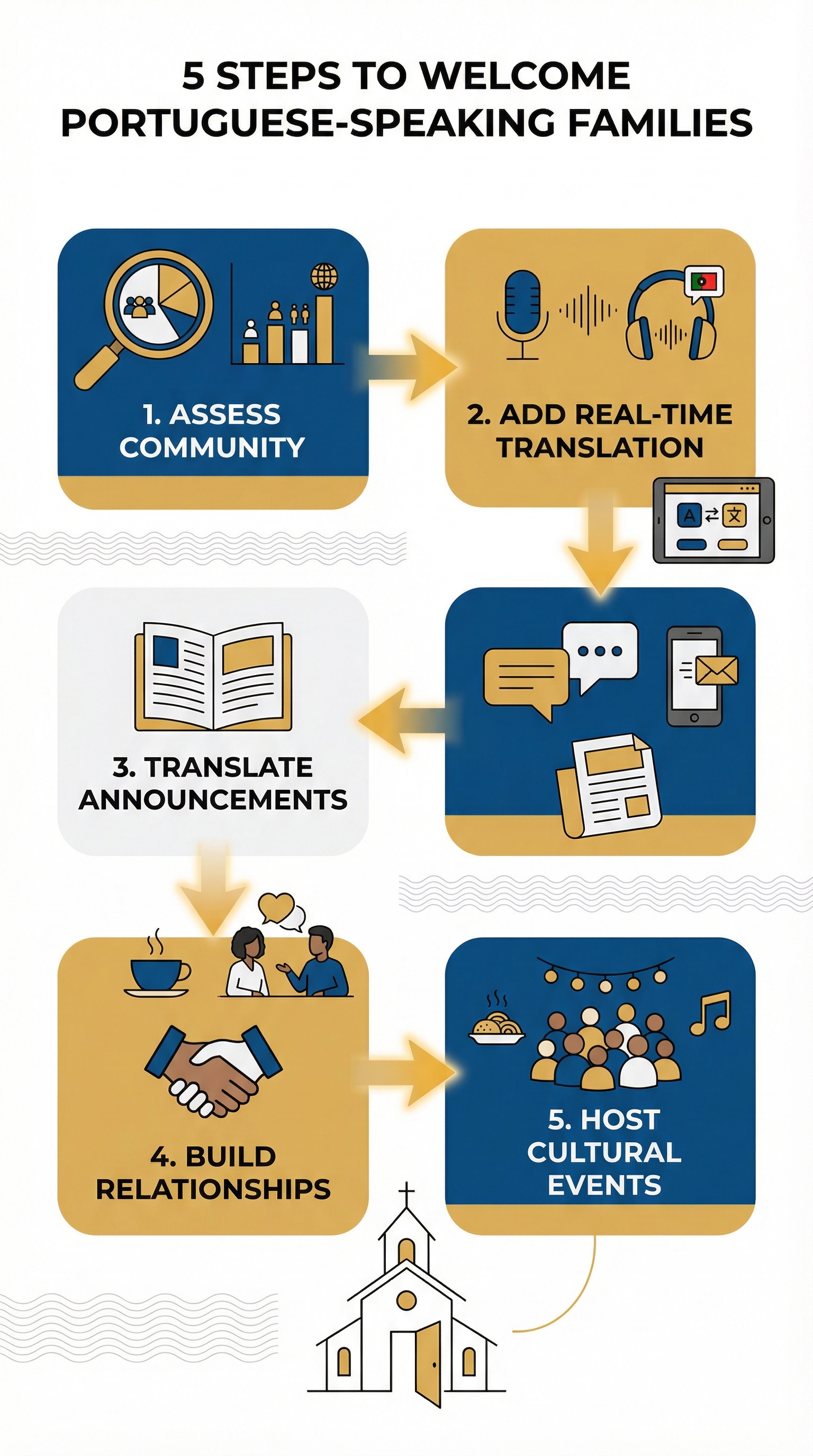
Practical Steps to Welcome Portuguese-Speaking Families
If you want to build a genuinely multilingual congregation, here is a clear path forward. As our guide on how to start multilingual church services explains, the key is to start with what you have and grow from there.
Step 1: Assess Your Portuguese-Speaking Population
Begin by understanding how many Portuguese speakers are already in your congregation or nearby community. Check U.S. Census data for your zip code or county—the American Community Survey provides language-spoken-at-home statistics that give you a clear picture of your neighborhood. Talk to your current members. You may be surprised to discover that several families are already part of your congregation but have not mentioned their language background because they did not think the church could help.
Step 2: Start with Translation at Sunday Services
You do not need to overhaul your service structure to start welcoming Portuguese speakers. Begin with real-time audio translation for your Sunday sermon and worship. With a platform like Glossa.live, setup takes less than 15 minutes. You connect your audio source, create a Portuguese language channel, and share a simple link with your Portuguese-speaking attendees. They open the link on their phone and receive the translation through earbuds. No additional hardware. No separate AV team. No complicated setup.
For a detailed walkthrough of the technical setup, see our guide on how to embed Glossa on your website.
Step 3: Translate Your Welcome and Announcements
The sermon matters, but so does everything around it. Many non-English speakers feel lost during announcement time, when the church gives specific information about upcoming events, service opportunities, and community news. Consider translating your weekly announcements into Portuguese and including them in your order of service. A simple Portuguese greeting—Bem-vindos! (Welcome!)—goes a long way. Train your greeters to say a few simple words in Portuguese. These small gestures say something important: we were thinking about you before you walked through the door.
Step 4: Build Authentic Relationships
Language access opens the door—but authentic relationship keeps people connected. Consider the following:
- Host a Brazilian or Portuguese cultural event. A community dinner, a celebration of Brazil's Festa Junina, or a Portuguese-language small group can provide natural entry points for relationship-building.
- Find a bilingual bridge person. Even one church member who speaks both English and Portuguese fluently can serve as a connector—not as a full-time interpreter, but as someone who helps new families feel at home.
- Partner with Brazilian-owned local businesses. A flyer at a Brazilian bakery or barbershop can reach families who would not otherwise know about your church.
- Pray in Portuguese occasionally. Even a brief moment—Vamos orar (Let's pray)—before a pastoral prayer signals genuine investment in the community.
What Brazilian and Portuguese Families Are Looking For in a Church
Understanding what Portuguese-speaking families value helps you build a church culture that genuinely resonates. Warmth and hospitality are non-negotiables. Brazilian culture is characterized by warmth, physical affection, and expressive community. A cold, formal service environment will feel foreign and uncomfortable. Train your greeters and members to be genuinely warm—not just functionally polite.
Strong preaching and worship matter deeply. Brazilian evangelical culture tends toward expressive worship and passionate preaching. When Portuguese-speaking families can actually understand the sermon and the worship through real-time translation, they engage fully. Community and belonging go beyond the Sunday service—small groups, fellowship meals, and ministry opportunities are all critical. And for many recent immigrants, practical support—connecting families with resources for healthcare access, English learning, or employment—makes your church genuinely essential to their lives.
The same principles apply whether you are building a multicultural church or focusing on one specific language community. The goal is always the same: genuine welcome backed by practical access.
Addressing Common Questions About Portuguese Church Translation
Is AI translation accurate enough for sermons?
This is the most common concern, and it is a fair one. General-purpose AI translation tools can stumble on religious language, biblical names, and theological concepts. But platforms specifically designed for church translation—like Glossa.live—are trained on biblical texts and worship context. Portuguese is one of the better-supported languages in AI translation, with high accuracy for both European and Brazilian Portuguese. For a deeper look, see our guide on how AI translation works for church services.
Do I need to support both European and Brazilian Portuguese?
Brazilian and European Portuguese differ meaningfully—in accent, vocabulary, and some grammar. If your community is primarily Brazilian, you can specify Brazilian Portuguese for the best results. Most AI translation platforms, including Glossa.live, support both variants.
What if we already have some bilingual members?
Wonderful. Bilingual members are a gift—use them for relationship-building, prayer, and follow-up, not as a substitute for consistent, scalable translation. A volunteer interpreter can burn out quickly if they feel solely responsible for bridging the language gap every single Sunday. AI translation handles the consistent heavy lifting so your bilingual members can focus on building genuine connections.
How much does it cost?
Real-time translation is dramatically more affordable than hiring professional interpreters. Glossa.live offers pay-as-you-go options starting at /hour per language, and monthly plans that scale with your needs. For a typical church, welcoming Portuguese speakers with real-time translation might cost 0–0 per month—a fraction of what even one monthly interpreter session would cost. For a full comparison of options, see our guide on affordable church translation.
Churches Already Reaching Portuguese-Speaking Families
You do not have to figure this out from scratch. Churches like Spanish River Church in Florida already offer Portuguese translation every Sunday alongside Spanish and Creole, welcoming immigrant families across multiple language communities. New Hope Brazilian Baptist Church in Pompano Beach uses headsets so attendees can hear the sermon in English while the pastor preaches in Portuguese—demonstrating that bilingual church infrastructure is achievable at virtually any size.
In the Greater Boston area, where the Framingham Brazilian community is concentrated, evangelical churches that have made services accessible in Portuguese have seen Portuguese-speaking attendees go from occasional visitors to committed members once real-time translation became available. The broader data supports this: as our guide on why multilingual worship grows your church explores, churches that offer services in the languages of their community routinely report 30–50% increases in engagement from those language groups.
According to Lifeway Research, effective bilingual worship services share common elements—among them, genuine hospitality, consistent translation, and strong cultural awareness. All of these are achievable for any church willing to take the first step.
Getting Started This Week
The Portuguese-speaking families in your community are not waiting for your church to build a perfect program. They are looking for a church that makes them feel seen and understood—starting now. Here is a simple three-step path to begin:
- This week: Sign up for a free Glossa.live trial. Test the Portuguese translation with your pastor's audio and gather feedback from any Portuguese speakers already in your congregation.
- Within 30 days: Announce that Portuguese translation is available at your Sunday service. Print a bilingual welcome card with Bem-vindos! and include it in your bulletin.
- Within 90 days: Host one Portuguese-friendly community event—a dinner, a small group, a neighborhood outreach—that builds relationships beyond Sunday morning.
The technology is ready. The community is waiting. And the welcome you offer—simple, genuine, and in their language—could change the course of a family's life in America.
Conclusion
Reaching Portuguese-speaking families at your church does not require a new building, a new pastor, or a new department. It requires a genuine desire to remove language barriers and the right tools to make it practical.
The Brazilian and Portuguese-speaking community is one of the most deeply faithful immigrant populations in the United States. They are not looking for a perfect church. They are looking for a welcoming one.
By taking even small steps—offering Portuguese translation at Sunday services, printing a bilingual welcome card, training greeters to say Bem-vindos!—you signal something that transcends language: this church is for you.
To explore how Glossa.live makes multilingual ministry possible for churches of any size, visit glossa.live and start your free trial today. Start small. Start today. And let real-time translation do what it was designed to do: remove the barriers that keep families from belonging.