How to Reach Chinese-Speaking Families at Your Church
Every Sunday, thousands of Chinese-speaking families across the United States are searching online for a church where they'll feel at home. Many of them type "Chinese church near me" hoping to find a faith community that speaks their language — literally. If your church serves a community with Chinese-speaking residents, you have an extraordinary opportunity to welcome these families and become their spiritual home.
Chinese Americans represent one of the largest Asian demographic groups in the US, with over 5 million Mandarin and Cantonese speakers living across the country. In cities like Houston, San Francisco, Los Angeles, New York, and Dallas, Chinese-speaking families make up a meaningful percentage of the population — and a large portion of them are actively looking for a church home that honors their language and culture.
The good news? You don't need to start a separate Chinese church or hire a full-time Mandarin pastor to reach this community. With real-time AI translation tools like Glossa.live, your existing congregation can begin welcoming Chinese-speaking families this Sunday — no special equipment required.
This guide walks you through exactly how to do it: understanding the Chinese-speaking community in your area, the barriers that keep them away, and practical steps to offer Mandarin and Cantonese services starting right now.
Who Are Chinese-Speaking Families in America?
Before you can effectively reach Chinese-speaking families, it helps to understand who they are and what they're looking for.
Chinese Americans are not a monolithic group. The Chinese-speaking community in the US includes immigrants from mainland China (who typically speak Mandarin), immigrants from Hong Kong and parts of southern China (who often speak Cantonese), second-generation Chinese Americans who may speak both English and their parents' language, and international students who are often spiritually curious and far from home.
According to Pew Research Center, Asian Americans are one of the fastest-growing demographic groups in the United States, and Chinese Americans represent the largest single Asian ethnic group. Many of these families hold traditional values — family, community, hard work, and respect for elders — that align beautifully with the values of a Christ-centered church.
For many Chinese-speaking immigrants, their first years in the US can be isolating. They're navigating a new culture, a new language, and unfamiliar systems. A church that welcomes them in their own language isn't just offering a worship service — it's offering belonging. That's a powerful opportunity for ministry.
Why Chinese-Speaking Families Often Can't Find a Church Home
Many Chinese-speaking families genuinely want to connect with a local church. But several barriers prevent them from staying — even when they visit.
Language is the most obvious barrier. If your services are entirely in English, a Mandarin or Cantonese speaker may be able to follow along partially, but they won't connect deeply with the sermon, the Scripture, or the worship. Language is the vehicle for faith — when it's not accessible, the message doesn't land.
Cultural familiarity matters too. Chinese families often appreciate a warm but structured worship environment. If your church feels unfamiliar culturally — in its music style, greeting practices, or approach to community — Chinese-speaking visitors may feel like guests rather than family.
Many assume no Chinese services exist at your church. Unless a church clearly advertises multilingual services, Chinese-speaking families will assume the service is English-only and look elsewhere. If you offer translation, communicating that clearly opens the door.
Understanding these barriers is the first step to removing them. The great news is that language — the most significant barrier — is now one of the easiest to solve.
The Simple Way to Offer Mandarin and Cantonese Translation
Offering translation used to require expensive equipment: FM transmitters, dedicated interpreter booths, hired professional translators. For most churches, that meant the cost was simply too high.
That equation has changed. Today, real-time AI translation tools make it possible for any church — regardless of size or budget — to offer Mandarin and Cantonese translation during their services. Here's how it works with Glossa.live:
- Set up Glossa.live on your existing device. No special hardware required. Glossa works on any laptop, tablet, or computer. Your sound team doesn't need to change anything about their setup.
- Chinese-speaking attendees connect via their phones. Each person opens Glossa.live on their smartphone and selects their preferred language — Mandarin, Cantonese, or any of the 100+ other languages Glossa supports. They listen to a real-time AI translation through their earbuds.
- Your service runs as normal. Your pastor preaches. Your worship team leads. Nothing changes for the rest of your congregation. Chinese-speaking guests simply hear the service in their language, in real time.
The entire setup can be done in minutes. Many churches have also embedded Glossa directly into their website, making it even easier for visitors to access translation before they arrive.
What Languages Should You Offer?
For reaching Chinese-speaking families specifically, two languages are most important:
Mandarin (Simplified Chinese): This is the official language of mainland China and the most widely spoken form of Chinese in the US. Most recent immigrants from mainland China, as well as many second-generation Chinese Americans, understand Mandarin. If you're only going to offer one Chinese language, start here.
Cantonese: Cantonese is spoken by many families from Hong Kong, Guangdong province, and parts of Southeast Asia. In cities like San Francisco and New York, Cantonese-speaking communities have deep historical roots. If your community has a significant Cantonese-speaking population, offering this language alongside Mandarin significantly expands your reach.
English alongside Chinese: For second-generation Chinese Americans — often called "1.5 generation" or second-gen — services in both English and Chinese feel most familiar. Some families have elderly parents who prefer Mandarin, while their adult children prefer English. Offering both allows the whole family to worship together. This is one of the most powerful benefits of real-time translation: the same service can serve multiple generations at once.
If you're unsure which languages your community speaks, a simple survey of current members or a conversation with local Chinese community organizations can tell you a lot. For more on how to start multilingual church services, our comprehensive step-by-step guide covers everything from choosing languages to launching your first multilingual service.
Building Genuine Relationships with the Chinese-Speaking Community
Technology solves the language problem. But genuine welcome goes deeper than translation.
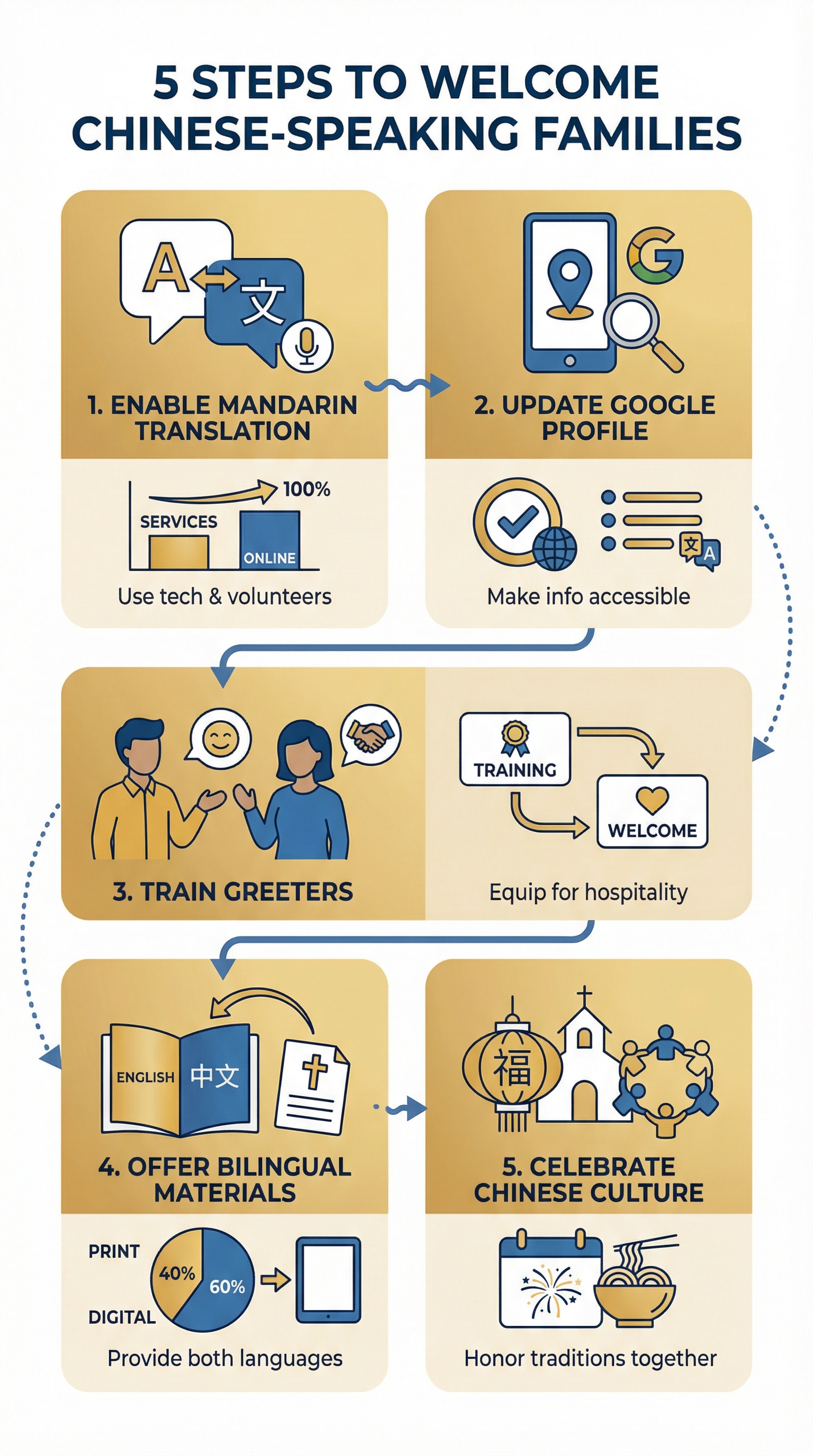
Partner with local Chinese community organizations. Many cities have Chinese community centers, Mandarin-language schools, or professional associations. These organizations often serve families who are spiritually open but haven't connected with a church. A simple phone call expressing your desire to welcome their community can open unexpected doors.
Train your welcome team. A Chinese-speaking family who visits your church will be watching how they're greeted. Even learning a simple greeting in Mandarin or Cantonese communicates genuine care. Consider training your greeters on Chinese cultural norms around hospitality and respect.
Offer printed materials in Mandarin and Cantonese. Service bulletins, visitor cards, and informational brochures in Chinese go a long way toward communicating that your church prepared for their arrival.
Celebrate Chinese culture and community events. Chinese New Year (typically January–February) is a major cultural celebration. A special bilingual service or community dinner around this time can be a natural bridge for outreach. These are opportunities for your congregation to say, "We see your culture, and we celebrate it."
As you'll discover reading about how churches are reaching immigrant communities through real-time translation, the most effective multicultural churches combine technology with genuine hospitality. One without the other falls short.
Real-World Example: Churches Welcoming Chinese-Speaking Neighbors
"We've always wanted to reach our Chinese neighbors. We just didn't know it could be this simple. The families who've joined us are now some of the most committed members of our congregation. It's transformed our community." — Mid-sized Baptist church pastor, Houston, TX
Houston is home to one of the largest Chinese-American communities in the United States. Several churches in the Houston area have already begun offering Mandarin translation for Chinese-speaking residents who search for "Chinese church Houston" or "Chinese community church near me."
One mid-sized Baptist church in the Houston suburbs added Mandarin and Cantonese translation to their Sunday morning service using AI-powered real-time translation. Within the first month, they welcomed three new families from mainland China — all of whom found the church because it appeared in search results and offered translation.
This kind of growth isn't unusual. Churches that actively welcome Chinese-speaking families — and communicate that welcome clearly online — often see meaningful growth simply because they removed a barrier that was keeping people away. For more on this growth pattern, see why multilingual worship grows your church, where we walk through real examples of churches that saw 30–50% growth through multilingual services.
According to Christianity Today, Chinese American churches are navigating profound cultural and generational shifts. English-speaking Chinese American churches often struggle to hold onto second-generation members, while Mandarin-speaking immigrant churches find it hard to retain younger members raised in English. A welcoming, multilingual, multi-generational church that bridges these worlds can become something extraordinary for its community.
How to Let Chinese-Speaking Families Know You're Welcoming Them
Translation only works if people know it's available. Here's how to communicate your multilingual welcome:
- Update your Google Business Profile. When someone searches "Chinese church near me" in your city, Google Business Profile results appear first. Adding language capabilities and mentioning Chinese translation in your description helps your church appear in these results.
- Publish content in Mandarin on your website. Even a single welcome message in Chinese communicates, at a glance, that your church prepared for their arrival.
- Ask current Chinese-speaking members to invite others. Word-of-mouth is powerful in Chinese communities, which tend to be relational and trust-based. A personal recommendation carries far more weight than any advertising.
- Announce multilingual services on streaming platforms. When you stream on YouTube or Facebook, mention in the description that Mandarin and Cantonese translation is available via Glossa.live.
If you're also livestreaming, read our guide on how to stream your church service in multiple languages — reaching Chinese-speaking families online through your livestream doubles your impact.
Common Questions About Offering Chinese Translation
"Is AI translation accurate enough for Scripture and sermons?"
This is the most common concern pastors raise — and it's a fair one. Generic AI translation can miss theological nuance. Glossa.live's AI is specifically trained on biblical language and church context, which means it handles theological terms, proper names, Scripture references, and worship language far better than generic translation tools. Is it perfect? No translation is. But for the vast majority of sermons, the quality is more than sufficient for meaningful spiritual engagement.
"Do we need to hire a Mandarin-speaking staff member?"
Not necessarily. A bilingual greeter or volunteer is a wonderful addition to your welcome team, but it's not required to get started. Many churches begin with just the AI translation tool and add human touches as their Chinese-speaking community grows.
"What if someone doesn't have a smartphone?"
Glossa.live works on any internet-connected device. You can have a few tablets available at the welcome table for visitors who don't bring a phone. Having these devices ready communicates preparedness and genuine care.
Getting Started This Week
Reaching Chinese-speaking families at your church doesn't require a major initiative, a capital campaign, or a new staff hire. It starts with a decision: we want every person who walks through our doors to understand the message of the Gospel in their language.
- Sign up for Glossa.live and walk through the setup. Most churches are up and running in under 15 minutes.
- Enable Mandarin and Cantonese as translation options in your Glossa dashboard.
- Update your Google Business Profile to note that translation is available.
- Train your greeters to point Chinese-speaking visitors to the translation option.
- Tell your congregation what you're doing and why — it builds excitement and encourages invitation.
If you want a broader strategy for building a multilingual church, our complete guide to building a multicultural church walks you through everything from language access to cultural inclusion to diverse leadership.
The Chinese-speaking community in your city is looking for a church home. With real-time translation, you can be that home. Try Glossa.live free and see how it could work for your congregation.
Conclusion
Chinese-speaking families represent one of the largest, fastest-growing, and most spiritually receptive communities in the United States. Many of them are actively searching for "Chinese church near me" — they want a church that speaks their language. With real-time AI translation, your church can be that church.
The barriers that once made multilingual ministry feel impossible — cost, equipment, staff — have largely disappeared. What remains is the decision to welcome, the preparation to serve well, and the technology to make it work. Glossa.live makes all three achievable for any congregation, regardless of size or budget.
Your Chinese-speaking neighbors are searching. With the right tools and a heart for inclusion, your church can be exactly what they've been looking for.