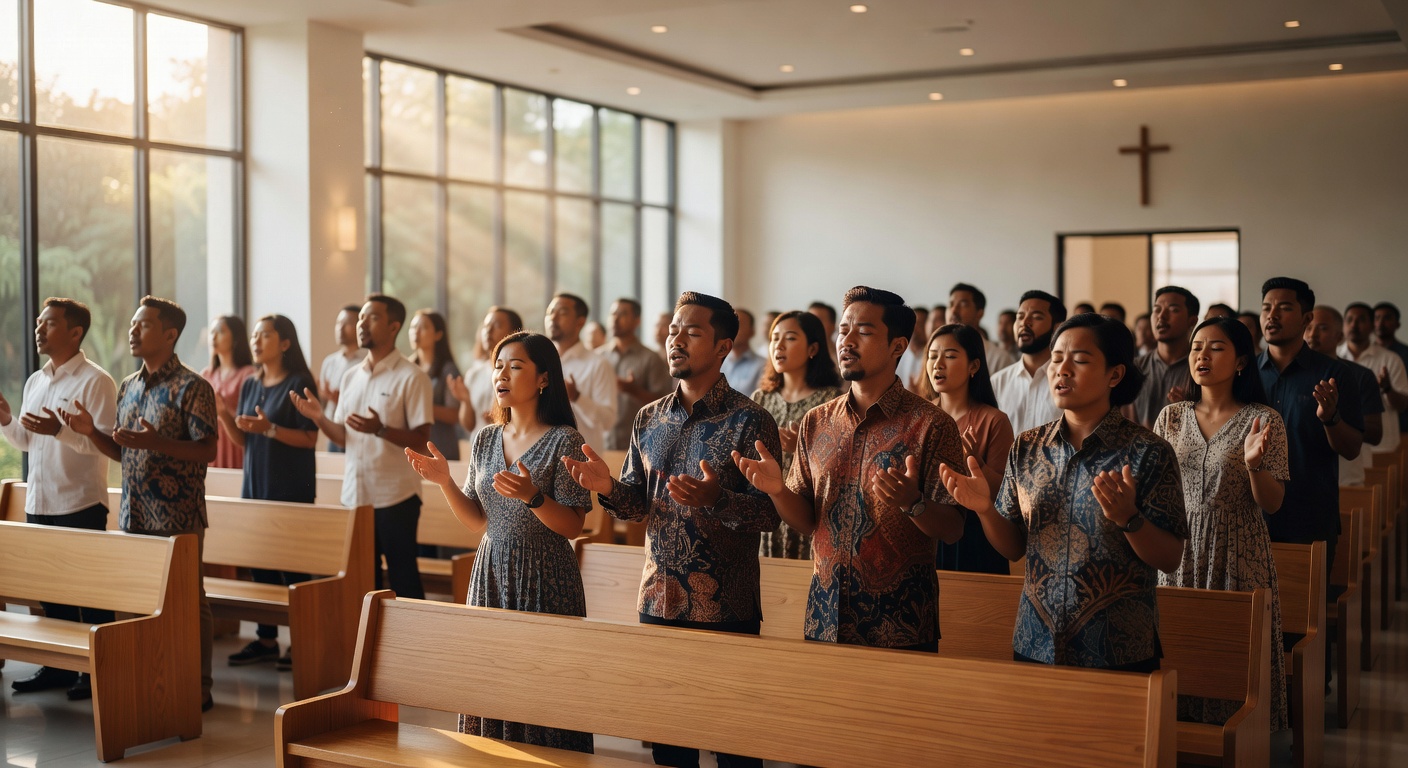
How to Reach Indonesian-Speaking Families at Your Church
Indonesia is the world's most populous Muslim-majority nation — yet it is also home to over 20 million Christians, one of the largest Christian populations in Asia. When Indonesian families arrive in your city, they bring with them a rich faith tradition, a deep sense of community, and a sincere desire to worship. The question is: will they find a home at your church?
For many churches in cities like Houston, Los Angeles, New York, Dallas, and Seattle, Indonesian families are already in the neighborhood — often quietly searching for a congregation that can speak to them in Bahasa Indonesia. Reaching them begins with a simple commitment: making your services accessible in their language.
Why Indonesian-Speaking Families Are Coming to Your City
The Indonesian diaspora in the United States has grown steadily over the past two decades. While Indonesian Americans number around 100,000-150,000 nationwide, major metropolitan areas have growing Indonesian communities tied to universities, technology companies, medical institutions, and international business.
Cities with notable Indonesian populations include Los Angeles, Houston, Seattle, the San Francisco Bay Area, New York, Boston, and Chicago. Many Indonesian families arrive on student visas or skilled worker visas, and their time abroad can be a formative period for both faith exploration and community-seeking.
What makes this community particularly significant for churches is the faith background many Indonesian immigrants carry. Indonesia's Christian communities — including Batak Protestant, GPIB (Gereja Protestan Indonesia bagian Barat), GKI (Gereja Kristen Indonesia), and Pentecostal churches — have produced generations of devoted believers. When these families land in your city, they are often searching for a church that feels like home.
The Language Barrier That Keeps Indonesian Families Away
There is an important distinction between functional English and worshipful English. A software engineer from Bandung might present fluently in team meetings but still struggle to feel spiritually connected during a fast-moving sermon with cultural idioms, humor, and theological nuance. Worship is personal. Language is intimate.
For Indonesian families who are new to your city — especially parents, grandparents, or those whose English is still developing — attending a church service entirely in English can feel isolating. They may nod along but miss key moments of teaching or prayer. They may hesitate to return not because they do not want to, but because they did not feel included.
This is where your church has a powerful opportunity. You do not need to hire a full-time Indonesian interpreter or run a separate Indonesian-language service. You need a way to offer real-time translation that allows Indonesian-speaking members to participate fully in your existing services — without distracting anyone else or requiring special equipment.
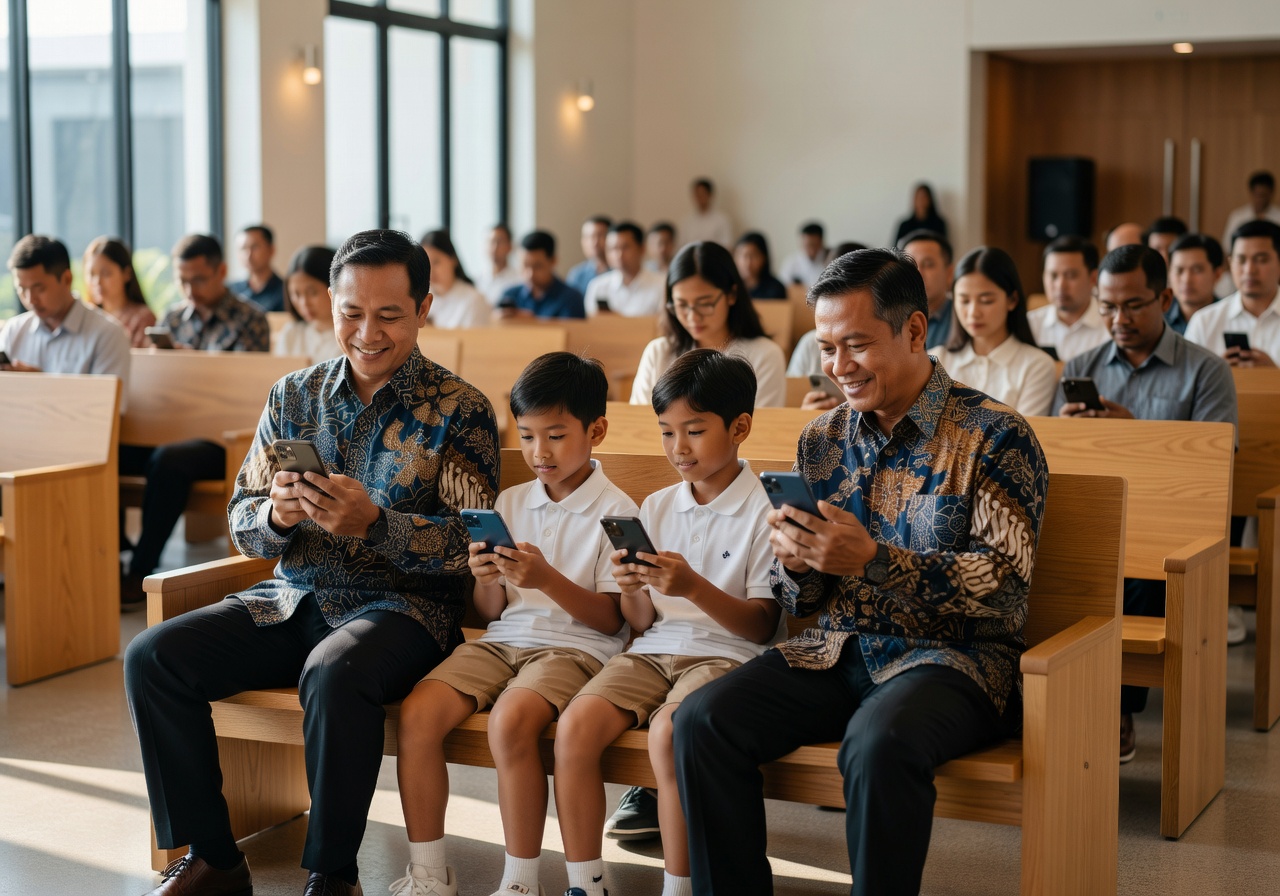
Glossa.live makes this possible. With AI-powered real-time translation in 100+ languages — including Bahasa Indonesia — members can follow along on their own smartphones while you preach, lead worship, and share announcements, all in English. No headsets. No booths. No extra staff. Just genuine inclusion.
Understanding Indonesian Christian Culture
Reaching Indonesian families effectively means more than adding translation. It means understanding a little about who they are.
- Community-oriented faith: Indonesian culture is deeply communal. The concept of gotong royong — working together and helping one another — runs through both society and church life. Indonesian Christians often expect their church to feel like a family: warm, relational, and oriented around shared meals and fellowship, not just Sunday worship.
- Denominational diversity: Indonesian Christians come from many backgrounds. Batak Christians (from North Sumatra) are often tied to the HKBP (Huria Kristen Batak Protestan), one of the largest Protestant churches in Asia. Many younger Indonesians are connected to charismatic and Pentecostal movements.
- Language: While Bahasa Indonesia is the national language, some older Indonesians may be more comfortable in Javanese, Sundanese, Minang, or Batak dialects. Bahasa Indonesia is the best starting point and covers the vast majority of Indonesian Christians in diaspora contexts.
- Tight community networks: Indonesian communities in diaspora are closely connected through WhatsApp groups, Facebook communities, and local Indonesian student and professional associations. A positive experience at your church can spread quickly through these networks.
How Real-Time Translation Works for Indonesian Services
You do not need to build a separate ministry or run a separate service to serve Indonesian families. Real-time AI translation makes it possible to include them in your current services with almost no additional setup.
- Your service runs as normal — your pastor preaches in English, worship songs are sung in English, announcements are made in English.
- Glossa.live captures the audio — through a simple microphone connection or your existing audio setup.
- AI translates in real time — into Bahasa Indonesia (and any other languages you need simultaneously).
- Indonesian members follow on their phones — no special equipment, no headsets, no interpreter booth required.
Setting this up takes minutes. You can learn how to embed Glossa on your platform and get started within the same week. The result? Indonesian families who once sat quietly during sermons can now understand every word. They can participate in prayer. They can respond to the message. They feel like they belong.
Five Practical Steps to Welcome Indonesian Families
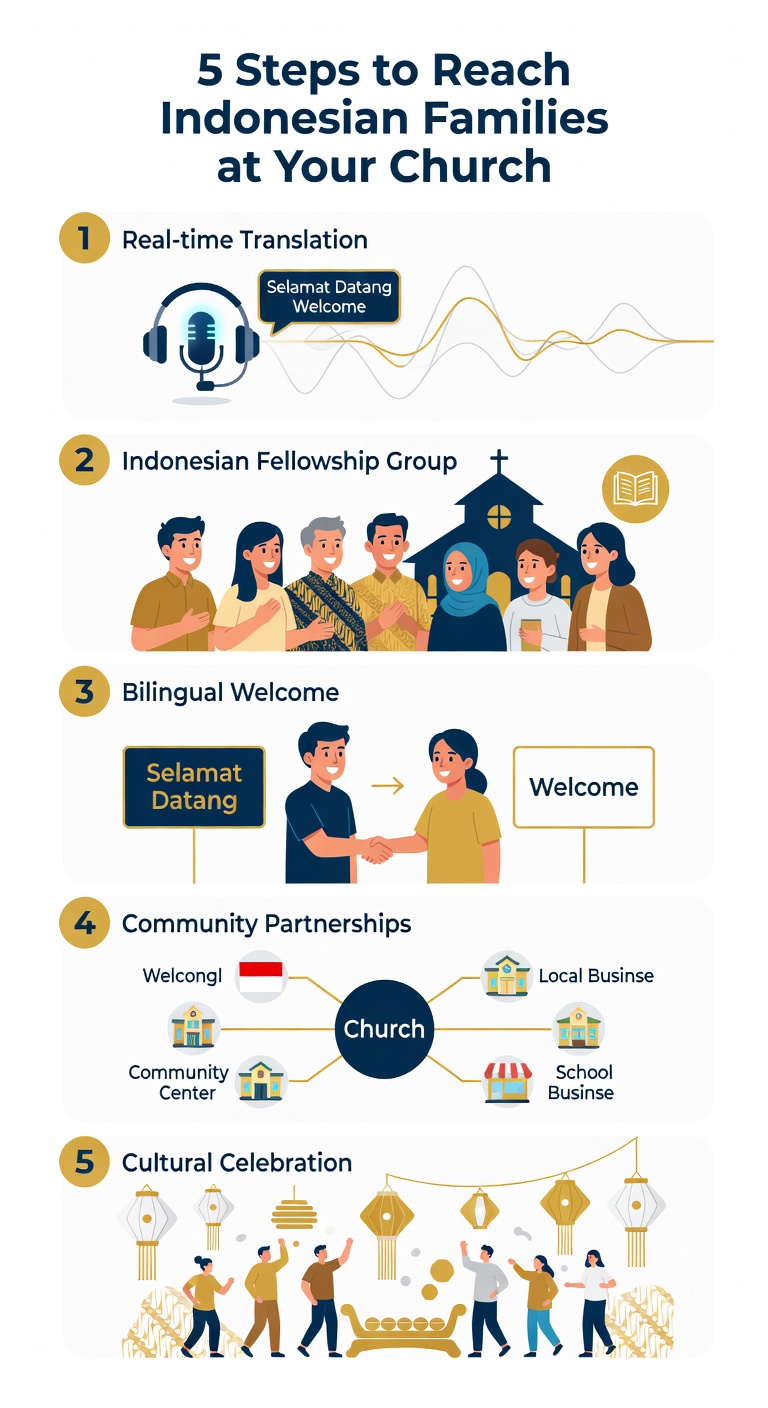
Translation is the foundation, but genuine welcome goes deeper. Here are five practical steps that will make Indonesian-speaking families feel truly at home.
- Start with real-time translation. Even families who speak English reasonably well will feel more welcomed when they see that your church has made an effort to include them in their native language. Set up Bahasa Indonesia as an available language on Glossa.live and announce it before the service begins.
- Connect with local Indonesian networks. Find out if there is an Indonesian Student Association at a nearby university or a local Indonesian community center. Introduce your church, share how you're offering translation, and invite them to visit. A single relationship with a community connector can open doors to dozens of families.
- Provide a bilingual welcome. Print a simple welcome card in both English and Bahasa Indonesia. Have a greeter who can say "Selamat datang" (welcome) — small gestures like this communicate respect in a language anyone can understand.
- Create an Indonesian fellowship group. Consider starting a small group or monthly gathering where Indonesian members can connect, share food, and feel the communal spirit that Indonesian culture prizes. A monthly dinner or a shared WhatsApp group goes a long way.
- Celebrate Indonesian heritage. When your church acknowledges Indonesian Independence Day (August 17) or other cultural milestones, it signals that you see Indonesian members as full members of your church family, not guests who happen to attend.
What Indonesian Church Outreach Looks Like in Practice
Imagine a church in Seattle with a growing Indonesian population nearby. Several Indonesian families have visited but have not committed. They appreciate the English worship but feel a bit lost during the sermon.
The church sets up Glossa.live for Bahasa Indonesia — a 15-minute setup. The following Sunday, an Indonesian family sits in the back and opens the translation on their phones. For the first time, the mother follows the entire sermon. Her teenage daughter is surprised that her mom is nodding along and taking notes. After the service, they stay for lunch and meet two other Indonesian families who attend.
Within a month, the church has a small but growing Indonesian community. They have started a WhatsApp group. They bring friends. The pastor did not need to learn Indonesian. The church did not need to hire an interpreter. The translation happened quietly, in the background — and it transformed the experience completely.
This is the power of removing a language barrier that most churches do not even know exists. For more on this kind of transformation, read how multilingual worship drives church growth and how churches are reaching immigrant communities through real-time translation.
AI Translation in Bahasa Indonesia: What to Expect
AI translation in Bahasa Indonesia has matured significantly in recent years. Indonesia's national language is one of the most well-supported languages in modern translation AI, in part because of its relatively straightforward grammatical structure — no verb conjugation, no noun gender — and its widespread digital presence.
For church contexts, Glossa.live's translation handles theological vocabulary (salvation, grace, Holy Spirit, repentance), sermon-style delivery, worship songs and liturgical phrases, pastoral announcements, and conversational prayer.
No translation — human or AI — is perfect. What matters most to Indonesian families is the gesture of inclusion. A 95% accurate translation available every Sunday is infinitely more valuable than a perfect interpreter who is only occasionally available.
If you know your congregation includes Batak speakers or Javanese speakers who may be more comfortable in their regional language, Glossa.live supports over 100 languages and can offer multiple language options simultaneously during the same service.
Common Questions About Indonesian Ministry
We do not have any Indonesian members yet — is it worth setting up translation?
Yes. Having translation available before anyone requests it sends a powerful signal of welcome. When a visiting Indonesian family discovers that your church already has Bahasa Indonesia available, they feel anticipated and valued — not like an afterthought.
What if the translation is not perfect?
Most Indonesian Christians in diaspora settings are forgiving of translation gaps; they are grateful for the effort. The gesture matters more than perfection. A church that tries to include Indonesian families will always be preferred over one that makes no attempt at all.
Can we use this for Indonesian students specifically?
Absolutely. Many Indonesian students in the US are away from their home church and home culture for the first time. They are often spiritually open and relationally hungry. A church that offers Bahasa Indonesia translation is uniquely positioned to become a spiritual home for Indonesian students during their formative university years.
Building a Long-Term Indonesian Ministry
If Indonesian families begin to grow into a significant portion of your congregation, you may want to think beyond translation toward deeper ministry investment. Some churches develop an Indonesian-language small group, led by a bilingual elder or layperson, that meets weekly or biweekly. This creates space for deeper discipleship in the heart language while still integrating Indonesian families into the broader congregation.
Others develop bilingual worship nights or special services on major holidays — Easter, Christmas, Indonesian Independence Day — that celebrate the cultural heritage of Indonesian members while welcoming the whole church into that celebration.
These are long-term investments. But they start with a single step: making this Sunday's sermon accessible in Bahasa Indonesia. For a broader look at building inclusive church culture, see how to build a multicultural church and practical strategies for overcoming language barriers in church.
Get Started This Sunday
Reaching Indonesian-speaking families at your church does not require a new budget line, a new staff position, or a complete restructuring of your services. It starts with a 15-minute setup and a genuine commitment to saying: everyone is welcome here — in whatever language they speak.
Glossa.live is available for churches of any size. You can start with a single language, a single service, and see the difference for yourself. Hundreds of churches are already reaching their multilingual communities this way — from small community churches to major denominations.
Your Indonesian neighbors are looking for a church. Make sure yours is ready to welcome them.