How to Reach Hmong-Speaking Families at Your Church
The Hmong community in the United States is one of the most resilient and tightly knit immigrant groups in the country. More than 300,000 Hmong Americans now call the US home, with the largest populations in Minnesota (especially the Twin Cities), Wisconsin, California (Fresno, Sacramento, and Merced), North Carolina, and Michigan. Yet if you ask most church leaders how they are reaching Hmong families in their community, you will often get a blank look.
That is not because pastors do not care. It is because Hmong outreach is rarely taught in seminaries, rarely modeled at denominational conferences, and rarely even discussed at neighborhood ministerial alliances. The Hmong church is a quiet but powerful movement in American Christianity — and for most English-speaking congregations, it is almost invisible.
If your church is near a Hmong community — or if a Hmong family has recently visited your Sunday service — this guide is for you. It will walk you through who the Hmong community is, what they are looking for in a church, why language matters so much, and how modern real-time translation technology makes it possible to welcome Hmong families into your existing worship service without rebuilding your whole ministry.
Who the Hmong Community Is — And Why They Matter
The Hmong are an ethnic group whose ancestral homeland spans the mountains of southern China, Laos, Vietnam, and Thailand. Most Hmong Americans trace their roots to Laos, where their families fought alongside US forces during the Vietnam War as part of the CIA-backed "Secret War." When Saigon fell and Laos came under communist control, tens of thousands of Hmong soldiers and their families were targeted for persecution. Many fled on foot through the jungle, crossed the Mekong River into Thailand, and eventually resettled in America beginning in the late 1970s.
That history shapes everything. Hmong Americans carry a deep sense of gratitude to the United States — and also a deep sense of loss for the homeland many of them never got to say goodbye to. First-generation elders still remember the refugee camps. Second-generation adults grew up translating for their parents at doctor visits and parent-teacher conferences. Third-generation Hmong kids are growing up bilingual, bicultural, and navigating the same identity questions every immigrant-origin community eventually faces.
Spiritually, the picture is beautiful. Before Christianity arrived, most Hmong practiced traditional shamanism rooted in ancestor veneration and animism. Missionary work beginning in the 1950s — particularly by the Christian and Missionary Alliance (CMA) — led to widespread conversions, and today a large portion of Hmong Americans identify as Christian. The Hmong District of the Christian and Missionary Alliance alone represents more than 100 Hmong congregations across North America, and there are many more Hmong Baptist, Lutheran, Catholic, and independent churches scattered throughout the US.
Still, many Hmong families — especially younger adults and families who have moved away from concentrated Hmong neighborhoods — are looking for a welcoming multicultural church where they can worship without feeling like a cultural afterthought. That is where your church comes in.
Why Language Is at the Heart of Hmong Church Life
To understand Hmong ministry, you have to understand how central language is to Hmong identity. There are two main dialects — White Hmong (Hmong Daw) and Green Hmong (Hmong Njua / Mong Leng) — and they differ enough that a single sermon may not be equally accessible to everyone, even within one congregation. Written Hmong uses a Romanized Popular Alphabet (RPA) developed by missionaries in the 1950s, which means literacy in written Hmong is still uneven across generations.
Here is what that means in practice:
- First-generation elders often speak Hmong as their primary language and may have limited English. They follow worship most deeply in Hmong.
- 1.5-generation adults (those who came to the US as children) are often fully bilingual — but they still think and pray in Hmong, and they feel most connected to God in their heart language.
- Second-generation young adults may speak conversational Hmong at home but think in English. They often bounce between English-speaking services and Hmong services depending on whether their parents are with them.
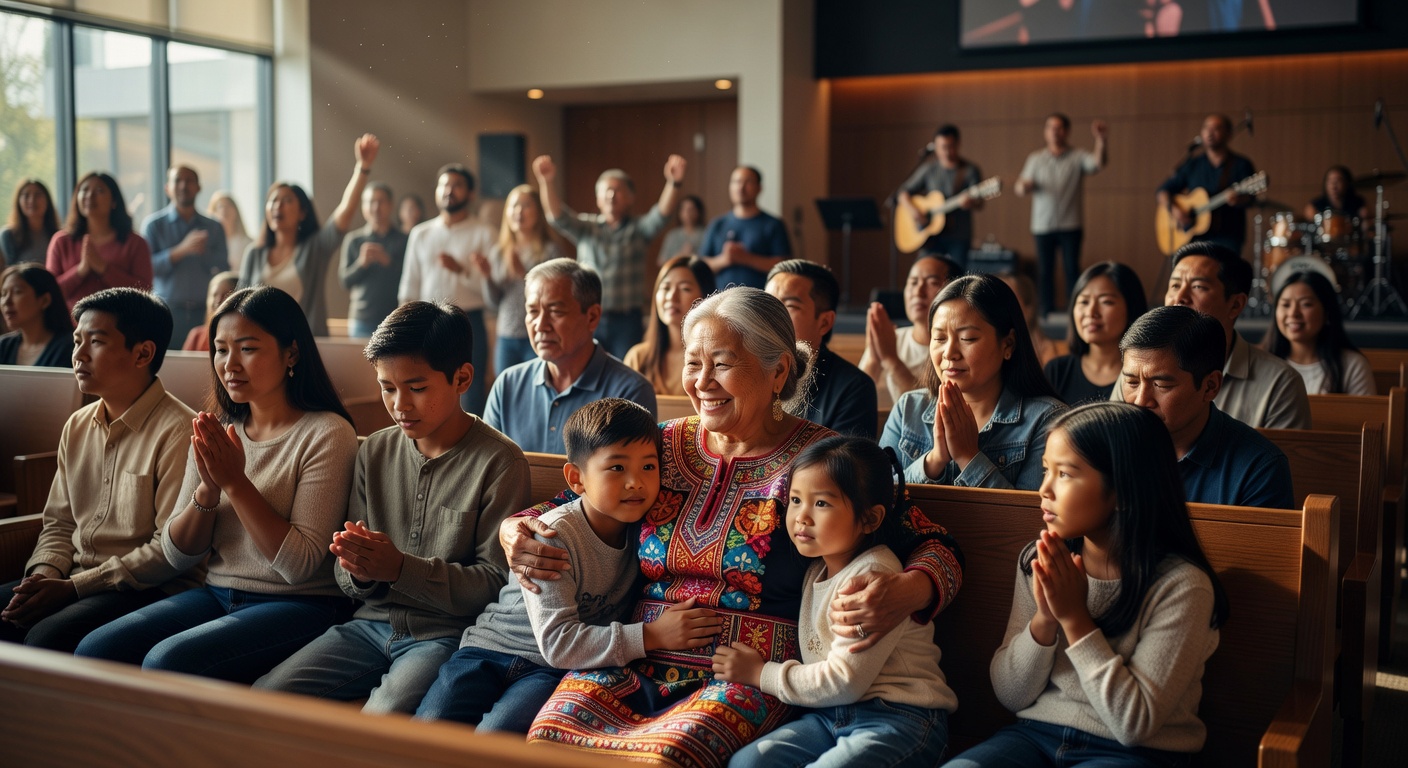
- Third-generation kids may understand Hmong but rarely speak it. They need English services — but they also need to see their grandparents worshiping alongside them, not in a separate room down the hall.
That multigenerational reality is why so many Hmong families dream of a church where everyone in the family can worship together in the same room — with the service happening in one language and real-time translation reaching every ear. For decades that has been impossible without hiring professional interpreters and renting expensive headset equipment. Today, with real-time AI translation for churches, it is not only possible, it is simple.
What Hmong Families Are Looking For in a Church
Every family is different, but a few common threads come up again and again when Hmong believers talk about what they want in a church home.
A place that honors the elders. Respect for parents and grandparents runs deep in Hmong culture. When a Hmong family visits your church, they are watching how you treat older members. Are elders greeted warmly? Are they made to feel important? Is the service accessible to them — or do they have to sit through an hour of English they cannot follow?
A place that understands the weight of family. Hmong identity is clan-based. The 18 traditional Hmong clan surnames (Cha, Fang, Hang, Her, Khang, Kong, Kue, Lee, Lor, Moua, Pha, Thao, Vang, Vue, Xiong, Yang, and others) connect people across states and generations. When one family member commits to a church, their decision often ripples through the whole clan. That is a blessing and a responsibility — churches that welcome Hmong families well often find themselves welcoming entire extended families over time.
A place where worship feels alive. Hmong Christianity tends to be warm, expressive, and deeply communal. Long prayer times, heartfelt singing, and testimonies from the congregation are all normal parts of Hmong services. Churches with cold, rigidly-scheduled services may feel unfamiliar at first — but a warm welcome and a space for Hmong voices to be heard goes a long way.
A place that does not make them choose between their culture and their faith. This is the big one. Hmong believers do not want to leave their Hmong-ness at the door in order to be Christian. They want to bring their language, their music, their stories, and their community into worship. Churches that make space for that, even in small ways, build trust quickly. For practical ideas, read our guide on overcoming language barriers in church.
How Real-Time Translation Changes Hmong Outreach
For most English-speaking churches, the biggest obstacle to welcoming Hmong families is not theology or willingness — it is logistics. How do you serve a community whose elders need Hmong and whose teenagers need English, when you only have one pastor preaching one sermon?
The traditional answer was to run two separate services: a Hmong service at 9 AM and an English service at 11 AM. That can work, but it fragments the congregation and signals to Hmong families that they are a side project, not the main event. It also requires a Hmong-speaking pastor, which is a significant hiring commitment.
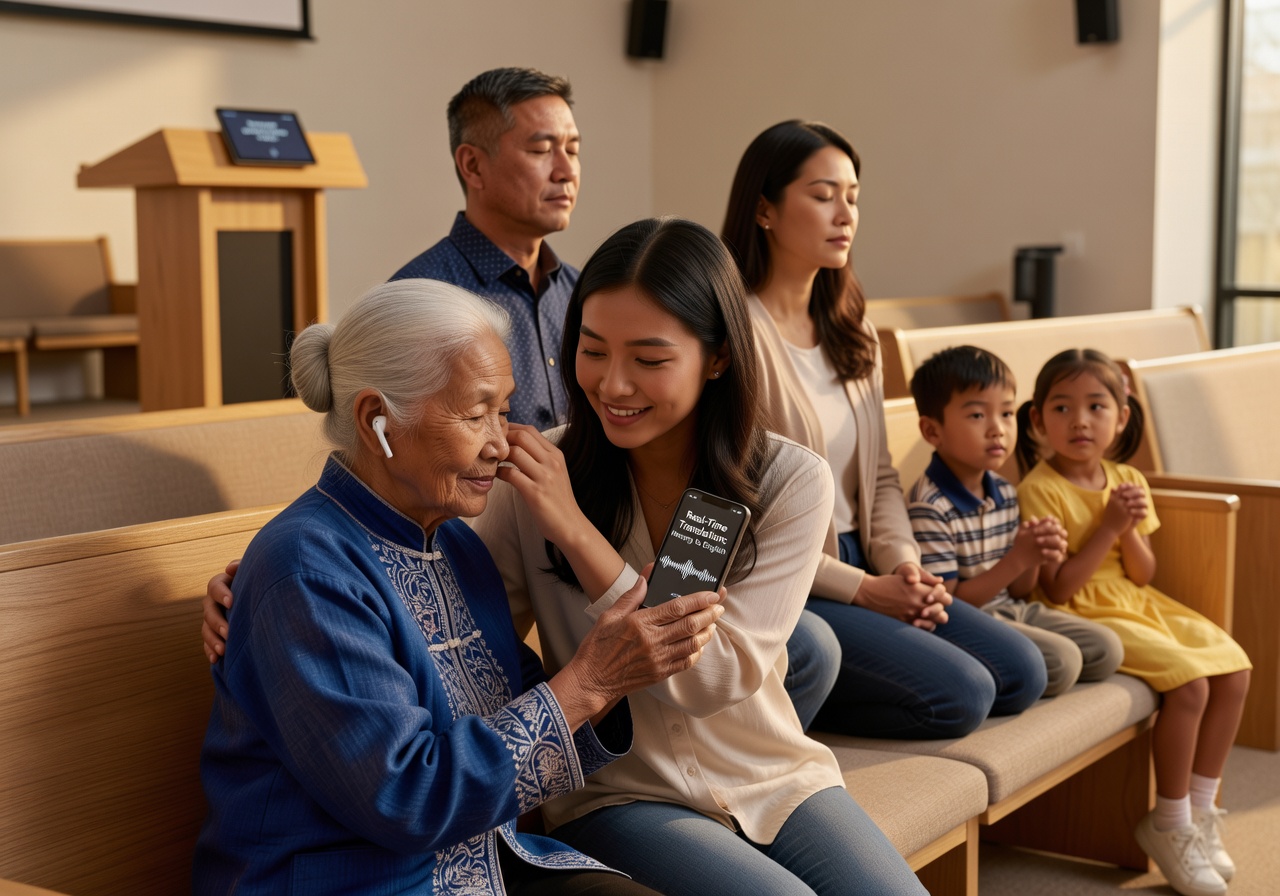
The modern answer is real-time AI translation. Glossa.live broadcasts your regular English sermon in more than 100 languages simultaneously — including Hmong — directly to the phones of anyone in the room. There is no special equipment, no headsets to hand out, no hiring a translator. People open the Glossa link on their phone, pick their language, plug in a regular earbud, and they hear the entire service in Hmong as you preach.
A few practical things to know about using Glossa for Hmong translation:
- Glossa supports Hmong (White Hmong / Hmong Daw) as a target language. If your congregation includes Green Hmong speakers, let us know — we are continually expanding dialect coverage.
- The AI is trained on biblical and ministry vocabulary, so scripture quotations, theological terms, and worship language translate reliably.
- Hmong grammar is structurally very different from English, so encourage your pastor to avoid heavy English idioms (like "on the ball" or "out of the blue") for the cleanest translation.
- Older members who are less comfortable with smartphones can share a device with a grandchild — the translation runs on a single phone that two people can share with a simple audio splitter.
- No internet at the grandmother's seat? Glossa runs on the church's existing WiFi — you do not need a cellular signal for every attendee.
For churches looking at the bigger picture of translation technology, our guide on choosing a church translation system walks through the tradeoffs between AI and traditional interpreters, and explains why most churches no longer need dedicated translation receiver hardware.
Practical Outreach Strategies for Reaching Hmong Families
Technology removes the translation barrier. But building genuine relationships with the Hmong community still takes intentionality. Here are six practical strategies that work.

1. Learn the Geography of Your Local Hmong Community
If you are in the Twin Cities, Fresno, Milwaukee, Sacramento, La Crosse, Appleton, Detroit, Charlotte, Denver, or Merced, there is almost certainly an established Hmong community nearby. Get to know where the Hmong markets, community centers, clan associations, and existing Hmong churches are. Respect the churches that are already doing the work — your goal is not to compete, but to become a welcoming option for Hmong families who, for whatever reason, are looking for something different.
2. Partner With an Existing Hmong Church
Many Hmong Alliance, Baptist, and Lutheran churches in the US are short on facility space, particularly for special events like weddings, funerals, graduations, and New Year celebrations. Offering your building as a partner venue creates instant goodwill. Hosting a joint worship night once a year — with your worship band and a Hmong pastor preaching, translated into English via Glossa for your congregation — is a beautiful way to build a real relationship rather than a transactional one.
3. Honor Hmong New Year
Hmong New Year (Noj Peb Caug) is the biggest cultural celebration of the year, typically held between November and December. It is a time of family reunions, traditional dress, courtship games, music, and feasting. If your church hosts a Hmong New Year appreciation event — even a simple potluck with Hmong foods and a short message — you communicate something important: we see you, we honor your culture, and you are welcome here. Many Hmong families will attend a cultural event long before they ever set foot in a Sunday service.
4. Recruit a Hmong Bridge Leader
You do not need a full-time Hmong pastor to do Hmong ministry well. What you do need is at least one respected Hmong voice on your team — a lay leader, deacon, or regular attender who can help you navigate cultural expectations, correct missteps before they become problems, and invite other Hmong families with credibility. If no such person exists yet in your congregation, pray for one, and be patient. The right bridge leader will come.
5. Advertise in Hmong-Language Spaces
Hmong Americans are active on Facebook, Hmong radio stations (especially in Minnesota, Wisconsin, and California), and in-person community gatherings. A simple post in a local Hmong community Facebook group that mentions "Sunday service now available in Hmong through real-time translation" will reach people no amount of English advertising ever would. Pair the announcement with a short video of how Glossa works on a phone, and you have an invitation that travels well.
6. Equip Your Greeters
When a Hmong family visits for the first time, the first thirty seconds at the door matter enormously. Train your greeters to recognize Hmong last names (Vang, Xiong, Lee, Yang, Moua, Thao, Her, Lor, Vue are common), to offer a warm "Nyob zoo" (hello) if they can, and to hand the family a card explaining how to access Hmong translation on their phone. Small gestures like these tell a family: you were expected, and you are welcome.
Frequently Asked Questions About Hmong Church Ministry
Do most Hmong Americans speak English?
Second and third-generation Hmong Americans are typically fluent in English. First-generation elders often have limited English — and even bilingual adults usually prefer worship, prayer, and scripture in Hmong. Real-time translation lets you serve everyone in the same service without forcing a choice.
Is the Hmong community predominantly Christian?
A significant portion of Hmong Americans are Christian — particularly within the Christian and Missionary Alliance, Baptist, Lutheran, and Catholic traditions. However, many Hmong families still practice traditional shamanism or blend traditional practices with Christianity, and others are unaffiliated. Your outreach should be welcoming to believers and seekers alike.
What is the difference between White Hmong and Green Hmong?
White Hmong (Hmong Daw) and Green Hmong (Hmong Njua or Mong Leng) are the two main dialects spoken in the US. They share much vocabulary but differ in pronunciation and some grammar. Most printed Hmong Bibles and church materials are in White Hmong, and Glossa's current Hmong translation targets White Hmong. Green Hmong speakers can usually understand White Hmong content with minimal friction.
How do I say "welcome" in Hmong?
"Nyob zoo" (pronounced roughly "NYAW zhong") is a warm greeting that means "hello" and works beautifully as a welcome at your church door. "Koj puas nyob zoo?" means "How are you?" — learning just a few phrases goes a long way.
What if we have only one or two Hmong families?
That is actually the perfect starting point. With real-time AI translation, you can welcome one Hmong family just as easily as you can welcome fifty. As they feel at home, they will bring extended family — and the Hmong community word-of-mouth is exceptionally strong.
Getting Started This Sunday
If you have read this far, you probably already know there are Hmong families in your community who could be part of your congregation. The next step is small, practical, and surprisingly easy.
First, set up Glossa.live for your Sunday service. It takes less than fifteen minutes and works on any phone. Second, make sure "Hmong" is enabled as one of your offered languages. Third, print a simple welcome card with a QR code to the Glossa link, and train your greeters to offer it to anyone who looks like they might appreciate a translation option. Fourth, share in a Hmong community Facebook group or at a Hmong market that your church offers Sunday services with Hmong translation — and then be ready to welcome the first family warmly when they walk in the door.
You do not have to have all the answers. You do not have to be an expert in Hmong culture. You just have to create space — a room where a Hmong grandmother can hear the Gospel in the same breath as her English-speaking grandchildren, where a Hmong father does not have to choose between his culture and his Sunday morning, and where a Hmong family can finally find a church that feels like home.
That is what real welcome looks like. And it is what Glossa.live was built to make possible. Learn more about how AI translation works for church services, or read our practical guide to building a multicultural church for the bigger picture.
Every tribe and tongue and people and nation belongs in the same worship service — not in separate rooms down the hall, but side by side. Technology has finally caught up with that vision.
Ready to welcome your first Hmong family? Start with Glossa.live for free — no special equipment, no complicated setup, just real-time translation on the phones people already carry in their pockets.