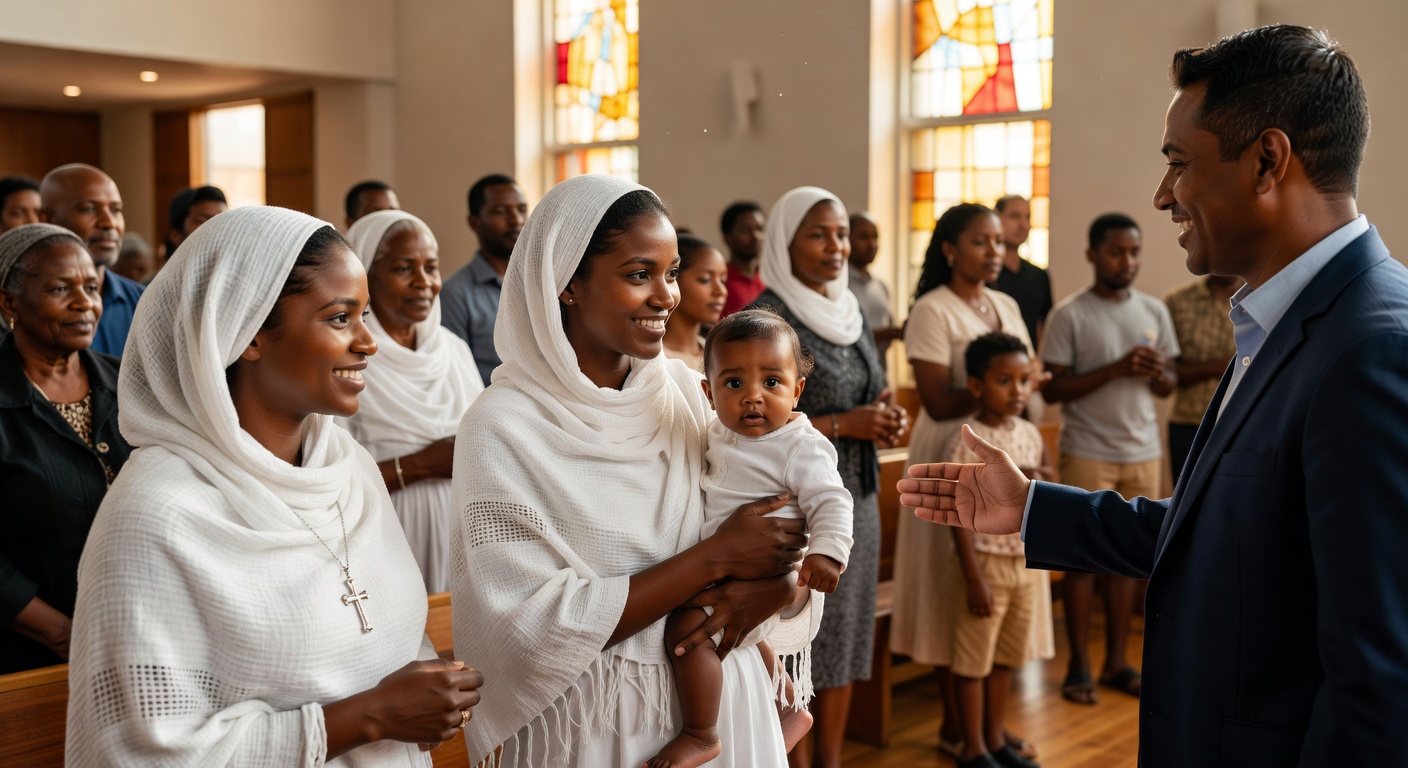
How to Reach Eritrean-Speaking Families at Your Church
Long before the sun lifts over the eucalyptus trees of Asmara, you can hear it: the slow, plain chant of the Eritrean Orthodox Tewahedo liturgy rising out of an ancient stone church. A deacon shakes a sistrum. A priest, draped in white netela embroidered in gold, swings the censer. The Ge'ez melodies of qenema chant — preserved more or less intact since the 4th century, when Christianity first arrived on the Red Sea coast with Frumentius — fold the worshipers into a rhythm older than almost any other living Christian tradition on earth. When an Eritrean family walks into your American church, you are meeting people from one of the cradles of Christianity, and one of the most resilient persecuted-church communities in the world today.
Roughly 50,000 to 100,000 people of Eritrean ancestry live in the United States, with the largest communities in the Washington DC metro area (especially Northern Virginia and Silver Spring), Dallas-Fort Worth, Seattle, Denver, Atlanta, Oakland, Los Angeles, Houston, Las Vegas, Minneapolis-St. Paul, and Columbus. Monthly search volume reflects how many Eritrean-Americans are looking for a spiritual home: "eritrean orthodox church" draws about 1,600 searches a month, "medhanealem eritrean orthodox church" 1,000, "eritrean church" 880, "dallas eritrean church" 590, "eritrean orthodox church near me" 260, and "eritrean christian" another 170. Behind every one of those searches is a real family — a refugee mother who fled indefinite national service, an engineer in Denver who left to find religious freedom, a teenager born in Khartoum and raised in Seattle — looking for a congregation that honors their faith, their language, and their story.
This guide will help you understand Eritrean families, why Eritrean worship can feel so different from a typical American service, and how to welcome Eritrean-speaking families well — without needing to launch a separate Tigrinya service from scratch.
Who Are Eritrean-Speaking Families in America?
Eritrea is a small horn-of-Africa country of about 3.5 to 6 million people, wedged between Sudan, Ethiopia, Djibouti, and the Red Sea. It became independent from Ethiopia in 1993 after a 30-year war of independence, and that history matters deeply: even though Eritreans share much of their culture, language families, food, and Christian heritage with their Ethiopian neighbors, they are not Ethiopian. Conflating the two — even kindly — is one of the fastest ways to make an Eritrean family feel unseen. If you remember nothing else from this guide, remember this: Eritreans are Eritreans.
Eritrea is home to nine officially recognized ethnic groups, but the two largest by far are the Tigrinya (about half the country, mostly Christian, concentrated in the highlands) and the Tigre (about 30%, mostly Muslim, concentrated in the lowlands). Smaller groups include the Saho, Afar, Bilen, Hedareb, Nara, Kunama, and Rashaida. Most Eritrean-Americans you meet at church will be ethnic Tigrinya, and the language they pray, sing, and grieve in will be Tigrinya — written in the same Ge'ez script as Amharic but with its own grammar, vocabulary, and sound.
Eritrean families arriving in the United States usually come through one of three pipelines: the original 1980s diversity and student visa wave; refugee resettlement from camps in eastern Sudan, Ethiopia, and Israel; and ongoing asylum claims by Eritreans who escaped indefinite national service, religious persecution, or the 2018-2020 border conflicts. According to UNHCR, more than 580,000 Eritreans live as refugees worldwide — roughly one in every six to ten Eritreans on earth — making it one of the largest refugee populations per capita in the world. This is a deeply diaspora people.
Most Eritrean-Americans are bilingual or trilingual. Older family members are often most comfortable in Tigrinya (ትግርኛ), and many also speak Arabic and some Italian (a legacy of the 1890-1941 Italian colonial period). Younger generations born or raised in the US are usually fluent in English but still speak Tigrinya at home, at family gatherings, and especially in worship. The single most important thing for pastors to grasp is that for many Eritrean Christians, language and liturgy are inseparable from identity. The Ge'ez chant their grandparents sang in Asmara is the same chant they want to hear in Denver.
Eritrean Christianity: Tewahedo, Catholic, and the Pente Wave
Eritrea was one of the first kingdoms in the world to adopt Christianity. King Ezana of Aksum was baptized around 330 AD by the Syrian missionary Frumentius, making the Christian tradition that took root in what is now northern Ethiopia and Eritrea older than the conversion of Rome, England, Russia, or most of continental Europe. To worship with an Eritrean family is to be welcomed into a tradition that has been continuously practiced for nearly seventeen centuries.
Today there are four main Christian streams in the Eritrean community, and a healthy welcoming church should at least be able to recognize them by name:
- Eritrean Orthodox Tewahedo Church (ኤርትራዊት ኦርቶዶክስ ተዋሕዶ ቤተ ክርስትያን) — by far the largest stream, about 50% of all Eritreans. Autocephalous since 1998 when it split from the Ethiopian Orthodox Tewahedo Church. Liturgy in Ge'ez, sermons in Tigrinya. Major US parishes are typically named after Medhanealem (Savior of the World), Kidane Mehret (Covenant of Mercy), Debre Tsion, Debre Selam, or Mariam (Mary).
- Eritrean Catholic Church — a small but historically significant Eastern Catholic church (sui iuris) in full communion with Rome, using the Ge'ez Rite. Especially common among Eritreans from the central Asmara-Keren area where Italian Capuchin missionaries were active.
- Eritrean Lutheran / Mekane Yesus heritage — the Evangelical Lutheran Church of Eritrea, descended from 19th-century Swedish Evangelical Mission work in the western lowlands. Smaller but well-organized in diaspora.
- Pente / Evangelical and Pentecostal churches — sometimes called "Pente" by Eritreans, these include independent congregations with names like Word of Life, Mulu Wengel (Full Gospel), Rhema, Kale Heywet (Word of Life Church), and various Charismatic fellowships. Severely persecuted in Eritrea (banned by the government in 2002 alongside any church not Orthodox, Catholic, Lutheran, or Sunni Muslim), the Pente diaspora is energetic, evangelistic, and often the most likely to engage with American multilingual ministry.
If your church is welcoming an Eritrean family for the first time, gently asking "is your family Orthodox, Catholic, Lutheran, or evangelical background?" is a respectful and useful opening question. The answer will shape what feels like home in your worship — and it will tell the family that you see them as Eritrean Christians, not just "another African family."
Where Eritrean-Americans Live (And Why It Matters for Your Church)
Eritrean diaspora settlement patterns in the US were shaped almost entirely by refugee resettlement programs and chain migration. If you serve in any of these metros, there is a real and growing Eritrean community within driving distance of your sanctuary.
| Metro Area | Eritrean Community Profile |
|---|---|
| Washington DC / Northern Virginia / Silver Spring MD | The single largest Eritrean-American community. Strong Orthodox parish life (Medhanealem in Alexandria, Kidane Mehret in Silver Spring), thriving Pente and Lutheran congregations, and the largest concentration of Eritrean restaurants, businesses, and cultural organizations in the US. |
| Dallas-Fort Worth, TX | 590 monthly searches for "dallas eritrean church" alone — a clear signal of demand. Strong Orthodox and Pente presence; many Eritrean families resettled through Catholic Charities of Dallas. |
| Seattle, WA | Tukwila and South King County are major resettlement hubs. Tigrinya is one of the most-requested interpretation languages in Seattle Public Schools and Harborview Medical Center. |
| Denver / Aurora, CO | Aurora hosts one of the largest African refugee resettlement populations in the West, including thousands of Eritreans served by the African Community Center. |
| Atlanta, GA / Clarkston | Clarkston is famously called "the most diverse square mile in America." A growing Eritrean Orthodox and Pente community. |
| Oakland / SF Bay Area | Older established community with multiple Eritrean Orthodox parishes. |
| Los Angeles, CA | Especially around Koreatown and South LA. Tigrinya speakers, plus the broader Habesha (Ethiopian-Eritrean) cultural footprint of Little Ethiopia. |
| Las Vegas, NV | A surprisingly large and growing Eritrean population, drawn by hospitality industry jobs. |
| Minneapolis-St. Paul, MN | Strong refugee-resettlement infrastructure, alongside the established Ethiopian community. |
| Houston, TX | Growing community served by YMCA International Services and Catholic Charities resettlement. |
| Columbus, OH | Smaller but growing, especially in the Northland and East Columbus neighborhoods. |
If your church is in or near any of these metros, you almost certainly have Eritrean families — Orthodox, Catholic, Lutheran, or evangelical — within fifteen minutes of your front door. Most are not actively visiting non-Eritrean churches yet. The question is whether your church is ready for them when they do.
Why Tigrinya Translation Changes Everything
It is tempting to assume that because most Eritrean-American families have working English, language is not really a barrier. In daily life — at school, at work, at the grocery store — that is often true. But worship is different. Worship is the language of grief, gratitude, lament, and praise. It is the language a mother prays in when her son is still trapped in indefinite national service back home. It is the language a grandfather sings in when he remembers his own father chanting the same Ge'ez melodies in a stone church in Mendefera fifty years ago. English is what Eritreans use to live in America. Tigrinya is what they use to talk to God.
This is where real-time translation transforms welcome from an aspiration into something practical. With Glossa.live, every person in your sanctuary — including the Tigrinya-speaking grandmother who just arrived from Asmara two months ago — can hear the sermon, the prayers, the announcements, and the call to respond in their heart language, on their own phone, in real time. No headsets to buy. No interpreter to recruit. No separate service to launch. Just open the app, scan a QR code, and listen.
Glossa supports Tigrinya, Amharic, Arabic, Italian, and more than 95 other languages — which means a single Sunday service can include a Tigrinya-speaking Eritrean family, an Amharic-speaking Ethiopian family, an Arabic-speaking Sudanese family, a Spanish-speaking family, and an English-speaking family, all hearing the same sermon in the language of their hearts at the same moment. For Eritrean families specifically, this means your church can become a place where Tigrinya matters without your pastor having to learn a new language and without your worship team having to find a Tigrinya interpreter every week.
If you would like to see how this works in practice, the Glossa embed setup guide walks you through every step — most churches are running in under fifteen minutes.
Cultural Foundations: Eight Things Every Pastor Should Know
Eritrean Christian culture is rich, layered, and quite different from typical American evangelical or mainline church culture. These eight points are not the whole story, but they are a meaningful start.
1. Fasting (Tsom) Is Central
Eritrean Orthodox Christians observe roughly 180 days of fasting per year — far more than most Western Christians realize. Fasting means vegan: no meat, no dairy, no eggs, no fish (with some exceptions for fish on certain fasts). The major fasts are Hudade (Lent, 55 days), Wednesdays and Fridays year-round, the Apostles' Fast, the Assumption Fast, and Advent (Nineveh / Tsome Nebiyat). If your church serves food at events, always have a vegan option — and label it clearly. This single act of hospitality tells Eritrean families that you have done your homework.
2. The Calendar Is Different
Eritrean Orthodox Christians follow the Coptic-derived Eritrean calendar (the same as the Ethiopian calendar, with 13 months and a 7-8 year offset from the Gregorian). Christmas (Lidet / Genna) is January 7. Easter (Fasika) follows Eastern Orthodox calculations and is usually a week or so after Western Easter. Timket (Epiphany) on January 19 is one of the most important feasts of the year. Meskel (Finding of the True Cross) on September 27 involves bonfires and is a deeply cherished celebration. Knowing these dates and naming them publicly — "happy Timket" or "happy Meskel" in a service announcement — is a small thing that means a great deal.
3. Independence Day (May 24) Is Sacred
May 24 marks the 1991 liberation of Asmara that ended the 30-year war of independence. For Eritreans of every religious background, it is the most important secular holiday of the year. A simple acknowledgement — a prayer for Eritrea, a paragraph in the bulletin, an invitation to share a testimony — is a profound gesture of solidarity. For families with loved ones still in Eritrea or in refugee limbo, it can also be a complicated and grief-filled day.
4. Buna (Coffee) Is Ministry
The Eritrean and Ethiopian coffee ceremony — three rounds (abol, tona, baraka) of strong coffee brewed from freshly roasted beans, served with frankincense smoke and popcorn — is one of the most beautiful cultural expressions of hospitality on earth. Coffee originated in this part of the world. If you want to honor an Eritrean family, drink their coffee. If you want to bless them, offer them coffee after church (good coffee, not lukewarm drip). The cup is the conversation.
5. Names Carry Stories
Most Eritrean names follow a patronymic pattern: first name + father's first name + grandfather's first name. So Aman Tesfay Ghebremeskel is Aman, son of Tesfay, son of Ghebremeskel. There is no "family surname" the way most Americans expect. When a Tesfay Tewolde signs his daughter up for Sunday school, her last name is his first name, not his last. Forms that demand "family name" can be frustrating; a kind explanation goes a long way. Common Eritrean names include theological gems: Medhin (savior), Yohannes (John), Tewodros (Theodore), Selam (peace), Hiwot (life), Tirhas (mercy), Mehret (mercy), Kidane (covenant), Awet (victory), and many compound names like Ghebreyesus (servant of Jesus) or Welde-Mariam (son of Mary).
6. The Saturday-Sabbath Tradition
The Eritrean Orthodox Tewahedo Church observes both Saturday and Sunday as holy days — a tradition shared with the Ethiopian Orthodox and rooted in the church's deep Old Testament continuity. Many devout Eritreans attend Saturday liturgy as well as Sunday. This is one reason an Orthodox Eritrean family may be slow to commit to a Sunday-only American congregation: their week of worship is fuller than most American Christians realize.
7. Trauma Lives in the Room
Many Eritrean-Americans have first-hand experience of indefinite military conscription (Sawa), torture, imprisonment for evangelical worship, the perilous Sahara and Mediterranean migration routes, and family separation lasting decades. The 2002 government decree banning all non-recognized churches has imprisoned thousands of Pente, evangelical, and Charismatic Eritrean Christians, sometimes for years in shipping containers in the desert. Don't ask probing questions early. Don't bring out a news headline as a conversation opener. Earn the right to hear the story slowly. A trauma-informed pastoral presence is essential.
8. Habesha Is a Bridge — and a Boundary
The word Habesha refers to the broader cultural family of Tigrinya, Amhara, Tigre, and related Horn-of-Africa peoples. Many Eritreans embrace Habesha as a cultural identity that links them with Ethiopian-Americans, especially in food, music, and church traditions. But Habesha is not a synonym for "Ethiopian." An Eritrean family may happily share a Habesha cultural night with the Ethiopian family at your church — and still need to be acknowledged as Eritrean. Both/and, not either/or. (For more on neighboring outreach, see our guide to reaching Ethiopian-speaking families for context that complements without conflating.)
Practical Steps for Welcoming Eritrean Families This Sunday
You do not need to be a missionary, an Orthodox liturgist, or a Tigrinya speaker to welcome an Eritrean family. Most of what makes the difference is simple, learnable, and rooted in what your church already does well. Here is a practical starter list.
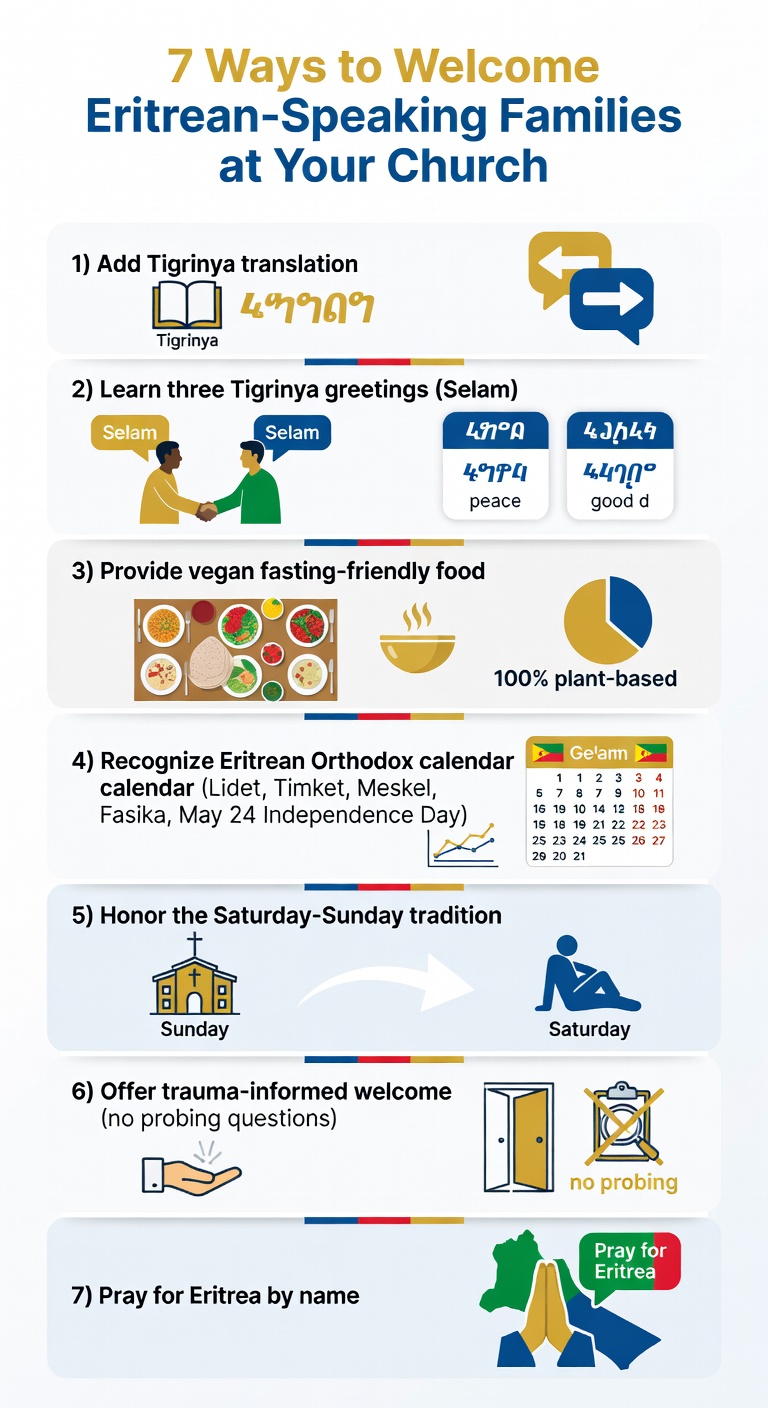
- Add Tigrinya translation to your service. Use Glossa.live so any Tigrinya speaker can listen on their phone. Print a small "Translation available — scan here" card in the bulletin and at the welcome table.
- Learn three Tigrinya words. Selam (peace / hello), Egziabher Yibarkka (God bless you), and Yekenyeley (thank you, said to one person). Use them with confidence and a smile. You will not pronounce them perfectly. It will not matter.
- Make sure there's vegan food at every fellowship event. Lentils (misir), salad, injera (the spongy sourdough flatbread), bread without butter, fruit. Always have at least one option clearly labeled vegan / fasting-friendly.
- Recognize the Eritrean calendar. Mention Lidet (January 7), Timket (January 19), Fasika (Eastern Easter), Meskel (September 27), and Independence Day (May 24) in your bulletin or service announcements when those dates fall on a Sunday.
- Don't ask about politics on the first visit. Eritrean political conversations — about the government, the Tigray war, the diaspora opposition — are extraordinarily painful and divide families. Stay away from the topic until trust is deep.
- Respect both Saturday and Sunday. If you have an Orthodox-background Eritrean family, understand that they may also worship at an Eritrean Orthodox parish on Saturday. You are not competing; you are complementing.
- Connect the kids. Many second-generation Eritrean-American kids speak only basic Tigrinya and feel caught between cultures. A youth group that knows their parents' homeland exists — and asks about it — is a gift.
- Pray for Eritrea by name. From the pulpit. Out loud. In English. Let an Eritrean family hear their country lifted up in your service. It will mean more than you know.
Building a Tigrinya-Welcoming Service Without Starting a New Church
One of the biggest myths in immigrant ministry is that welcoming a new language community requires planting a new ethnic congregation. For most Eritrean families in most US cities, that is exactly the wrong approach. Most Eritrean-American families want both: the dignity and depth of their own Orthodox or Pente community on one hand, and the accessible, English-speaking, multicultural American congregation that meets their kids and their neighbors on the other. Your church doesn't need to replace anything. It needs to make room.
Here is what "making room" looks like in practice for a midsize American church that wants to welcome Eritrean families:
- Real-time Tigrinya audio translation of your sermon and key prayers via Glossa.live, listenable on any phone with no headset purchase.
- Bilingual Scripture reading once a month: an Eritrean teen reads the passage in Tigrinya, you read in English. Beautiful, simple, costs nothing.
- An Eritrean Christmas (Lidet) potluck in early January, hosted in your fellowship hall — let an Eritrean family lead the menu and the music.
- A buna ceremony at one Sunday's coffee hour, hosted by an Eritrean family. Frankincense, popcorn, three rounds, real conversation.
- A bulletin column or weekly email feature highlighting a member of your Eritrean community — their story, their hopes, their family.
- Quietly building referral relationships with the local Eritrean Orthodox parish, Eritrean Pente fellowship, and refugee resettlement agency. You don't need to compete with these spaces; you need to know them.
Common Mistakes to Avoid
- Calling Eritreans Ethiopian. Even "Habesha" is safer than "Ethiopian." Just say "Eritrean."
- Assuming all Eritreans are Orthodox. Pente, Catholic, Lutheran, and Muslim Eritreans all exist in the diaspora.
- Serving only Western food at fellowship events. Have vegan and injera-friendly options every single time.
- Asking probing questions about how someone got to the US. The migration journey is often deeply traumatic. Wait to be told, never ask.
- Treating English fluency as evidence that translation isn't needed. Worship language is heart language, not job language.
- Bringing up Eritrean politics. Even with the best intentions, this almost always causes pain. Stay focused on Christ, family, and welcome.
- Forgetting the Saturday Sabbath. Don't be hurt if an Orthodox family doesn't attend every Sunday — they may be at liturgy on Saturday already.
Resources for Going Deeper
Three trustworthy starting points for understanding Eritrean Christian culture and refugee experience:
- Open Doors USA publishes the World Watch List, where Eritrea consistently ranks among the top ten most difficult countries in the world for Christians. Their reporting on the persecuted Eritrean church is sober and well-sourced.
- UNHCR's Eritrea page offers up-to-date data on Eritrean refugees, the indefinite-conscription crisis, and the Sahara-Mediterranean migration route.
- Lifeway Research provides practical, pastor-friendly studies on welcoming new ethnic groups into existing congregations.
For more on welcoming neighboring African and Horn-of-Africa communities, see our companion guides: How to Reach Ethiopian-Speaking Families, How to Reach Nigerian-Speaking Families, How to Reach Ghanaian-Speaking Families, and How to Reach Congolese-Speaking Families.
Worship is the language of grief, gratitude, lament, and praise. English is what Eritreans use to live in America. Tigrinya is what they use to talk to God.
The Bigger Picture: Why This Matters
Eritrean Christianity is one of the oldest unbroken traditions in the church universal. It survived seven centuries of Islamic empires lapping at its borders. It survived Italian colonization, British administration, Ethiopian annexation, a 30-year war, and a quarter-century of state-sponsored religious persecution that has emptied Pente and evangelical pews into shipping-container prisons. It is, by any honest measure, a miracle of perseverance.
When an Eritrean family walks into your American sanctuary, they are bringing seventeen centuries of faith with them. They are bringing the chant of Frumentius and Ezana. They are bringing the persecuted prayers of friends who are still in prison. They are bringing the courage to start over in a country that does not know how to pronounce their name. The least your church can do — the best your church can do — is make absolutely sure they can hear, in their own language, that they are welcome here.
Ready to make Tigrinya welcome on your phone screens this Sunday? Try Glossa.live — free to start, no equipment required, set up in fifteen minutes. Every language spoken in your community deserves to hear the Gospel. Eritrean families are waiting to find out if yours is the church that finally says selam.