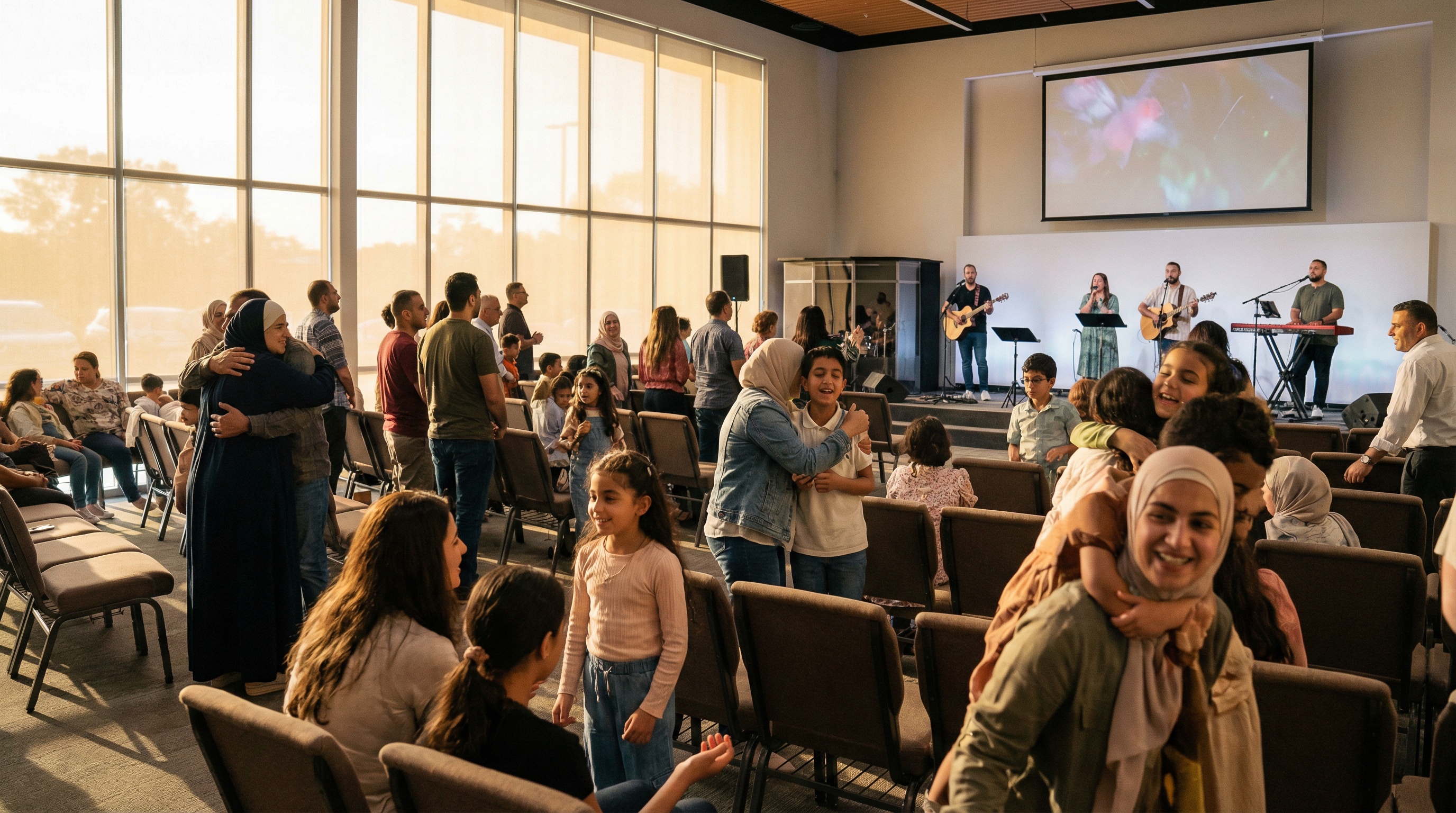
How to Reach Arabic-Speaking Families at Your Church
Is your church in a city with a growing Arab-American community, but your Sunday service is exclusively in English? You are not alone. Across the United States, hundreds of thousands of Arabic-speaking families are quietly searching for a church where they can worship in their heart language.
Arabic is the fifth most spoken language in the world, with over 400 million native speakers globally and a rapidly growing diaspora in the United States. Cities like Houston, Detroit, Los Angeles, Chicago, Dearborn, and New York have vibrant Arab-American communities, many of them Christian, many of them searching for a church home where they feel truly welcomed.
Reaching Arabic-speaking families at your church does not require hiring a professional interpreter or launching a separate Arabic-language service. With the right tools, a little cultural awareness, and a genuine commitment to inclusion, your church can become a place where Arabic-speaking families feel seen, heard, and deeply welcomed.
Who Are Arabic-Speaking Families in America?
Before you can effectively reach Arabic-speaking families, it helps to understand who they are. The Arab-American community is remarkably diverse, and that diversity matters for ministry.
Geographic origins vary widely. Arabic speakers in America come from Lebanon, Egypt, Syria, Jordan, Iraq, Palestine, Yemen, Sudan, and dozens of other countries. While they share a common language, their cultural traditions, worship styles, and experiences of displacement can differ significantly.
Many are already Christian. This is one of the most important things to understand. Arab-American communities in the U.S. are predominantly Christian, including Coptic Orthodox, Maronite Catholic, Greek Orthodox, evangelical, and Protestant families. Many are deeply devout, with a rich heritage of faith that predates Western Christianity. They are not looking to be converted; they are looking for a church where they belong.
Others have Muslim backgrounds. Some Arabic-speaking visitors may be Muslim-background believers who have come to faith in Christ and are exploring Christian community for the first time. This requires additional cultural sensitivity, but also extraordinary ministry opportunity.
Language is a real barrier. Even Arabic-speaking families who speak functional English often prefer to worship and pray in Arabic. The language of prayer is often the language of the heart. When your church service is exclusively in English, something important is lost, even for families who technically understand the service.
According to the Arab American Institute, there are approximately 3.7 million Arab-Americans in the United States, with significant populations in Michigan, California, New York, Texas, Illinois, and New Jersey. These are not niche communities; they are your neighbors.
Why Reaching Arabic-Speaking Families Matters for Your Church
Ministry motivation should always come first. But if you are asking practical questions about why this matters for your church growth, the answer is clear.
The Arab-American church opportunity is largely untapped. Many English-speaking churches have Spanish and Vietnamese outreach on their radar, but Arabic is often overlooked. This creates a significant open window for churches willing to take the first step.
Arabic-speaking families are often deeply committed churchgoers. Churches with strong Arab-American ministries frequently report that these families become some of the most engaged members, active in small groups, generous in giving, and deeply invested in the church community. When people find a church where they truly belong, they commit.
Translation technology has made this accessible. The cost barrier that once made Arabic ministry impossible for most churches has largely disappeared. With real-time AI translation tools like Glossa, any church can offer live Arabic translation during their existing English service, no second service required, no expensive equipment, no professional interpreter on the payroll.
It reflects the global church. The Christian church was born in the Middle East. Arabic-speaking Christians carry a faith tradition that is ancient, vibrant, and profound. Welcoming them into your congregation is recognizing the richness of the global body of Christ.
The Unique Cultural Context of Arabic Ministry
Effective outreach to Arabic-speaking families goes beyond translation. Cultural understanding is essential to making people feel genuinely welcomed, not just linguistically accommodated.
Hospitality is central to Arab culture. In Arab culture, hospitality (known as karam) is one of the highest values. Warmth, generosity, and genuine welcome are expected and noticed. If your church is cold or transactional, Arabic-speaking visitors may leave feeling unwelcome regardless of whether they understood the sermon.
Family is the organizing unit. Arabic-speaking communities tend to be deeply family-oriented. When one family member feels welcomed, they bring the whole family. When one family member feels overlooked, the whole family may not return. Invest in the whole family: children's ministry with translation, youth programming that is culturally sensitive, and adult fellowship that extends beyond Sunday morning.
Generational differences exist. First-generation immigrants may strongly prefer Arabic-language services. Second-generation Arab-Americans may be comfortable in English but still deeply value their cultural heritage. Your approach to serving each generation may differ, but real-time translation helps bridge that gap effectively.
Trust takes time. Arab-American families have often experienced significant disruption including war, displacement, discrimination, and cultural dislocation. Trust is earned through consistency, genuine care, and follow-through. Do not treat Arabic outreach as a campaign. Treat it as a long-term relationship.
How Real-Time Arabic Translation Works in a Church Service
One of the most common questions church leaders ask is: how does translation actually work during a live service? For a deep dive on the technology, see how AI translation works for church services.
With traditional interpretation, you need a bilingual interpreter physically present, someone who speaks into a microphone while your pastor preaches, with congregants wearing receiver headsets. This is expensive, logistically complex, and dependent on finding a qualified Arabic interpreter every single week.
With AI-powered real-time translation, the process is dramatically simpler. Here is how it works with Glossa:
- Your pastor speaks in English. Glossa's AI listens in real time and generates an Arabic translation, typically within 1-2 seconds.
- Arabic-speaking congregants receive the translation on their phones. They open Glossa on any device, select Arabic, and receive the live translation as text or audio. No special devices required.
- The experience feels natural. Because the translation arrives almost instantly, Arabic-speaking families follow the service in real time, responding to the same moments and worshipping together with the congregation.
Glossa's AI is specifically trained on biblical and theological language, so when your pastor references Scripture or theological terms, the Arabic translation maintains accuracy and reverence. This is a significant difference from generic translation tools.
Practical Steps to Welcome Arabic-Speaking Families
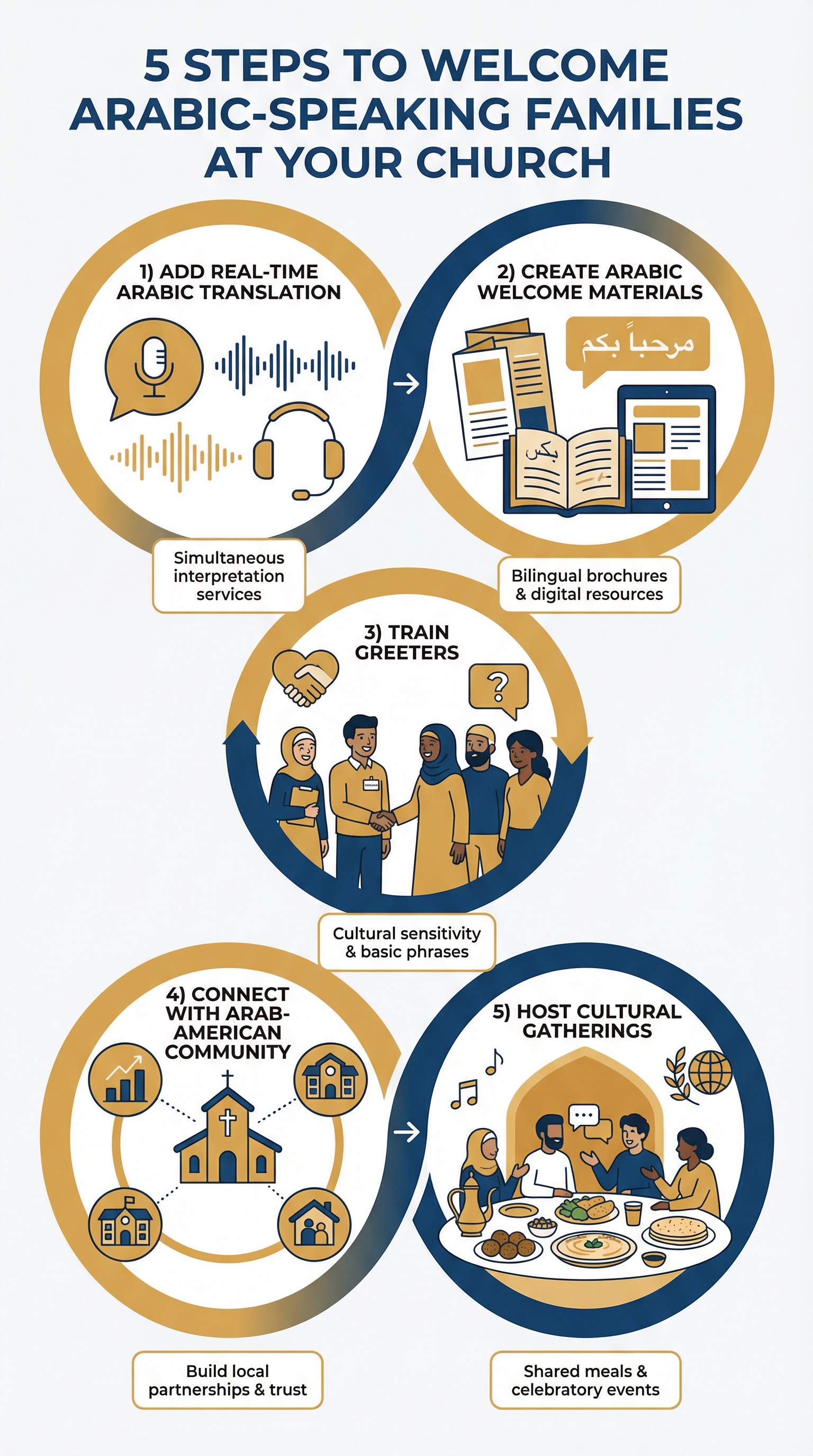
Translation is the foundation, but it is not the whole picture. Here are practical, actionable steps your church can take to genuinely welcome Arabic-speaking families.
Start With Real-Time Translation This Sunday
The most important first step is making your services accessible. Embed Glossa on your church website or share the Glossa link with Arabic-speaking visitors. When families arrive and discover they can follow the service in Arabic on their phone, the impact is immediate. Learn more in our guide on how to embed live translations on your church site.
Create Arabic-Language Welcome Materials
First impressions matter. Have a welcome card, bulletin insert, or brochure available in Arabic. Even a simple welcome sign in Arabic at your entrance communicates that Arabic speakers are expected and valued, not an afterthought.
Train Your Greeters and Welcome Team
Your greeters are the first face of your church. Coach them to warmly greet Arabic-speaking visitors, point them toward the translation resource, and connect them with any Arabic-speaking members of your congregation. A warm personal introduction goes a long way.
Find and Empower Arabic-Speaking Members
If you already have Arabic-speaking families in your congregation, involve them. Ask them to serve as cultural liaisons, connecting new Arabic-speaking visitors, leading a prayer in Arabic during a special service, or helping you understand what the Arabic-speaking community in your city needs. Build genuine relationship first.
Host Arabic-Friendly Gatherings
Consider hosting a community dinner or cultural celebration that invites Arab-American families in your area. Arabic culture places enormous value on shared meals and hospitality. A gathering with Middle Eastern food and warm conversation can do more for outreach than any formal campaign.
The Language of Prayer: Why It Matters
There is a dimension to Arabic church outreach that goes beyond logistics: the language of prayer itself.
For many Arabic-speaking Christians, the Psalms, the Lord's Prayer, and the liturgy have always been heard and spoken in Arabic. This is part of their spiritual inheritance. When they attend an English-language church, they do not just face a communication barrier. They face a disconnect from the language in which they have always encountered God.
This is why offering even a small moment of Arabic in your service can be deeply meaningful. Consider:
- Opening or closing a service with the Lord's Prayer in Arabic
- Having an Arabic-speaking leader pray during a special service
- Displaying a Scripture verse in Arabic alongside English on your screens
These small gestures signal something profound: your language is welcome here. Real-time AI translation captures the content of the message, but these moments of cultural inclusion capture the spirit of welcome. Together, they create an environment where Arabic-speaking families feel they truly belong.
Common Questions About Arabic Church Outreach
Does AI translation handle Arabic dialects accurately?
Arabic has multiple regional dialects including Egyptian, Levantine, Gulf, and Maghrebi, as well as Modern Standard Arabic (MSA). Glossa's AI is trained on both MSA and common spoken dialects, with particular attention to biblical and theological vocabulary. For church services, the translation quality is highly effective. Modern Standard Arabic is universally understood across the Arab world and is ideal for formal religious settings.
How do we let Arabic-speaking families in our area know about our church?
Word of mouth is powerful in tight-knit Arab-American communities. Start by genuinely welcoming the Arabic-speaking families you already have. Connect with local Arab-American community organizations and cultural centers. Share on social media in Arabic if possible. And be visible in your community as a place of welcome.
Is this worth the investment for a small church?
The cost of starting is minimal. Real-time translation via Glossa requires no equipment investment, and pricing is flexible. See our guide on affordable church translation options for a full cost breakdown. The real question is whether there are Arabic-speaking families in your community who need a church home. In most U.S. cities, there are.
"They told us they had been looking for years. They were not looking for a perfect church. They were looking for a church that would see them." -- A pastor whose congregation began welcoming Arabic-speaking families through real-time translation
Your Next Step: Reaching Arabic-Speaking Families at Your Church
Reaching Arabic-speaking families at your church does not require a major program launch or budget approval. It starts with one simple act: making your service accessible in Arabic this Sunday.
- Embed Glossa on your church website so Arabic-speaking visitors can access live translation from their own phones — see how to embed Glossa
- Create a simple Arabic welcome message to display at your entrance or in your bulletin
- Ask your Arabic-speaking members to help you understand what the community in your city needs
- Show up consistently — trust is built over time, through genuine relationship
The Arabic-speaking families in your city are looking for a church where they belong. With real-time translation and a genuine heart for inclusion, your church can be that place.
For a broader look at how churches are removing language barriers across all communities, our guide on overcoming language barriers in church is a great next read. And if you are building a fully multilingual congregation, see how other churches have approached the journey in our guide to building a multicultural church.
Ready to get started? Glossa.live makes real-time Arabic translation possible for any church, no special equipment required. Try it free and see the difference it makes for Arabic-speaking families in your congregation.