Church live translation pricing usually comes down to three things: how you're billed (per hour, per month, or per event), how many languages you need at once, and whether listeners or devices add cost. The good news is that most AI platforms no longer charge per attendee or require hardware. Here's how to compare plans honestly and work out what your church will actually pay.
How is church live translation priced?
Most platforms price live translation by time, not by headcount.
You'll typically see one of these models:
- Pay as you go — you pay for each hour of translated speech, per language. Good for occasional or seasonal use.
- Monthly subscription — a set number of included hours each month, with a lower rate for extra hours. Good for weekly services.
- Annual or custom contracts — negotiated for large or multi-campus churches, often with extra features like branding or API access.
- Per-device or hardware rental — the older model for FM and UHF interpretation kits, where receivers and headsets drive the cost.
The billing unit matters more than the headline price. A plan that looks cheap per month can cost more than pay-as-you-go if your services are short, and the reverse is true if you run several services every weekend.
What actually drives the cost for your church?
Your bill is mostly a function of hours × languages.
Three questions set the number:
- How many hours of speech do you translate each month? Count every service, not just Sunday morning — midweek studies, youth nights and leadership meetings add up.
- How many target languages run at the same time? On many platforms, each language is metered separately, so two languages for one hour can count as two translation hours.
- Are listeners capped? Some plans limit concurrent users. For a growing congregation, unlimited listeners removes a cost you can't easily predict.
Smaller line items can matter too: support level, voice output versus captions only, and integrations with your presentation and streaming software.
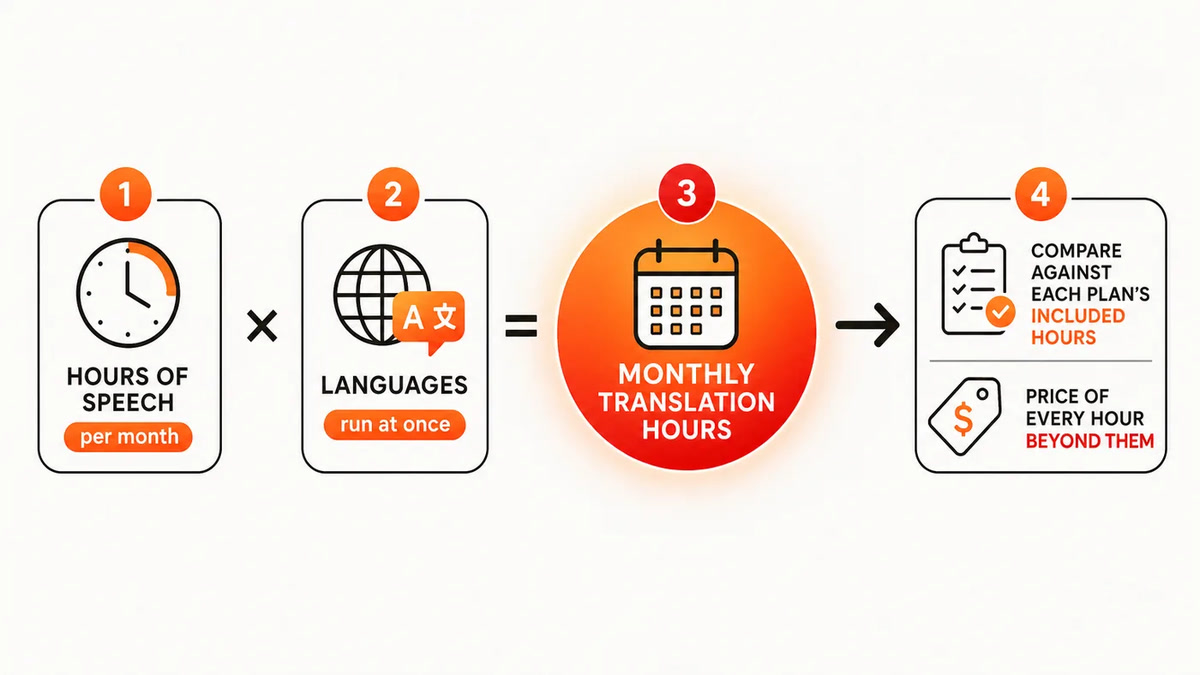
Here's a simple way to estimate. Take the hours of speech you translate in a typical month and multiply them by the number of languages you run at once. That gives you your monthly translation hours, which you can then compare against each plan's included hours and the price of every hour beyond them.
Church translation app cost vs traditional interpretation equipment
AI translation apps usually cost less up front because your congregation brings the hardware.
With traditional interpretation, the transmitter is basically a little radio station, and every listener needs a receiver and headset. That means buying or renting kits, charging and sanitizing them, handing them out and collecting them again — plus recruiting a human interpreter for each language and each service.
A church translation app flips that. Attendees open a link or scan a QR code on their own smartphone and listen through their earbuds or read live captions. There's no booth, no receivers and no per-device cost.
The honest tradeoff: a skilled human interpreter still brings judgment that AI can't fully match, and some churches keep one for a primary language. If you want a deeper look at budget options, our guide to affordable church translation solutions walks through choices from free to fully managed.
Church interpretation platform languages: what to check
Language counts on a pricing page don't tell you everything.
Before you compare plans, check:
- Which languages your community actually speaks — and whether the platform supports both translated audio and captions for them.
- How many languages can run simultaneously in one service, and whether each one is billed separately.
- Church and biblical vocabulary — Scripture references, theological terms, pastors' names and ministry names are where general-purpose tools often stumble.
- Accessibility — live transcription in the original language helps hard-of-hearing attendees, even if nobody needs a translation.
Platforms such as Wordly, Hope Translator, ChurchTranslator.AI and Lingou Live are among the alternatives churches look at. Plans, included features and language lists change, so compare each provider's current pricing page side by side using the questions above rather than relying on a single headline number.
Live sermon translation pricing with Glossa
Glossa uses transparent, usage-based pricing. Every church plan includes unlimited listeners, 100+ languages and integrations with tools like OBS and ProPresenter.
| Plan | Price | Included hours | Extra hours | Highlights |
|---|---|---|---|---|
| Pay As You Go | $5 per translation hour per language | — | — | 4-hour free trial, 24/7 email support |
| Standard | $99/month | 25 per month | $4/hour | 24/7 email support |
| Advanced | $299/month | 100 per month | $3/hour | 24/7 phone support, voice cloning |
| Premium | $499/month | 250 per month | $2/hour | 24/7 phone support, voice cloning |
On Pay As You Go, you pay only while speech is actually being translated — quiet moments don't run up the meter. That's super handy for churches testing translation before committing to a monthly plan.
Glossa is built for church services specifically. It handles biblical terminology and custom church vocabulary, delivers translated audio and live captions to attendees' phones, and plugs into the AV tools your team already runs — ProPresenter, OBS, vMix, browser sources, embedded webpages, and livestreams to YouTube, Facebook, RTMP, Zoom and Google Meet. After each service, usage reports show streaming time, listeners, languages and cost, so you always know where the hours went.
Getting people connected is the easy part. Put a free QR code slide for church translation on your projector before the service starts, and attendees can scan it and pick their language in seconds.
For individuals, Glossa Personal costs $5 per listening hour. It lets one person follow a service at any church in their own language through earbuds, with a live transcript and saved services to replay — no church setup required.
Which pricing model fits your congregation?
Match the plan to your rhythm, not to your size.
- Occasional services or a trial run: pay-as-you-go keeps cost tied to actual use.
- One or two weekly services in one or two languages: a monthly plan with included hours usually smooths out the budget.
- Multiple services, several languages, or multiple campuses: higher tiers with lower extra-hour rates and integrations tend to win.
- Livestream-heavy ministries: prioritize integrations with your streaming stack over the lowest hourly rate.
Whatever you choose, run a real service through it before you commit. Listen for how it handles your pastor's pace, Scripture readings and worship lyrics. For a broader comparison of approaches, see how to choose among the best translation systems for churches.
FAQ
How much does church live translation cost per month?
It depends on your hours and languages. With Glossa, pay-as-you-go is $5 per translation hour per language, and monthly plans run from $99 (25 hours) to $499 (250 hours). Multiply the hours you translate each month by the number of languages you run at once, then compare that total against each plan's included hours and extra-hour rate.
Do churches pay per listener for AI translation?
Not with every platform. Glossa includes unlimited listeners on all church plans, so a congregation of fifty and one of five thousand pay the same for the same translation time. When comparing providers, always check whether there's a cap on concurrent users, because per-listener limits can make costs hard to predict as your church grows.
Is a church translation app cheaper than interpretation equipment?
Usually, yes, especially at the start. An app runs on attendees' own smartphones, so there's no need to buy or rent receivers, headsets or transmitters. Traditional kits also need someone to charge, distribute and collect devices every week. The tradeoff is that human interpreters add judgment and nuance, so some churches combine both approaches.
Can we try live sermon translation before paying?
Many platforms offer a trial. Glossa's Pay As You Go plan includes a 4-hour free trial, which is enough to test a full Sunday service or two in your own building. Use it to check accuracy with your pastor's voice, Scripture references and worship songs, and to see how easily attendees connect from their phones.
Ready to compare for yourself?
The right plan is the one that fits how often you meet and how many languages your people speak. Start with a real service, look at the usage report, and let the numbers guide you. You can explore plans and start a free trial at Glossa.