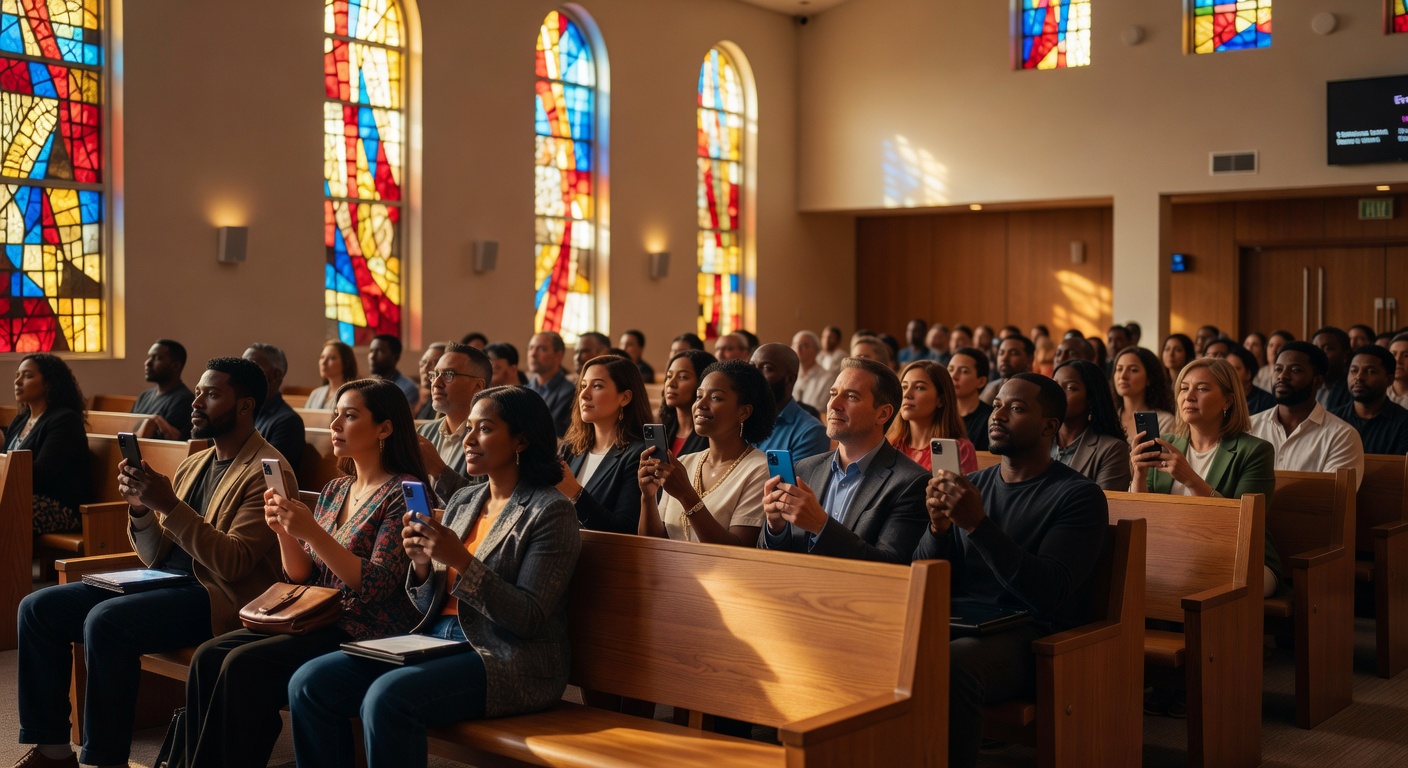
Best Translation Systems for Churches: How to Choose the Right One for Your Congregation
If your church serves families who speak different languages, you've probably asked the same question dozens of pastors ask every week: what's the best translation system for church services?
The answer depends on your congregation's size, budget, the languages you need, and how much setup you're willing to manage. Some churches spend thousands on FM radio equipment. Others rely on volunteer interpreters whispering in the back row. And a growing number are turning to AI-powered translation apps that work on any smartphone—no hardware required.
This guide compares the most common translation systems for churches side by side. You'll learn what each option costs, how it works during a live service, and which solution fits different types of congregations. Whether you're a small community church with a handful of Spanish speakers or a large multi-campus ministry serving a dozen languages, there's a translation system that makes sense for you.
Why Churches Need Translation Systems in 2025
The need for church translation has never been greater. According to the Migration Policy Institute, more than 67 million people in the United States speak a language other than English at home. That's roughly one in five Americans—and many of them attend church or would attend church if they could understand the service.
For pastors, the math is simple. If 30 percent of your community speaks Spanish, Vietnamese, or Mandarin at home, offering English-only services means you're only reaching a fraction of the people God has placed around your church.
Traditional solutions—hiring professional interpreters, purchasing FM receiver systems, or running separate language-specific services—have worked for decades. But they come with real limitations: cost, complexity, scheduling headaches, and the challenge of scaling beyond one or two languages.
That's why translation systems for churches have evolved rapidly. Today's options range from simple smartphone apps to enterprise-grade AI platforms, and many churches are discovering they can reach far more people at a fraction of the old cost.
The Five Main Types of Church Translation Systems
Before comparing specific products and approaches, it helps to understand the five categories of translation systems available to churches today. Each has distinct strengths, and the best choice depends on your situation.
1. AI-Powered Translation Apps
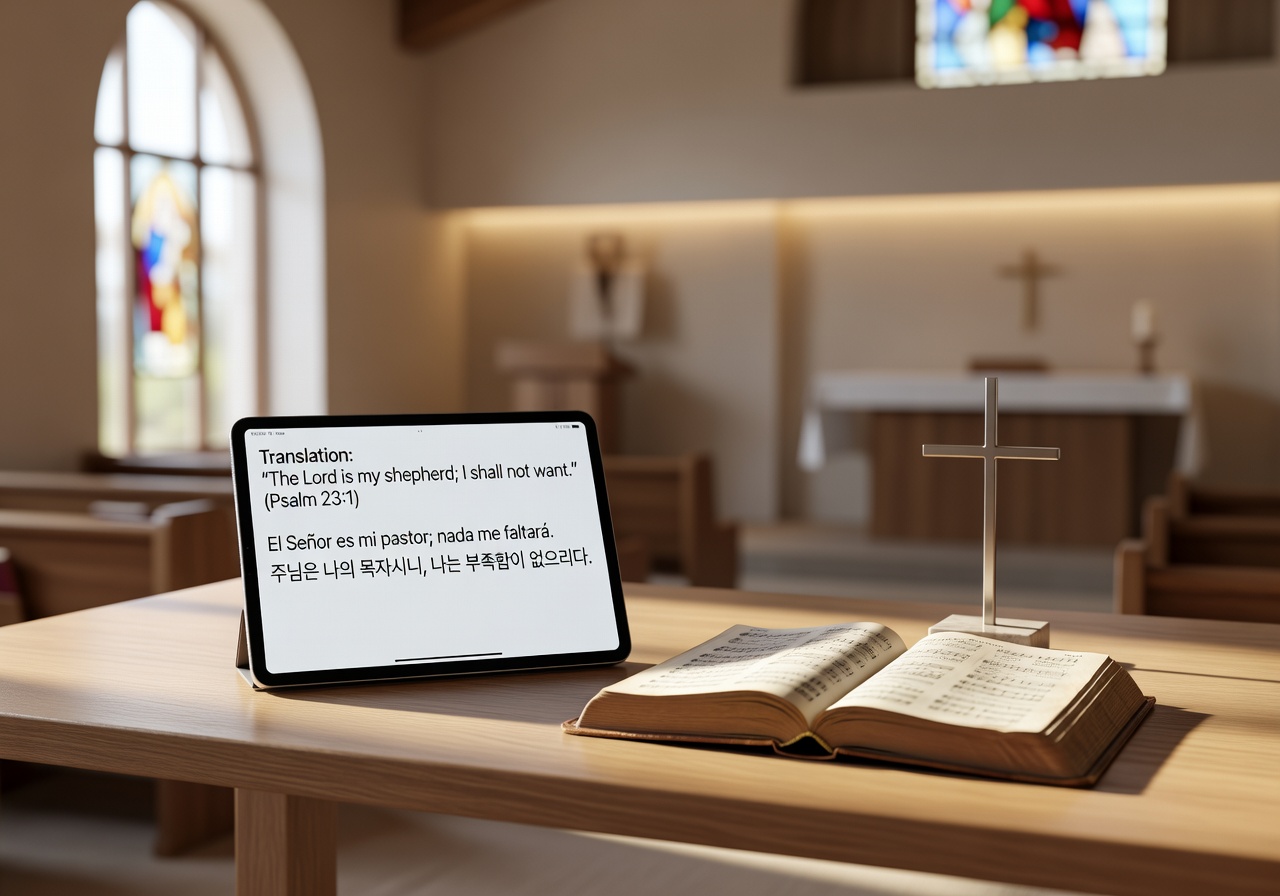
AI translation apps use artificial intelligence to listen to a sermon in real time and deliver translated audio or text to listeners on their own devices—phones, tablets, or laptops. No special hardware is needed.
How it works: The pastor speaks into a microphone (or the app picks up audio from the room). AI processes the speech, translates it, and delivers the translation to anyone who opens the app on their device. Some platforms, like Glossa.live, use voice cloning to make the translated audio sound natural rather than robotic.
Best for: Churches that need multiple languages, want minimal setup, and prefer a pay-as-you-go model. Works especially well for congregations where members already have smartphones.
Cost range: Free tiers available; paid plans typically $5– style="min-width: 320px;"5 per hour per language, or monthly subscriptions starting around $49– style="min-width: 320px;"99.
Pros: No hardware to buy or maintain, supports dozens of languages simultaneously, works on any device, easy to set up (often under 15 minutes), scales from small groups to mega-churches.
Cons: Requires reliable WiFi or cellular data, AI translation quality varies by platform and language pair, some congregation members may not have smartphones or be comfortable using them.
2. FM Radio Receiver Systems
FM receiver systems have been the gold standard for church translation for decades. A human interpreter listens to the sermon, translates it live, and speaks into a transmitter. Listeners wear small FM receivers with earpieces to hear the translation.
How it works: Your church purchases a transmitter, a set of receivers (usually 10–50 units), and headphones. A bilingual volunteer or professional interpreter sits in a booth or designated area, listens to the sermon, and translates in real time into a microphone connected to the transmitter. Listeners tune their receivers to the correct channel.
Best for: Churches with dedicated interpreters already on staff or in the congregation, and those serving one or two languages consistently.
Cost range: $500–$3,000 for a starter kit (transmitter + 10–20 receivers), plus ongoing costs for batteries, replacement earpieces, and maintenance.
Pros: Reliable audio quality, no internet required, well-established technology, works in areas with poor connectivity.
Cons: Requires a skilled human interpreter for each language, hardware costs add up (especially for larger congregations), receivers need to be distributed, collected, cleaned, and maintained, adding a new language means finding another interpreter and buying more equipment.
3. Human Interpreters (Live and Consecutive)
Some churches rely entirely on human interpreters without any electronic equipment. The interpreter stands near the pastor or in a section of the congregation and translates verbally. This can be simultaneous (speaking at the same time as the pastor using a separate sound system) or consecutive (the pastor pauses after each sentence for the interpreter to translate).
Best for: Small churches with a strong bilingual volunteer base, or churches that only need one additional language.
Cost range: Free if using volunteers; style="min-width: 320px;"00–$500 per service for professional interpreters.
Pros: Highest quality translation (a skilled interpreter understands context, theology, and cultural nuance), personal touch, no technology barriers, works for any demographic including elderly members.
Cons: Extremely difficult to scale beyond one or two languages, dependent on interpreter availability (illness, vacations, burnout), consecutive interpretation doubles service length, quality varies enormously between interpreters.
4. Caption and Subtitle Systems
Caption-based systems display translated text on screens rather than delivering audio. Some churches project translated subtitles on a secondary screen, while others use apps that display captions on individual devices.
Best for: Churches that also want to serve deaf or hard-of-hearing members, or congregations where reading translated text is culturally acceptable.
Cost range: $0–$200/month for software-based solutions; $2,000– style="min-width: 320px;"0,000 for professional captioning hardware and displays.
Pros: Serves both translation and accessibility needs, text can be saved and shared after the service, some systems are very affordable, works well for livestream and online services.
Cons: Reading text during worship feels less immersive than hearing audio, requires literacy in the target language, can be distracting, misses the emotional tone and inflection of spoken translation.
5. Hybrid Systems (AI + Human)
A growing number of churches combine AI translation with human oversight. For example, a church might use an AI platform for most languages while keeping a human interpreter for their primary minority language. Or they might use AI for the main sermon but have bilingual volunteers available for prayer, announcements, and personal interaction.
Best for: Medium to large churches that want broad language coverage but also value the personal quality of human interpretation for their largest language group.
Cost range: Varies depending on combination, but typically style="min-width: 320px;"00–$400/month for AI plus volunteer interpreter costs.
Pros: Best of both worlds—AI handles scale and language variety while humans handle nuance and personal connection, cost-effective for covering many languages, flexible.
Cons: More complex to coordinate, requires both technology setup and interpreter management.
Comparing Church Translation Systems: What Matters Most
When evaluating translation systems for your church, focus on these six factors. Every congregation weighs them differently, so think about what matters most for your specific situation.
Languages Supported
If your community speaks two or three languages, almost any system will work. But if you serve a diverse congregation with five, ten, or more languages, your options narrow quickly. Human interpreters and FM systems require one interpreter per language—finding reliable volunteers for Vietnamese, Mandarin, Arabic, and Amharic simultaneously is a massive challenge. AI translation apps, on the other hand, typically support 50–100+ languages from a single platform. Glossa.live supports over 100 languages, making it practical for even the most diverse congregations.
Setup Complexity
Church tech teams range from "the pastor's teenage son" to full AV departments. Be honest about your church's technical capacity. FM systems require physical setup each Sunday—distributing receivers, checking batteries, setting up the transmitter, and coordinating with the interpreter. AI apps are typically much simpler: open a browser or app, connect to the audio source, and share a link or QR code with the congregation.
Translation Quality
This is where many church leaders hesitate, especially with AI. The truth is that AI translation quality has improved dramatically. Modern AI translation systems—especially those trained on biblical and theological language—handle sermon content surprisingly well, including scripture references, theological terms, and pastoral language.
That said, human interpreters still offer the highest quality for a single language. A skilled interpreter understands not just words but context, emotion, and cultural nuance. For most churches, the trade-off is clear: human interpretation gives you the best quality in one language, while AI gives you good quality across many languages simultaneously. If you can do both—a hybrid approach that combines AI with human oversight—that's often the ideal solution.
Cost and Budget
Church budgets are real, and translation shouldn't break the bank. A basic FM system with 20 receivers runs style="min-width: 320px;",500–$2,500 upfront, plus $200–$500 per year for maintenance. If you hire a professional interpreter, add $400–$2,000 per month.
AI translation apps typically cost $50–$200 per month for unlimited languages, or $5– style="min-width: 320px;"5 per hour per language on pay-as-you-go plans. For a church running a 90-minute service in three languages weekly, that's roughly $60– style="min-width: 320px;"80 per month with no upfront hardware cost. For churches watching every dollar, we've written a detailed guide on affordable church translation options that breaks down costs further.
Scalability
Think about where your church is headed, not just where it is today. If your community is growing and diversifying—as many American churches are—you need a system that scales. FM systems scale linearly: each new language requires a new interpreter, a new transmitter channel, and more receivers. AI systems scale much more gracefully: adding a new language is usually just a setting change, with no additional hardware or personnel.
Reliability
Nothing disrupts a worship service like technical failure. FM systems are mechanically reliable but depend on having an interpreter present. If your Spanish interpreter is sick, there's no Spanish translation that Sunday. AI systems depend on internet connectivity and the platform's uptime. The safest approach is to have a backup plan: a mobile hotspot for internet-dependent systems, or a bilingual volunteer who can step in if technology fails.
How Real Churches Are Solving Translation
Seeing how other churches handle translation can help you decide. Here are three common scenarios.
The small community church (100–200 members): Grace Community Church has 30 Spanish-speaking families. For years, a bilingual deacon translated consecutively, doubling the service to two hours. After switching to an AI translation app, they now run a normal-length service while Spanish speakers follow along on their phones. The deacon still greets Spanish-speaking visitors personally and helps with prayer—but he's no longer chained to the pulpit every Sunday.
The mid-size suburban church (500–1,000 members): Crossroads Fellowship serves a community that has grown increasingly diverse—Spanish, Korean, and Vietnamese families now make up nearly 40 percent of their neighborhood. They tried running separate language services but couldn't sustain three extra services with volunteer teams. Now they use AI translation for all three languages during their main service, with a Korean interpreter available for their mid-week Bible study where theological discussion requires more nuance.
The large multi-campus church (2,000+ members): A denomination-affiliated church with three campuses uses AI translation across all locations, covering 12 languages consistently. Each campus has the same translation capability without needing 36 interpreters. For special events like Easter and Christmas, they bring in professional interpreters for their top three languages while AI handles the rest. Their approach to streaming church services in multiple languages shows how they extended translation to their online campus too.
Quick Comparison: Church Translation Systems at a Glance
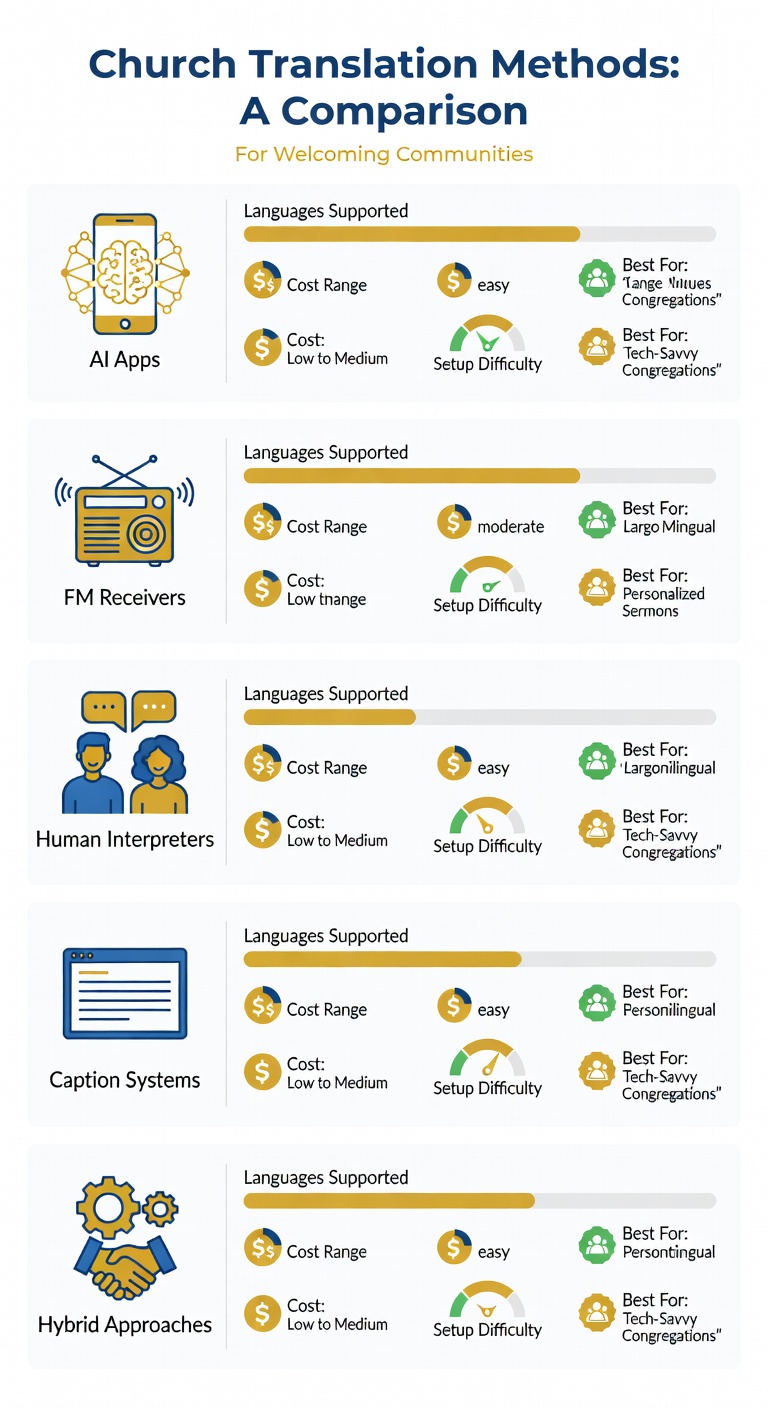
| System Type | Languages | Monthly Cost | Setup | Quality | Best For |
|---|---|---|---|---|---|
| AI Translation Apps | 50–100+ | $50–$200/mo | Minimal | Good & improving | Multi-language, low-tech churches |
| FM Receiver Systems | 1–4 | style="min-width: 320px;"25–$250/mo* | Moderate | Depends on interpreter | Dedicated interpreter, 1–2 languages |
| Human Interpreters | 1–2 | Free–$2,000 | None | Highest | Small churches, strong bilingual base |
| Caption/Subtitle | Varies | $0–$200/mo | Moderate | Good (text only) | Accessibility + translation needs |
| Hybrid (AI + Human) | Many | style="min-width: 320px;"00–$400/mo | Moderate | Best overall | Medium-large diverse churches |
*FM system monthly cost amortized from style="min-width: 320px;",500–$3,000 upfront over 12–24 months, plus maintenance.
How to Choose the Right Translation System for Your Church
Still not sure which approach is right? Walk through these four questions.
How Many Languages Do You Need?
If you need one language, start with a volunteer interpreter. It's free, personal, and effective. If you need two to three languages, consider FM systems or an AI app depending on your budget and tech comfort. If you need four or more languages, AI translation is almost certainly your best path—finding and coordinating four-plus interpreters every Sunday isn't sustainable for most churches.
What's Your Budget?
If your budget is essentially zero, start with a volunteer interpreter or a free-tier AI app. If you have style="min-width: 320px;"00–$300 per month, an AI translation platform gives you the most capability per dollar. If you have $500+ per month, consider a hybrid approach—AI for broad coverage plus a professional interpreter for your primary language.
How Tech-Savvy Is Your Congregation?
If your members are comfortable with smartphones, an app-based AI system works beautifully. If a significant portion of your congregation doesn't use smartphones (common in some elderly or refugee communities), FM receivers or human interpretation may be more inclusive. Many churches find that even less tech-savvy members adapt quickly when a volunteer shows them how to open the app—especially when the alternative is not understanding the service at all.
What's Your Growth Trajectory?
If your community is becoming more linguistically diverse—and most American communities are—choose a system that can grow with you. Adding a new language to an AI platform takes minutes. Adding a new language to an FM system takes months of recruiting, training, and purchasing equipment.
Getting Started with Church Translation
Whatever system you choose, here are three practical steps to get started this month:
Step 1: Survey your congregation. Find out what languages are spoken at home. You might be surprised—many churches discover language needs they didn't know existed. A simple card in the bulletin or a brief announcement asking "What language do you speak at home?" can reveal a lot.
Step 2: Start with one language. Don't try to launch five languages on day one. Pick the most-spoken minority language in your congregation and offer translation for that language first. Get the process working, gather feedback, and expand from there.
Step 3: Try before you buy. Most AI translation platforms offer free trials. Glossa.live offers a free trial so you can test real-time translation during an actual service before committing. For FM systems, ask the vendor about demo units. For interpreters, try a few Sundays with a volunteer before hiring a professional.
The most important thing isn't which system you choose—it's that you choose to start. Every Sunday without translation is another Sunday where families in your community can't fully participate in worship. The technology exists, the cost is manageable, and the impact on your ministry can be transformative.
Your congregation deserves to hear the message in the language of their heart. The right translation system makes that possible.