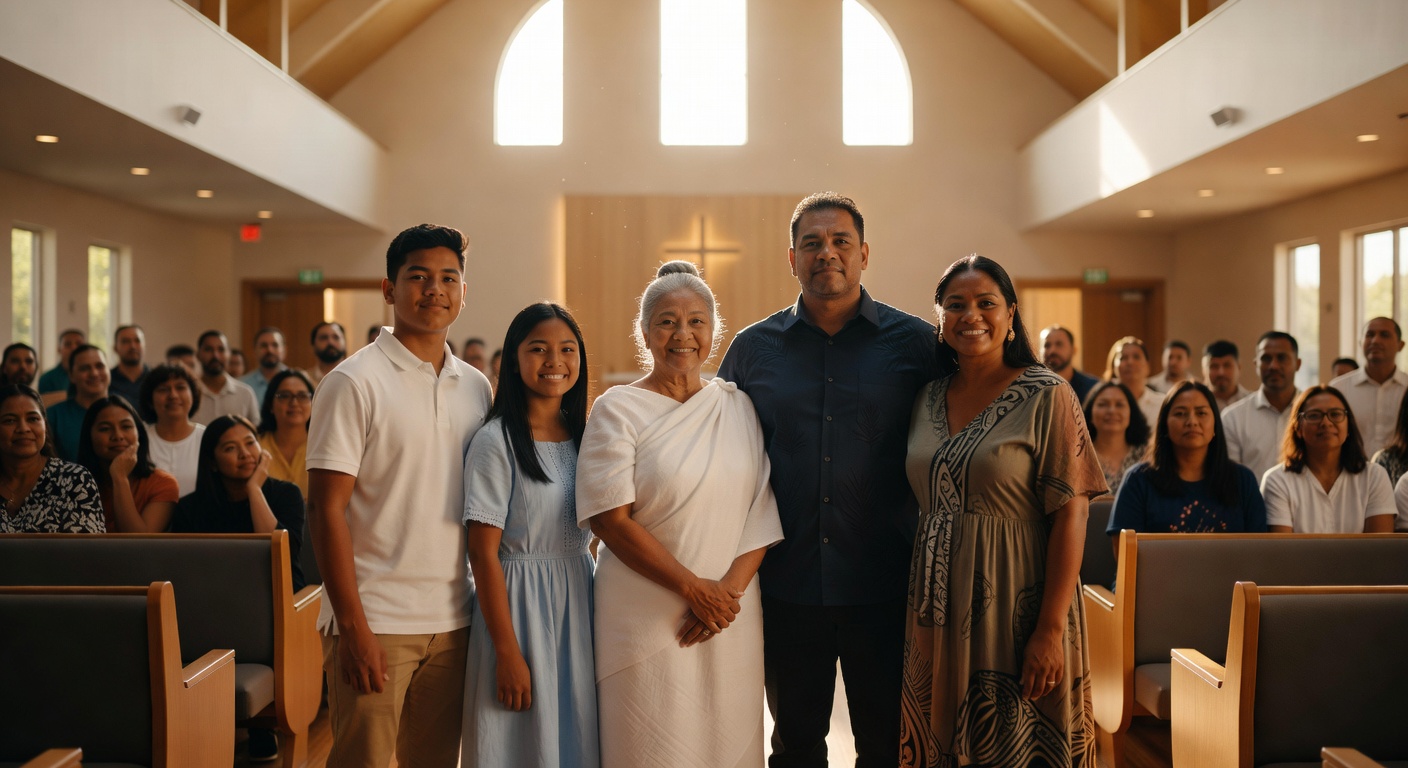
How to Reach Tongan-Speaking Families at Your Church
In the Kingdom of Tonga, Sunday is still set apart. Shops close. Ferries stop. The beaches empty out, and the brass bands of the Free Wesleyan Church tune up outside whitewashed chapels from Nuku'alofa to Vava'u. The national constitution declares the Sabbath "sacred in Tonga forever," and for generations, four-part harmony sung in Tongan has rolled across the islands every week. When a Tongan family walks into your American sanctuary, you are meeting people from one of the most deeply Christian cultures in the Pacific — and one of the most musically trained.
About 57,000 people of Tongan ancestry live in the United States, with the largest communities in Utah (Salt Lake City is the single biggest hub outside Tonga itself), California (the Bay Area, Sacramento, Los Angeles), Hawaii, and Washington state. Monthly search volume tells the story: "tongan church" draws about 320 searches, "first tongan united methodist church" 140, "tongan methodist church" 50, and "tongan church near me" another 50. Behind each of those searches is a real family — a rugby coach from Ha'apai, a nurse from Tongatapu, a grandmother who still keeps Sunday the way her own grandmother did — looking for a congregation that honors their faith, their language, and their story.
This guide will help you understand Tongan families, why Tongan worship can feel so different from a typical American service, and how to welcome Tongan-speaking families well — without needing to launch a separate Tongan service from scratch.
Who Are Tongan-Speaking Families in America?
Tonga is a Polynesian kingdom of 171 islands (only 45 inhabited) spread across the South Pacific about halfway between Hawaii and New Zealand. Unlike most Pacific nations, Tonga was never formally colonized — it kept its monarchy through the entire 19th and 20th centuries and remains a constitutional monarchy today, ruled by King Tupou VI.
Families arriving in the U.S. usually come through one of three pipelines: direct migration from Tonga on employment or family reunification visas; secondary migration from New Zealand or Australia, where hundreds of thousands of Tongans already live; or multi-generational American families who trace their roots back to Latter-day Saint mission work, Free Wesleyan ministry exchanges, or college football and rugby recruiting pipelines that have brought young Tongan men to universities across the Mountain West and West Coast.
Most Tongan-Americans are bilingual. Older family members (matu'a, the elders) are often more comfortable in Tongan (lea faka-Tonga). Younger generations are usually fluent in English but still speak Tongan at home, at family gatherings, and — especially — in worship. This is the single most important thing for pastors to understand: in Tongan culture, Sunday, family, and language are braided together. You cannot reach one strand without honoring the others.
Why Tongan Worship Feels Different — And What It Teaches Us
If you have ever visited a Free Wesleyan Church of Tonga service, you already know: Tongan worship is loud, harmonized, and deeply communal. Congregations sing in four-part harmony without music sheets. Brass bands — a legacy of 19th-century Methodist missionaries — still lead processions on holy days. Funerals and weddings become weeklong community events. Church is not a one-hour Sunday appointment; it is the backbone of the week.
Several values shape the Tongan worship experience, and understanding them will change how you welcome Tongan families into your own congregation:
- Faka'apa'apa (respect) — the cornerstone of Tongan social life. Respect flows to elders, to clergy, to parents, to older siblings, and to the sacred. In church, this looks like formal dress, quiet reverence from children, and deep deference to the pastor's word.
- Kainga (extended family) — far more than the American nuclear family. Cousins are siblings. Aunties and uncles function as co-parents. When you invite one person to church, you are often inviting a kainga of 15 to 40 people who come together.
- Fatongia (duty, obligation) — the sense that each person has responsibilities to family, church, and community. Tongans give sacrificially to church — often more than American pastors expect — because of fatongia, not guilt.
- Fakafeiloaki (welcome, hospitality) — Tongan hospitality is overwhelming by American standards. Guests are fed first, fed most, and fed again. A church that mirrors this hospitality will be remembered.
- Faiva (song and performance) — Tongans are famous across Polynesia for choral singing, brass bands, and lakalaka (standing dance). Music is not decoration; it is worship itself.
If your church service is quiet, short, and individualistic, it may feel thin to a Tongan family used to three-hour Sundays and hymns sung in full harmony. This is not a problem — it is an invitation. Small, respectful adjustments go a long way.
The Major Church Traditions Tongan Families Come From
Tonga is one of the most denominationally Christian countries on earth — over 98% of the population identifies as Christian. If a Tongan family arrives at your door, they almost certainly come from one of these traditions:
Free Wesleyan Church of Tonga (Siasi Uesiliana Tau'ataina 'o Tonga)
The largest denomination in Tonga, tracing back to 1826 Methodist missionary work. Roughly 36% of Tongans belong. Distinct for its brass-band tradition, four-part hymnody, and close ties to the Tongan monarchy — the King is traditionally a member. Diaspora congregations thrive in Salt Lake City, Oakland, East Palo Alto, Los Angeles, and Seattle. When a Tongan family mentions "the church at home," this is most likely what they mean.
The Church of Jesus Christ of Latter-day Saints
About 18–20% of Tongans are Latter-day Saints — the highest percentage of any nation on earth. LDS missionaries arrived in Tonga in 1891, and the church has built Tongan-language wards in Salt Lake City, St. George, Provo, Sandy, Hayward, Sacramento, Inglewood, Honolulu, and Laie. Many Tongan families in Utah came originally through LDS sponsorship or education programs at Brigham Young University–Hawaii.
Catholic Church of Tonga (Siasi Katolika)
Roughly 15% of Tongans are Catholic, served by the Diocese of Tonga. Tongan Catholic chaplaincies exist in Salt Lake City, Oakland, and Los Angeles, often within larger diocesan Pacific Islander ministries. The Tongan Catholic style retains strong Polynesian musical tradition alongside the Latin Mass structure.
Free Church of Tonga, Church of Tonga, and Assemblies of God
Smaller but active Methodist-rooted denominations (the Free Church of Tonga and Church of Tonga broke off from the Free Wesleyan Church at different moments in the 19th century). The Assemblies of God and other Pentecostal expressions (Tokaikolo Christian Fellowship, in particular) have grown quickly among younger Tongan families in California and Utah, and are worth knowing about if you minister among second-generation Tongan youth.
You do not need to master these distinctions. What matters is that when a Tongan family visits, you can ask — warmly and curiously — "What church tradition does your family come from back home?" That one question communicates respect more effectively than any program.
Where Tongan Families Live — And How to Find Them
If your church sits in or near one of these metro areas, you are already inside the Tongan diaspora and likely already have Tongan neighbors you have not yet met:
- Salt Lake City / West Valley City, Utah — the single largest Tongan population outside Tonga. Tens of thousands of Tongans live along the Wasatch Front. Home to multiple Tongan-language LDS wards, Free Wesleyan diaspora congregations, and the annual Tongan Cultural Day.
- San Francisco Bay Area — especially East Palo Alto, Oakland, Hayward, San Bruno, and South San Francisco. A historic Tongan community dating to the 1960s, with strong Free Wesleyan and Catholic roots.
- Greater Los Angeles — Inglewood, Carson, Long Beach, West LA, and the South Bay. Strong Pentecostal (Tokaikolo) and Free Wesleyan presence.
- Sacramento — a growing community with Free Wesleyan, LDS, and Assemblies of God congregations.
- Honolulu / Laie, Hawaii — long-established through LDS church ties and BYU–Hawaii.
- Seattle / Kent / Federal Way, Washington — a younger, growing community.
- Euless and Irving, Texas; Phoenix, Arizona; Las Vegas, Nevada — emerging communities, often linked to construction, rugby, or football pipelines.
The easiest way to meet Tongan neighbors is to attend a community event: a youth rugby match, a cultural night at a local high school, a funeral (if you are invited — funerals are a major part of Tongan community life), or a Heilala-style celebration in July. If you want to partner rather than compete with existing Tongan congregations, reach out to a local Tongan pastor first. Most will welcome the conversation.
Practical Ways to Welcome Tongan-Speaking Families
You do not need to launch a full Tongan-language service to welcome Tongan families. In fact, most Tongan-Americans already attend existing English services — they just feel more at home when a few small signals tell them: you see us. Here are steps that consistently work:
1. Learn the greetings
The standard greeting is Malo e lelei ("hello" / literally "thank you for being well"). The response is Malo e lelei, fēfē hake? ("Hello, how are you?"). A warm "mālō" (thank you) to a greeter goes a very long way. Printing Mālō e lelei, afio mai ("Welcome") on a bulletin insert once a month signals that you have thought about Tongan families before they ever arrive.
2. Honor the Sabbath
For many Tongan elders, Sunday is still sacred in a way that feels foreign to most American evangelicals. A long Sunday lunch after service, a slower pace, and a clear "no work meetings" culture on Sundays will feel deeply familiar and honoring.
3. Welcome the kainga, not just the individual
When one Tongan person visits, expect family to follow. Be ready for cousins, aunties, grandparents, and friends of friends. Have enough chairs, enough food, and enough patience. Do not be surprised if ten people show up for Easter because one family member liked your Palm Sunday service.
4. Invite singing, not performance
Tongans sing. If you have Tongan members, invite them to lead a hymn in Tongan once a month — even a single verse. 'Eiki 'Otua Māfimafi ("Lord God Almighty") or Tuku ke Pule 'a Sīsū ("Let Jesus Reign") will move an English congregation to tears and tell Tongan families that their musical tradition is welcome here.
5. Translate the sermon
This is the single highest-leverage step. Tongan elders comprehend English sermons, but they hear the Gospel in Tongan. Real-time Tongan translation — delivered to a smartphone in the pew — means your Tongan grandmother can follow every word of your message in her heart language without you hiring a separate interpreter or splitting your service. This is exactly what Glossa.live was built to do. (See our guide to multilingual church services for the broader playbook.)
How Real-Time Tongan Translation Changes Your Sunday
For a long time, the only way to offer Tongan translation was either (a) have a Tongan-speaking elder interpret live from a pew, which is exhausting and inconsistent, or (b) launch a separate Tongan service, which divides the congregation and rarely scales. Real-time AI translation changes the math entirely.
With a tool like Glossa.live, your pastor preaches normally in English. Any Tongan-speaking attendee opens a simple link on their phone, selects Tongan, and receives the sermon in real time — as live captions in Tongan or as audio through their earbuds. No extra equipment. No new staffing. No splitting the service. Setup takes less than 15 minutes, and our walkthrough on how to embed Glossa on your website shows exactly how to add it to an existing church site.
Churches using Glossa.live for multilingual ministry — from large denominations like Hillsong to neighborhood congregations reaching Samoan-speaking families, Filipino-speaking families, and many other communities — report reaching 30–50% more people when they add language support. For Tongan congregations, the impact is often even higher, because the entire extended kainga comes when one family member feels truly welcomed.
Cultural Moments That Open Natural Doors
Instead of launching a full Tongan ministry on day one, many churches find it easier to start with a single moment — a Sunday where Tongan families feel explicitly invited and seen. Good entry points include:
- Tongan Language Week (first full week of September in New Zealand and celebrated in much of the U.S. diaspora). A perfect moment for a bilingual bulletin and a Tongan hymn.
- Heilala Festival (early July) — Tonga's cultural festival. Host a Sunday lunch featuring lu sipi (lamb in taro leaves) or 'ota 'ika (raw fish in coconut).
- Emancipation Day / 4 June — Tongan National Day, honoring the 1862 emancipation of Tongan commoners.
- White Sunday (Faka'ome) — a Pacific-wide children's Sunday in October where children lead worship. Beloved by Tongan, Samoan, and Fijian families alike. (See our article on reaching Samoan-speaking families for shared Pacific Islander context.)
- Christmas Eve / Kilisimasi Fiefia — Tongans celebrate with pola feasts, caroling, and late-night services. Invite Tongan families to lead a carol in Tongan.
- Resurrection Sunday / Toetu'u — pair the English resurrection message with a Tongan hymn or benediction.
Common Misunderstandings Pastors Make
A few gentle corrections pastors often need to hear after their first year of Tongan ministry:
- Tongan is not Samoan, and Tongans are not Hawaiian. The cultures share Polynesian roots, but Tongan language, church traditions, and social structures are distinct. Ask before assuming.
- "Island time" is not laziness — it is hospitality. If a Tongan family arrives late or stays three hours after service, they are not being disrespectful. They are being present.
- Tongan families tithe and give sacrificially. Do not assume immigrant families need financial help. Many Tongan families give a higher percentage of their income to church than any American demographic.
- Elders should be greeted first. Before shaking a young adult's hand, greet the matu'a (elder) standing behind them. This is basic faka'apa'apa.
- Do not ask about "Tongan food" in a reductive way. Ask what a family's mother used to cook. Ask whether they grew up in Tongatapu, Vava'u, or Ha'apai. Specificity honors.
A Practical 90-Day Starter Plan
If you want to move from "we welcome everyone" to "Tongan families know they belong here," here is a concrete three-month plan most churches can follow:
Month 1 — Learn
- Identify which Tongan denominations are represented near your church (Free Wesleyan, LDS, Catholic, Tokaikolo, Assemblies of God).
- Visit one existing Tongan congregation as a guest. Introduce yourself to the pastor with a gift.
- Invite any existing Tongan members of your church out for coffee. Ask them what would make them bring their kainga.
- Learn five Tongan phrases: Mālō e lelei, Mālō 'aupito (thank you very much), 'Ofa atu (love to you), 'Ofa 'a e 'Otua (God's love), Afio mai (welcome).
Month 2 — Prepare
- Set up real-time Tongan translation. Start with Glossa.live — configuration takes under 15 minutes.
- Print a bilingual bulletin for one Sunday. Include the call to worship in Tongan and English.
- Invite a Tongan musician to lead one hymn in Tongan at an upcoming service.
- Add a Tongan greeter to your welcome team on a specific target Sunday.
Month 3 — Invite
- Pick one target Sunday — White Sunday in October, Tongan Language Week in September, or Easter — and promote it specifically to Tongan neighbors.
- Host a Sunday lunch with Tongan-friendly food (roast pork, taro, lu, coconut cream dishes).
- Ask every Tongan visitor a single powerful question: "Who else in your family should we meet?" Follow up within 48 hours.
- Review. What felt honoring? What felt awkward? Adjust for the next cycle.
Why This Matters
Tongans are, proportionally, one of the most Christian peoples on earth. They brought the Gospel back to parts of Fiji in the 19th century. They sent missionaries to Papua New Guinea and the Solomon Islands before most American churches had heard of those places. They built hymnody, theology, and a culture of fatongia that American congregations have a great deal to learn from.
When Tongan families walk into your sanctuary and find themselves greeted in lea faka-Tonga, hearing a hymn in harmony, following the sermon in real-time Tongan translation, and seated with their whole kainga — something shifts. Not just for them. For you. Your congregation is drawn further into the global, multilingual church that Pentecost always promised.
This is the quiet miracle of multilingual ministry. It does not require enormous resources, new staff, or a building renovation. It requires attention, respect, and the humility to let another tradition shape your Sunday even a little. The Tongan church has been rehearsing four-part harmony and Sabbath-keeping for two hundred years. They are not a project to be served; they are neighbors who already know how to sing.
Ko e 'Otua ko 'eku Kaulalo. / The Lord is my support. — Psalm 23, Tongan Bible (Tohitapu)
Start This Sunday
Real-time Tongan translation is one of the simplest and most practical doors you can open this year. One setup. One Sunday. One Tongan grandmother hearing her English-speaking grandchildren's pastor preach in her heart language — for the first time in your building.
Ready to try it? Start at Glossa, read our walkthrough on how to embed Glossa on your website, and explore related guides like how to start multilingual church services and reaching Samoan-speaking families at your church.
Mālō e lelei. Afio mai. Welcome. We are glad you are here.