How to Reach Korean-Speaking Families at Your Church
There are more than 1.8 million Korean Americans in the United States. They live in Los Angeles, New York, Washington DC, Chicago, Houston, and in cities and suburbs across every corner of the country. And here's what many church leaders don't realize: Korea is one of the most Christianized nations in Asia, with roughly 30 percent of the population identifying as Christian.
That means Korean Americans aren't strangers to church. Many grew up attending church every week. They know what a welcoming congregation looks and feels like—and they notice when it isn't. The question for your church isn't whether Korean families are searching for a spiritual home in your community. They almost certainly are. The question is whether your church is ready to welcome them.
Reaching Korean-speaking families at your church doesn't require you to hire a Korean-speaking pastor or run a parallel Korean-language service. What it does require is an intentional commitment to language inclusion—and the right tools to remove the barriers that have kept Korean families on the outside.
Why Korean Outreach Is a Growing Opportunity for Churches
Korean Americans represent one of the largest Asian immigrant communities in the United States. According to Pew Research Center data on Asian Americans, they're a highly educated, deeply community-oriented group with strong ties to both faith and family. For first-generation Korean immigrants in particular, faith communities are among the primary ways they maintain cultural identity and build relationships.
Here's what makes this a significant moment for Korean outreach:
- The phrase "Korean church near me" is searched nearly 10,000 times per month in the United States alone. Korean Americans are actively looking for faith communities—and your church can be their answer.
- Many Korean Americans have drifted from Korean-only churches. Second-generation and "1.5 generation" Korean Americans often feel caught between two worlds. A church that bridges both—worshiping in English with Korean translation available—can become a powerful multigenerational option.
- Korean communities are highly networked. When a Korean-speaking family discovers a church that genuinely welcomes them in their language, word travels fast. A single family that finds a home at your church can open the door to dozens more.
Understanding Your Korean Congregation Before You Start
Korean Americans are not a monolithic group. Understanding the generational and cultural dynamics at play will help you build a genuinely effective outreach strategy.
First-generation Korean immigrants are those who came to the US as adults. Many prefer Korean as their primary language for worship, prayer, and spiritual formation. For this group, Korean translation isn't a convenience—it's essential for meaningful spiritual engagement. They may be fluent enough for daily life in English but still find it difficult to engage deeply with sermons and worship in a second language.
The "1.5 generation" refers to Koreans who immigrated as children or teenagers. They're typically bilingual, comfortable in both English and Korean, and often serve as the bridge between first-generation parents and second-generation American-born children. This group can be deeply valuable as ministry partners if you're building a Korean outreach ministry.
Second-generation Korean Americans were born in the US and are typically English-dominant. They may or may not speak Korean fluently, but many still have a strong Korean cultural identity and a desire to worship in a context that understands their heritage. This generation often carries the weight of maintaining cultural and linguistic connection for their parents and grandparents—and they appreciate a church that takes that seriously.
How Churches Are Successfully Welcoming Korean Families
Churches across the US have found practical, sustainable ways to welcome Korean-speaking members without overhauling their entire worship structure.
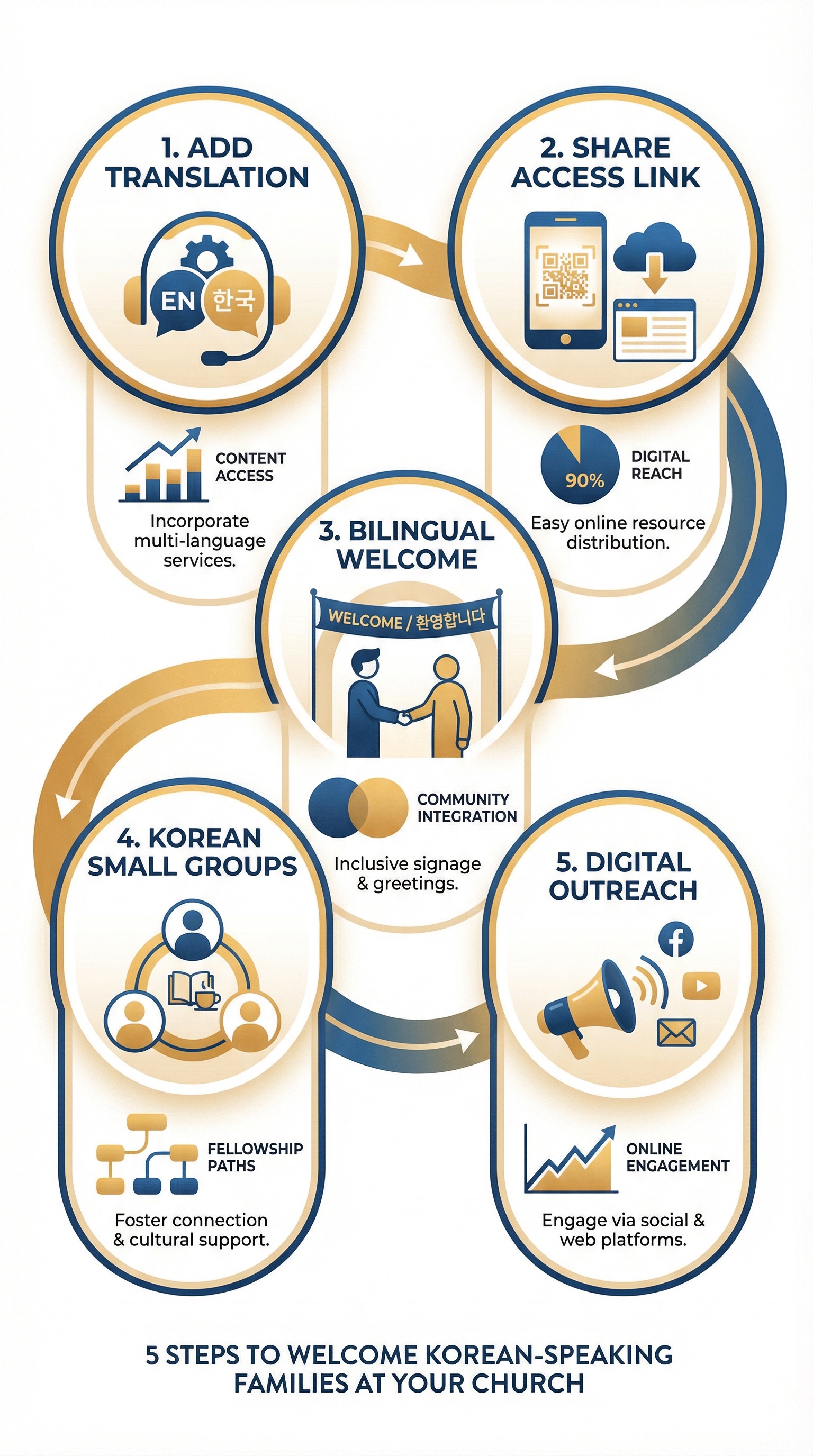
Real-time Korean translation at Sunday services. The most straightforward approach is adding Korean translation to your existing service. Korean-speaking attendees tune in on their phones or tablets using a simple link, put in an earbud, and hear the sermon in Korean while sitting with everyone else in the congregation. There's no separate room, no interpreter booth, no disruption to your worship flow.
A Korean Presbyterian congregation that partnered with an English-speaking church in the Dallas area used this approach during a period of transition. Rather than running separate services, they used real-time AI translation so that both communities could worship together. Older Korean-speaking members could fully follow the service in Korean, while the younger generation participated alongside English-speaking friends and neighbors.
Korean-language small groups and Bible studies. For many first-generation Korean families, the real community happens in smaller settings. Even if your main service is in English with Korean translation, offering a Korean-language small group creates space for deeper spiritual community in their heart language. This is often where genuine belonging is built.
Bilingual hospitality. Small gestures carry significant weight in Korean culture, where hospitality is deeply valued. Korean-language welcome materials, signage, or even a brief Korean greeting from the stage—"여러분을 환영합니다" (welcome, all of you)—communicate that your church has made an intentional effort to be welcoming. These signals matter more than many church leaders realize.
Setting Up Korean Translation at Your Church
One of the most common questions church leaders ask is: How do we actually offer Korean translation without hiring a full-time Korean interpreter?
Professional Korean interpreters with theological knowledge and church experience are genuinely difficult to find. Those who are available typically charge $75-$200 per hour. For a small or mid-size church, the cost of professional interpretation makes Korean outreach feel financially out of reach.
AI-powered real-time translation has changed this calculus entirely. Glossa.live provides real-time Korean translation of your sermon and worship service, trained specifically on biblical and worship content. It understands theological terminology, biblical proper names, and the cadence of preaching—not just conversational Korean.
Here's how the setup works in practice:
- Connect to your audio. Glossa.live integrates with your existing soundboard or microphone setup. As the pastor speaks, the AI picks up the audio and begins translating into Korean in real time.
- Share the access link. Korean-speaking attendees receive a simple link—via text message, a QR code on your bulletin, or a printed card at the door. They open it on their phone or tablet, put in an earbud, and follow the service in Korean.
- The service runs normally. There's no additional technical complexity, no separate room for Korean speakers, and no disruption to your existing worship flow. Korean families are integrated into the congregation, not separated from it.
For churches that want to extend their Korean outreach online, you can also embed the Korean translation stream on your church website—allowing Korean-speaking families to follow your service from home. Our step-by-step guide on how to embed live translations on your site walks through the technical setup in detail.
Practical Steps to Begin Korean Outreach This Month
You don't need to have everything figured out before you start. Here's a realistic path forward for any church, regardless of size or budget:
- Start with relationships, not programs. Before you launch anything, invest in understanding the Korean-American community in your city. Talk to Korean families already connected to your church. Ministry flows from genuine relationship, not from programs.
- Identify your bridge builders. Korean Americans already in your congregation—especially 1.5 or second-generation—can serve as invaluable ministry partners. Their cultural insight and community connections will be essential to your outreach.
- Start translation at one service. Treat it as a pilot. Announce it through your Korean-American connections and give it time to build momentum. Starting multilingual church services is often simpler than church leaders expect.
- Make it visible. Add a note to your bulletin, website, and social media that Korean translation is available. A few Korean-American families who discover this option can become your most enthusiastic advocates within their own community networks.
- Connect with Korean community organizations. Korean-American communities are often organized around cultural associations, Korean language schools, and community organizations. Building authentic relationships with these groups opens natural pathways for invitation.
Common Questions About Korean Church Outreach
Do we need a Korean-speaking pastor?
Not to start. Real-time translation allows Korean-speaking families to fully engage with your current preaching team's teaching. However, if you're hoping to build a multigenerational Korean-American community within your church, having a Korean-speaking lay leader—even in a volunteer capacity—becomes increasingly valuable over time.
How accurate is AI translation for Korean?
Glossa.live's translation is trained on worship and biblical content—so it handles theological vocabulary well. Korean is a complex language with multiple formality levels and significant grammatical differences from English, and modern AI translation has improved dramatically. For most sermon delivery, the quality is excellent and genuinely sufficient for comprehension and spiritual engagement.
What if only a few families in our congregation speak Korean?
Even two or three Korean-speaking families represent a real ministry opportunity—and Korean-American social networks are strong. Many churches have seen their Korean ministry grow from a handful of families to a thriving bilingual community within 12-18 months of genuinely committing to language inclusion. For more on building this kind of momentum, see our guide to reaching immigrant communities through real-time translation.
Is AI translation respectful in a Korean context?
Korean culture places deep value on hospitality and genuine care. The most important signal you can send is that you have made an intentional effort to welcome Korean speakers. Korean families are far more likely to appreciate the attempt than to critique the method. The technology enables what matters most: Korean families worshiping together with their congregation, rather than being separated from it.
The Bigger Picture: Korean Ministry as Kingdom Work
Reaching Korean-speaking families isn't about hitting a demographic goal or diversifying your attendance numbers. It's an expression of the global, multilingual nature of the church.
The Christian faith has deep roots in Korea. Korean Christianity has sent more missionaries per capita than almost any other nation on earth. Korean believers have a rich tradition of prayer, Scripture engagement, and sacrificial ministry. When Korean families find a genuine home in your congregation, they don't just bring themselves—they bring that heritage, that spiritual richness, and that deep commitment to the gospel.
As you build the infrastructure for Korean-language inclusion, you'll find it becomes easier to welcome other language communities too—Vietnamese, Spanish, Mandarin, Arabic, and more. The systems you put in place for Korean outreach multiply your capacity for multilingual ministry. Our article on why multilingual worship grows your church offers a broader framework for churches thinking about language inclusion as a long-term strategy.
The Korean families in your city are searching for a church. Some of them are using Google right now to find one that will welcome them. With the right preparation and the right tools, your church can be their answer.
Get Started with Korean Translation at Your Church
Glossa.live makes it simple to add Korean—and 100+ other languages—to your church services without specialized equipment or technical complexity. You can be up and running in minutes, and the first step costs nothing.
Start with one service. Invite your Korean-speaking community. Let them know they're welcome here—in the language closest to their hearts.