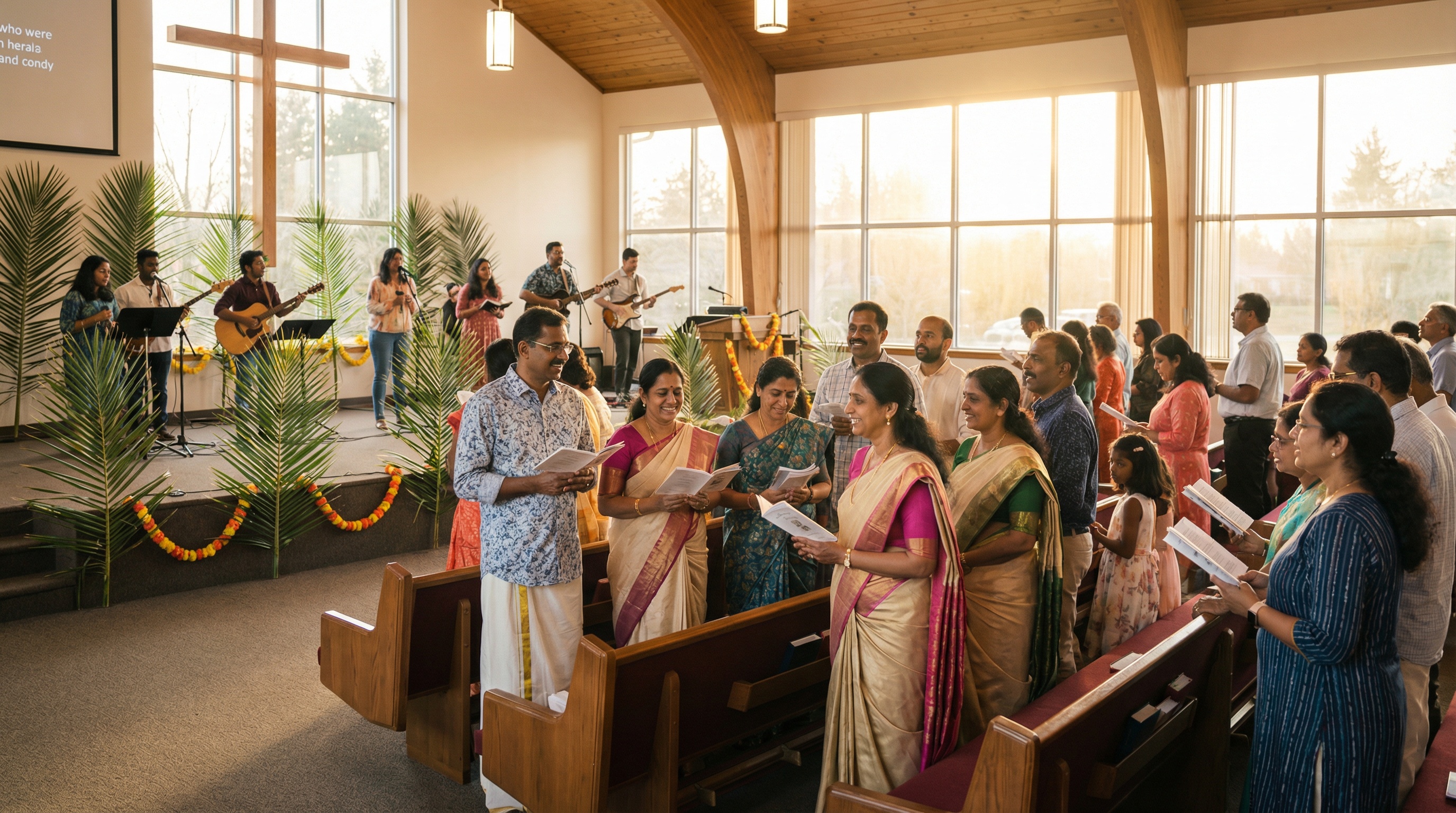
How to Reach Indian-Speaking Families at Your Church
There are more than 4.4 million Indian Americans living in the United States, making them one of the largest and fastest-growing immigrant communities in the country. Many of them are deeply rooted in faith — attending Catholic, Pentecostal, Orthodox, Baptist, and other Christian churches that trace their heritage back centuries. Yet most English-speaking churches have never intentionally tried to reach them.
If your congregation is near a South Asian neighborhood, a university with international students, or a medical center (where Indian-born physicians and nurses are overrepresented), there is a very good chance Indian families are already in your community — and quietly searching for an indian church near me that truly feels like home.
This guide is for pastors and ministry leaders who want to welcome Indian families with open arms, honor their rich cultural heritage, and remove the language barriers that too often keep them from fully participating in church life.
Why Indian Families Are Often Overlooked in Church Outreach
Indian Americans are one of the most educated and economically successful immigrant groups in the US — and also one of the most overlooked when it comes to targeted church outreach.
Part of the reason is complexity. India is home to over 1,600 spoken languages. The Indian Christian community speaks dozens of them: Malayalam (dominant among Kerala Catholics, Mar Thoma, and Pentecostal communities), Tamil (Tamil Nadu Christians and Sri Lankan diaspora), Telugu (Andhra Pradesh Pentecostals), Hindi (North Indian Christians), Kannada (Karnataka Christians), Punjabi (Punjabi Christian families), and Marathi, among others.
That diversity can feel overwhelming. Many church leaders assume Indian outreach is too complicated, or that Indian Americans are already assimilated and do not need language support. Both assumptions are wrong. First-generation immigrants — whether they arrived two years ago or twenty — often carry a deep longing to worship in their heart language. Second-generation Indian Americans frequently want their parents and grandparents to feel included in the same service, not separated into a different room.
The good news: you do not need to hire a different interpreter for every Indian language. Modern real-time translation technology like Glossa.live lets you broadcast your sermon in Malayalam, Tamil, Telugu, Hindi, and dozens of other languages simultaneously — with no special equipment, and no separate staffing costs. See how multilingual church services work for congregations of any size.
Understanding the Indian Christian Community in America
Before building outreach strategies, it helps to understand who the Indian Christian community actually is.
Kerala Christians are perhaps the most visible Indian Christian group in the US. The state of Kerala in South India has had a Christian presence since the 1st century — tradition holds that the Apostle Thomas arrived in 52 AD. Today, Keralites are heavily represented in American hospitals, tech companies, and universities. They bring strong denominational traditions: Malankara Orthodox (Syrian Orthodox), Jacobite, Mar Thoma, Catholic (Syro-Malankara and Syro-Malabar Rite), and Kerala Pentecostal (IPC — Indian Pentecostal Church of God). The Malayalam language is central to their worship identity.
Tamil Christians form another significant group, often affiliated with Church of South India (CSI) traditions, Baptist churches, and Pentecostal fellowships. Their presence is particularly strong in cities like Atlanta, Dallas, and the Bay Area.
Telugu Christians — many from Andhra Pradesh — are strongly represented in Pentecostal and evangelical churches. North Indian Christians — Hindi, Punjabi, and Marathi speakers — tend to be more scattered but are found in major metro areas. Many are converts from Hindu or Sikh backgrounds, and their faith journey carries unique significance and complexity.
What unites these communities? A love of worship that is expressive, communal, and music-centered. Many Indian Christians grew up in churches where praise and prayer were extended, emotional, and participatory. They thrive in congregations that honor those values.
What Indian Families Are Looking For in a Church
When an Indian family walks into your church for the first time, they are asking a few quiet questions.
Will I understand the sermon? For first-generation immigrants — even those who speak conversational English — theological nuance is hard to follow in a second language. Humor is missed. Subtle points evaporate. The emotional depth of a well-crafted sermon becomes thin when you are translating in your head.
Will my parents feel welcome here? Multigenerational families are common in Indian culture. If a young Indian professional is considering your church, they are often thinking about whether Grandma can follow the service too.
Can we worship together, not separately? Segregating Indian members into a separate language service while the main service runs in the sanctuary sends a message — even if it is unintentional. True inclusion means worshiping side by side.
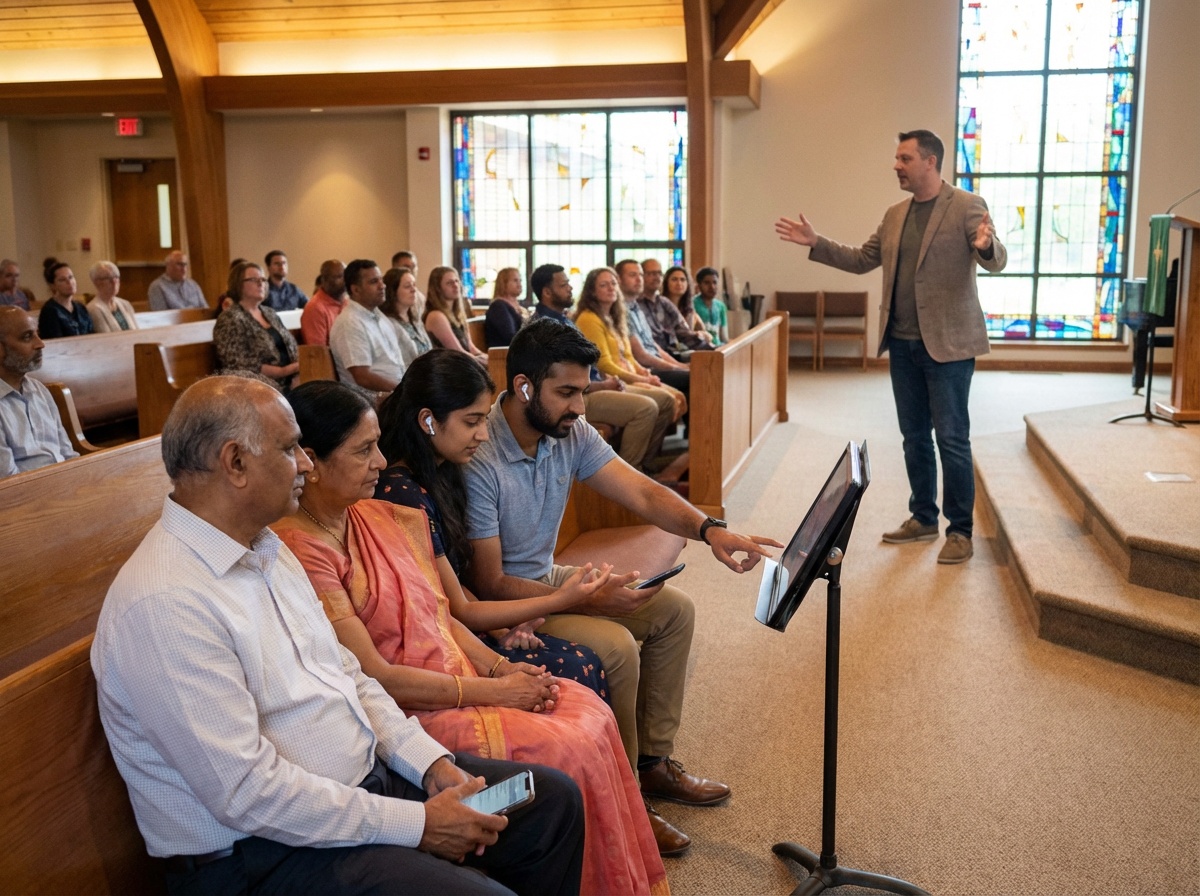
Real-time translation solves these concerns directly. When your Indian members — and their visiting relatives — can follow every word of the sermon in their own language through a phone or earpiece, everything changes. The sermon lands. The altar call connects. The scripture passage moves them. That is what belonging feels like. Read more about overcoming language barriers in church as a first step.
How Real-Time Church Translation Works for Indian Languages
Glossa.live supports over 100 languages, including Malayalam, Tamil, Telugu, Hindi, Kannada, Marathi, Punjabi, Bengali, Gujarati, and many more. Members simply open the Glossa app on their phone, select their language, and plug in an earbud. The AI translates your sermon in real time as you speak — no special hardware required.
A few practical notes for Indian language translation:
- Malayalam and Tamil have well-developed AI training data, so translation quality is strong for sermon content.
- Telugu and Hindi also perform well — the Glossa AI is trained on biblical content and handles scripture references reliably.
- Theological terminology benefits from consistent phrasing — encourage your pastor to avoid heavy idioms and colloquialisms for best results.
- Regional dialects may vary — High Malayalam used in formal church settings translates differently than colloquial speech. Invite members to provide early feedback.
You can learn exactly how to set this up with Glossa's step-by-step embed guide — it walks through the technical side in minutes.
Practical Outreach Strategies for Reaching Indian Families
Translation technology opens the door, but genuine community building keeps people engaged. Here are five outreach strategies that work well for Indian communities.
1. Partner with Indian Christian Congregations
Many cities have standalone Indian churches — an IPC fellowship, a Mar Thoma congregation, a Tamil Catholic prayer group. These communities often lack resources and space. Offering your facilities for their gatherings, or co-hosting services, creates deep goodwill and authentic relationships that no advertising can replicate.
2. Host an Indian Cultural Celebration
Events like Onam (Kerala harvest festival), Christmas carol conventions (a huge tradition in Kerala and Tamil Nadu), or a simple South Asian food potluck are natural bridges. They say: we honor where you come from. Many Indian families will attend a cultural event before they ever attend a Sunday service.
3. Recruit a South Asian Bridge Person
You do not need a full-time Indian pastor. A lay leader or deacon from an Indian background — even if they are already at your church — can be invaluable in translating not just language but culture. Let them help shape your outreach approach from the inside.
4. Advertise in Indian Community Channels
Indian Americans are active in WhatsApp groups, local Indian community Facebook groups, and diaspora apps. A simple post that mentions services available in Malayalam, Tamil, or Telugu will reach people no amount of English advertising ever would. Pair this with a note about using Glossa for real-time translation on their own phone.
5. Welcome Indian University Students
Indian students make up one of the largest international student groups at US universities. A church near a campus that offers even occasional services in Telugu or Hindi — or simply a welcoming Indian Christian community — can become a spiritual home for students who are far from their families.
Frequently Asked Questions About Indian Church Ministry
| Question | Answer |
|---|---|
| Do we need to learn about Hinduism? | Not necessarily, but cultural awareness helps. Many Indian Christians have family members from Hindu or Sikh backgrounds. Sensitivity around this and awareness of caste identity dynamics in some communities helps you pastor more thoughtfully. |
| Should we offer a separate service in Malayalam or Tamil? | Starting a full separate-language service is a major commitment. A better first step is offering real-time translation through Glossa during existing services. A bilingual worship element — a song in Malayalam, a testimony in Tamil — can follow naturally as community grows. |
| How do we find Indian families in our area? | Start by asking existing members. Check Census data for your zip code — many Indian communities cluster near hospitals and tech campuses. Also consider whether any members have Indian coworkers or neighbors who might be searching for a church. |
| What if our budget is tight? | Glossa.live offers flexible pay-as-you-go pricing. A small church could offer Malayalam translation for just a few dollars per service. See our guide to affordable church translation for more options. |
A Vision for the Indian Christian Family at Your Church
Imagine a Sunday morning where Mrs. Thomas — a 72-year-old grandmother visiting from Kerala — sits in your sanctuary and hears your pastor's sermon in crystal-clear Malayalam through her earbuds. Her granddaughter, who brought her, watches her face change. The grandmother wipes her eyes during the altar call. She understood every word.
That moment is what this is all for. Not a program. Not a demographic strategy. A human being, created in the image of God, hearing the Gospel in the language her heart has spoken for seven decades.
Indian families — with their rich faith traditions, their warmth, their multigenerational households, and their hunger for community — have so much to offer the church. And the church has so much to offer them. Real-time translation removes the last barrier between those two gifts.
Every language spoken in your congregation deserves to hear the Gospel. Glossa.live makes that possible — in Malayalam, Tamil, Telugu, Hindi, and 100+ more languages — without expensive equipment or complicated setup.
If you are ready to start reaching Indian-speaking families at your church, explore how multilingual church services can transform your congregation, and try Glossa.live free today.