How to Reach Haitian-Speaking Families at Your Church
There are over one million Haitians and Haitian-Americans living in the United States—and many of them are actively looking for a church where they feel truly at home. According to Pew Research Center, Caribbean-American immigrant communities are among the most religiously active in the US, with high rates of weekly church attendance. And yet, in many predominantly English-speaking churches, Haitian families quietly sit through services they cannot fully follow, then slip out the door and keep searching.
If your church is located near a Haitian community, you may already know this pattern—seeing Haitian families visit once and never return. The barrier isn't a lack of interest. It's language. Haitian Creole is the first language of most Haitian immigrants, and for older members and new arrivals especially, it's the language of prayer, of community, and of feeling understood.
Reaching Haitian-speaking families doesn't require hiring a full-time interpreter or launching a separate congregation. In this guide, you'll learn who Haitian-Americans are, what they're looking for in a church home, and exactly how to welcome them—starting with real-time Haitian Creole translation.
Who Are Haitian-Americans and Why They Matter to Your Church
Haiti is the most populated Caribbean nation and has a predominantly Christian population. Around 80% of Haitians identify as Christian, with a significant mix of Catholic, Baptist, Pentecostal, and Seventh-day Adventist denominations. Faith is not peripheral to Haitian culture—it's central. Church is where Haitian communities gather for worship, celebrate family milestones, and support one another through difficulty.
Haitian-American communities are particularly concentrated in South Florida (Miami, Fort Lauderdale, West Palm Beach), New York and New Jersey (Brooklyn, Queens, the Bronx), Boston and eastern Massachusetts, Orlando and central Florida, Atlanta, and Washington D.C. If your church is in any of these regions, there's a good chance Haitian families are already part of your surrounding neighborhood.
For Haitian families—especially first-generation immigrants—the church represents more than a place of worship. It's a social anchor, a source of practical support, and a community of people who understand the immigrant experience. When a Haitian family finds a church that truly welcomes them in their language, word spreads fast. That's the opportunity churches with Haitian neighbors have right now.
Understanding Haitian Creole: The Language of the Heart
Many people assume Haitian immigrants speak French. Technically, both French and Haitian Creole are official languages of Haiti—but for everyday life, prayer, and conversation, most Haitians speak Haitian Creole (also written as Krèyòl ayisyen). Haitian Creole evolved from French, West African languages, and other colonial influences, and while French speakers may recognize some words, the two languages are not mutually intelligible.
This matters enormously for churches. If you offer French translation, you may reach some educated Haitians—but you'll miss the majority of the community, especially those who grew up in rural Haiti or arrived in the US more recently.
For your church to genuinely reach Haitian families, Haitian Creole translation is essential. The good news: modern AI translation platforms like Glossa.live support Haitian Creole as a fully available translation language. That means you can offer real-time Haitian Creole translation during your worship service—without hiring a human interpreter, without special equipment, and without a long setup process.
Why Haitian Families Leave — And What Keeps Them
Church leaders who have worked with Haitian communities often report the same pattern: a Haitian family visits, seems engaged, but doesn't return. When asked why, the most common answer is some version of: "We couldn't really follow what was happening."
This isn't a criticism of the sermon or the worship style. It's a language barrier in action. When someone can't follow the message—even when they're genuinely interested—they eventually stop attending. Especially when there are other churches in the area that may feel more linguistically familiar.
What keeps Haitian families coming back is the experience of being seen, heard, and understood. That means hearing the sermon in Haitian Creole rather than only English, feeling that the church actively made an effort to reach them, seeing other Haitian members who feel at home, and being able to participate in small groups and conversations. Understanding how to overcome language barriers in church is one of the most important steps any pastor can take when serving a diverse community.
How Real-Time Translation Works for Haitian Church Services
You don't need a soundproof interpreter booth, wireless receivers, or a trained bilingual volunteer available every Sunday. Real-time AI translation has changed the equation for churches of all sizes.
Here's how it works with a platform like Glossa.live:
- The pastor speaks in English (or any language) as usual
- Glossa.live captures the audio in real time and translates it to Haitian Creole instantly
- Haitian-speaking members listen on their own devices—smartphones, tablets, or earbuds—in their preferred language
- No special hardware, no receiver units to distribute, no interpreter on stage
Members simply open Glossa on their phone during the service. For families with older members who may not be as comfortable with smartphones, a church volunteer can help them get connected at the door—it takes about a minute.
The same system works whether you're offering Haitian Creole translation, Spanish, French, or 100+ other languages simultaneously. Many churches that serve Haitian families also serve Spanish-speaking and other immigrant communities, and Glossa handles them all in a single service. You can also embed Glossa on your church website so members and visitors can connect before they even walk through the door.
Practical Steps to Welcome Haitian-Speaking Families
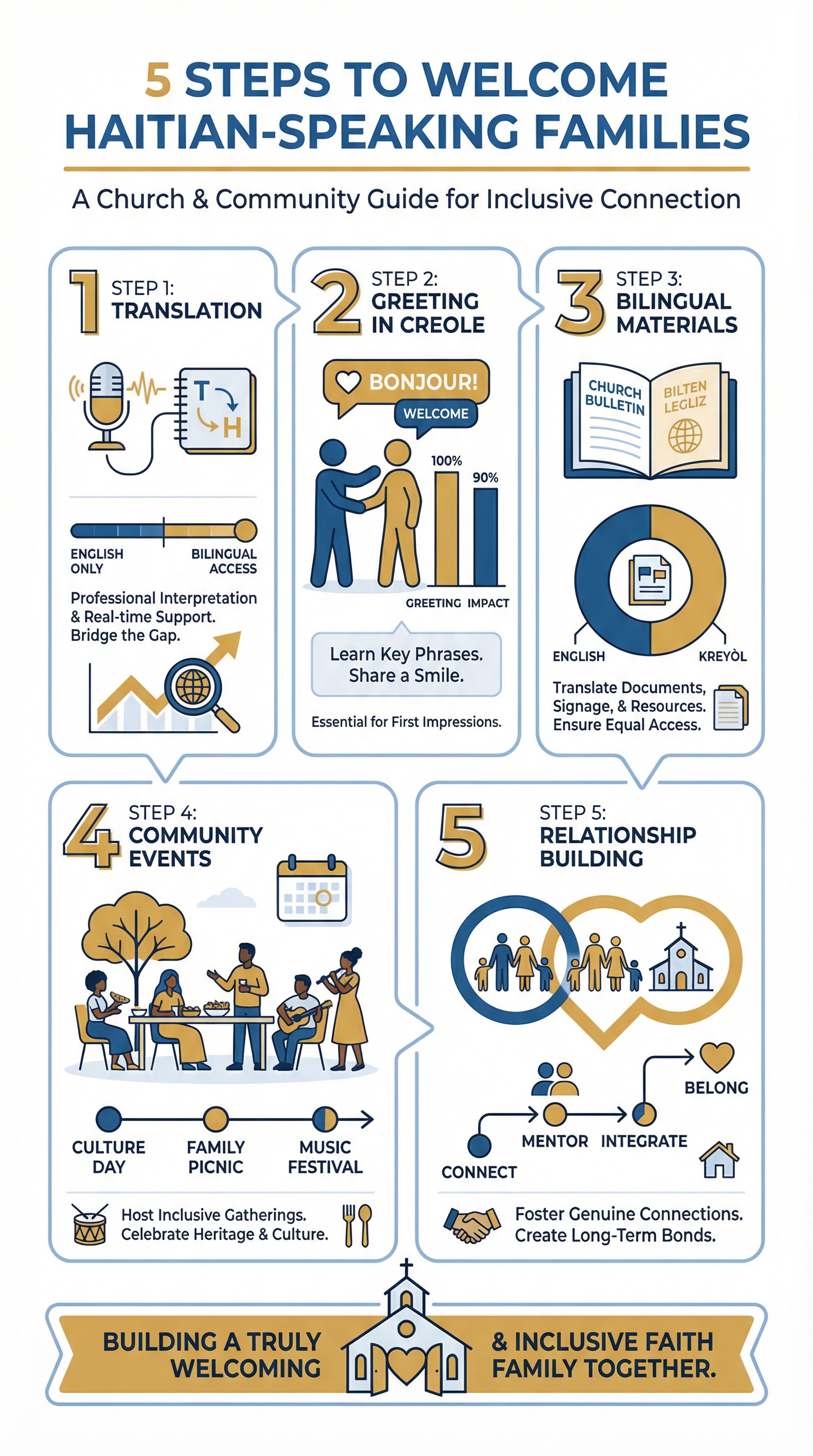
Translation is powerful, but welcoming Haitian families well involves more than technology. Here's a practical approach that churches have found effective:
- Start with a warm greeting in Haitian Creole. A pastor or greeter who can say "Bonjou, byenvini!" makes an immediate impression. It signals that your church has made an effort to prepare for them.
- Train your welcome team to ask about language needs. When a new visitor arrives, greeters can simply ask: "Would translation in Haitian Creole be helpful today?" Then walk them through connecting to Glossa.
- Translate key printed materials. Welcome packets, bulletin inserts, tithing envelopes—consider adding a Haitian Creole version. Community volunteers or free translation tools can help.
- Build relationships, not just services. Haitian culture places high value on relationships and trust. A community meal, a pastoral visit, or a connection with local Haitian community organizations goes a long way.
- Share what you're doing. Mention your multilingual services on social media, your Google listing, and in community outreach materials. Word of mouth is powerful in tight-knit Haitian communities.
As part of how churches are reaching immigrant communities through real-time translation, the most successful churches combine technology with genuine relational investment. Translation opens the door; hospitality keeps families coming back.
What the Data Says About Haitian-American Church Attendance
Faith is a defining characteristic of Haitian-American identity. Studies consistently show that Caribbean-American immigrants—especially from Haiti—have higher rates of church attendance than the general US population. Many Haitian immigrants attended church every Sunday in Haiti and are looking to continue that practice in the US.
But finding a church that feels welcoming is a significant challenge. Language is the first barrier. Cultural unfamiliarity is the second. Many Haitian families end up attending small, Haitian-led churches not because they prefer smaller congregations, but because those are the churches where they feel understood.
This represents a real opportunity for churches willing to remove the language barrier. A church that offers Haitian Creole translation doesn't need to become a "Haitian church"—it becomes a church that Haitian families can call home alongside everyone else. If you're building toward a more multicultural congregation, the complete guide to multilingual church services covers the full strategy step by step.
Churches Already Making a Difference for Haitian Families
Several churches around the US have found success reaching Haitian-speaking families, and their experiences offer a template for what's possible.
Pentecostal and evangelical churches in South Florida that offer Haitian Creole translation report steady growth in Haitian attendance once word spreads. Families who previously drove 30 minutes to a Haitian-led church start attending the nearer church once they know translation is available. Baptist churches in the Northeast—particularly in Boston and New York—have found that hosting Haitian community events alongside Haitian Creole translation during services creates a lasting bridge.
When we started offering Haitian Creole translation, a grandmother came up to me after the service with tears in her eyes. She said it was the first time she had ever fully understood a sermon at an English church. That Sunday changed our church. — Pastor, Florida Baptist Church
The pattern is consistent across church traditions and regions: language access creates attendance, and genuine relationships create belonging. Translation is the first step, but it opens the door to everything else.
How to Start: Your First Sunday with Haitian Creole Translation
Here is the simplest path to offering Haitian Creole translation at your church this week:
- Set up Glossa.live — It takes about 15 minutes. No special equipment needed.
- Test it before Sunday — Run your pastor's voice through the system in Haitian Creole. You'll hear exactly what Haitian-speaking members will hear.
- Tell your visitors — At the door, let them know: "We have translation available in Haitian Creole today. Here's how to access it on your phone."
- Gather feedback — After the service, ask Haitian members how the translation worked and what would make it better.
- Build on it — Once the foundation is in place, explore a Haitian Creole welcome statement, bilingual materials, or a Haitian community dinner.
Building a Truly Welcoming Haitian Church Community
Reaching Haitian-speaking families is both a missional opportunity and a practical challenge. The Haitian-American community is deeply faith-oriented, actively looking for churches, and concentrated in specific regions of the US. The primary barrier has never been a lack of interest in English-speaking churches—it's been the language gap that makes those churches feel inaccessible.
Real-time AI translation in Haitian Creole removes that barrier without requiring a new budget line item, a dedicated interpreter, or a restructured service. It requires a willingness to welcome people in the language they actually speak—and the tools to do it.
When a Haitian grandmother hears the sermon in Haitian Creole for the first time at your church, something shifts. She understands not just the words, but the message: You belong here. We made room for you.
That's the kind of church your community is looking for. Glossa.live makes it possible to offer that welcome—in Haitian Creole and 100+ other languages—starting this Sunday.