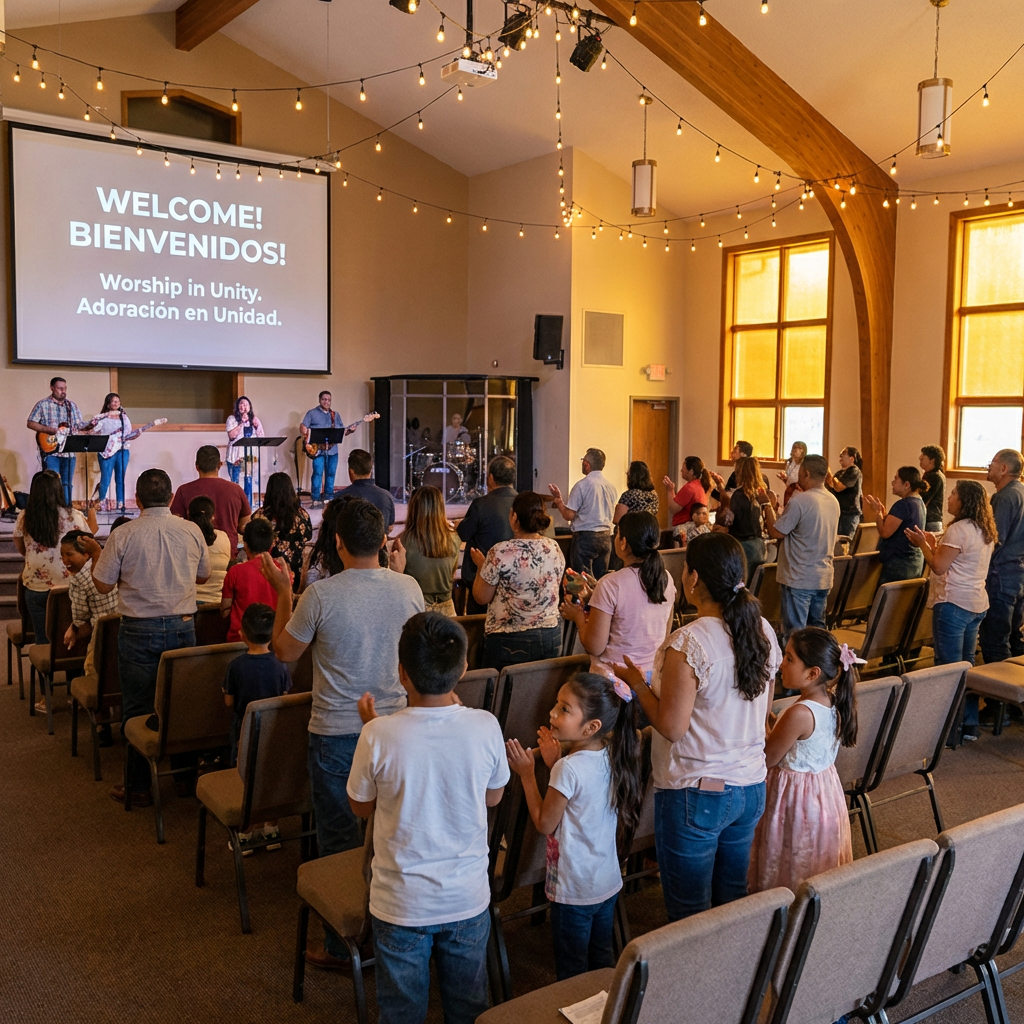
How to Reach Spanish-Speaking Families at Your Church
There are 68 million Latinos living in the United States today. That number has nearly doubled since the year 2000, according to Pew Research. Many of these families live within a few miles of your church—and yet, for thousands of congregations across the country, a language gap keeps the door closed before it ever opens.
Reaching Spanish-speaking families at your church isn't about launching a massive new program or hiring bilingual staff you can't afford. It's about removing a barrier that shouldn't be there in the first place. And the good news? It's far more achievable than most church leaders think.
In this guide, you'll learn practical, proven strategies to welcome Spanish-speaking families into your congregation—from real-time translation technology to community outreach approaches that actually work. Whether your neighborhood is 10% or 60% Hispanic, these steps can help your church become a place where language is no longer a barrier to belonging.
Why Reaching Spanish-Speaking Families Matters for Your Church
The Hispanic community is one of the fastest-growing demographic groups in the United States. Between 2000 and 2024, the Latino population nearly doubled, growing from 35.3 million to 68 million. Today, Latinos make up roughly 20% of the total US population—and in states like Texas, California, Florida, and Arizona, that number climbs much higher.
For churches, this growth represents both a calling and an opportunity. According to a 2025 Lifeway Research study, new Hispanic churches in the US are reaching people and growing consistently. Hispanic church plants achieve approximately three times the evangelistic impact compared to the national average, according to Exponential. That's a powerful signal: when churches make the effort to reach Spanish-speaking communities, the response is real.
But you don't have to plant a new church to make a difference. Many existing congregations are finding that adding Spanish-language access to their current services—through translation technology, bilingual worship elements, and intentional outreach—transforms their reach overnight.
The question isn't whether your church should reach Spanish speakers. The question is how.
Understanding Your Spanish-Speaking Neighbors
Before launching any outreach initiative, take time to understand the Spanish-speaking families in your community. Not all Hispanic communities are the same, and what works in South Texas may look different from what works in suburban Georgia or urban Chicago.
Learn the Demographics
Start with some research. Your city or county likely publishes demographic data that shows the percentage of Spanish-speaking households in your area. The US Census Bureau's American Community Survey is an excellent free resource that breaks down language spoken at home by zip code.
Ask yourself these questions:
- What percentage of families in our zip code speak Spanish at home?
- Are they primarily first-generation immigrants, second-generation, or a mix?
- What countries of origin are most represented (Mexico, Central America, South America, Caribbean)?
- Are there established Hispanic businesses, schools, or community organizations nearby?
Understand the Language Spectrum
One of the most common mistakes churches make is assuming all Spanish speakers are monolingual. In reality, the Hispanic community spans a wide spectrum. Some families speak only Spanish. Others are fully bilingual. Many second- and third-generation families primarily speak English but still connect deeply with Spanish in worship and faith contexts.
This matters because your outreach strategy needs to serve the full spectrum. A church that offers exclusively English services misses monolingual Spanish speakers entirely. But a church that assumes everyone needs Spanish may overlook bilingual families who want both languages represented in their worship experience.
The best approach? Offer both. Real-time translation technology like Glossa.live makes this possible without running two separate services—your pastor preaches in English, and Spanish-speaking members hear the translation simultaneously on their own devices.
Five Practical Strategies for Reaching Spanish Speakers
1. Add Real-Time Spanish Translation to Your Services
The most immediate, impactful step you can take is removing the language barrier during worship. And thanks to AI-powered translation, you no longer need to hire professional interpreters or invest in expensive equipment to make that happen.
Real-time translation tools designed for churches let you broadcast your sermon, announcements, and worship elements in Spanish (and dozens of other languages) simultaneously. Members open the translation on their phone, tablet, or any device—and hear the service in their language as it happens.
This approach has several advantages over traditional interpretation. It costs a fraction of what a professional interpreter charges. It's available every single Sunday without scheduling headaches. And it scales—if your congregation also includes Vietnamese, Korean, or Arabic speakers, you can serve them all at once.
For churches just getting started, here's how to set up Spanish translation:
- Choose a real-time translation platform built for worship contexts (look for one trained on biblical language, not just generic translation)
- Test it during a midweek service or small group before launching on Sunday morning
- Announce it to your congregation and community—this is worth celebrating
- Make it simple for attendees: a QR code on the bulletin or projected on screen is all they need. You can even embed the live translation on your church website
To learn more about how this technology compares to traditional interpreters, check out our guide on translation equipment for churches and modern AI alternatives.
2. Build Relationships in the Hispanic Community
Technology opens the door, but relationships keep people coming back. Reaching Spanish-speaking families requires more than translation—it requires genuine, consistent presence in the community.
Here are some relationship-building approaches that churches across the country have found effective:
- Partner with local Hispanic organizations. Connect with Hispanic chambers of commerce, cultural centers, and immigrant advocacy groups. These organizations can introduce you to families who may never have considered visiting a church.
- Host bilingual community events. Food festivals, back-to-school drives, health fairs, and holiday celebrations are natural gathering points. When you host events that serve the community without requiring church membership, you build trust over time.
- Visit Hispanic-owned businesses. Introduce yourself. Leave bilingual information about your church. Show up as a neighbor, not a salesperson.
- Offer ESL classes. English as a Second Language (ESL) classes are one of the most effective ways churches connect with immigrant families. They meet a real need and create a natural bridge to deeper community.
- Recruit bilingual ambassadors. If you have bilingual members in your congregation, empower them to serve as greeters, translators, and cultural bridges. Their presence signals to Spanish-speaking visitors that this church is for them, too.
3. Make Your Church Visibly Welcoming
First impressions matter. If a Spanish-speaking family drives past your church or visits your website, what do they see? If everything is in English only, the unspoken message is clear: this place isn't for us.
Small changes make a big difference:
- Add Spanish to your signage. Welcome signs, directional signs, and service information in both English and Spanish signal inclusion before anyone walks through the door.
- Create bilingual print materials. Bulletins, visitor cards, and informational brochures should be available in Spanish. This doesn't require a separate print run—a simple bilingual layout works beautifully.
- Update your website. Add a Spanish-language section or, at minimum, a welcome message in Spanish. Include information about Spanish translation availability during services.
- Use bilingual social media. Post in both English and Spanish on your church's Facebook, Instagram, and other platforms. This expands your reach and shows that your church values the Hispanic community.
- Display bilingual worship elements. If you project song lyrics or scripture on screen, include Spanish translations alongside English. This creates a truly shared worship experience.
4. Incorporate Hispanic Cultural Elements in Worship
Reaching Spanish-speaking families isn't only about language—it's about culture. When families see their traditions honored and reflected in worship, they feel a sense of belonging that goes deeper than translation alone.
Consider these additions to your worship life:
- Include Spanish worship songs. Songs like "Reckless Love" ("Amor Sin Condición"), "What a Beautiful Name" ("Qué Lindo Nombre"), and classic hymns in Spanish can be woven into your worship set. Many contemporary worship songs have widely used Spanish versions.
- Celebrate Hispanic heritage. Hispanic Heritage Month (September 15 to October 15) is an opportunity to highlight Latino culture, testimonies, and contributions to the faith.
- Invite Hispanic guest speakers. Having a Spanish-speaking pastor or leader share a message—even occasionally—sends a powerful signal of welcome and partnership.
- Acknowledge cultural holidays. Día de los Muertos, Las Posadas, and other cultural celebrations offer opportunities for dialogue, education, and shared community.
The goal is not to become a Hispanic church. The goal is to become a church where Hispanic families feel seen, valued, and included alongside every other member of the congregation.
5. Start Small and Grow Intentionally
You don't need to overhaul everything at once. In fact, the most sustainable approach is to start small, learn as you go, and build on what works.
Here's a practical timeline:
Month 1: Research and prepare. Study your community demographics. Set up a real-time translation tool and test it with a small group. Identify bilingual volunteers.
Month 2: Soft launch. Begin offering Spanish translation during your main service. Add bilingual signage and welcome materials. Announce the change to your congregation and community.
Month 3: Community outreach. Host your first bilingual community event. Begin building relationships with local Hispanic organizations. Start an ESL class if resources allow.
Months 4–6: Evaluate and expand. Track attendance changes. Gather feedback from Spanish-speaking attendees. Adjust your approach based on what you learn. Add additional cultural elements to worship.
Months 7–12: Deepen and sustain. Develop Spanish-speaking small groups. Train bilingual leaders. Consider launching targeted outreach initiatives based on the relationships you've built.
Overcoming Common Concerns
"We Don't Have the Budget"
This is perhaps the most common concern—and the most addressable. Real-time AI translation services like Glossa.live start at just $5 per hour per language on a pay-as-you-go basis, with monthly plans beginning at $99. Compare that to the $300–$500 per service that a professional interpreter typically costs, and the math is clear.
Bilingual signage and print materials can be produced in-house. Community events can be run on existing budgets by partnering with local organizations. And ESL classes often attract volunteer teachers from your own congregation.
"Our Congregation Might Resist Change"
Change is always challenging, but framing matters. This isn't about changing who your church is—it's about expanding who your church reaches. Most congregations, when they understand the mission behind multilingual services, respond with enthusiasm.
Share the demographics with your leadership team. Tell the stories of families in your community who are looking for a church but can't find one that speaks their language. Cast the vision for what your congregation could look like in three to five years.
"We Don't Have Bilingual Staff"
You don't need bilingual staff to get started. AI translation technology removes the need for on-staff interpreters. Bilingual volunteers from your existing congregation can serve as cultural ambassadors and greeters. And as your Spanish-speaking community grows, bilingual leaders will emerge naturally from within.
"Is AI Translation Good Enough for Worship?"
Modern AI translation—especially platforms trained specifically on biblical language and church contexts—delivers impressive accuracy. Glossa.live, for example, is trained on theological terminology and worship-specific content, so words like "grace," "redemption," and "salvation" translate correctly in context, not as generic dictionary entries.
Hundreds of churches worldwide, from Hillsong to small community congregations, use AI translation for their services every week. The technology has reached the point where it enhances worship rather than distracting from it.
Real Churches, Real Results
Churches across the country are discovering that reaching Spanish speakers transforms their congregations in ways they never expected.
The 2025 Lifeway Research study found that new Hispanic church works grow consistently, starting from an average of 31 attendees in their first year and expanding steadily over time. Hispanic church plants report approximately 30 new commitments to Christ for every 100 attendees—roughly three times the national average.
But you don't have to plant a new church to see these results. Existing congregations that add multilingual services report reaching 30–50% more people on average. When language barriers come down, families who have been driving past your church for years finally walk through the door.
One church leader described the experience this way: removing the language barrier felt like taking down a wall that had separated them from their own community. The families were always there. The church just couldn't reach them.
Getting Started This Week
Reaching Spanish-speaking families at your church starts with one decision: to remove the barrier. The tools are available. The community is ready. And the mission has never been more clear.
Here's what you can do right now:
- Check your community demographics. Use the Census Bureau's American Community Survey to understand who lives within five miles of your church.
- Try real-time translation. Set up Glossa.live and test Spanish translation during your next service. It takes minutes, not months, and you can try it free.
- Talk to your team. Share this article with your leadership and cast the vision for what a multilingual, inclusive church could look like.
- Take one step. Whether it's adding a Spanish welcome sign, launching translation, or visiting a local Hispanic business—take one step this week.
The 68 million Spanish-speaking people in the United States aren't a demographic statistic. They're families, parents, children, and seniors looking for a place to belong, a place to worship, a place to call home. Your church can be that place.
Language doesn't have to be a barrier to belonging. Not anymore.